Work Text:
The late afternoon sunlight filtered through the lace curtains in Glenda’s bedroom, casting golden streaks across the wooden floor. Dust motes danced lazily in the light, swirling like tiny spirits called out of hiding. The air held that warm, mellow hush particular to Southern houses in late summer—when the heat finally loosens its grip but the silence feels earned, like a breath held all day now slowly exhaled.
The house was unusually quiet—a rare moment of calm in a home usually filled with the chatter and movement of her daughters. The kind of quiet that felt intentional, like the house itself was resting.
But not completely quiet.
Beneath the stillness ran something softer, subtler: the faint creak of a floorboard in the hallway. The swish of small feet on carpet. A whisper of fabric brushing against the wall. Not the chaos of sibling squabbles or toybox catastrophes. No, this was quieter than that. It was the sound of intent wrapped in stealth—the kind of hush a small child cultivates when they are up to something important.
Miracle was armed with a toddler’s sense of purpose: absolute, unwavering, and profoundly mysterious to adults. Her blonde curls bounced with each tiptoed step as she crept down the hallway, a little wisp of movement in her soft yellow overalls, one strap forever slipping off her shoulder. She moved like a cat in socks, her feet making a hushed shuffle over the hallway runner, arms slightly outstretched for balance—not because she needed it, but because it gave her the air of someone navigating a sacred errand.
Her face was set in a look of solemn concentration, lips pursed, brows drawn tight in a way that mimicked her mama’s thinking face—though on Miracle, it was undermined slightly by the smudge of applesauce still clinging to her chin. She carried no flashlight, no tools, no toy companions. Only determination. And in her mind, the mission was already mythic.
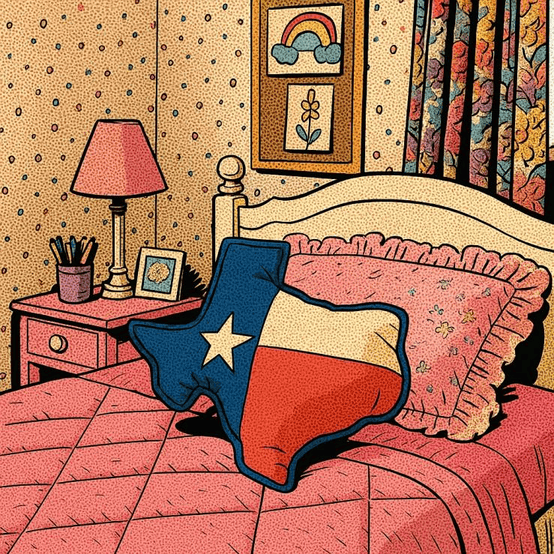
Inside Glenda’s room, the pillow sat where it always did—perched on the far side of the bed like a sleepy sentry. Shaped like Texas, stuffed firm but soft at the edges, it wore its flag colors proudly, as if stitched together out of songs and sunburns and stories half-told on back porches. The blue was deep like dusk, the white bright as line-dried sheets, the red bold as a county fair ribbon. It was Glenda’s and had always been Glenda’s. Miracle knew that. She also knew it was magic.
She had seen her mama lean against it at the end of long days, eyes closed, humming something too old for Miracle to name. She’d seen her tuck it under her elbow during phone calls, her voice low and measured as if she were navigating something that required the shape of Texas to steady her. Once, late at night, Miracle had woken from a bad dream and seen her mama asleep with it clutched close to her chest, as if the pillow was the last thing keeping the dark from creeping in.
With a breath drawn deep like a diver about to plunge, she clambered up onto the bed. Her legs kicked once, then twice, and then she was up—belly first, hair static-wild from the quilt. She scooted forward, belly to knees, and stretched both arms around the pillow.
The pillow was heavy in the awkward way special things often are. She dragged it backward down the bed like a lumberjack hauling something precious through forest brush. It made a soft fwump as it hit the floor, but nothing broke, nothing squeaked.
Back down the hallway she went, the pillow dragging behind her, catching the light and leaving the faintest trail in the carpet’s nap. She kept looking over her shoulder as she went, unsure if the shadows in the corners would tattle.
At the threshold of her room, she paused. Miracle’s room was a swirl of soft chaos—books piled like building blocks, dolls posed mid-conversation, a plastic horse napping on its side near the door. The reading nook by the window was her favorite spot, crowned with a small bookshelf and a patchy fleece blanket that Scarlett had given her the Christmas before. It was already home to two stuffed lambs and a bear named June.
She heaved the pillow into the nook, then carefully, almost reverently, placed it in the center. She adjusted its angle, fluffed one end with her small palm, and stepped back. Tilted her head. Then nodded.
“Now you gots a place. A good place,” she declared, satisfied.
Later, once the sun had dipped just enough to turn the bedroom light gold, Glenda called from the hallway, her voice floating through the house like the scent of cornbread. “Miracle, you in there, honey?”
There was a rustle of movement, a thud as a doll was scooted over.
“Uh-huh!” came the answer, a little muffled.
Glenda stepped into the doorway a few moments later, arms folded across her chest. She wasn’t frowning—her mouth curled just slightly at the corners, that bemused expression she often wore when her children were up to something clever but just shy of permissible. Her eyes swept the room, immediately landing on the unmistakable shape of the Texas pillow, now nestled proudly beneath Miracle’s head like it had always belonged there.
“Well now,” Glenda said, “looks like somebody’s gone shoppin’ in Mama’s room.”
Miracle sat upright, the pillow squished between her back and the wall. Her eyes were wide, but she didn’t look sorry—just prepared. “I bringed it. It’s mine now. Texie sleep here.”
Glenda raised an eyebrow, stepping into the room and leaning one shoulder against the doorframe. “Mm-hmm. I see. And did Texie ask before it packed up and moved in?”
“Um.” Miracle’s eyes darted. “It … it wanted to go pway wif me.”
“Did it now?”
“Yeah! It said, ‘Miracle, take me to da tea pah-ty!’” She deepened her voice comically, mimicking what she imagined a pillow might sound like.
Glenda chuckled low in her throat, shaking her head just slightly. “Alright, smart pea. Lemme say it plain: next time you wanna borrow somethin’ from Mama, you come ask, alright? That pillow’s special to me.”
Miracle nodded solemnly. “I jus’ wanted to cuddle it.”
“I know, baby. And I ain’t mad,” Glenda said, her voice softer now, but edged with something firm. “You can keep it in here for a while. But you gotta take care of it. Real good care.”
Miracle’s face lit up. “I will! I give it cookies an’ napkins an’—”
Glenda grimaced, just faintly—a mother’s trained reflex, the kind of face she’d made a thousand times when one of her girls said something charming and deeply alarming in the same breath. Cookies and napkins. Lord have mercy.
She schooled her expression quickly and gently cleared her throat, her voice staying warm and even, like the low notes of a lullaby. “Now, baby,” she said, brushing a loose curl behind Miracle’s ear, “Mama knows you got a big, generous heart, and I love that about you. But that pillow’s a special kind, y’hear? Not like your dollies or blankie. It don’t like crumbs or stickiness.”
Miracle tilted her head, curious. “Why not?”
Glenda smiled faintly, searching for the softest way to wrap truth in something a child could hold. “’Cause them doggies you’ve got? They’re rough and tumble. They been on adventures. You drag ‘em through the grass, let ‘em ride in the laundry basket, feed ‘em pretend jam with real spoons.”
Miracle nodded vigorously, proud. “Uh-huh! Ruffie and Scout went to the woods, an’ they had a tent, an’ then they fall down the hill but I patched ‘em wif sticker band-aids. Dey brave.”
“I know, honey. They are brave. Brave as anything. But see, they don’t mind a little dirt. That pillow?” Glenda patted the fabric gently. “It’s more of a porch-sittin’ kind of fella. Likes peace and quiet. He’s from a long time ago. He’s not used to cookie crumbs or juice spills.”
“But,” Miracle interrupted, brows furrowed in earnest defense, “I clean good! When I make mess, I wipe it wif a napkin! I did it ‘cause the strawberry got on June Bear’s foot, ‘member? I clean it all gone. I even blow on it, too. Like fwoo!” She demonstrated, lips pursed, breath puffing in Glenda’s direction.
Glenda chuckled, her hand smoothing Miracle’s hair in lazy circles. “You did, baby. You did real good that time. June Bear was lucky to have you.”
Miracle beamed, all dimples and apple cheeks, and went on without pause, the words slipping out in a tangle of declarations. “An’ when Ruffie got jam on his eye I used lots of tissues! An’ then I said, ‘sorry Ruffie!’ an’ I kissed his head. An’ I put him in the sun, ‘cause sun make it better. An’ I used my shirt one time too, but not this one! This one’s clean. See?” She pulled at the hem of her shirt to show it, then added solemnly, “I don’t want Texie to be sticky neither.”
Glenda listened, chin resting in her hand now, letting Miracle finish her catalog of miniature heroics. There was something so honest, so touchingly thorough in her toddler logic. Every mark of affection was an act of care, even the messes. Even the jam.
“Well,” Glenda said finally, sitting back on her heels, “that’s mighty good to hear. I reckon if Texas had to live anywhere other than Mama’s room, I’m glad he landed with someone who’s so good at fixin’ things and keepin’ ‘em clean.”
Miracle grinned, triumphant. “He safe now. He got me and Sadie and Clem. We takin’ turns bein’ his guard.”
“His guard, huh?”
“Yuh-huh. Clem got night shift.”
Glenda laughed quietly, pressing a kiss to Miracle’s forehead. “That’s a fine arrangement. Just remember what I said, alright? No cookies, no crayons, no makin’ him go campin’ in the garden.”
“No garden,” Miracle echoed, nodding seriously. “He don’t like bugs.”
“Exactly.” Glenda stood, stretching her knees with a soft groan. “You take good care of him, and he can stay a while. But if I catch even a whiff of peanut butter in that fabric—”
Miracle gasped and clapped both hands over her mouth. “Noooo! I won’t! Not even close! I put peanut butter way over dere.” She pointed to the far side of the room, where a play kitchen sat in orderly neglect.
“Then we understand each other,” Glenda said, winking. She reached for the door, pausing to look back at the tiny Texas guardian now curled protectively around her borrowed treasure.