
Chapter Text
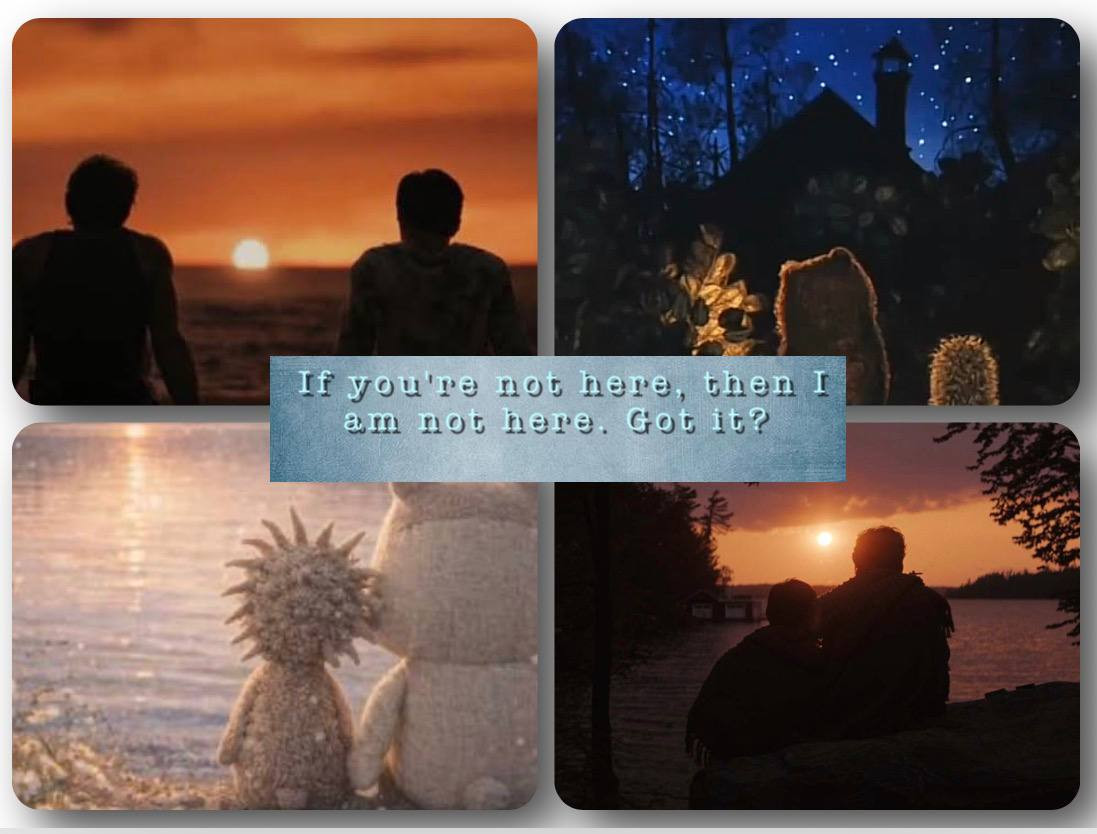

2020
The moon crept out from behind the pines on the far side of the lake early, before nine, snagged on the top of the tallest one, and couldn’t seem to work itself free. Shane watched it from the living room of the cottage, through the big window that looked out over the water. He hadn’t turned on the lights — light still made his head hurt. The only things glowing in the room were the moon and the TV.
Today was exactly ten years. Ten years since seventeen-year-old Shane, red to the tips of his ears with his own nerve, had walked up to Ilya Rozanov to say hello.
They’d decided to celebrate quietly. Nobody knew about the cottage anyway, and after that game Shane wasn’t in any shape for a party. They’d been playing Boston. Marlow had put him into the boards — and the last thing Shane remembered before the ice tilted and swam away was Ilya’s face. White, terrified, very close.
Strange. He couldn’t remember how Ilya had ended up next to him. Had he skated over after the whistle? Or was that later, when they were picking Shane up off the ice? No — by then, he thought, he’d already blacked out.
Except…
Shane frowned.
Ilya had been playing for Ottawa for three years now.
So where had he come from, out there on the ice? Maybe Shane had seen him later, at the hospital? Ilya had come, after all. Sat beside him, held his hand, argued with the doctors. Or was that already here, at the cottage?
He tried to put things back in order, but the memories kept sliding into one another. Ice. Ilya’s face. A white ceiling. Someone’s hand on his shoulder.
His head started to ache again.
The doctors had warned him this could happen after a concussion. No point trying to remember everything at once.
The Notebook was on. He’d turned the sound down almost to nothing; he didn’t need the words, he knew the movie by heart. Not because he loved it. Because Ilya did.
He’d made the tea before he sat down. Two mugs — out of habit, without thinking, the way you don’t think about lacing your skates. Three sugars in one. Ilya drank his tea like a child, sweet to the point of disgusting, and Shane used to wince every time, until one day he caught himself spooning in three sugars without even asking. He set both mugs on the coffee table, pulled on the gray hoodie — the one Ilya had left in his hotel room in Boston once, which Shane had never given back — curled up in his corner of the couch, and tugged the blanket up to his chin.
One night — one of those nights when sleep wouldn’t come — a strange thought had found him. If Ilya suddenly disappeared — completely, for good — what would he have left? Shane started counting before he could stop himself, and for some reason it came out ridiculously short. Ilya loves The Notebook and pretends he watches it for Rachel McAdams. Ilya takes three sugars in his tea. Ilya sleeps diagonally across the bed. Ilya hates it when Shane leaves first — Ilya had never once said so, but Shane knew. And a gray hoodie that had almost stopped smelling like him.
Ten years. And that’s it?
The thought was cold and quiet, like the water by the dock at night. Shane slammed it shut like a door — fast, without looking, before it could finish. Ridiculous. Ilya wasn’t going anywhere. He was right here, at the other end of the couch.
Out here, at the cottage, they were allowed everything. No hotels, no rooms booked under fake names, no six a.m. team buses. No cameras, no teammates on the other side of the wall. Just the lake, the pines, the dock — and the two of them. For three years they’d escaped out here every chance they got, and out here Shane slept past seven. Out here, in the lake, Ilya had soaked him head to toe on the very first day and laughed so hard he scared off every loon on the lake. Here, on this very couch, they’d argued about Sveta and about the wedding — half joking, half not, until they were hoarse. And upstairs, in their bed, they’d stayed up until three in the morning dreaming up the foundation, and it was there, in the dark, that Shane had told him for the first time that he loved him. And the world hadn’t ended.
“Sitting in the dark again,” Ilya said. “How is your head?”
“Fine. Really.” Shane tugged the blanket higher. “You saw it all yourself. You were at the hospital, and then you sat here with me for three days, feeding me soup and confiscating my phone. I’m fine, Ilya.”
“I am still going to kill Marlow.”
“He didn’t mean it.”
“You should not watch so much TV.”
“I’m already better.”
“Yes. But you do not turn on the light.”
“Because the moon is enough.”
“Romantic,” Ilya snorted. “Ten years, and you are still the same.”
“Same how?”
“Like back then. You walked up to me first, all red, with your hand out. ‘Hi, I’m Shane.’ Like I did not know who you were.”
Shane huffed.
“And my movie again,” Ilya added. “You said it is for girls.”
“I said it’s for you.”
“Is there a difference?”
“You cry at it. Every time.”
“I do not cry.” A pause. “It is allergies. To Ryan Gosling.”
Shane smiled and took a sip. The tea was too hot and burned his tongue, but he drank more anyway.
“Drink yours before it gets cold,” he said. “Three sugars. The way you like it.”
“Later.”
“Mom’s going to ask. She sent that tea specially for you. Not for me. For you.”
“Of course for me,” Ilya said, enormously pleased. “Your mother loves me more than she loves you.”
“Everybody knows that.”
Somewhere on the couch his phone buzzed — short, twice. Shane didn’t turn it over. Probably Mom. Mom always texted in the evenings. He didn’t have to look.
The moon finally came unstuck from the pine and drifted higher.
On the screen, young Noah and Allie were laughing at something only they understood. Shane didn’t need the sound to know what was coming — that line, the one about birds. If you’re a bird, I’m a bird. Ilya always mouthed it along with Allie and thought Shane didn’t notice.
“It’s good, though,” Ilya said, “that we have each other.”
Shane almost turned his head — and didn’t.
Ilya didn’t say things like that. Ilya said your taste in music is terrible and you lost another faceoff, it was painful to watch. And when he suddenly did say something like that — quietly, without the smirk — it was better not to look at him. You’d scare it off. Shane had learned that a long time ago.
“Mm-hm,” he told the moon.
“Just imagine. I am not here. You sit alone, and there is no one to talk to.”
“And where are you?”
“I am not here.”
“That’s not possible. You’re right here.”
“Then imagine I am not. Imagine ten years ago you did not walk up to me. Imagine we never met.”
“But we did,” Shane said stubbornly.
“I think so too,” Ilya agreed. “But suppose — suddenly I am just gone. Completely. You are alone. What do you do?”
Shane balanced his mug on his knee. It was a game. Ilya loved games like this: asking something ridiculous with a perfectly straight face and watching Shane try to answer it honestly, conscientiously, like it was an exam.
“I’d drive to your place,” Shane said.
“Where?”
“Home. Ottawa. I’d knock until you opened the door, and I’d say: so why didn’t you come?”
“Silly.” There was something warm in Ilya’s voice, and a little tired. “What would I say, if I am not there?”
“If you’re not home, then you drove out here, and we missed each other. I’d come back, and you’d be here. On my couch, feet on the table, watching your Notebook. And I’d start—”
“What?”
“Yelling at you.”
“For what?”
“For not doing what we agreed.”
Silence. The moonlight lay on the rug in a cold rectangle.
“And what did we agree, Hollander?”
Shane opened his mouth — and closed it.
They’d agreed a long time ago. Before this was anything at all. No names. No stay. No calling just to call. One night, one hotel room, and in the morning everyone gets on their own bus. Simple.
“We agreed it would be simple,” Shane said. “Hotels. One night at a time. That’s it.”
“And?”
“And we both broke it.”
“I did first,” Ilya said. “I said ‘Shane.’”
Shane remembered. Someone else’s house, late morning, a hand in his hair — and his own name, said so quietly it was like someone was tasting it. His T-shirt on inside out. The seam rubbing at his neck. The door he’d closed so carefully, as if someone in the house were still asleep.
“And I left,” he said.
“And you left,” Ilya agreed.
No reproach. Just a fact. Like a score on the board that can’t be changed anymore.
“Doesn’t matter,” Shane said, and it came out sharper than he meant. “Whatever we agreed, we agreed. But you have to be either at your place or at mine. There’s no third option.”
“But I am not anywhere. Do you understand?”
“You’re sitting right there.”
“I am sitting here now,” Ilya said. “But if I am gone completely — where will I be?”
“Here. Or in Ottawa.”
“That is if I exist.”
“Well, yeah.”
“And if I don’t exist at all?”
Shane huffed out a laugh — not quite as amused as before.
“Then you’re in the lake,” he said. “Sneaking up underwater to soak me head to toe, like the very first day.”
“Not in the lake.”
“Then you’re upstairs. In our bed. Lying diagonally like always, wanting to talk about the foundation until three in the morning again.”
“Not upstairs,” Ilya said. “Do you understand?”
“Then you’re at practice. Or at Sveta’s — and don’t you dare tell me you’re marrying her after all, you promised. Or you’re sitting on a bench in the park again, watching ducks, and your phone’s dead because you’ve never charged it in your life.”
“Or with Sasha,” Ilya said. Strangely, as if he were weighing the name in his palm.
“Hm,” Shane said.
“Did I tell you about Sasha?”
“No.” Shane frowned. The name surfaced on its own, from somewhere deep: once he’d heard Ilya say it into the phone — softly, in a completely different voice, one he had never once used with Shane. And Shane hadn’t asked. “You never told me about her.”
“Him,” Ilya said.
The room went very quiet. Something moved at the very edge of it — like a shadow under the water by the dock, large and dark.
“Doesn’t matter,” Shane said quickly.
He hadn’t asked then. He wasn’t going to ask now.
A dull ache started up in his temple. Ilya was looking at him strangely — closely, expectantly, as if he were waiting for something.
“I’m fine,” Shane said. “I told you.”
Ilya was quiet a little longer, as if waiting for Shane to change his mind after all. Then he gave a barely perceptible nod.
“I am not with Sasha either.”
“Then you went somewhere and you haven’t come back yet.” Shane didn’t notice he’d started talking faster. “I’ll call everyone. Sveta. Marlow. Your agent. Your whole team. Everyone who has your number.”
“You already called everyone,” Ilya said quietly. “You do not have Sveta’s number. And the rest do not know.”
His head twinged again. Shane winced and pretended he hadn’t.
“Then I’ll fly. To Boston. To Moscow. Anywhere.”
“Not there either. You looked, in Moscow, remember?”
For a second, the room went colder. Shane saw it — didn’t remember it, saw it, a flash at the edge of his vision — gray sky, a foreign airport, signs he couldn’t read. Minus twenty. A phone that died in the cold in forty minutes.
“I don’t remember,” he said, too fast. “That didn’t happen.”
“It did.”
Pain shot from his temple to the back of his skull — short and vicious. Ilya was looking at him with that same look: close, expectant. As if he were waiting for Shane to finally say something else.
“Then I just didn’t look hard enough,” Shane said.
And without giving Ilya a chance to say a word, he kept going — faster, louder: “I’ll turn everything upside down. I’ll call the league, the embassy, the papers. They’ll put your picture on every channel, between the hockey and the weather. Someone will see you. Someone will definitely see you.”
“I am not there, Hollander. I am not anywhere.”
Shane gripped the mug until his fingers hurt.
“Then… then I’ll go out on the ice,” he said. “An empty arena. Dead center, right on the faceoff dot. And I’ll yell, ‘Ro-za-nov!’ So loud they’ll hear it in the last row. And you’ll hear me. And you’ll yell back, ‘Hol-lan-der!’ From somewhere. The stands. The tunnel. The penalty box, where you belong. There.”
“No,” Ilya said, very gently. “I am not here even a little bit. Do you understand?”
He said it like it mattered to him that Shane understood. Like it hadn’t been a game for a long time.
“Why won’t you leave me alone?” Shane almost shouted it, and the sound of his own voice in the dark room frightened him. “If you’re not here, then I’m not here either. Got it?”
“No.” The voice was very close. “You are here. And I am not.”
Shane went quiet. Frowned. The moon climbed higher still, and the rectangle on the rug grew paler and longer.
“Well, Hollander…” Ilya said.
Shane didn’t answer.
He sat, looking at the moon, and waited. Any second now Ilya would laugh — low, smug, that terrible delighted laugh of his. He’d say, You should see your face. And he’d swing his feet up into Shane’s lap — heavy, warm, like they belonged there. And Shane would say, You’re an idiot. And everything would be the way it always was.
Ilya didn’t laugh.
Shane reached under the blanket — to where his feet always were.
The blanket lay flat. Under it was a couch cushion: cool, smooth, uncreased. Shane ran his palm over it, as if he might have missed something. Again. Again.
“Ilya,” he said.
Silence.
He turned his head. Slowly. The way you turn toward the scoreboard when you already know what it says.
The other end of the couch was empty. Not the kind of empty you get when someone has gone to the kitchen for a glass of water and will be right back. Really empty. For a long time. The blanket was folded into a neat square — the way only Shane ever folded it. Ilya would have thrown it anyhow, of course. Shane was sure of that, even though he had never actually seen it. The cushion didn’t have a single dent in it. The second mug sat on the coffee table, full to the brim, and the tea in it was cold, a thin cloudy film on top.
“Never seen it,” the voice agreed.
It wasn’t coming from the other end of the couch. It was coming from the doorway.
“I am not here, Hollander. I never was. Not on this couch, not in this house. Not once.”
“You were,” Shane said. “You were sitting right there. You—”
“You never invited me here.”
Shane opened his mouth. He had invited him. A thousand times. Evenings in the car, in the shower after practice, at night before he fell asleep — he’d invited Ilya here over and over, shown him the lake, the dock, the kitchen, argued with him about which side of the bed he’d take.
Never once out loud.
“You moved to Ottawa,” Shane said. His voice wasn’t working right. “For me. Everyone said you’d lost your mind, but you—”
“That is not here either. I did not move to Ottawa. I just left.”
“You promised. About Sveta. On this couch.”
“That is not here either. You never asked me for anything.”
“I told you…” Shane’s breath caught. “Upstairs. In our bed. The first summer. I told you that I—”
“That is not here either,” Ilya said, very quietly. “You never said it. Not there. Not anywhere.”
“The lake,” Shane said. “You soaked me, the very first day—”
“That is not here either. I have never seen your lake.”
“The foundation. We dreamed it up together, in our bed, until three in the morning—”
“That is not here either.”
“The hospital. You sat with me until—”
“That is not here either. Your mom drove you home from the hospital.”
“Mom—”
“Your mom did not send me tea. She knows me from the news. Like everyone.”
A pause.
“I am not here,” Ilya said. “You know that.”
Shane said nothing.
“You keep saying you are fine,” Ilya said, more quietly. “All night. Nothing is fine, Hollander. You are alone here. For a long time now. You need help. Not me — help. Call your mom. Answer her. At least her.”
Shane shook his head.
“You left,” Ilya said. His voice was even. Perfectly even. “First. And I left.”
“Yes,” Shane said, and his throat closed. “But I came back.”
“And I did not.”
Shane finally looked at him.
He hadn’t looked all night — and now he did. Ilya was standing in the doorway. He was exactly the way Shane had left him that morning: staring at the floor, a little to one side, a muscle jumping in his jaw. That was the last real thing Shane had of him. Everything else — the cottage, the lake, their couch, their bed, the foundation, the hospital, Ottawa, Mom’s tea, it’s good that we have each other — he had made up himself. Everything that might have been, if he had stayed that morning. Three years that never happened.
“Ilya,” he said.
Ilya lifted his eyes. Just for a second.
Then he turned and walked out.
The door didn’t creak. It had never opened.
Shane couldn’t remember how many nights in a row he’d been making tea for two.
His phone lay beside him, face down. He turned it over, even though he knew what he would see.
Where are you?
Ilya, answer me.
Marlow says he doesn’t know. Is he lying or does he really not know?
Please.
One word. Even just a period.
I made you tea. Idiot. I make you tea every night.
Where the hell are you, Rozanov?
There was nothing under the last one. Not Delivered. Not Read. Just the time it was sent. Eleven days ago.
On the screen, old Noah was reading Allie their own story, and she listened to him like a stranger and didn’t recognize him. Somewhere in the middle of the movie were the letters. Noah had written to her every day for a year. Three hundred and sixty-five letters. She never got a single one.
Shane had sent forty-three messages. He’d counted.
Further up, in another thread, were Mom’s messages — the ones he didn’t have to read. Did you eat? Do you want us to come up? Sweetheart, at least answer me. There wasn’t a word about Ilya in any of them. Mom didn’t know there was anyone to ask about.
He didn’t remember when he started crying. The screen just blurred, and then the moon, and then the whole room. And Shane sat there hunched over, clutching the phone to his chest with both hands, and cried — quietly, uglily, the way he had never cried in his life. Not even back then, in the cab, with his T-shirt on inside out.
He’d said it himself, just now. Then I’m not here either. And it had turned out to be only half true. Shane was here. Sitting on this couch with a cold mug of tea and a phone that didn’t ring. Here — and with no idea what for.
The moon had climbed all the way up and was looking down at him, cold and calm. The way you look at someone who has been left alone.
The movie ended. Shane knew how: old Noah and Allie fall asleep in the same bed, holding hands, and never wake up. Together. Ilya always said it was the happiest ending in any movie ever made. Shane used to argue with him — how is that happy, they die.
Now he understood.
The credits began to roll.
“If you’re not here,” Shane said to the empty end of the couch.
He unclenched the fingers still pressing the phone to his chest and opened his mom’s thread. He stared at her last message — Do you want us to come up? — for a long time. Read it again. And again.
He typed a reply — with one finger, slowly, as if it were the hardest thing he had ever done. Deleted it. Tried again.
Mom, please come.
He hit send.
Delivered. Almost instantly — Read. And three dots: Mom was already typing.
Shane watched them through his tears. Forty-three messages had gone into the void. And this one — just one — had arrived in a second.
Just not to the one he wanted.
“Fuck you, Rozanov,” he whispered. His voice broke halfway through. “Fuck you.”
The moon said nothing.
Neither did Ilya.