
Chapter Text
Chicago, 1927
The city bustled under a pastel October sky. Cars ranging from clapped-out old Fords to gleaming new Chryslers rattled up and down the asphalt ribbons that flowed between the looming skyscrapers. Twin streams of pedestrians flanked them, hurrying this way and that, huddled inside thick overcoats and swaddled in scarves to keep out the autumn’s chill. From a window on the 4th floor of a nondescript office building in the middle of the city, Siv Västerström watched them go. At this height they looked like wind-up toys, little cars and tin businessmen whirring off to wherever they had to be.
Her own reflection looked back at her in the glass like a ghost. A pale, nervous face sticking out of a cheap dark suit. The clothes of someone who was always on the verge of striking it big, and the face of someone who expected they never would.
She frowned and turned away from the glass, back to face the interior of the office that she shared with her husband of eighteen years. The sign on the door said ‘Västerström and Sons, Legal Practitioners’ – although considering that their eldest was only ten and unlikely to take an interest in his father’s work, that was a bit of an exaggeration. Torbjörn had said it would make their business sound more professional and established. As best as Siv could tell, it hadn’t worked.
Torbjörn was sat at the other end of their office, behind his desk, with his sleeves rolled up, tie loosened and a cigarette burning its last into an ashtray by his side. He had a telephone jammed up against his ear and was scribbling furiously on a scrap of paper in front of him, pausing occasionally to say “Yes, sir” and “No, sir” into the phone.
Siv guessed it was Trond Andersen on the other end of the line. No-one else would be able to coax such a deferential tone out of her husband this early in the morning.
She sighed and sat down heavily behind her desk. It had seemed like such a good idea, all those years ago. She’d only been twenty, Torbjörn twenty-three, the pair of them fresh off the boat from Stockholm and looking to start a new life in America together. But money had been hard to come by in the new world, so when a wealthy industrialist by the name of Trond Andersen had approached them and offered to inject some cash into their ailing legal practice, they had seized the opportunity with both hands. Trond hadn’t even demanded repayment or interest, claiming to understand the plight of a penniless Scandinavian immigrant in the American Midwest all too well. It wasn’t until they were well and truly in his pocket that he began to ask small ‘favours’. Defend a friend of mine in court. Help me with this slightly dodgy property deal. And somehow, helping with these had slowly, over about a decade, become helping to run the massive criminal empire the man controlled under the table.
An empire that only got bigger in 1920 when the 18th Amendment had outlawed the manufacture and sale of alcoholic drinks from coast to coast. Suddenly, America had found itself full of thirsty people who had not a drop to drink – and Trond had stepped up to fill the void, using his credentials as a shipping magnate to import vast quantities of liquor, quite illegally, over the Great Lakes from Canada. Some of it stayed in Chicago. Some of it was boxed up and sent as far afield as New York and Los Angeles. And no matter where it went, the paperwork inevitably crossed the desks of Siv and Torbjörn. It was not an easy paper trail to follow, but if a Prohibition agent ever did…
It could be worse, she thought as Torbjörn spluttered out a final “Yes, sir” and dropped the phone down on its hook like he was worried it might burn him if he held it any longer. At least when you ran with Trond Andersen, you had protection. Capone and the others who battled for the speakeasies and black markets of Chicago against him were, in a way, rather small-time compared to Trond. Capone bought off mayors and police commissioners. Trond, with the backing of his titanic industrial enterprises, had enough money to buy a government. And the scheming old bastard probably knew enough secrets to topple five.
“That was Trond,” Torbjörn sighed as he reached down and picked up what was left of his cigarette.
“I guessed,” Siv replied. “What does he want this time?”
“We’re in trouble, Siv,” her husband said, breathing out a cloud of smoke that coiled blue in the dim light.
“In that case, I’m telling the jury it was all your idea.”
“Not that kind of trouble,” Torbjörn muttered, too worried to even crack a smile at her bad joke. “Trond’s angry.”
“He’s never happy.”
“No, but this time he’s angry. He’s been robbed. Capone’s men stole…” He glanced quickly at the scrap paper he had scribbled on and shook his head in disbelief. “…seven thousand dollars’ worth of bootlegged liquor from him last night.”
Siv felt something nasty crawl up her spine and the bottom drop out of her stomach. “How much?”
“You heard me. Apparently they just turned up at one of the warehouses down by the docks and cleaned us out. Killed everyone down there and took all the booze out in cargo trucks.”
“And he’s sure it was Capone?”
“One of the guys who did it got left behind. They had to leave in a hurry when the cops showed up. Trond had him… interrogated.”
Siv shuddered. She knew what that meant. They’d probably find that man in a year or two’s time. Rotting on the shores of Lake Michigan, perhaps, or part of the concrete in a new skyscraper.
“Now Trond wants us to retaliate,” Torbjörn continued, stubbing out his cigarette. “Says we need to send a message.”
“And how exactly does he want us to do that? I’ve no intention of starting a war, Torbjörn.”
“Well unfortunately, Trond does.”
Briefly, he outlined the demands their boss had made of them. When he was finished Siv buried her head in her hands and groaned.
“This is going to take some serious muscle,” she said at last. She yanked open the bottom drawer of her desk and pulled out a thin ledger. “And if I recall correctly…” she murmured, leafing through it, “…yep, all the people we’d normally put on a job like this aren’t available. They’re either busy, in jail, or dead.”
“Do we at least have a safecracker on hand?”
“Normally, I’d give Agneta a call. She’s good with locks.” Siv checked her watch. “But her train just left.”
“Huh?”
“She moonlights as a stewardess on the Twentieth Century Limited. And it left for New York about half an hour ago.”
Torbjörn swore. “So we’ve got no-one?”
“Nope… oh, wait, hang on. There might be someone we can use.” Siv frowned and leafed through the ledger a few pages.
“Who?”
“I think the Finns are still in town.”
“Oh, Christ. You can call them, in that case. The guy always gives me the creeps.”
Siv shrugged. “He’s not too bad. Just a bit quiet. And his cousin’s friendly enough.”
“He’s nineteen, Siv! No-one should be that good at his job at nineteen!”
Siv grunted noncommittally and put the ledger down. “Regardless, they’re all we’ve got.”
“I don’t suppose either of them can open a safe?”
“Nope.”
Torbjörn furrowed his brow in thought for a second, then clicked his fingers as he got an idea. “Hang on,” he said. “Trond said he wanted the contents of the safe. He never said he wanted the safe opened carefully.”
Siv’s expression became very wary. “Torbjörn, you’re not suggesting…”
“Emil! He’s perfect for this!”
“He’s your nephew, for God’s sake! You can’t throw him into danger like this!”
“Oh, he’ll be fine! Especially if he’s got someone good looking after him. And you have to admit, he’s very good at opening things.”
“Yeah. Walls, if remember correctly. A few ceilings, maybe a room or two. An entire chemistry department, once.”
Torbjörn shrugged, palms-up, as if that was just a little detail. “If you’ve got any better suggestions…”
Siv knew she was beaten on this one, although God knew she didn’t like the idea. She sat back in her chair and looked out of the window, up at the spires of downtown Chicago which were lit white and gold by the morning sun.
“Fine,” she said at last. “But you can call his father, and explain why we want to send his only son to start a war with Capone’s outfit.”
This cannot possibly go well, she thought as she picked up the phone on her own desk, checked her ledger, and dialled the last known address of the Hotakainens.
Two days later
Emil Västerström had not been in the speakeasy thirty minutes yet, and already he was wondering idly how he’d burn the place to the ground.
The place was called the Kastrup Club and its one saving grace was that it opened before midday. Whereas most speakeasies in the city only flung their doors wide after sundown, the Kastrup Club was open from seven in the morning to three at night, every night. Its owner, a burly Dane by the name of Mikkel Madsen, would if asked say that he intended to cater for every kind of customer, no matter what their work hours or drinking habits. Privately, Emil thought it was so the man could get every last customer he could. The place sure looked like it could do with them.
Either that, or a spark in just the right place. All that high-proof liquor behind the bar sure was flammable, after all.
Emil leaned back in his chair and blew out his cheeks idly, looking around the cramped room he was sat behind a table in. It was just like any other watering hole from here to the east coast – bar along one wall, a few tables and chair scattered around, a dance floor for the evening crowd and a piano squeezed into one corner.
There was a woman sat at the bar with flame-red hair and an expensive suit – a man’s suit, Emil couldn’t help but notice, but tailored to flatter her – who he was almost certain was Sigrun Eide, the woman the police were looking for after the Sheridan Bank robbery last month. But he wasn’t going to make those kinds of accusations in public, not if half the rumours he’d heard about the woman were true. She was chatting to Mikkel quietly but animatedly, the man behind the bar listening to her with a small smile.
Emil suddenly realised that he had been staring at her and, worse still, she had noticed him staring in the mirror behind the bar. Sigrun – and it was her, he decided, she looked just like her photo on the wanted posters – raised an eyebrow at him and he quickly looked away and checked his watch in a way that he desperately hoped said “I’ve got no beef with you” and not “I’m reporting you to the first flatfoot I see.”
The hands on his watch read twenty-five to eleven. They’re late, he thought indignantly to himself. Drumming his fingers impatiently on the battered tabletop, he knocked back the last of the scotch he had bought himself to calm his nerves and pulled a letter from his pocket. The corners of the paper were bent and ragged from where he had been doing this for the last hour now.
It read:
Dear Emil
Have found a job for you. Unwise to discuss specifics in this letter. Meet your new co-workers at the following establishment. Bring a broad selection of your hobbies.
Kastrup Club, 67 West Eire Street
10.30 am, 10/22/27
Your beloved uncle
Torbjörn Västerström
P.S. Burn this letter once you are done with it.
He still didn’t know what this job involved, apart from his ‘hobbies’ – a rather obvious codeword for the high-explosives that Emil had made part and parcel of his life over the last three year. And if his uncle had to use codewords, that meant the job probably wasn’t entirely legal. Not that Emil cared. The important thing was that he had to make a good first impression on his new co-workers, whoever they were, and not come across as a nervous over-eager wreck. Hence the single glass of scotch.
It was also the reason why he had dressed for the occasion. Pitch-black three-piece suit, shoes polished to a mirror gleam, a tasteful navy blue tie all tucked under a heavy overcoat that came down to his thighs when he wore it but was at the moment hung over the back of his chair. You had to look the part, Emil decided, and he hoped his part would soon be ‘demolitions consultant’ or something equally fun. He imagined something like helping cook up new explosive compounds for gangsters to use – well paid, and out of any immediate danger.
A touch of orange flame from his favourite lighter – a beautiful Nassau inlaid with pearl and silver, a gift from his parents on his sixteenth, back when they had still wanted to speak to him – and the letter was shrivelling and blackening in the ashtray next to him. He was just debating whether to light another cigarette – he had finished one a while ago but too many made him feel sick – when the speakeasy’s door swung open, letting in a gust of chilly autumn air and a few dead leaves.
Two figures were silhouetted against the morning light and as the door closed behind them they made their way inside, one almost having to drag the other. Emil squinted at them as his eyes readjusted to the speakeasy’s dingy light.
Siblings was his first guess, a man and a woman approximately his age. They had vaguely similar faces and the same strange hair colour, a sort of white-grey like winter frost on the river. The woman was short and slightly dumpy, plump without being fat, dressed in a pale green jacket and skirt. She carried a handbag on her right shoulder and wore a cloche hat on her head. Whoever did her hair had obviously been asked to give her the Louise Brooks look and an elegant bob cut peeked out from under it. She caught sight of the burning letter by Emil’s elbow, raised her eyebrows a little, and made for his table.
Trailing behind her was the man Emil assumed to be her brother. He looked a little like someone had tried to make the opposite person in every way to his sister. Stick thin, almost painfully so, with a pinched and angular face, he glared at Emil as he approached with eyes that were like shards of ice. His clothing was funereal in contrast to that of his sister, a dark grey suit beneath a heavy double-breasted overcoat that was a year or two out of fashion. A grey flat cap on his head perched atop his messy, unkempt hair. Just about the only colour on him was an oddly jaunty red tie that was loose around his neck – that and those piercing blue eyes.
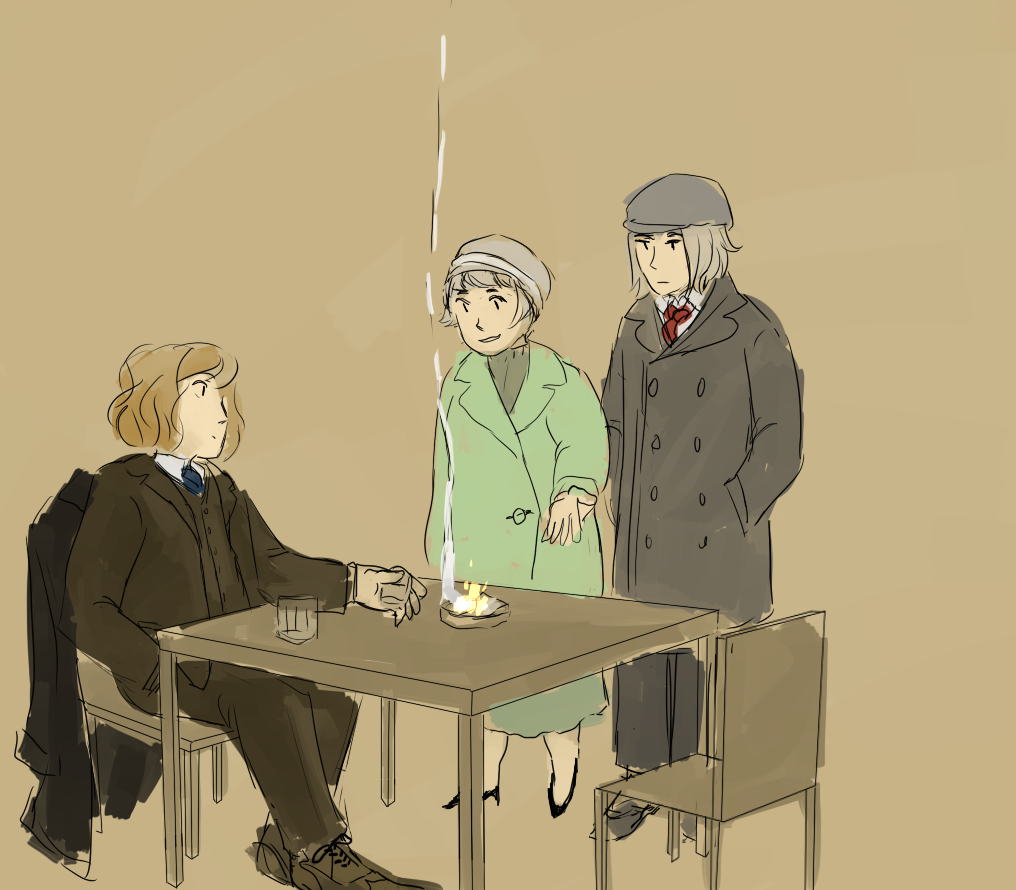
Starting early
The woman laughed softly as they drew level with his table. “They told me we’d be meeting a bit of a firebug,” she trilled, gesturing at the smouldering remains of the letter, “but I didn’t expect you to have gotten started so soon.” She grinned and extended a cotton-gloved hand, which Emil rose to his feet to shake. “You must be Emil.” He nodded. “Tuuri Hotakainen,” she said by way of introduction. “And this is my cousin, Lalli. Lalli, this is Emil Västerström. You’ll be working with him today. Remember?”
Emil offered Lalli his hand. Lalli stared at it, then nodded imperceptibly and sat down with his arms folded.
“You’ll have to excuse him,” Tuuri said apologetically as they sat down as well. “He’s not one for conversation.”
I never would have guessed, Emil though, offering Lalli a friendly little smile. He was rewarded with the same cold stare and turned back to Tuuri, a little intimidated.
Unsure of exactly what to do in situations like this, Emil tried to make small talk. “With names like that, I’m guessing you’re both Finnish?”
“By way of Wisconsin, yes,” Tuuri admitted, taking her hat off and tossing it down onto the table. “A town called Keuruu. Don’t suppose you know it?”
Emil shook his head. “Heck, I’ve never left Chicago,” he grinned. That was a little lie, but he was unwilling to go into his past in front of people he’d only just met. “The world stops at Jefferson Park, as far as I’m concerned.”
Tuuri laughed. “Says you! But I have to say, I can’t blame you. I’ve only been to Chicago a couple of times, and it’s incredible! The buildings, the clubs, the cars, the people…” she waved her arms around a bit as if trying to encompass the magnitude of the city. “Quite a shock to a simple country gal,” she said, exaggerating her rural accent. Emil smiled and shrugged.
They talked for a few minutes more until a slightly awkward silence reared its head, and Emil decided to get down to business.
“So, about this job…” he began.
“Sssh! Not here,” Tuuri hissed, looking around. “The fewer people know about this, the better. We can discuss this in the car.”
“The car?” Emil frowned, a little confused. “Alright…”
Tuuri got to her feet and plonked her hat back on her head. Lalli stood in one smooth motion like a spring uncoiling. Emil followed, shrugging his coat on and reaching beneath the table and retrieving two suitcases he had stowed under it earlier. The ‘hobbies’ that his uncle had told him to bring.
The mid-morning autumn cold stung his cheeks as the three of them stepped out of the Kastrup Club, Emil offering a little wave to Mikkel as he left. The big Dane nodded in farewell, and Emil thought that the man was perhaps looking a little warily at his two new companions. It was hard to tell, though. The light in the speakeasy was very dim.
The club’s door opened out onto a side alley. They waded through drifts of dead leaves, litter and discarded newspapers, passing beneath the rickety iron fire escapes of dilapidated tenements, Tuuri leading, Emil following and Lalli bringing up the rear.
“I feel a bit like I’m being escorted away,” Emil joked to Lalli as they rounded a corner, twisting his head to talk over his shoulder. “You guys going to take me for a one-way ride or something?”
“Not yet,” Lalli muttered. He had an astonishingly quiet voice, Emil had to strain to hear him over the roar of Chicago traffic and the distant rumble of the trams.
“So you can speak English!” Emil cried in mock-surprise, still facing the wrong way. “I was getting worried.”
“Just watch where you’re-” Lalli started, and then Emil caught his foot on an uneven bit of ground and was nearly sent sprawling. He squawked in surprise and his suitcases tumbled to the ground as he threw out his arms to cushion his fall. His face came to within a foot of the alley’s hard concrete before strong hands grabbed him by the shoulders and hauled him back upright.
“-going,” Lalli finished with a withering look, setting Emil back on his feet. The young man was surprisingly strong. Emil just blushed furiously and dusted himself off.
“Thanks,” he mumbled as he picked up his suitcases. Thank Christ he’d only brought stable compounds with him, he thought – there were enough of his ‘hobbies’ inside each to reduce him, Lalli and Tuuri to interesting red paintings on the nearby brickwork.
“If you two are quite finished, the motor’s just up ahead,” Tuuri said, jerking a thumb over her shoulder.
“Yeah. Sorry,” Emil said sheepishly. So much for good first impressions, he thought miserably to himself.
They rounded the final corner together, and Emil soon forgot all about his failed attempts to look good. He looked in dismay at the heap of rust and cobbled-together parts that, in a previous life, might have been a Model T Ford.
“Doesn’t look like much, I know, but she’ll get you where you need to go,” Tuuri said blithely, walking round and slipping in through the driver’s door. “Hop in, then we can talk!”
“You mean this flivver moves?” Emil wondered, half to himself.
“And then some,” Lalli said coolly. He pointed to the back seat as he yanked the front passenger door open with a squeal of rusty metal. “Get in.”
The inside of the car smelled of petrol and old leather. Emil sat awkwardly on the back seat and tried not to get any of the dirt on it onto his nice suit. He was beginning to have some serious misgivings about this job. Certainly, if the people offering it drove a car like this, the pay wouldn’t be stellar.
“Okay, so, about the job – how much do you know?” Tuuri asked, swivelling in her seat to face him.
“Not much,” Emil admitted with a bashful grin. “My uncle just told me there was a job going, and a time and place to meet you. And to bring these,” he added, gesturing at his suitcases.
“And what’s in those?”
Emil’s grin became a little cocky. “See for yourself,” he said, handing one across to her. Tuuri rested it on her lap and clicked the clasps open. Her eyes went wide.
“I don’t know what any of this is, but it sure looks dangerous,” she said warily.
Emil leaned over her shoulder and pointed. “For starters, good old-fashioned dynamite. You want things to go boom, you ask a Swede.” Lalli rolled his eyes. “This here’s TNT, a few pounds of it. Should take down a decent wall or two. Those are grenades, military surplus Mark-IIs, they only brought them into service a few years ago.” He pointed at a tin that contained a strange green putty. “And this is a little something from England called Explosive 808. Plastic explosive, basically. Mould it to any shape you want, light the fuse and run like hell. Good for safecracking.”
Tuuri closed the suitcase and handed it back with exaggerated care. “I’m almost afraid to ask what’s in the other one.”
“Time bomb. Ten sticks of dynamite and a clock, in case you want to leave a nasty surprise for someone.”
There was a short silence in the car as both Tuuri and Lalli processed that information.
At last, Lalli spoke. “Tuuri,” he whispered quietly, “when you drive us to the target, please do not crash.”
Emil laughed. “Oh, don’t worry. All this stuff’s stable. You need an expert to set them off, which is where I… come… in…” he trailed off. “I’m sorry, did you just say target?” he asked with mounting concern.
“He sure did,” Tuuri said. “Do you have much experience with jobs like these?”
“Ahhh…” Emil frowned. “I think… I think maybe not…” This didn’t sound good at all. “I think maybe there’s been a misunderstanding here…”
“Let’s keep this simple,” Lalli said, staring at Emil in the car’s rear-view mirror, his icy eyes only just visible between the brim of his flat cap and the edge of the mirror. “We need you to help me blow open a safe. This safe is on the thirtieth floor of a skyscraper. The entire floor is owned by Mr Al Capone, and will be filled with his goons. We’ll probably have to kill most of them. Is this the job you thought you were doing?”
Emil went pale. “No! God, no!” he spluttered. His mind seemed to shut down at the prospect, all he could do was stare dumbly at the back of Lalli’s head. Some part of him insisted that this must all be a bad joke.
“Well, tough, because it’s the job you’re doing,” Lalli said.
Tuuri gave him a slightly apologetic look, turned round, started the car’s engine and threw it into gear. Emil sat back in his seat, head whirling and sweat starting to bead on his brow.
Oh, Uncle Torbjörn, he thought desperately as the Model T trundled down the alley and into the flow of traffic on West Eire Street, towards the towers of central Chicago. What the hell have you gotten me into?