Work Text:
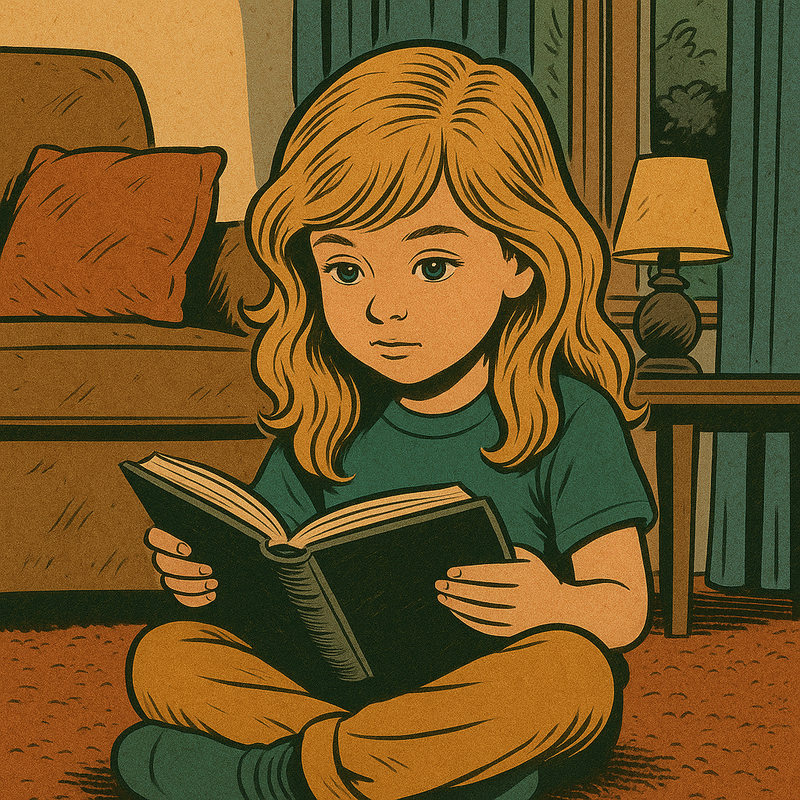
By four, Dana read with the light of someone who had found a secret door in the wall and meant to hold it open for everybody else. She chose her audience with ceremony—sometimes her sister Holly, sometimes the twins in their bouncy seats—then arranged the room the way a conductor arranges chairs. Pillows on the rug became “the soft seats,” a crocheted throw over a dining chair became “the red curtain,” and the stack of picture books—some from the library, some hand-me-downs with scotch-taped spines—became her program.
“Reading show,” she announced, palms out like a stage magician. “Tickets are free today because we’re very generous.”
Holly, three and a bit, trotted in socks that made her slide on the hardwood, thumped to a stop against the rug, and sat cross-legged with solemn anticipation. “I’m the ’dience,” she said, managing half the syllables. “I clap. I can clap quiet.”
From the kitchen, Glenda called, “You can clap regular, baby. Just not hurricane loud.”
“I can clap breeze,” Holly promised.
The twins—Amy and Tracey—were present in infant form that summer, twelve pounds of astonished humanity apiece, lashed into their chubby moon-lander seats with the kind of gently suspicious expression the very new bring to any human project. Dana had placed them side by side and angled them so they could “see the stage.” They were more interested in their own feet, but this, to Dana, merely meant the story would have to work harder.
She selected a book with a glow-worm on the cover. The title, which she could read, made her smile in a way that felt like a private secret becoming public. “Okay,” she said, opening to the front, “the author is—” she sounded out the name, a small, careful pilot taxiing a huge plane. Pride flickered through her voice when she landed it. “And this,” she tapped the illustrator’s credit, “is the person who drew the whole thing so good.”
“Good drawins,” Holly agreed, leaning in so far her hair fell into the gutter of the book.
Dana smoothed the first page with a proprietary hand and began, reading the words as written but also reading the spaces between them, narrating the pictures, filling in what the glow-worm might be thinking in the dark. When she came to a word she didn’t know, she paused, placed her finger under it, and peered, lips moving soundlessly once, then twice. She tried the first sound on her tongue like a sip of too-hot cocoa. “Lan-tern,” she decided. “The glow-worm had a lantern in his tummy, and it—” she squinted again, “—shine. Shined? Shone,” she corrected, exhaling a laugh, pleased by the fancy feel of the word. “It shone.”
“Shone!” repeated Holly, who liked shiny words as much as shiny things.
The twins, untroubled by grammar, kicked their socked feet in asynchrony. One of them, perhaps Amy, made a soft vowel of approval that could have been wind or contentment. Dana accepted it as a review.
When she reached a picture of the glow-worm lighting a path for other bugs, she lowered her voice to a hush, whispering so close to the paper you could hear the rasp of breath on the page. “The night is kind of scary for the little ant,” she confided, “but the glow-worm is like, ‘Hey, I’m here, I’m a lamp with legs.’” She flipped her hair back, looked at Holly. “Do you think ants get scared of the dark?”
Holly blinked, serious as a judge. “Ants have friends,” she decided. “If they have friends, they’re not scared.”
“Correct,” Dana said, and the certainty rolled through her like a bell. She resumed. “So the glow-worm shares his light because that’s what you do if you have some. And if you have none, you can still walk near the light. That still counts.”
From the kitchen came the burr of the blender—Glenda making something cold and summery—and the house held its breath the way houses do when children are trying to do something big. Outside, the July afternoon was a white sheet pinned to the line. Inside, the living room was a fort of small intentions and large, benevolent dreams.
By the second book—about a rabbit who collected buttons—Holly was fully in the story, leaning forward and back with the rhythm of Dana’s voice, clapping “breeze” between pages. “Dana,” she whispered during a particularly suspenseful button-hunt, “I like your readin’ voice. It’s like a… like a train.”
“A train?” Dana asked, delighted.
“A nice one. With a snack car.”
Dana grinned so hard she had to duck behind the book for a second to hide it. “Okay. Next stop: The Meadow Station.” She leaned toward the twins. “Folks in the bouncy cars, remember to hold onto your socks.”
Tracey yawned with eloquent indifference. Amy stared at a ceiling fan blade as if it were a passing bird. Dana read on as if no applause in the world could equal the faith of two babies and a three-year-old listening like it mattered.
—
Autumn came in a rustle of paper leaves from school. On rainy afternoons, Dana made the living room into a library performance hall with a cardboard sign: STORY HOUR 3:30. She wrote the hours herself, blocky but proud. Sometimes she added “Featuring Holly!” because Holly liked to turn pages and announce things like, “Now is when the duck says quack.”
One gray day, the windows filmed over with condensation and the smell of wet leaves followed Glenda inside when she returned from the yard. “You girls want cocoa?” she asked, already taking down the pot.
“We’re in story hour,” Dana said, not rudely, just in the way of someone protecting sacred ground.
“Then I’ll be at the concession stand.” Glenda tucked a strand of hair behind her ear and whispered to the twins, who now sat upright in their seats, yet to decide whether they were separate people. “Popcorn for the VIPs,” she told them, handing each a puffed, unseasoned rice thing. They grabbed with unseemly gusto, cramming powdery crescents to their gums.
Dana chose a library book with a blue library jacket and that smell of plastic and dust. “Today,” she announced, “we learn about whales.” She pronounced the h earnestly. “They are huge, they sing songs, and they don’t have legs which is sad but they like it that way.”
Holly gasped. “No legs?”
“No legs,” Dana confirmed. “But they have flippers. They’re like arm-wings. If you had flippers you could hug the ocean.”
“I hug you,” Holly offered, as a compromise.
“Deal,” Dana said, and read—about migration routes and krill and the secret highways under the waves. When she reached the chart of whale sizes and realized one was longer than a school bus, her eyes flew wide and then she made them fly wider, because to be a reader to an audience is to live your astonishment out loud. “Guys,” she said softly, “it’s like a whole street of house.”
Holly whispered, “A whole street,” as if repeating a spell.
The twins clapped their rice cakes together and discovered percussion, and for a minute, reading hour became a band. Dana didn’t mind. She knew where she was in the paragraph and she knew how to find her way back, the way a bird knows its tree. She finished the page like you finish a song you love—sorry it’s ending, glad it happened.
“Questions?” she asked gravely, imitating the school librarian, a woman who had told her last week, with conspiratorial kindness, “You have a reading engine, kiddo. Keep it fueled.”
Holly’s hand shot up. “If whales don’t have legs,” she said, “what do they do for pants?”
Glenda laughed, the spoon chiming in the pot. Dana kept a straight face because dignity is part of the ritual. “They don’t wear pants,” she said. “The ocean is their big, blue dress.”
“Oh,” Holly said, satisfied. “Okay.”
—
By five, Dana had a whole routine. She warmed up by reading the cereal box at breakfast—ingredients, vitamins, the small squares that said “serving suggestion” which she found hilarious because the bowl was full of cereal already, what else could the suggestion be? She read signs out car windows, she read the back of the shampoo bottle in the bath—“apply, lather, rinse, repeat”—and once tried to repeat so many times Glenda had to negotiate a ceasefire with a towel and the promise of a bedtime book.
In the late spring of her fifth year, the twins had learned to toddle with that courageous, doomed gait of young sailors. Dana adjusted her show for a roving audience. “Story parade,” she declared, balancing the book on her arm like a tray, following the twins as they drifted, narrating the pictures as if doing voiceover for a nature documentary. “Observe the rare Amy, who travels in circles, and the equally rare Tracey, who travels in the same circle but the other way.”
Holly marched behind, beating a wooden spoon against a toy drum with ceremony. “I’m the band,” she said.
“You’re the whole band and the parade marshal,” Dana told her. “And the security. If the ants come for our snacks, you have to say, ‘Sorry, this parade is closed for ants.’”
“I will say it nice,” Holly promised. “But firm.” She had borrowed firm from adults and liked the feel of it, like a new crayon.
They ended up in a sun-patch by the sliding door. Dana sat cross-legged and opened a favorite, a book with a girl who built a moon out of paper and string. “She tapes the moon together,” Dana read, “and then when the real moon peeks through the window, they wave.” She paused, watching the twins testing the door with exploratory palms. “I think the moon likes it when you try.”
“Me too,” Holly said. She leaned her head on Dana’s shoulder, her hair smelling like crayons and rain. “When I try and it’s hard, I make a face.” She scrunched her cheeks to demonstrate, a fierce squash of resolve.
“That’s a good face,” Dana approved. “That’s a scientist face.”
“Am I a scientist or a princess?”
“Both,” Dana said, as if it were obvious.
Glenda, carrying a basket of laundry, passed the doorway and caught the tableau: the big sister reading, the middle sister listening with her whole body, the twins steadying themselves against the glass, four small people haloed in afternoon. “Keep going, girls,” she said softly, as if the reading were a fragile weather you could scare away with noise. “You sound like home.”
—
When Dana turned six, she decided to write her own book for performance. She stapled blank pages together and drew a cover with a castle, a squirrel, and a coffee mug, because those felt like important elements. The title was in her best tall letters: THE SQUIRREL WHO LIKED COFFEE BUT WAS NOT ALLOWED. She brought it into the living room like a baker carries a cake.
“Premiere,” she announced. “This is premier. You can dress fancy if you want.”
Holly appeared moments later in a tutu over pajama pants and a plastic bangle she called her bracelet of power. The twins arrived with applesauce on their shirts and a wild look in their eyes, which was their formalwear.
Dana cleared her throat. “Chapter One: A Rule.” She read the words she had written, slowly, tasting the fact that she had put them there. “Once there was a squirrel named Magnificent. She lived in a tree and wrote a lot of notes that said, ‘No Coffee For Squirrels.’ Because that was the rule and also it made her sad.”
“Why sad?” Holly asked immediately, unable to let a character suffer without inquiry.
“Because she never tried it,” Dana said. “And people want the thing they never tried.”
Glenda, folding towels on the couch, raised an eyebrow.
“But then,” Dana continued, “her friend, a cardinal named Susan, said, ‘Rules are good when they are safe. But also sometimes, you can make a tiny tiny exception if you have a friend with you and you listen to your body and you drink only one sip.’” Dana looked up, measuring the world she’d built against the one she lived in, making sure the bridges held. “So Magnificent had one sip in a very small acorn cup, and she felt bouncy and wrote three more notes that said, ‘No Coffee For Squirrels Except On Tuesdays If Your Mom Says Okay.’ The end of Chapter One.”
Glenda pressed her lips together to keep from laughing. “Seems like Susan the cardinal is very responsible,” she observed.
“Extremely,” Dana agreed, pleased with the character’s good sense.
“Can I be the page-turner?” Holly asked, solemn with honor.
“You are the official page-turner and bell ringer,” Dana said. “When we get to the end you make the bell sound, which is ‘ding’ or ‘bong’ depending.”
“Bong,” Holly decided.
Dana read Chapter Two (in which Magnificent learns that what she really wanted was not coffee but company in the morning) and Chapter Three (in which a rainstorm ruins the notes but reveals she remembers them anyway). She leaned into the funny parts and the hushed parts, into the surprise of her own sentences, into the way her sisters’ faces changed when she pulled a word from the pocket of her mind and held it up to the light.
When she finished, Holly produced the agreed-upon bell sound—“bong” with both cheeks—and the twins clapped with the ferocity of drummers. Glenda, who had not clapped to avoid breaking the spell, set down the towels and said, in that voice reserved for big moments disguised as small, “Bravo, author.”
“Thank you,” Dana said, flushing with an energy that made her want to run and stand very still at the same time. She slid the stapled book into a shoebox she had labelled LIBRARY, next to a few more she’d made: THE HOUSE THAT LIKED EVERYONE, THE RIVER WHO NEEDED A NAP, HOW THE WIND LEARNED TO SPEAK KIND.
Holly peered into the box as if it contained jewels. “You made all these?”
“With my hands,” Dana said, flexing them like tools. “And my reading engine.”
“What’s my engine?” Holly asked, suddenly anxious she didn’t have one.
“You have two,” Dana said promptly. “A listening engine and a try-again engine.” She tapped Holly’s forehead, then her chest. “They live in here and here. They never run out.”
Holly thought about this, then nodded, reassured. “I can borrow your books?”
“You can borrow anything,” Dana said. “You’re my sister.”
The twins, located suddenly at the bookshelf, began to liberate paperbacks with the intense gravity of people who had just discovered gravity. Dana sprang up, laughing, to intercept catastrophe, and the room tumbled into the merry chaos of a life where books were as common as cups and just as necessary. Pages were re-shelved, slippers found, a sippy cup negotiated, and eventually the shoebox library was carried to the low coffee table where the audience could reach it with their small, fruit-sticky hands.
“Tomorrow,” Dana said, smoothing the box lid, “I’ll read the river one. It’s sleepy.”
“I like sleepy,” Holly said, rubbing her eyes.
“I like stories,” Dana confessed, as if it were a secret even though it saturated every inch of her. “I like when they turn on a light.”
“Like the glow-worm,” Holly said, remembering July.
“Exactly like,” Dana said. She switched off the floor lamp so the late afternoon could pour in, a honeyed gold. The house seemed to lean closer, just to hear what might be said next.
And so they kept at it—these homegrown matinees of wonder—through the blue damp winters and the cicada summers, through kindergarten and taller shoes, through the day the twins learned to say “again” and meant it. Dana read her way forward the only way she knew: out loud, with her whole face, to the people who would always be her first and truest crowd.
By the time Amy and Tracey were toddlers—talking, toddling, twinning in mischief—Dana had a permanent audience whether she wanted it or not. The twins had gone from gummy spectators in bouncy seats to small, uncontainable hurricanes of curiosity. At two and a half, they spoke in a hybrid dialect of English, private twin shorthand, and sheer enthusiasm, punctuated by the laughter that burst out of them like fireworks with no warning.
They were identical enough to fool strangers, but nobody in the house ever mixed them up. Amy’s hair curled just a bit more, a fine frizz that haloed her in the right kind of light. Tracey’s smile tilted higher on one side, like she was about to whisper a secret joke. Dana could tell them apart in silhouette by the way they stood: Amy leaned forward into the world; Tracey cocked her head and waited to see what the world would do first.
The living room had become their shared territory, a republic of imagination and crumbs. Story hour continued there most afternoons, only now it required as much choreography as reading skill. Dana, seven by then and proud of it, had learned to keep her books high enough to dodge sticky fingers and flying blocks.
“Okay, listeners!” she said one rainy afternoon, setting her book atop a stack of couch cushions. “No touching the story. Only listening with your ears.”
“Ears!” Tracey repeated, tugging gently at hers as if confirming they were still attached.
“Ears!” Amy echoed, then pressed hers against her sister’s. “We share ears.”
“Ew, no!” Tracey giggled, wriggling away. “You can’t share ears!”
“Can too!”
“Can not!”
Dana sighed, but she was smiling. “You both have ears, that’s plenty. Now—today’s story is about a fox who learns to dance.”
“Dance!” cried Amy, jumping up and instantly proving her comprehension. Tracey joined her. The two of them began bouncing in a circle, holding hands and shrieking “dance!” with abandon.
“Yes, yes, very method,” Dana said, putting a hand to her forehead like a weary director. “But the fox learns slowly. First we have to read what happens.”
“No!” Amy said gleefully. “Fox dance now!”
“Fox tired,” Tracey countered, collapsing onto the carpet.
Dana flipped the page. “See? You’re right, Tracey—the fox gets tired. Because she’s learning patience. You have to practice.”
Tracey lifted her head and blinked, intrigued. “Practice?”
“Yes. That means doing something lots and lots until you get really good at it.”
Amy looked skeptical. “Lots?”
“Very lots,” Dana confirmed. “Like how you practiced jumping in puddles and now you’re champions.”
The twins exchanged a conspiratorial glance, delighted with this validation. “Puddle champs!” they shouted in unison.
Glenda passed through the doorway with a basket of laundry, shaking her head affectionately. “They’ve been declaring themselves champions of everything lately,” she said. “Breakfast champions. Toothbrush champions.”
“Puddle champions is at least true,” Dana said with mock dignity. “Now, can we finish the story before bedtime becomes breakfast?”
The twins nodded with exaggerated solemnity, folding their legs crisscross-applesauce. Dana read on, her voice steady and practiced, the rhythm smooth now after years of living inside stories. She turned the book so they could see the pictures: a bright orange fox spinning under the moon, surrounded by leaves that looked like sparks.
Tracey gasped. “Fox got fire feet!”
“No, silly,” Amy said. “Those are leafs!”
“Leaves,” Dana corrected gently. “And they’re dancing too.”
“Everybody dance,” Amy said, lifting her arms. “Leaves, fox, us, everybody.”
So Dana put the book down, and the three of them danced in the living room. Tracey twirled first, then Amy copied, then Dana joined, the book forgotten for the moment. Their feet thudded softly on the rug, the rain clapped against the windowpanes, and Glenda, half-hidden in the kitchen doorway, smiled to herself—the kind of smile mothers save for moments that will outlive photographs.
When the spinning turned to laughter and the laughter to falling over, Dana flopped between them, breathless. The twins lay sprawled on either side of her, tiny hands patting her arms. “More story,” Amy murmured.
“You just lived it,” Dana whispered, brushing hair from her forehead. “That’s the best kind.”
“’Nother one tomorrow,” Tracey promised drowsily.
“Deal,” Dana said, tracing a lazy circle on the carpet with her finger. “Tomorrow the fox gets a sister. Maybe two.”
“Twins,” Amy said proudly.
“Of course,” Dana replied. “Twins always make the story better.”
And in the soft hum of rain and breath, all three drifted toward sleep—the reader, and her twin muses—dreaming, no doubt, of foxes with fire feet dancing through the leaves.