
Work Text:
St. Raphael the Archangel Catholic School sat in the winter-gray fold of suburban Pittsburgh as if it had been built not only for instruction but for containment: red brick darkened by decades of weather, narrow windows reflecting the pale morning, a squat bell tower holding its silence above the entrance, the small cross at its peak turned almost black against the low sky. The parking lot was already crowded with staff cars and a few late parent drop-offs easing away from the curb, tires whispering over old salt and slush. Beyond the school’s chain-link fence, Maple Hollow moved through its ordinary weekday routines—mail trucks, kitchen lights, buses groaning at corners—but inside the Catholic school the day had changed shape. The ordinary noises had been gathered, thinned, redirected. The building seemed to be holding its breath.
The front hallway carried the smell of floor wax, damp wool, chalk dust, cafeteria steam beginning too early in the back of the building, and that faint papery scent particular to schools before noon. Coats hung from hooks in thick, dark bunches outside the younger classrooms, sleeves dangling like tired arms. Backpacks slumped beneath them. A row of laminated saint portraits watched from the wall, their calm faces set above the scuffed tile and the rubber soles of children being shepherded from one place to another. The usual flow of movement had become unusually deliberate. Teachers stood in doorways with clipboards held flat against their chests. A few aides moved quickly but not hurriedly, mouths closed, eyes alert, the institutional quiet of adults trying to make children feel safe without letting them see how carefully the morning had been arranged.
In the gym, the youngest students had been gathered first because they were the easiest to unsettle and the hardest to keep still. The folding chairs had not been used for all of them; some sat cross-legged on the polished floor, class by class, each cluster marked by a teacher seated or kneeling at its edge. The basketball hoops had been cranked upward and strapped out of the way. The climbing ropes hung motionless. Blue mats were stacked against the far wall like a sleeping animal. Above them, a speaker fixed near the scoreboard gave off a faint electrical hum, a small dry crackle now and then, enough to make several children glance upward as if the ceiling itself were about to speak. The younger ones did not understand the full reason they were there, but they understood that the adults had decided together. That alone gave the air weight. They sat straighter than usual, fidgeted more carefully, whispered less freely. Sneakers squeaked and then stilled. A child’s cough traveled farther than it should have.
The gym’s fluorescent lights made everything too clear: the shine on the floor, the uneven rows of knees, the small hands worrying at sweater cuffs, the green and white school crest painted at center court, half-covered by children in plaid jumpers and navy trousers. Teachers who normally corrected posture or whispered reminders did so more softly today. They had been told what tone to keep. They had been told where to stand. They had been told that if anyone cried, the child was to be comforted, not removed unless necessary. The school had rehearsed nothing, but it had prepared. That was different, and the difference could be felt in every adult face.
Farther down the building, the theatre held the older grades, packed under dimmer light. St. Raphael’s called it a theatre with a certain pride, though it was really a wide assembly hall with a low stage, velvet curtains that had faded from deep red into something brownish at the folds, and rows of fixed seats whose undersides clapped too loudly if handled carelessly. The older students filled the rows from front to back, divided by homeroom, their uniforms making them look more orderly than they felt. The stage was empty except for a wooden lectern standing slightly off-center and a microphone that would not be used yet. The curtains did not move. The crucifix above the proscenium caught a narrow bar of light from the side wall and held it along one shoulder.
In that room, anticipation had a sharper charge. The older students knew more words. They had heard radios in kitchens, televisions from living rooms after bedtime, fathers muttering at newspapers, mothers telling them not to repeat things they only half understood. They knew the shape of the world had been disturbed, even if few of them knew how to place that disturbance on a map without help. The theatre seats creaked as bodies shifted. A boy near the back repeatedly folded and unfolded the corner of a program left from the Christmas pageant. Two girls in the middle row leaned toward each other, their mouths barely moving, until a teacher’s glance separated them without a word. Somewhere, a rosary clicked faintly between adult fingers and then disappeared into a cardigan pocket.
The school theatre had hosted spelling bees, Advent concerts, May crowning rehearsals, eighth-grade ceremonies, visiting priests, science demonstrations, choir assemblies, and the terrible yearly safety talks about roads and strangers. Its walls knew boredom and impatience. They knew children trying not to laugh. They knew hymn sheets dropped under seats and teachers urging quiet through clenched smiles. But this morning the room seemed older than its uses. The air pressed downward. The stage, left empty, looked less like a place for performance than a place where something official would arrive.
Elsewhere in the building, the students who could not fit safely into either gathering space remained in classrooms, seated at desks that had been turned slightly toward wall-mounted speakers or classroom televisions set high on rolling carts. Some rooms were full of middle-grade restlessness, pencils tapping until a teacher’s hand descended gently over a desk. Some were almost silent, the children sensing that silence itself might be expected of them. In one classroom, construction-paper snowflakes still hung in the windows, each one turning a little in the heat rising from the radiator. In another, a map of the world had been pulled down over the chalkboard and left there, its colored countries bright and strangely innocent under the buzzing light. The Gulf was too small from the back row. The desert was a color. Borders were lines. Names were printed cleanly, as if ink could make any place simple.
The public-address system tied the whole school together like a nerve. In the gym, in the theatre, in the classrooms, even in the office where phones rested in their cradles and the secretary had stopped sorting attendance slips, the same faint hum waited behind the walls. It made the school feel connected and exposed at once. Any moment, the principal’s voice would travel through cinderblock, varnished wood, ceiling tile, metal speaker grille, and classroom dust. Until then, the waiting became its own sound.
The teachers had dressed as they usually did—cardigans, skirts, sensible shoes, ties slightly loosened by men who had already been at their desks since before the first bell—but the morning had altered them. Their faces had that fixed gentleness adults use when they know children are studying them for clues. Nobody wanted to overstate the danger. Nobody wanted to insult the intelligence of the older students. Nobody wanted the little ones going home with nightmares built from words too large for them. The school’s task was narrow and enormous: to say enough, not too much; to steady the rooms without pretending the tremor had not reached them.
Past the classrooms, past the trophy case with its polished little figures frozen forever in acts of running, swinging, praying hands, and academic victory, past the bulletin board where blue paper clouds surrounded a cutout dove, Principal Thomas Dillon stood alone in his office.
His desk was neat in the way a desk becomes neat when its owner has spent the morning removing anything that might distract him from the thing he does not want to do. A stack of papers sat squared to the blotter. A framed photograph of his wife and children faced inward from the corner. Beside it, a mug of coffee had gone lukewarm, a pale ring drying where he had lifted it too many times without drinking. On the wall behind him hung the diocesan calendar, a crucifix, and a certificate whose glass reflected the window light. The radiator hissed at intervals, too loudly for such a small room.
Mr. Dillon had already read the notes several times. He had drafted them the night before, revised them before dawn, and trimmed them again after speaking with the pastor. Now he held the final pages in one hand, folded once, not because they needed folding but because his fingers required something to do. The paper had softened along the crease. His thumb rested at the margin beside the opening line. He did not look at the words anymore. He had looked at them enough.
For a moment he stood beside his desk and listened to the building. Through the closed office door came the muffled life of the school gathered unnaturally into pockets: a distant chair scrape, a soft adult footfall, the faintest tremor of children contained by expectation. He could picture every space without seeing it. The gym with its small faces turned toward the speaker. The theatre with its older students pretending not to be nervous because nervousness at that age felt too much like childhood. The classrooms where teachers waited beside blackboards and maps and saint posters, all of them trusting him to make his voice carry calm across wire.
He lifted the notes, lowered them, then reached for his suit jacket from the back of the chair. He put it on carefully, though the office was warm, and smoothed the front with both hands. His tie sat straight enough. He checked it anyway in the dark reflection of the certificate glass, not out of vanity but because disorder in himself felt disrespectful to what the morning required. On the desk, the phone remained still. On the far side of the door, the secretary had stopped typing.
Mr. Dillon crossed the office slowly. His shoes made almost no sound on the worn rug, then a clearer sound when he stepped onto the tile near the door. He placed his hand on the knob and paused, not dramatically, not long enough for anyone outside to notice, only long enough to take the first breath that belonged not to the man alone in his office but to the principal of a school full of children waiting for steadiness.
Then he opened the door.
The outer office seemed brighter than it had a moment before. The secretary looked up from her desk, one hand resting beside the attendance ledger. Her expression held professional readiness and something more human underneath it. Mr. Dillon gave a small nod, not a signal to begin, not yet, only an acknowledgment that the moment had moved. He stepped out, notes in hand, and the office door swung almost silently behind him.
The hallway beyond stretched long and polished ahead of him, its fluorescent lights reflected in dull bands along the floor. Lockers stood closed. Classroom doors stood partly open. The school’s religious quiet had deepened into something nearly ceremonial. As he began walking, the building seemed to draw attention toward him without any child seeing him at all. He passed the framed photographs of former graduating classes, their young faces arranged year by year in black-and-white and fading color. He passed the lost-and-found bin with one red mitten lying on top. He passed a bulletin board of hand-colored lambs and a poster reminding students of Lenten food-drive dates. Ordinary things. Faithful things. The kinds of things a school used to insist that time could be organized, named, made gentle.
His notes shifted slightly in his grip. He held them more firmly.
At the first classroom he passed, the teacher inside stood near the speaker, head turned toward the doorway though her students faced forward. Mr. Dillon did not enter. He continued. At the next room, a map glowed in the light, and a row of children sat with their hands folded because somebody had told them to keep their hands still and they had taken the instruction literally. Farther down, near the corridor leading toward the theatre, two teachers stood shoulder to shoulder, saying nothing. One held a clipboard. The other held a tissue she did not yet need.
The building’s anticipation crackled, not loudly, but everywhere. It lived in the wires above the ceiling tiles. It lived in the children’s stillness, in the teachers’ composed faces, in the secretary’s hand poised near the switchboard, in the stage lectern waiting under dim lights, in the gymnasium speaker humming above the painted crest. It lived in Mr. Dillon’s measured steps as he walked down the hall, carrying his notes toward the place where his voice would become the school’s voice, and where the morning, until then suspended, would finally begin.
The gymnasium doors were heavier than they looked, their narrow rectangular windows wired through with safety glass that caught the hall light in dull little diamonds. Mr. Dillon reached them at the end of the corridor and slowed, not because he was uncertain of where he was going, but because the passage from hallway to gymnasium felt like a passage from preparation into duty. Behind those doors, the youngest students of St. Raphael the Archangel Catholic School sat gathered beneath the basketball hoops and the watchful saints on the far bulletin board, their teachers arranged along the edges like a soft human fence. Beyond the gym, the older students waited in the theatre and the remaining classes waited in their rooms, all of them tied to this same moment by the tannoy system that hummed through the walls.
He adjusted his grip on the notes. The paper made a small dry sound against his palm. Then he pushed through.
The gymnasium changed when he entered. Not visibly all at once, not in any theatrical sweep, but in a ripple that passed through the children nearest the doors first and then widened by instinct. Heads turned. A few backs straightened. Several of the smallest children, who had been studying the laces of their shoes or the shining stretch of floor between their knees, looked up at him with immediate seriousness because adults approaching a stage always carried a special kind of importance. The teachers’ eyes found him too, and where the children showed curiosity, the adults showed relief so carefully contained it looked almost like stillness.
The stage at the far end of the gym was not a proper theatre stage. It was the practical platform used for assemblies, Christmas concerts when the theatre was already booked, award ceremonies, and the occasional visiting speaker whose microphone squealed before settling. A dark blue curtain hung behind it, drawn closed, its fabric puckered where old hooks pulled unevenly. Three wooden steps led up from the gym floor. A lectern stood waiting at center stage, plain and varnished, with the school crest fixed to the front. The microphone had already been positioned, its thin black stem bent toward where an adult mouth would be. Somewhere above, the speaker system gave another faint crackle, and in the theatre, in classrooms, in the office, that same sound would have touched the air.
Mr. Dillon walked the center aisle between the gathered classes. He did not rush. His pace was measured enough to comfort and slow enough to be observed. The children made room for him without needing to move; the teachers had arranged the classes so a path remained open, and that path now seemed brighter than the rest of the floor, polished by attention. He passed rows of folded legs and navy trousers, plaid skirts and cardigan sleeves, shoes tucked close to small bodies. One child stared at the folded notes as if the truth of the morning had been written there in letters large enough to see. Another glanced toward her teacher’s face and then back to him, using the adult’s expression as a measuring instrument. A boy near the front had one hand over his mouth, not from fear exactly, but from the effort of keeping himself quiet.
From the stage side, the gym looked larger than it did from the door. It held all those children in uneven rows, the youngest closest to the front, older elementary grades farther back, teachers at the sides and rear, every face tilted toward him or pretending not to be. The basketball court lines curved beneath them. The green and white crest at center court was nearly hidden by little knees and crossed ankles. At the back, near the doors, a few staff members stood with arms folded gently, not defensively, their shoulders drawn in as if the whole room were something they were trying to keep warm.
Mr. Dillon climbed the three steps.
The first step gave a small hollow creak. The second was firmer. On the third, his shoe landed with a low wooden sound that seemed to travel farther than it should have. He crossed to the lectern, placed the notes upon it, then straightened them once, though they were already straight. His hands settled on either side of the paper. He looked out.
In the theatre, the older students would be watching an empty stage of their own, listening for him through speakers rather than seeing him in person. In classrooms, children would be turned toward the square grilles mounted high on the walls, eyes fixed on nothing and everything. The tannoy made one building into many listening rooms. Mr. Dillon knew that if he spoke too closely into the microphone, the gym would hear his breath and the classrooms would hear distortion. If he stood too far away, the theatre would lose consonants and meaning. He had given hundreds of school announcements and never before had the physical act of speaking seemed so exacting.
He leaned in just enough.
There was a brief whine from the microphone, a sharp silver thread that made several younger children flinch and a few older ones in the back press their lips together. Mr. Dillon lifted one hand slightly from the lectern, not a wave, not a command, only a small steadying gesture. The sound settled. The gym returned to itself, quieter than before.
He began.
“Good morning, children.”
His voice entered the room in the careful tone of a man placing something fragile on a table. In the gym, the little ones heard him directly and through the speaker at once, his living voice and its thinner electric twin overlapping for half a second before becoming one. In the theatre, it arrived flattened by distance but still recognizably his: formal, calm, familiar. In classrooms, the words came from the wall, and several students looked instinctively at their teachers, waiting for permission to understand this as real.
“Teachers, sisters, staff, and students, thank you for being still this morning. I know this is not the usual way we begin a school day. I know some of you are sitting in the gymnasium, some of you are in the theatre, and some of you are listening from your classrooms. We are all together for a few minutes, even though we are in different rooms, and that is important.”
Near the front of the gym, a child who had been twisting the hem of his sweater stopped. One of the teachers seated beside the youngest group lowered herself more fully to the floor, folding her legs to match the children’s level. In a classroom upstairs, the teacher near the chalkboard stood with her hands clasped in front of her, eyes on the speaker, while the students faced the same wall as if it had become a doorway.
“Some of you may have heard grown-ups using the word war this weekend.”
The word moved through the gym without loudness and still landed heavily. War. It had only one syllable, but it seemed too large for the polished floor and the padded mats and the basketball hoops lifted harmlessly out of reach. A soft stirring passed through the children. A few heads turned. One little girl’s mouth opened slightly, then closed again when her teacher’s hand came to rest gently at the back of her shoulder. In the theatre, several older students sat very still, the word already familiar from television and kitchen talk but altered by hearing it at school, beneath a crucifix, from a principal.
Mr. Dillon did not rush away from it.
“That can be a scary word. It is a serious word. It is a word adults should never use lightly, and it is a word children should not have to carry alone. So we wanted to tell you together, here at school, that you are safe. School is safe. Home is safe. The fighting is very, very far away from Pennsylvania.”
At safe, several of the younger children visibly shifted, though not all in the same direction. Some relaxed because they had been waiting for that exact reassurance. Some grew more frightened because reassurance confirmed that there had been something to fear. A child in the second row leaned slightly against the teacher beside him. She allowed it without looking down. In the theatre, a few older students took in the phrase very, very far away with expressions that showed they knew distance was not the same as simplicity, but they were young enough still to want the sentence to be true in every way that mattered.
“The fighting is not here. It is not outside our doors. It is not in our neighborhoods. It is not in Pittsburgh. It is not near your houses, your yards, your streets, your churches, or your school. You may hear adults talk about countries and armies and presidents and soldiers. You may hear words on the radio or on television that are hard to understand. You may hear people disagree. You may hear people sound angry, or worried, or very sure of themselves. But I want every student listening to me now to hear this clearly: you are not expected to understand everything adults are discussing.”
One of the first graders in the gym blinked at him with enormous solemnity, as if this permission had been unexpected. A boy farther back lowered his hand from his mouth and placed it flat on his knee. In a classroom, a student who had been staring at the map of the world looked instead toward her teacher, and the teacher nodded once, not speaking, only letting her face soften enough to answer.
“You are allowed to ask questions. You are allowed to feel confused. You are allowed to feel frightened. You are allowed to feel nothing much at first and then something later. Sometimes big news reaches children in pieces. A word at breakfast. A sentence from the television. A grown-up voice in another room. A headline. A classmate repeating something without knowing what it means. Those pieces can feel larger when no one helps you put them down.”
He paused. The gym did not break the pause. Even the smallest students seemed to sense that silence was part of what he was giving them.
“In this school, we do not leave one another alone with frightening things. That is part of why we gathered you this morning. Not to make the day frightening. Not to turn school into the news. But to make sure you hear the truth in a calm voice, surrounded by the adults who care for you.”
A teacher near the gym wall folded her arms more tightly, then loosened them when she noticed. In the theatre, the rows remained attentive. The older students were not immune to restlessness, but the room held. The stage before them was still empty, the curtains still closed, the principal’s voice coming from above and around them rather than from a body they could watch. That made the speech feel both near and distant, a voice of the building itself.
“Your teachers are here. The sisters are here. The office is open. The parish is here. Your families will come for you at the end of the day as they always do. We will have classes today. We will have lunch today. We will line up, change rooms, sharpen pencils, read, count, write, draw, practice, and pray as we do on other days. Ordinary things matter very much when the world feels unordinary. They remind us that we still know how to care for one another.”
The mention of lunch seemed to ease some of the youngest children more than any larger statement could have. Lunch was concrete. Lunch meant trays, milk cartons, napkins, the known smell from the cafeteria, the small daily machinery that proved the school day had not been entirely broken. A few bodies on the gym floor shifted into a less rigid kind of sitting. In one classroom, a child reached under the desk and touched the metal lunchbox placed beside his chair, then let go again.
“There may be prayers today. Some of you pray often. Some of you are still learning how. Some of you may not know what to say, and that is all right. Prayer is not a performance. Prayer can be words. Prayer can be silence. Prayer can be asking God to protect people we will never meet. Prayer can be asking God to help frightened children everywhere, including children far away from Pennsylvania. Prayer can also be sitting quietly for a moment and remembering that every person in the world belongs to somebody.”
The adults took that line harder than the children. It crossed several faces before they could prevent it: a tightening around eyes, a downward glance, one teacher pressing her thumb into the side of her clipboard. The children heard it simply and seriously. Every person belongs to somebody. It was an idea they could understand without geography, without strategy, without dates or maps. A few of them looked around the gym as if testing the sentence against the people nearest them.
Mr. Dillon kept his voice even.
“You may hear people speak carelessly. Sometimes when adults are afraid, they speak too quickly. Sometimes children copy words from adults without knowing how heavy those words are. Here at St. Raphael, we will be careful. We will not make jokes about bombs or soldiers or people being hurt. We will not cheer for suffering. We will not frighten younger children because we want to feel older. We will not repeat rumors. If you hear something that worries you, bring it to a teacher. Bring it to me. Bring it to Sister Margaret, or to the office, or to the adult responsible for your room. You do not have to solve it by yourself.”
The older students in the theatre received this differently from the little ones in the gym. In the gym, it sounded like a rule, and rules were comforting when given gently. In the theatre, it found targets more precisely. Several students looked down. A few looked straight ahead with the too-careful faces of children who had already repeated things they did not understand. The teachers along the theatre walls noticed, but no one interrupted. The speech was doing what it had been meant to do.
“If your mother or father or someone in your family is worried, that does not mean you are unsafe. Adults can be worried because they know more about the world, and because they care about people beyond their own homes. That kind of worry can make voices sound different. It can make dinner quieter. It can make the television seem too loud. But worry is not the same as danger in this room. Worry is a feeling. Danger is something else. Here, today, in this building, you are cared for.”
In a classroom near the rear of the building, the radiator knocked once, loud enough to make three students jump. Their teacher turned from the speaker and gave them a small reassuring smile, then looked back toward the wall as Mr. Dillon’s voice continued. In the gym, one of the kindergarten children began to cry without sound at first, tears simply filling and slipping down. The teacher nearest her reached over, drew the child gently into her side, and kept her own eyes on the principal. No words were needed. The child pressed her face into the soft wool of the teacher’s cardigan and listened from there.
“Some of you have older brothers or sisters. Some of you have cousins. Some of you know people who serve in the military, or families who are watching the news very closely. Some of you may have heard names of places that sound strange to you, or seen pictures that made you uncomfortable. Pictures can stay in the mind. So can sounds. If something you have seen or heard keeps coming back to you, tell an adult. That is not being babyish. That is being honest.”
The theatre held a dense stillness then. Honesty, in an older child, could feel more exposed than fear. The microphone carried a faint breath between sentences, and the students heard that even Mr. Dillon had to breathe carefully before continuing.
“No one in this school will be in trouble for asking a sincere question. A question is not disrespectful because it is hard. A question is not wrong because the answer is sad. But there are questions your teachers may not be able to answer right away, and there are questions that may have to wait until you speak with your families. If that happens, it does not mean the adults are hiding from you. It may mean the answer needs care.”
In the gym, care was less abstract than war. Care was a teacher’s hand on a shoulder. Care was the principal standing very straight behind the lectern. Care was everyone in one room, even the children who were not in the room. The school, usually divided by bells and grades and doorways, had become a single listening body.
“We are a Catholic school. That means many things on ordinary days. It means uniforms and prayers and Mass and religion lessons and trying again after we fail. Today it also means we remember the dignity of human life, even when the world outside speaks in the language of armies. It means we remember that peace is not just a word for posters. Peace is something people practice in hallways, in classrooms, at lunch tables, in the way we speak to one another when we are afraid.”
A teacher in the gym lowered her gaze at that, not from disagreement, but because the sentence had touched the exact place where adult fear could become adult sharpness. Several students in the theatre glanced toward the hall monitors and teachers near the walls, perhaps hearing the instruction not only as something meant for children but for everyone.
“So today, we will practice peace here. We will walk, not run. We will use kind words. We will not crowd around anyone who is upset. We will help the younger students. We will let our teachers teach. We will not turn the school day into a place for rumors. We will be gentle with one another.”
The simplicity of the list calmed the building. Walk. Kind words. Do not crowd. Help. Let teachers teach. No rumors. Be gentle. These were things a child could do. In the classrooms, pencils lay still on desks. In the theatre, the older students listened with a different kind of attention now, less abstractly afraid, more aware that the principal was giving them roles that did not require pretending to be adults.
“There will be time today for your teachers to speak with you in ways appropriate for your grade. That means not every room will have the same conversation. The youngest children do not need the same details as the oldest children. That is not unfair. That is protection. Each of you deserves the truth in a size you can carry.”
A boy in the gym frowned slightly, considering the idea of truth having size. A girl beside him nodded as if it made perfect sense. In the theatre, one of the older students sat back a fraction, the tension in his shoulders loosening. He had wanted details, perhaps, but he also understood the relief of not having to receive everything at once.
“If you feel upset during the day, raise your hand. Ask to step into the hall. Ask to speak with your teacher. If you are in the gym now and you feel upset, stay close to your teacher when we finish. If you are in the theatre, your teachers are there with you. If you are in your classroom, your teacher is already in the room. You do not need to be embarrassed. Fear becomes heavier when we hide it.”
The child crying silently in the gym had stopped, though her face remained pressed to the teacher’s side. Another child near the back reached for a classmate’s sleeve and held it between two fingers, not enough to be noticed by many, but enough for him. In a classroom, a student’s hand drifted halfway upward and then lowered again when the teacher turned and offered a calm look that promised there would be time afterward.
Mr. Dillon looked down at his notes for the first time in several minutes. The next line waited for him, but he did not need it immediately. He let the pause remain long enough for the words already spoken to settle.
“When you go home today, your families may speak with you about what is happening. They may choose to turn off the television. They may choose to answer questions. They may choose to wait. Different families will handle this differently. What I ask of you is that you remember what you heard here: you are safe today. You are cared for today. School is still school. Home is still home. The fighting is far away, and the adults responsible for you are paying attention.”
The microphone held a faint low buzz under his voice. In the theatre, the phrase the adults responsible for you are paying attention moved through the older students with a quiet force. They wanted adults to pay attention. They wanted adults to know what they were doing. They wanted, even when pretending otherwise, to be able to trust somebody taller, older, steadier.
“We will now take a moment of quiet together. You do not have to know what to think. You do not have to know what to pray. Just be still. Think of your family. Think of your classroom. Think of the people who are far away and afraid. Think, if you can, of peace.”
He stepped back slightly from the microphone but did not leave the lectern. The gym entered silence in layers. The little noises did not vanish—children were children, floors creaked, fabric rustled, somebody sniffed, a shoe sole stuck faintly to varnish and released—but the intention of silence spread. In the theatre, heads bowed unevenly; some from faith, some from habit, some because everyone else did. In classrooms, teachers lowered their chins and children copied them. The whole school held one minute inside its walls.
Mr. Dillon stood with both hands on the lectern. He could feel the slight unevenness in the wood beneath his palms. He looked out over the gym and did not let his eyes become too fixed on any one child for fear of making the moment smaller than it was. The children were solemn, restless, confused, comforted, frightened, bored, curious, all in the proportions that children could be. That was the mercy and difficulty of them. They did not become one thing simply because adults gathered them and spoke seriously. They remained themselves. The school’s task was to hold all of that without asking them to become simpler.
After the silence had lasted long enough to be felt but not long enough to strain, he leaned toward the microphone again.
“Thank you.”
A few children inhaled as if released. Nobody clapped, because nobody had been told to and because the room knew this was not that kind of assembly. Mr. Dillon continued before the uncertainty could scatter.
“In a moment, your teachers will lead you from the gym, or speak with you where you are. Students in the theatre, you will remain seated until your teachers give you instructions. Students in classrooms, please stay where you are and listen to your teacher. The rest of the day will continue carefully and calmly. If you need help, ask for it. If someone near you needs help, tell an adult. We are going to take care of one another today.”
He gathered his notes but did not fold them. The speech was over, yet the room did not immediately understand that the moment had ended. The children waited for some final signal, some blessing, some bell. Mr. Dillon looked over them once more, his face composed, his voice still gentle.
“That is all for now.”
The microphone carried the last sentence through the gym, through the theatre, through the classrooms, and into the office where the secretary stood beside the switchboard with one hand over her heart without seeming to know she had placed it there. Then Mr. Dillon stepped back from the lectern.
The gym remained still for another second, and then the ordinary world began to return in cautious fragments. A teacher rose from the floor with one hand braced against her knee. Another bent to help the youngest children uncross their legs. A boy flexed his feet because they had gone numb. The child who had cried wiped her face with the heel of her hand, then allowed the teacher to smooth her hair once. Near the back, an aide opened one of the gym doors, and hallway light spilled in across the floor.
In the theatre, the older students stayed seated, the empty stage still before them, the principal’s voice no longer coming from the walls. Their teachers waited a beat before moving, as if the silence deserved not to be broken too quickly. In classrooms, students turned from the speakers to the adults in the room, carrying questions in their faces, some sharp, some blurry, some not yet formed enough to be asked.
On the gym stage, Mr. Dillon lifted his notes from the lectern and held them flat against his side. He descended the three steps with the same care he had used climbing them. The first step creaked again. The second held. The third returned him to the polished court, among the children and teachers and the low, living sound of a school slowly beginning to move.
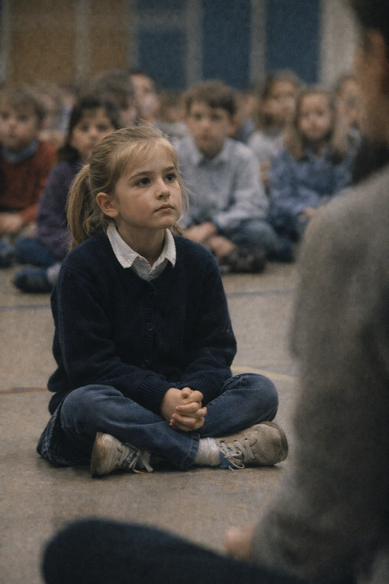
At St. Cecilia Catholic Elementary, the corridors filled again by degrees rather than all at once. The children came back from the morning assembly in lines that looked straighter than they felt, the usual scrape and shuffle of shoes softened by the way the teachers held their bodies: one hand raised but not stern, one finger to the lips without impatience, one steadying palm hovering near a shoulder when a child slowed or forgot to keep moving. The school had not become silent. No school full of six-year-olds could become silent for long. But its noise had changed. It came in little pieces now, a sniff, a shoe squeak, the soft thump of a lunchbox against a knee, the click of a classroom door being eased open instead of pushed wide.
Mrs. Hynes stood at her classroom doorway as her first-graders returned, counting them with her eyes as they crossed the threshold. She was not a tall woman, but she had the practiced stillness of a teacher who could make herself seem like a post in a storm, something children might drift toward without being told to. Her cardigan was buttoned wrong by one button near the middle, though no child noticed. Her hair had been pinned in the ordinary morning way, but a strand had loosened along her temple. She held the door open with one hand and rested the other lightly against the wood as each child passed into the room.
The classroom looked exactly as it had before they left it, which somehow made it stranger. The arithmetic workbooks were still stacked in a blue plastic bin on the front table. The chalkboard still held yesterday’s neat white columns of addition facts, the ones Mrs. Hynes had planned to review after prayers. The calendar still showed January, with a paper snowman tacked crookedly above the date. The windows looked out toward a narrow strip of playground where the blacktop was dry in some places and gray with old meltwater in others. A row of mitten-shaped art projects hung on a string above the coat hooks, each one decorated with cotton, glitter, yarn, or the impatient scribbles of children who cared more about being finished than being tidy.
The room smelled of crayons, pencil shavings, wool coats, paste, floor wax, and the faint warmth from the radiator below the windows. It was a room made for small certainties. Desks with name cards taped to the upper right corners. A reading rug with colored squares. A shelf of picture books whose covers had been repaired with cloudy tape. A jar of dull pencils beside Mrs. Hynes’s desk. A crucifix above the classroom door. A picture of the Sacred Heart, a little faded from years of light, watching over the place where children lined up for dismissal.
The children went to their seats without the usual burst of complaint about who had stepped on whose heel or who had gotten to be line leader twice. They were still carrying the assembly in their bodies. Some carried it as solemnity, sitting down carefully and folding their hands on the desktops as though still in the gym. Some carried it as restlessness, knees bouncing under chairs, fingers pulling at cuffs, eyes flicking toward the chalkboard and then to Mrs. Hynes. Some did not seem to know what they carried at all. They were only aware that the adults had spoken in careful voices, and that the word war had been said aloud in a place where usually the most serious words were homework, recess, and confession.
Debbie sat at her desk near the middle of the room, close enough to the windows that the gray light touched the side of her face but not so close that she could press herself fully into it. Her feet did not quite rest flat on the floor. She hooked one ankle behind the other and looked at the arithmetic bin on the front table. The blue plastic looked too bright. Numbers waited there, neat and trapped, all of them expecting answers. Debbie’s pencil lay where she had left it before the assembly, straight across the top of her desk, beside the small pink eraser she had rubbed into a softened wedge over the past week.
Mrs. Hynes let the last child sit before she closed the classroom door. The click of the latch seemed louder than usual. She stood by it for a moment, looking over the room, and the children looked back at her with that peculiar first-grade trust that was not simple obedience but expectation. They wanted to be told what kind of morning this was now. They wanted the next instruction to make the room make sense.
Mrs. Hynes crossed to the front table. Her hand hovered over the arithmetic bin, then moved past it.
She did something she almost never did so early in the day.
She put arithmetic aside.
The bin made a soft scrape as she slid it to the far corner of the table, away from the center, away from the morning. A few children watched with open curiosity. Arithmetic after assembly was normal. Arithmetic before lunch was normal. Arithmetic did not care whether grown-ups had said the word war. But Mrs. Hynes did not take out the workbooks. She reached instead for the cardboard trays of crayons, the broad shallow ones sorted more by hope than by color: reds among pinks, blues worn down to paper stubs, yellows with bitten ends, browns snapped in half and still useful.
She set the first tray on the nearest cluster of desks. The crayons rattled richly against one another, a sound so ordinary it seemed almost medicinal.
“You can draw your house,” she said. “Or your family. Or your dog. Or anything that makes you think of safe things.”
The sentence moved through the room more gently than the principal’s voice had moved through the speakers. It belonged to this classroom only. It belonged to Mrs. Hynes’s soft shoes, to the chalk dust at her sleeve, to the children at their desks, to the radiator clanking in the corner. Safe things. The words did not demand understanding of countries or armies. They did not require anyone to know what a coalition was, or where Kuwait sat on a map, or why adults used the same grave tone for television news and prayer intentions. Safe things could be drawn.
There was no official reason for this beyond common sense, and that was reason enough.
Crayons came out in a clatter. The sound loosened the room. Chairs shifted. Small hands reached. Paper was passed down rows, thick white sheets from the art cupboard, better than the lined paper used for spelling and sums. Mrs. Hynes moved from desk to desk with the stack held against her chest, placing one sheet before each child as if she were giving out something warmer than paper. She did not hurry them. She did not tell them to be creative. She did not announce that their drawings would be hung on the wall. That would have changed the task into performance. She only gave them the paper, and the crayons, and the permission to put safety somewhere visible.
Safety, to six-year-olds, turned out to be a set of highly specific images.
A front door appeared first on one page, large and brown, with a gold knob drawn as a yellow circle nearly as big as a fist. The child drawing it pressed so hard the paper buckled under the wax. Beside it, another child drew a bedroom lamp, the shade triangular, the bulb a sunburst, the pool of light colored orange around the bed. Someone drew macaroni on a plate, each noodle a separate curved line, steam rising in three careful gray strokes. Someone else drew a mother at a stove, her hair a wide cloud of black crayon, her arms stretched straight out from her body to reach both the frying pan and the pot. A dog appeared with six legs, then one leg was crossed out, then another, and finally the creature stood in furry confusion beside a house that had smoke coming out of its chimney. A cat hid under a chair with enormous eyes and a tail that curved like a question mark.
The children bent over their pages. Their seriousness returned, but it was a better seriousness now, one with color in it. Crayon wrappers peeled under small thumbs. Elbows settled heavily on desks. Tongues touched upper lips in concentration. The room filled with the dry whisper of wax against paper, the tiny knocks of crayons rolling off desks and being caught or not caught, the occasional intake of breath when a color was found, the soft murmur that almost happened and then faded because Mrs. Hynes had not said they could talk. She did not stop the room’s little noises. She let them stay human.
Debbie looked at her paper for a long moment before choosing a color.
She did not begin with people. She began with the roof.
The house came first because a house could hold everyone else. She drew the roof with a brown crayon, pressing especially hard, making the line thick and dark and certain. The first pass was not enough. She went over it again, then again, until the wax shone under the classroom light. The roof sat like a lid over the page, larger than the walls beneath it, a shelter made almost too heavy by the force she put into it. A few brown crumbs gathered along the edge where the crayon had begun to break down. Debbie did not brush them away. They seemed part of the roof now.
Then she drew the walls, taller than the house should have been, because there had to be room. She gave it too many windows. One window for the kitchen, one for the living room, one for the room upstairs where somebody might be sitting even if nobody could see them, one for the bathroom because she knew houses had bathroom windows though she made that one very small, one for the lower level, one for the room she shared, one for Beatriz, one for Angela, one that might not belong to anybody but felt necessary anyway. The windows did not line up. Some were squares, some were rectangles, and one leaned as if the house had taken a breath while she drew it. She colored each pane pale blue, then outlined them harder in black. She wanted the inside visible and protected at the same time.
Mrs. Hynes passed behind her once and did not stop. Debbie felt the teacher’s presence as a soft change in the air, the brief scent of chalk and lavender soap. Some teachers stopped too quickly when a drawing looked intense. Mrs. Hynes did not. She looked, because teachers looked, but she did not interrupt the roof or ask why there were so many windows. That made Debbie’s hand steadier.
She drew the front door red. Not because the real door was red, but because a red door showed where to enter. She put a yellow knob on it, then another yellow circle above the knob that might have been a peephole or might have been a small light. She made the steps wide and uneven. She drew a path coming toward the bottom of the page, and on either side of it she put patches of snow, though not enough to cover the grass. Snow belonged in January. Snow also made houses look like they were keeping something warm inside.
Then she began adding the girls.
Beatriz was tallest, because Beatriz was oldest and because Debbie’s mind gave her the shape of someone who stood where things needed doing. Debbie chose a dark green crayon for her jumper, then changed her mind and added blue over it, making the color thick and serious. Beatriz’s hair came out too square at first, so Debbie rounded it as best she could. She gave her straight arms and small hands. Beatriz looked a little like a traffic guard, standing near the path as if directing everyone safely into the house. Debbie considered this and decided it was correct.
Angela came next, in purple, because purple could be quiet or bright depending how hard one pressed. Debbie drew Angela near one of the many windows rather than on the path. She gave her hair a looser outline and put something in her hand that might have been a flower or a pencil or both. Angela’s jumper had tiny yellow marks across it, not because Angela owned such a jumper, but because plain purple looked too empty for her. Debbie added the marks carefully, each one a little dash of light.
Then Debbie drew herself. She did not make herself large. She put herself near the front door, halfway between outside and inside, with a pink jumper and hair drawn more carefully than the rest because she knew what her own hair was meant to look like even when the crayon did not obey. She gave herself two small black shoes, both pointing toward the door. Her face was a circle with two dark eyes and no mouth at first. After a while she added a tiny line, not smiling exactly, but present.
Grace was last, and Grace refused to become still even on paper. Debbie tried a circle for her head, then a line for her body, then another line because the first one made her look as if she had fallen over. The crayon moved faster. Grace became a little scribble of motion near the bottom of the page, in a bright jumper that began as orange and became red when Debbie added more color. She gave Grace hair like quick strokes around the head, arms in two directions, feet that did not match. Grace never held still in Debbie’s mind long enough to be rendered properly. A careful drawing of Grace would have been wrong. Grace was motion. Grace was noise on the stairs, a blur near the table, a small body that needed watching because she could become underfoot and then suddenly be gone to the next room.
Four girls stood or moved around the house now, each in her own color. Debbie looked at them and felt the picture become almost right, but not complete.
She added her mother at the kitchen window. Only the upper half of her, because that was all the window allowed. Dark hair. A blue dress that might have been an apron. One arm lifted. Debbie did not draw the stove, but she thought of it, and because she thought of it, she colored the kitchen window yellow from behind. Then she added her father in the living room window, smaller than her mother because the window was smaller and because she had already used too much space. She gave him a brown shirt and dark hair and a hand lifted too, though his looked more like a mitten than a hand. The two adults watched from inside. The girls remained outside but close to the door, which made sense to Debbie in the private order of the page. Everyone was there. Everyone could get in.
Around the house, she drew a line. At first it was only meant to be the ground, but it continued up one side of the paper and over the roof and down the other side until the house, the girls, and the windows were enclosed within a large uneven border. It was not a fence. It was not a bubble. It was just a line that said nothing should come closer than this. Debbie traced it twice with black and then once with dark blue. The blue softened it. The black kept it strong.
Across the classroom, safe things multiplied. A grandmother’s chair with a blanket over it. A television drawn with an enormous antenna. A plate of toast. A bunk bed. A father’s truck. A church with a cross that leaned sideways. A teddy bear so large it crowded out everything else on the page. A bowl of soup. A backyard tree. A baby brother asleep under a blanket patterned with blue dots. Children did not draw safety as an idea. They drew the objects that had held them without asking to be noticed.
Mrs. Hynes moved slowly between the desks, sometimes crouching, sometimes placing a new sheet of paper before a child who had made a mistake too large to tolerate, sometimes rescuing a crayon from the floor. She said very little. The line she had spoken at the start seemed to be enough. Anything that makes you think of safe things. She let the children decide what counted. She did not correct the child who drew only a lock. She did not correct the child who filled the whole page with yellow and then sat staring at it. She did not correct the child who drew soldiers at the edge of a house and then scribbled over them so completely that only dark wax remained. She simply supplied more paper where paper was needed, more crayons where colors ran out, and the calm adult nearness that kept the room from tipping.
Debbie chose gray for smoke from the chimney, then hesitated. The house did not need smoke. Smoke could mean warmth, but it could also mean something else. She put the gray crayon back and picked up yellow instead. She made light in every window. Some windows glowed more than others. The kitchen glowed brightest. The room where she and Grace slept glowed too, though she colored that one more gently, keeping within the lines as much as she could. She colored the window by Angela almost purple at the edges, as if Angela’s jumper had somehow reflected into the glass. Beatriz’s window she left mostly blue, because Beatriz liked things clear.
The roof still seemed most important. Debbie returned to it again, pressing the brown crayon until the point flattened against the paper. She made the roofline so thick it began to look like a beam. Her hand grew tired, but she did not stop at once. The roof had to hold. It had to cover the windows, the yellow rooms, her mother and father, Beatriz, Angela, herself, Grace in her bright scribble, the path, the snow, the red door, the small yellow knob. It had to hold all of it together.
A crumb of brown wax broke loose and stuck to the side of Debbie’s hand. She looked at it, then at the page, then rubbed it gently into the roof with her fingertip. The wax smudged, making one small place darker and smoother. She liked that. It looked less like a line and more like something built.
For a few minutes, the classroom became only this: children drawing what they could bear to draw, a teacher moving softly among them, arithmetic waiting untouched in the blue bin, the world held outside by walls, windows, crayons, and the common sense of a woman who understood that some mornings needed color before numbers. The tannoy speaker above the door stayed silent. The chalkboard kept its addition facts to itself. The paper snowman on the calendar smiled with its crooked black mouth. Debbie bent over her house and added one more window, very small, tucked just under the roof where no window would really be. She colored it yellow too. Then she set the crayon down and rested both hands flat on the desk, one on either side of the page, as if keeping the house from moving.
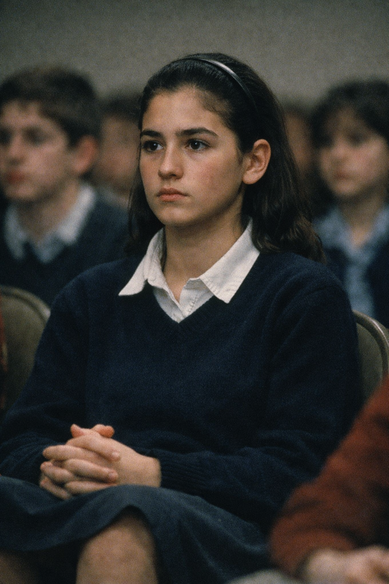
By the time Beatriz’s class returned to Room 214, the morning had stopped feeling like morning in any ordinary way. The room still had the shape of eighth grade: rows of desks, long windows facing the bare winter branches beyond the schoolyard, a chalkboard washed too many times until the green had gone gray in places, a crucifix above the door, a stack of history textbooks along the back counter, and the faint dusty smell of radiators working harder than they looked capable of working. But the room had been altered by what had just passed through the building. The desks looked too orderly. The old pull-down map at the front of the room looked newly important. The flag in the corner, usually ignored unless someone was saying the pledge, seemed heavier on its pole.
Sister Maureen did not tell them to take out their religion books or their grammar folders. She did not begin with a prayer, though her hand touched the rosary at her waist as she crossed to the front of the room. She was a practical woman, broad-shouldered under her black cardigan, her veil pinned with habitual exactness, her face neither severe nor soft in any simple way. She had the manner of someone who had comforted enough children to know that too much sweetness could become frightening in itself. She stood by the chalkboard for a moment, looking over them, letting the class settle into the fact that she was not going to pretend nothing had happened.
Beatriz sat two rows from the window with her notebook already open.
She had opened it before Sister Maureen spoke, almost before she was fully seated. The motion had been quiet: binder unclipped, paper turned to a clean page, pen uncapped, date written in the top right corner with the same neatness she used for science notes and history outlines. January sat there in blue ink, then the year, then a line drawn beneath it. She did not write Gulf War in large letters. She did not make the heading dramatic. She wrote School Assembly / Questions in small, controlled print, close to the margin, as if reducing the title would reduce the size of the thing itself.
Around her, the other students arranged themselves unevenly. Some slumped as though the assembly had exhausted them. Some sat too straight. A few tried for the careless posture of teenagers determined not to appear affected in front of one another, but their eyes betrayed them, moving too often toward Sister Maureen, toward the map, toward the windows, toward nothing at all. Fourteen was an age of pretending not to need reassurance while still listening desperately for it.
Sister Maureen folded her hands in front of her. “All right,” she said. “You heard Mr. Dillon. I am not going to repeat his whole speech. You are old enough for some questions, and old enough to understand that some answers will be incomplete. We will take this calmly.”
Beatriz wrote: Some answers incomplete. Calm.
She did not know why she wrote the word calm except that it mattered to record the tone as much as the facts. Calm was not the same as cheerful. Calm was not pretending. Calm was a thing adults could choose if they remembered to choose it. She pressed the pen lightly enough that the ink stayed clean, no tears in the page, no angry dents.
Sister Maureen turned to the chalkboard and wrote three words in a vertical list: FACTS, RUMORS, FEELINGS. Her chalk made a dry clicking sound with each capital letter. She underlined FACTS once, RUMORS twice, and FEELINGS with a softer line that trailed at the end.
“These are not the same thing,” she said, turning back to them. “Part of our job this morning is to know the difference.”
A hand went up near the front. It belonged to Paul Renner, whose father worked nights and whose older brother had graduated from St. Raphael three years before. Paul’s mouth had been set hard since they came back from the theatre. Sister Maureen nodded to him.
“Is this like a world war?” he asked.
The room changed around the question. Several students looked at him in annoyance, not because it was a bad question, but because he had said aloud the thing that had been crouching in the corner of the room. Beatriz did not look up at him for long. She wrote the question down first, carefully: Is this like a world war?
Sister Maureen did not answer too quickly. “No,” she said. “Not as we understand it now. This is a war in the Gulf region, involving Iraq and Kuwait, and now a coalition of countries fighting against Iraqi control and military action there. It is serious. It is not small. But no, you should not assume that means the whole world is at war with itself.”
Beatriz wrote: Not world war. Gulf region. Iraq / Kuwait. Coalition. Serious not whole world.
She left a space beneath it. Spaces helped. Spaces meant more could be added without crowding. She drew a small arrow beside coalition and wrote: countries working together for this war. She hesitated over together, because together sounded nicer than what soldiers did, but she left it. It was accurate enough for remembering.
A girl across the room raised her hand. Mary Claire Dolan. She usually asked questions to prove she had done the reading, but now her voice was smaller than usual. “Could they bomb here?”
A faint shifting passed through the class. Somebody exhaled too loudly. Somebody’s chair leg knocked the floor.
“No,” Sister Maureen said, and this time she answered immediately. “There is no reason to believe anyone is going to bomb Pittsburgh. There is no fighting here. Mr. Dillon said that clearly, and I will say it again. This war is far away from Pennsylvania.”
Beatriz wrote: Pittsburgh not target. Fighting far away. Don’t scare younger kids with bombs here.
The last part she wrote without thinking, and then she looked at it. Don’t scare younger kids. The ink sat there plainly, more personal than the line above it. She did not cross it out. It belonged in the notes. A fact was not only a place on a map. Sometimes a fact was what not to say at the dinner table when little ears were pretending not to listen.
Sister Maureen’s eyes moved over the room. “If you have heard someone say otherwise, that belongs under rumors unless a responsible adult gives you real evidence. And I will tell you plainly, children often mistake fear for evidence.”
Beatriz wrote: Fear ≠ evidence.
She made the equals sign carefully, then drew the slash through it twice to make sure it was visible.
Another hand rose, this one from Raymond Kappel, who had a habit of asking whatever sounded most frightening and then looking embarrassed after. “What if they use nuclear bombs?”
The word nuclear landed with a different weight from bomb. It was a school-drill word, a television word, a grown-up nightmare word. A couple of students turned toward the window as if the bare branches outside might have changed. Beatriz felt her stomach tighten, but her hand kept moving. She wrote the question in smaller letters because she did not like seeing it large.
Sister Maureen’s mouth firmed. “You have heard that word because adults have talked too freely around children, or because television likes words that keep people watching. Nuclear weapons exist. That is true. But nothing we know this morning means that a nuclear attack is expected here. You are not to go through school telling younger children that nuclear bombs are coming. That would be false, and it would be cruel.”
Beatriz wrote: Nuclear exists but not expected here. Do not repeat to little kids. False + cruel.
The words false and cruel pleased her in a hard way. They gave shape to something she had already felt. There were children who liked the power of frightening other children. There were children who carried adult phrases around like matches. False and cruel were good words for stopping them. She underlined them once.
Sister Maureen turned back to the board and wrote under RUMORS: “I heard…” Then she turned and faced them again. “Whenever a sentence begins that way, you pause. You ask who heard it. From where. From whom. You ask whether the person knows or is only repeating. That does not mean you become rude. It means you become responsible.”
Beatriz wrote: “I heard” = pause. Source? Knows or repeating? Responsible.
Her notes were beginning to take on the shape of a system. Question. Answer. Rule. She could feel herself organizing the room as if the room were a drawer and fear were a pile of papers that could be sorted into stacks. It did not make her unafraid. It gave her something to do with her hands.
A boy near the back, Kevin Marsh, raised his hand halfway and spoke before Sister Maureen fully called on him. “My uncle said it’ll be over fast.”
Sister Maureen tilted her head slightly. “That is not a question yet.”
Kevin flushed, then tried again. “Is it going to be over fast?”
“No one in this room knows that,” Sister Maureen said. “Some wars last days. Some last months. Some last years. Adults who tell you they know exactly how quickly war will end are often guessing. They may be educated guesses. They may be hopeful guesses. They may be foolish guesses. We should be careful with certainty.”
Beatriz wrote: No one knows length. Careful with certainty.
She looked at the phrase and almost underlined it, then did not. It already looked important without help.
Another hand. “Sister, are soldiers going to die?”
This question came from a girl named Elise who rarely spoke unless called on directly. Her voice trembled, and Beatriz looked up before she could stop herself. Elise’s face had gone pale above her uniform collar. Her hands were folded on the desk so tightly the knuckles showed.
Sister Maureen’s expression changed—not into softness exactly, but into a more personal seriousness. “Yes,” she said. “Some soldiers may die. Some already may have. Civilians may die too. War means human beings are in danger. That is why we do not talk about it as if it were a game.”
The room went very quiet.
Beatriz wrote: Soldiers and civilians in danger. Not a game.
For a moment the pen stopped after the period. She thought of the younger grades in the gym, the little ones sitting on the floor beneath the speaker. She thought of how the word civilian might not mean anything to some of them. She added beneath it: civilians = people not soldiers. Families, kids, old people, workers.
She did not decorate the page. She did not make boxes or arrows beyond what was useful. Her notes were not pretty. They were orderly, dense, built to survive being looked at later.
Sister Maureen moved away from the chalkboard and sat on the edge of her desk, an informal thing she almost never did. It brought her closer to them without pretending she was their peer. “You may also hear people speak as if everyone in a country is the same as its government,” she said. “That is another thing to be careful about. Iraqi civilians are human beings. Kuwaiti civilians are human beings. American soldiers are human beings. Soviet soldiers are human beings. British pilots are human beings. Kurdish fighters are human beings. We may discuss governments, armies, decisions, and actions. We do not reduce whole peoples to cartoons.”
Beatriz wrote as quickly as she could without losing neatness: People not governments. Don’t make whole peoples cartoons.
She paused on Soviet soldiers, because that was a phrase she had already heard differently from different adults. Some said it with suspicion. Some with surprise. Some with the old Cold War weight still clinging to the word Soviet even when the world was not the same as it had been in their parents’ stories. She wrote: Coalition includes different countries. Don’t assume simple.
Don’t assume simple. It looked like something Angela would say in a more beautiful way, if Angela were making a picture instead of a list. Beatriz did not think about that for long. Thinking about her sisters made her chest feel crowded.
A hand shot up from near the window. “My dad said Iraq took Kuwait years ago, so why now?”
It was a better question than the boy who asked it probably realized. Several students looked more alert. This was the kind of question eighth graders liked because it made the war seem briefly like history class, cause and effect, dates and decisions, something with a paragraph answer.
Sister Maureen nodded. “Iraq seized Kuwait in 1985. That is several years ago, yes. There have been boycotts, diplomatic pressure, resistance inside Kuwait, and many arguments among governments about what could or should be done. The present military action did not come from nowhere, and it did not happen because of one single weekend. That does not make it simple. It means the situation has a history.”
Beatriz wrote: Iraq seized Kuwait 1985. Boycotts / pressure / resistance / arguments. War has history, not one weekend.
She left another space. Dates mattered. Dates stopped everything from becoming a blur. Her hand moved automatically to the margin, where she wrote 1985 in a small box. If someone later said this had all begun yesterday, she would know that was wrong. If someone said nobody had tried anything before fighting, that was too simple. If someone said adults had everything under control, that was also too simple. Notes could not save anyone, but they could keep stupid sentences from taking over a room.
“What’s a boycott?” another student asked.
“A refusal to buy from, sell to, or cooperate with a country or company in order to apply pressure,” Sister Maureen said. “In this case, some countries tried to isolate Iraq economically because of Kuwait.”
Beatriz wrote: boycott = refusing trade/cooperation to pressure. isolate Iraq.
She liked definitions. Definitions had edges.
A boy whose cousin was in uniform asked whether the draft was coming back. His voice tried to sound casual and failed.
“No draft has been announced,” Sister Maureen said. “If your family has someone serving, you may be more worried than someone whose family does not. That is understandable. But do not tell classmates there is a draft unless there is one. There is not one this morning.”
Beatriz wrote: No draft this morning. Don’t say draft unless announced.
This morning. Sister Maureen used those words often. Not never. Not impossible. This morning. Beatriz noticed it. Adults who were careful did not promise more than they could promise. It bothered her, and it reassured her, both at once.
Another student asked if the fighting was in the desert. Sister Maureen crossed to the pull-down map and tugged it until the Gulf region hung visible, though still small from the back rows. She took a yardstick from the chalk tray and pointed—not with the drama of a television map, but with the plainness of a teacher showing where something sat in the world.
“Here is Iraq,” she said. “Here is Kuwait. Here is the Gulf. This region includes desert, cities, roads, oil fields, rivers, ports, and homes. Be careful when you say desert as if no one lives there. People live there.”
Beatriz wrote: Desert ≠ empty. Cities, roads, ports, homes, people.
She pressed harder on people than she meant to. The ink darkened at the bottom of the letters.
The room had begun to breathe differently. Questions still came, but less wildly now. Sister Maureen had given them a method: ask, sort, define, refuse rumors, remember people. Some students still looked frightened. Some looked relieved by the structure. Some looked impatient in the way children did when fear had nowhere to go and turned briefly into irritation.
“What if someone says they hope we wipe them out?” a girl asked.
Sister Maureen’s eyes sharpened. “Then you do not repeat it. And if it is said in school, you tell a teacher. That kind of language is sinful and dangerous. Anger at a government or an army does not give anyone permission to speak as if human lives are garbage.”
The room received that one with a kind of chastened attention. Beatriz wrote: “wipe them out” language = sinful/dangerous. Tell teacher. Human lives not garbage.
She did underline that. Human lives not garbage. It sounded almost childish and therefore exactly right. A child could understand garbage. A child could understand not being treated like it.
Sister Maureen returned the yardstick to the chalk tray. “You will hear slogans,” she said. “Slogans are often shorter than truth. That is why people like them. Be wary of anything too neat.”
Beatriz wrote: slogans shorter than truth. Be wary too neat.
Her page was filling. She turned it carefully and wrote the same date at the top of the next sheet. She did not want the second page to look disconnected from the first. The other students were not taking notes, not most of them. A few had written down definitions because school habits were hard to break, but most were watching Sister Maureen, or the map, or their own hands. Beatriz knew she might look overeager. She knew someone might tease her for turning even war into an outline. But nobody did. The room was too serious, and even if it had not been, Beatriz’s face had settled into a look that discouraged foolishness.
Her notes were not only for class. They were for accuracy. They were for the way words changed when they traveled down hallways, into buses, onto porches, into kitchens where younger children listened from the stairs or the floor. They were for the difference between somebody saying bombs are coming and somebody saying the fighting is far away. They were for remembering exactly how Sister Maureen had said not to make a game of it. They were for the moment when someone smaller asked a question and an older child had to decide whether to comfort, correct, or admit she did not know.
Sister Maureen took another question. “Why do grown-ups call it an operation instead of a war?”
There was a murmur of recognition. Operation had been on television. Operation made the whole thing sound mechanical, planned, maybe even clean.
Sister Maureen’s face tightened almost imperceptibly. “Military actions are often given names. Governments use those names for planning, communication, and public explanation. But a name can make something sound tidier than it is. You may hear Operation Desert Storm. You may hear other names. Remember that the name is not the whole reality.”
Beatriz wrote: Operation names = military/government labels. Can sound tidy. Not whole reality.
She thought of Angela for one dangerous second, because Angela would hear Desert Storm and imagine an actual storm, sand filling the sky. Beatriz wrote in the margin, smaller than the rest: Desert Storm is name, not weather. Then she stared at that line, feeling its usefulness. It was exactly the sort of thing someone little might misunderstand. It was also the sort of phrase adults could forget sounded like something else.
“Are the people there scared of us?” another student asked.
Sister Maureen folded her hands again. “Some may be. Some may be relieved. Some may be angry. Some may be too busy surviving to think in simple categories. We should not pretend to know what every person far away feels.”
Beatriz wrote: People there may feel many things. Don’t pretend know everyone.
She had to pause and shake her hand once under the desk. Her fingers were cramping from writing so steadily. The pen had left a faint indentation along the side of her middle finger. She flexed it, then continued.
A boy asked whether soldiers were heroes. Sister Maureen did not allow the easy answer.
“Some soldiers behave heroically,” she said. “Some are frightened and do their duty anyway. Some are placed in terrible situations by decisions made far above them. Hero is a serious word. We do not use it cheaply, and we do not use it to erase suffering.”
Beatriz wrote: Hero serious word. Don’t use cheaply. Duty + fear can coexist.
That line made her stop again, though only for a breath. Duty and fear could coexist. She knew that in the body before she knew it in words. She knew what it was to keep moving because stopping would make others notice she was scared. She bent closer over the page and wrote it again in smaller print beneath the first version, as if repetition could store it more deeply.
Duty + fear.
The classroom radiator clanked. Outside, the bare branches scraped lightly against one another in the winter wind. Somewhere down the hall, a younger child began crying and was quickly soothed; the sound rose and vanished before it became a disruption. Several students heard it and looked toward the door. Beatriz did too. Sister Maureen let the moment pass, then drew the class back with her voice.
“You are hearing younger children in the building today,” she said. “Remember that. What is said among eighth graders may not be suitable for first graders. What you can carry may be too heavy for a six-year-old. That does not make the six-year-old foolish. It makes you responsible for your words.”
Beatriz did not look up. She wrote too quickly for perfect neatness: What eighth graders can carry may be too heavy for six-year-olds. Responsible for words.
She underlined responsible.
The pen paused at the end of the line. There it was. The thing she had felt from the beginning of the morning but had not yet had put before her so plainly. Responsible for words. Not responsible for the war. Not responsible for what adults had built. Not responsible for fixing fear in every room of the house. But responsible for words. That was something. That was a place to stand.
A student near the front asked if they should watch the news when they got home.
Sister Maureen answered more gently. “That is for your parents to decide. But I will say this: watching more does not always mean understanding more. Sometimes it only means seeing more than you are ready to see. If the news makes you feel ill, frightened, or unable to sleep, tell an adult and stop watching.”
Beatriz wrote: More watching ≠ more understanding. Stop if too much. Tell adult.
She thought of the television glow at home, the way news could turn the living room into somewhere else without moving a single piece of furniture. She thought of her mother’s face when she was listening and trying not to show too much. She thought of her father going still. She did not write those things. They were not class notes.
Another question came from a boy who usually liked military models and drawing planes in the margins of his notebooks. His voice was quieter than Beatriz expected. “Is it wrong to think the planes are interesting?”
Sister Maureen looked at him for a moment, and when she answered, she did not scold. “No. Machines can be interesting. Strategy can be interesting. History can be interesting. But interest must not become delight in destruction. You may study how something works and still remember what it does.”
The boy nodded once, eyes lowered.
Beatriz wrote: Machines/strategy can interest. Not delight in destruction. Remember what it does.
She liked that Sister Maureen had not humiliated him. Humiliation made people defend the wrong thing. A good correction left the person somewhere to go.
The class continued this way, question by question, the room becoming not easier exactly but more ordered. Sister Maureen did not know everything. She said so when she did not. That mattered. When asked how many people had died, she said reports would change and they should not trade numbers like baseball cards. When asked whether God chose sides in war, she became very still and said God was with the suffering and the truthful, and that human beings should be careful about placing God on their own banners. When asked whether praying for enemies was required, she said Christ had been clear on that point, and difficulty did not release them from the command. When asked if anger was a sin, she said anger could be a warning bell and must be governed before it became cruelty.
Beatriz wrote as much as she could.
Numbers change. Don’t trade like cards.
God with suffering/truthful. Careful with banners.
Pray for enemies. Difficult still required.
Anger = warning bell. Govern before cruelty.
Her page filled with the kind of sentences she could hear again later if she looked at them long enough. Sister Maureen’s words were not as tidy as Beatriz’s notes made them, but the notes kept the bones. Bones mattered. Bones let something stand.
At last the questions slowed. The class did not run out of fear; it ran out of the first force of asking. Students sat with answers they had not wanted and reassurances they did not fully trust yet. Sister Maureen remained at the front of the room, the chalkboard behind her still divided into FACTS, RUMORS, FEELINGS. Under FACTS she had written Iraq, Kuwait, far away, no draft announced. Under RUMORS she had written I heard, nuclear attack here, over by Friday. Under FEELINGS she had written fear, anger, confusion, curiosity, prayer. The board looked strange, like a grammar lesson for a damaged world.
Sister Maureen dusted chalk from her fingers. “We are not going to solve war in this room,” she said. “We are going to conduct ourselves decently in the presence of it. That is the work available to us this morning.”
Beatriz wrote: Conduct ourselves decently. Work available this morning.
She did underline that one, because the phrase work available seemed to settle something in her. It did not ask her to be powerless. It did not ask her to be grand. It gave her a task small enough to do and serious enough to matter.
Sister Maureen looked at the clock, then back at the class. “In a moment, we will return to history, not because this is unimportant, but because the day still has to be lived. Before we do, I want you to sit quietly for one minute. Not whispering. Not writing. Quietly.”
Beatriz’s pen stopped.
For the first time since she had sat down, her hand was empty of motion. The room settled around her. Some students bowed their heads. Some stared at the board. Some looked out the windows at the bare branches and the dull slice of winter sky beyond them. Beatriz looked at her notes.
The pages were dense, practical, almost severe. They contained no drawings, no dramatic lettering, no private confession. Yet she could feel the private purpose running beneath every line. Not to panic. Not to repeat. Not to let someone else’s careless sentence become the truth simply because it was louder. Not to let the younger ones inherit the worst-shaped version of the morning.
Her pen lay across the notebook, capped now, parallel to the blue margin. She noticed a tiny smear of ink along the side of her finger and rubbed it once with her thumb. It did not come off.
Sister Maureen’s minute of quiet held.
At the front of the room, the map hung open. Iraq and Kuwait were still too small from Beatriz’s desk, the whole region compressed into color and line, but she knew where to look now. She knew enough to know she did not know enough. She knew the difference between fact and rumor, or at least knew to ask for the difference before speaking. She knew slogans were shorter than truth. She knew fear was not evidence. She knew what eighth graders could carry might be too heavy for six-year-olds.
When Sister Maureen finally moved, the rustle of her sleeve sounded almost loud.
“All right,” she said. “Take out your history books.”
Desks opened. Textbooks thudded softly. The ordinary machinery of class resumed in cautious pieces. Beatriz slid her notes beneath the front cover of her binder instead of leaving them loose. She pressed the rings closed with a clean metal snap and rested her hand on the cover for one second longer than necessary, making sure the pages were secure before she reached for her history book.
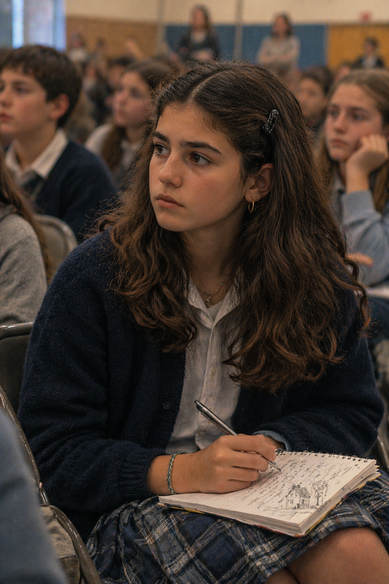
By the time Angela’s class came back from the assembly, the corridor had the strange feeling of a place that had just hosted weather.
Children moved in lines because that was what school demanded, but the lines no longer held the usual careless shape. They were narrower, quieter, more conscious of themselves. Shoes tapped and squeaked on the waxed floor. A coat sleeve brushed a bulletin board and made one paper leaf tremble. Somebody up ahead gave a small laugh at nothing at all, the kind of laugh that came when a child was trying to prove she was not frightened and only succeeded in sounding brittle. Teachers kept their voices level and almost unnaturally gentle, all of them sounding, to Angela, as though they had been told to lower their hands when approaching nervous animals.
She walked back with her reader hugged against her chest, feeling not quite frightened herself and not quite calm either. The assembly had not made the war feel near. If anything, Mr. Dillon had been very firm that it was far away, very, very far away, in the particular repetitive rhythm adults used when they wanted a sentence to hold. But the building still felt wrong. Wrong in the way church felt after somebody fainted. Wrong in the way home felt when a phone call had changed the day before anyone said how. The floor was the same. The lockers were the same. The saint in the frame at the end of the hall still looked down with the same painted patience. Yet all of it had thinned somehow, as if the ordinary morning had been peeled back and something more anxious had been slid beneath it.
When the class reached the room, Mrs. Keane stood aside to let them in one by one.
“All right,” she said in the voice adults used when they had decided that routine itself was going to be the medicine. “Everyone back to your seats. We’re going to carry on.”
Carry on. Angela noticed the phrase and tucked it away. Not resume. Not settle down. Carry on. It sounded like something one said after storms or funerals or power cuts.
The classroom had been left exactly as it was before the assembly, which only made the interruption feel stranger. Their reading books were still stacked in the center of each table cluster. Vocabulary words remained on the board in Mrs. Keane’s neat upright hand. A half-finished sentence from the earlier lesson still waited in chalk beside a page number that now looked oddly innocent. The room smelled of pencil shavings, wet wool from coats hung too close together, and that faint sweet-dusty smell of elementary classrooms that came from crayons and paste and old paper all living in the same air.
Children slid into chairs. Desks scraped. A lunchbox tipped and was righted. Somebody’s ruler clattered to the floor with such violence that three heads turned before the girl who dropped it even realized she had. Angela sat down, laid her reader on the desk, and looked without seeming to look.
She was good at that. She had always been good at that.
Julie Mangan was chewing the inside of her cheek hard enough to hollow one side of her face. Tommy Brennan, who never sat still unless he was ill, was sitting ramrod straight and not moving his hands at all. Patricia Sloane had opened her book to the correct page before Mrs. Keane even asked, which meant she was frightened, because Patricia only became supernaturally obedient when trying to stop something from getting worse. Across the room, a boy in the back row whispered something to the kid beside him and got no answer, only a sharp shoulder twitch that meant not now.
Mrs. Keane began handing the readers back with purposeful cheer.
“Page forty-two, everyone. We’re picking up where we left off. Let’s show ourselves we can still do our work.”
Angela opened her book obediently.
The page showed a black-and-white illustration of two children standing beside a fence with a dog between them, some simple story about a missing cap or a borrowed bucket or some other small world problem that usually would have been perfectly fitted to the middle of a school morning. Today it looked thin and almost insulting in its harmlessness. Not because Angela wanted war in her reader or had any appetite for adult horrors invading schoolbooks, but because the whole room knew they had been taken out, gathered, spoken to over microphones, then returned here as though a story about a fence and a dog could absorb everything that had changed.
Mrs. Keane called on one of the boys at the front to begin.
His voice came out too soft at first, then too loud on the second sentence, as if he had remembered halfway through that reading aloud required performance and had no energy left for one. He stumbled over a word he knew perfectly well. A few children smiled reflexively, then seemed ashamed of the smile the moment it appeared. Mrs. Keane corrected him kindly and had him continue.
Angela tried to follow the story, and for perhaps three lines she even managed it. The dog had wandered somewhere. The children were trying to think where. One of them looked by a shed. The other checked the gate. It was all meant to be comfortingly small.
But the room would not hold still around the lesson. It kept giving itself away in tiny sounds and movements. Someone’s breathing going too fast. A page turned too early. A pencil tapping twice, then stopping as if caught at it. A girl in the next row staring not at the book at all but at the classroom door, as if half-expecting another announcement to come through it in person.
Angela’s own attention spread the way it always did when something emotional was wrong. Not away from the room, but through it. She watched the boy reading and also the shape of Patricia’s hands pressed flat on her desk and also the way the cloudy daylight looked against the glass of the windows and also the pulsing awareness that beneath the story, beneath the page, beneath the ordinary act of school, every child in here knew a new word had entered the day and was not going to leave because a teacher asked nicely.
The boy reached the end of a paragraph.
Mrs. Keane nodded. “Good. All right, Denise, you take the next one.”
Denise lifted her chin over her book and began in a clear voice that lasted exactly one sentence before the interruption came.
It came not from cruelty or mischief or the deliberate desire to upend the room, but from fear finding the wrong door.
“My brother says older kids can get listed,” said a girl from the table by the windows.
No hand raised. No warning. She simply said it into the pause between one reader and the next, and because the room had been stretched too tight already, the words entered it like a pin.
Denise stopped reading.
Mrs. Keane looked up sharply. “Nancy—”
But Nancy, pale with the courage of someone who has finally spoken the thing sitting in her throat, went on anyway.
“He said if you’re older they write your name down. Like for the war.”
Listed.
The word sat in the middle of the room, at once childlike and bureaucratic, exactly the sort of half-understood terror children built when they had overheard adult talk and stitched it back together wrong.
For one suspended second nobody moved.
Angela felt the pause physically. It was the kind of stillness in which every mind in the room rushed to test the sentence against its own private world.
Then Patricia said, too fast, “What do you mean older?”
Nancy swallowed. “Like sixteen. My brother said sixteen and up.”
The room broke.
Not into screaming at first. Into recognition.
“My sister’s sixteen,” said a boy near the back, the words coming out thin and flat, as if he had only just discovered the fact himself.
“My cousin is.”
“My brother just turned sixteen in November.”
“No, that’s not—”
“My brother’s seventeen.”
“He’s only sixteen, that’s not even grown.”
“He said they can take names—”
All at once the children were not in the classroom anymore. Not really. They had been thrown across distances into kitchens, driveways, shared bedrooms, dinner tables where older siblings had rolled their eyes, laughed too loud, or talked with great false authority about matters they barely understood. Every sixteen-year-old in the room had become immediate. Not a category. A face. An actual coat on an actual hook at home. A sister who slammed doors. A brother who ate cereal standing at the counter. A cousin who borrowed tapes and never returned them.
The first tears came from a girl called Erin whose older brother was, everyone knew, exactly sixteen because he had recently gotten his driver’s permit and had driven too fast down Hollow Run Road one Sunday after Mass. She did not sob heroically. Her face simply collapsed in on itself with shock, and then she was crying so suddenly and so silently at first that the desk beside her had to notice before the teacher did.
Angela turned instinctively.
Erin was staring at nothing, one hand over her mouth, shoulders hitching. Her book lay open and forgotten in front of her.
“No,” said Tommy Brennan, but said it angrily, as if refusal alone could change the rules of the world. “No, that’s stupid. They can’t just take people. My brother wouldn’t go.”
The insistence made the room worse. Children heard the fear under it more quickly than the defiance on top.
“My sister’s sixteen,” Patricia said again, this time in a voice so small it sounded like someone else’s.
A boy at the front asked, “What does listed mean?” and another answered, “Like drafted,” though he mispronounced it, and then that word entered too, heavier than the first, less child-invented and therefore somehow more dangerous.
Mrs. Keane put her hand flat on the desk at the front of the room.
“Everyone quiet. Quiet now.”
No one obeyed at once, because the children were no longer merely noisy. They were frightened, and frightened children did not sort themselves instantly into good order just because a teacher’s tone sharpened. Voices overlapped. One child had begun crying because the others were crying and did not fully know why. Somebody knocked a pencil case to the floor and the contents spilled under two desks with a sound far too dramatic for rubber erasers and stubby crayons. A boy insisted his father said they only needed grown men. A girl countered that sixteen was nearly grown. Another asked, “Can they list girls?” which sent a fresh tremor through the room because none of them knew the answer, and ignorance with edges was sometimes worse than information.
Angela felt the panic move around the room almost visibly, the way cold moved under a badly shut window.
It was not one fear. That was what struck her. It was a room full of different fears catching on the same spark. Some children were imagining brothers and sisters disappearing. Some were imagining letters, uniforms, buses, names being called out in school. Some were frightened only because everyone else was. Some were suddenly aware that the world had categories and thresholds in it—under ten, older kids, sixteen, grown—and that one might step from one to another without any warning except a birthday.
Erin’s crying had become loud enough now that it seemed to embarrass her, which made it worse. She turned her face away and pressed both fists to her eyes, trying and failing to stop.
Without really deciding, Angela shifted her chair a little closer.
Erin’s desk was one over and slightly ahead; close enough that a movement could seem accidental if anyone later thought to notice it.
“It doesn’t mean true,” Angela said to her, low and quick, leaning just enough for the words to land privately. “She heard it from her brother. That doesn’t make it true.”
Erin shook her head hard, still crying.
Angela tried again, because she knew from long practice that certain kinds of panic were not argued with by bigger promises. They had to be narrowed first.
“She doesn’t know,” she said. “She’s just scared.”
That helped, a little. Not because Erin stopped crying, but because the room of her fear shrank slightly from the size of war to the size of Nancy saying something dreadful at the wrong moment. Sometimes that was enough to let a child breathe one extra breath.
At the front, Mrs. Keane abandoned the tone of discipline.
Angela saw the exact second she did it.
The teacher’s face changed. Something in it softened and sharpened at once. She stopped being the woman trying to restore a reading lesson and became the woman who understood that twenty-six children had just gone somewhere else and would not be called back by page numbers.
She stepped out from behind the desk.
“Books closed,” she said.
The room obeyed that much. Almost gratefully.
“Close them. Everyone.”
Pages thudded shut one after another. The sound ran through the room like a series of little doors being pulled to.
Mrs. Keane moved into the aisle between the desks rather than staying at the front. Angela noticed that too. It mattered where an adult stood. Angela had always known that, even before she knew she knew it.
“Nobody in this room is being sent anywhere,” Mrs. Keane said, more plainly than before. “Do you hear me? Nobody in this room.”
“But older kids—” Patricia began.
Mrs. Keane cut in gently, not with force but with speed.
“Nancy repeated something she heard. That is not the same as a fact. Children and older brothers are both very good at frightening one another with things they do not understand properly.”
A few children gave a wet little laugh at that, not because it was funny exactly, but because it sounded like a sentence from the world before this one.
Nancy had gone red all the way up her neck.
“I didn’t mean—” she began, already on the brink of tears herself now that she could hear what her words had done.
Mrs. Keane looked at her and made the crucial choice not to blame her publicly.
“I know you didn’t,” she said. “You were worried. But we are not going to pass along alarming things unless we know they are true.”
That checked the room slightly. Not solved it. Checked it.
Tommy Brennan muttered, “My brother said—”
“And your brother,” said Mrs. Keane, “is not the principal, the President, or the army, so for today we are going to let him be sixteen in peace.”
That landed more cleanly. A few children sniffed laughter. Even Tommy, trapped between indignation and the fact that his brother was exactly the sort of boy who would enjoy sounding important over breakfast, went quiet.
Erin was still crying, softer now.
Mrs. Keane knelt beside her desk.
That changed everything again. Not magically, but enough.
A kneeling adult in a classroom was a serious thing. It meant this was no longer classroom trouble. It was real human upset, and the teacher was willing to lower herself into it rather than command from above.
“Erin,” Mrs. Keane said very softly, “look at me.”
Erin did not at first. Then she did, eyes swollen and miserable.
“Your brother is at home,” Mrs. Keane said. “Nobody is taking him from your kitchen this morning. Nobody is coming to this school with a list. Do you understand?”
Erin gave one jerky nod.
“Good. Breathe.”
The room breathed with her, almost against its will.
A boy near the radiator lifted his hand halfway and spoke before being called on.
“What does drafted mean?”
There it was at last, the real word sitting in the room like an object nobody wanted but everyone had already bumped into in the dark.
Mrs. Keane did not pretend not to hear it.
“It is an adult word about soldiers and government rules,” she said carefully. “It is not something any of you need to solve right now. What you need to know right now is what Mr. Dillon told you this morning. You are safe. School is safe. Home is safe. And if you are worried about somebody older in your family, you bring that worry to an adult, not to one another as a rumor.”
That was the best she could do, Angela thought. She could hear the edges of it. Safe was a useful word, but it was also a blanket word, large enough to cover things and hide them both. Mrs. Keane was trying to keep them from spiraling into ideas they were too young to carry. Angela understood that and also understood, with the painful little clarity children sometimes had, that the teacher could not actually seal the world outside the classroom. She could only make its entrance less violent.
Patricia raised her hand, though her face had gone blotchy.
“My sister’s sixteen,” she said, like someone repeating a diagnosis.
Mrs. Keane stood and looked at her. “And is your sister in this classroom?”
Patricia shook her head.
“No.”
“Then after school you may go home and tell your mother you felt frightened and ask her your questions there. In this room, we are not going to imagine the worst thing and hand it to each other all morning.”
That, more than anything, began restoring the room. Not because it was comforting in a soft way, but because it gave the panic a boundary. The worst thing and hand it to each other. Yes. That was exactly what had happened.
Angela sat very still.
She could feel her own heart now, not racing, but present. The class had tipped so fast that her body was only just catching up. She looked around and saw the aftermath taking shape in fragments.
Tommy Brennan slumped back into his chair with the resentful relief of a boy whose imagination had carried him somewhere humiliating. Nancy was crying now too, though quietly, ashamed that everyone had heard her. Erin was red-eyed and hiccupping, exhausted from the speed of it. The boy who had asked what drafted meant was staring at the grain of his desk as if he could read the answer there. Several children had folded inward in that particular schoolroom way, elbows close, shoulders up, trying to make themselves smaller now that the moment of exposure had passed.
Mrs. Keane looked at the closed readers, at the class, and made another decision.
“All right,” she said, with no effort now to drag them back to page forty-two. “Reading can wait.”
The sentence moved through the room like permission.
“I want everyone to take out a piece of paper. We are going to write, or if you’d rather not write, draw, one thing at home that feels familiar to you. One thing that is ordinary. A person, a chair, your dog, the sound your back door makes, your brother leaving his socks where he shouldn’t. Anything ordinary and true.”
A few children blinked at that.
Angela loved her a little in that moment.
Not because it was perfect, but because it was intelligent. Mrs. Keane was not demanding cheerfulness now. She was not demanding immediate recovery. She was giving them back the domestic world in parts small enough to hold.
Papers came out. Crayons for the ones who still preferred them. Stubby pencils. A box of markers from the shelf at the back.
The room did not become happy. It became bruised and busy.
Nancy drew her kitchen table. Patricia began writing her sister’s name over and over, then finally made a list beneath it of things her sister left lying around the bathroom. Tommy, after some resistant huffing, drew his brother’s stupid car with a dent in the side, which made the whole thing seem a little less mythic. Erin, still wet-faced, started with her dog and then added the chair beside the radiator where her brother always sat to lace his boots.
Angela looked at her blank page and let the room wash over her.
This was the part of being herself she almost never knew how to explain. People thought she drifted because she was inattentive. In truth, at moments like this, she was too attentive. She could still hear the panic in the room under the new quiet. It had not vanished. It had only changed form. Now it lived in the pressure of crayons, in lists of household objects, in the way children kept choosing things that stayed where they were supposed to stay: bowls, chairs, beds, dogs, porches, a father’s work boots, a sister’s hairbrush, the bent fork no one threw away. All morning the adults had told them safety was real. Now the children were trying, in their own language, to redraw safety in proof.
Angela drew her kitchen table first.
Not because it was the prettiest thing in her home, but because it was where everything happened and therefore the one object that seemed capable of standing in for the rest. She drew the little scratches in the wood. The bowl of fruit Marisol sometimes filled too full. A permission slip half under a placemat. A mug. A ribbon. It became, under her hand, not just a table but the feeling of her house trying to contain everybody at once.
Mrs. Keane moved quietly around the room, no longer pretending the morning had been ordinary. She paused by children who needed pausing by. She laid one hand on a shoulder here, straightened a sheet of paper there, spoke in a low voice to Nancy until the girl stopped crying from shame and simply looked wrung out instead.
At one point she stopped by Angela’s desk.
Angela expected the usual teacher glance, the one that looked at the drawing and then at the student and tried to guess whether she was doing it “properly.”
Instead Mrs. Keane only looked for a moment and said, quietly, “That’s lovely,” before moving on.
Angela did not know why that made her want, briefly, to cry.
Maybe because everything else had been built out of trying not to frighten them, and this was the first small moment of simple noticing all day.
The room settled by degrees.
Not truly. Not all the way. But enough that chairs were only chairs again. Enough that a dropped crayon did not sound like catastrophe. Enough that when somebody sniffed hard after crying, no one else immediately burst into tears in answer.
Still, the class had changed. Angela could feel the new arrangement of things as clearly as if desks had been moved.
Before the assembly, school had been a building where lessons happened and adults knew what to do. After the assembly, and especially after the panic, school had become a place where adults were trying very hard to know what to do. That difference mattered. It did not make the adults bad or false. It only made them visible.
Later, when the lunch bell finally rang and the children rose in a rush of stale emotion and practical hunger, the readers on their desks remained closed.
Page forty-two, with its dog and fence and harmless little problem, lay where they had abandoned it.
Angela looked at it one last time before standing.
It struck her then, with that peculiar sharpness she sometimes had, that a book could stay open to the same page while an entire room went somewhere else and came back altered. The page had not changed. The room had.
She slipped her drawing into the front of her folder and picked up her lunch.
Around her, children were already translating the morning again. Some into chatter. Some into silence. Some into frantic normality.
Erin stayed close to her as they filed out.
“You think Mrs. Keane’s right?” Erin asked in a small voice.
Angela looked at her, then ahead into the corridor where teachers waited, back in their lines, back in their careful calm.
“She’s right that Nancy didn’t know,” Angela said.
It was not a grand answer. It was the one she could mean.
Erin nodded as though that would have to do.
And it did, for the moment.
The class went out into the hallway carrying lunchboxes, drawings, half-mended calm, and all the fresh knowledge of children who had just discovered how fast fear could jump from one mouth to twenty-six hearts. Behind them the classroom stayed where it was, books stacked, chalk on the board, windows letting in the same winter light, looking from the outside like a place where reading had simply been interrupted and would resume tomorrow.
But Angela knew better.
By recess, the school had remembered how to sound like itself in the broadest possible way. Doors opened, lines loosened, teachers raised their voices just enough to be heard over the scrape of boots and the squeal of rubber soles on tile. The building released children into the cold as if exhaling them. The playground filled in patches: first the quickest ones, already half-running before they had fully cleared the door; then the careful ones adjusting mittens and scarves; then the stragglers who had forgotten hats, or lost one glove, or needed a teacher to zip a coat to the chin.
The January air came sharp across the blacktop. It smelled of old snow, wet metal, wool, and the faint exhaust from cars passing beyond the school fence. Along the edges of the playground, dirty piles of plowed snow had hardened into gray-white ridges, crusted on top and soft underneath where impatient boots had broken them open. The basketball hoops stood bare and unused, their nets stiff in the cold. The painted lines on the blacktop had faded in places, pale yellow and white worn thin by years of running feet. Beyond the chain-link fence, the street looked ordinary: parked cars, bare trees, houses with curtains half drawn against the winter brightness. Ordinary things seemed strangely important now, as if the world had to keep proving it could still do them.
The younger children did not run quite as freely at first. They came out with the morning still clinging to them: the gym assembly, Mrs. Hynes’s quiet voice, the crayons, the drawings now drying or curling slightly on desks inside. For several minutes, recess had an uncertain quality. A few children began games and then abandoned them. Someone tried to start tag, but the first chase only lasted across half the blacktop before the runners slowed, distracted by a louder conversation near the fence. Two girls knelt beside a patch of old snow and pressed mittened fingers into it, not making anything recognizable, only needing to touch something cold and real. A boy kicked at a frozen clump until it broke into pieces, then looked around to see whether he was in trouble.
No one was in trouble yet. The teachers on recess duty stood farther apart than usual, making a loose perimeter without appearing to guard anything. Mrs. Hynes had her hands tucked deep into the pockets of her coat. Another teacher wore a knitted hat pulled low and kept turning her head slowly, watching clusters form and dissolve. They did not hover. They knew children sometimes needed to say things badly before they could be helped to say them better. Still, their eyes remained alert.
By the fence, claims had already begun.
One boy said his uncle was flying secret missions. He said it with his chin lifted and his cheeks red, not entirely boasting, not entirely lying, and not entirely certain what a secret mission would require beyond darkness, speed, and the kind of adult importance that could not be questioned. He had likely heard his family say his uncle might be deployed, or had seen a uniform in a photograph, or had taken one true piece of information and wrapped it in something larger because larger felt less frightening than vague. The other children listened with the peculiar hunger they gave to frightening stories told in daylight.
Another girl said her older sister had seen missiles on television with her own eyes. She repeated this as if the older sister’s eyes were proof enough for everyone. The missiles had crossed the screen; the older sister had been allowed to stay up; therefore the girl now possessed information of unusual power. She did not know what kind of missiles, or where, or whether they were being launched or only shown in a report. The word itself was enough. Missile had the shape of something fast and pointed. It made several children look toward the sky, though the sky over St. Cecilia was only pale, blank winter, crossed by bare branches and a few slow clouds.
A little knot of children discussed whether soldiers slept in tents or underground. The conversation had the earnestness of children trying to arrange terror into practical categories. Tents made sense from camping, though most of them had only camped in yards or parish retreats where adults brought cocoa and flashlights. Underground made sense from cartoons, from burrowing animals, from the belief that if danger came from above then safety must be below. Someone suggested soldiers slept in tanks. Someone else said they probably did not sleep at all. That possibility stilled them for a moment more effectively than any adult correction might have done.
Debbie stood near the chain-link fence and listened rather than joined.
Her mittens were damp from touching the snow by the fence post. The red yarn had darkened at the fingertips, and little bits of grit clung to the wool where she had pressed her hand against the cold ground earlier without knowing why. The air made her nose pink and sharpened the edge of each breath. Her hat had slipped back slightly, letting fine strands of pale hair escape around her face. She did not pull it down. She kept her mittened hands close to her coat, fingers curled inward, shoulders raised a little against the cold.
The fence rose beside her in diamond shapes, metal cold enough to burn if held too long. Beyond it, the world went on with an indifference that did not feel cruel exactly, only strange. A car rolled past. A woman in a blue coat walked quickly along the sidewalk with a paper bag tucked against her hip. Somewhere farther off, a dog barked twice and then stopped. The houses beyond the schoolyard had windows, doors, chimneys, front steps, all the things Debbie had drawn that morning. None of them looked like they knew there was a war.
The principal’s words had helped, but they had not dissolved the heaviness entirely. They had given it shape. That was different. The heaviness now had an official frame around it: far away, safe here, ask an adult, do not repeat rumors, do not frighten younger children. Those sentences stood like posts in Debbie’s mind, but between them the worry still moved. It slipped through as pictures rather than facts. Children somewhere else. Mothers somewhere else. Blankets somewhere else. A school bell somewhere else, or no bell at all. Words she had heard but did not fully understand—missiles, soldiers, Kuwait, Iraq—floated in her like pieces of paper dropped into water, spreading at the edges.
The other children’s voices rose and fell.
“My uncle has to fly at night,” the boy said, though his certainty wavered on the last word. “Because then nobody can see.”
A child beside him objected that planes had lights. Another answered that secret planes could turn their lights off. Someone else said that if a plane turned its lights off it would crash into another plane. The discussion shifted immediately into the rules of invisible airplanes, not because any of them cared about aviation but because arguing over rules felt easier than imagining a real person in a real cockpit over a real country none of them could picture.
Debbie looked through the fence at a strip of dirty snow beneath the hedges. She did not believe the boy exactly, but she did not think he was bad for saying it. Children were taking whatever pieces they had and building things out of them. It was what they did with blocks, with stories, with rumors, with fear. She had built a house with too many windows. He had built a secret mission. The difference seemed important and not important at the same time.
A second cluster near the hopscotch lines had turned the morning into logistics. Whether soldiers had bathrooms. Whether they had cereal. Whether they got letters. Whether they had to wear helmets while eating. One child insisted they ate from cans because that was what soldiers did in old movies. Another said they ate sandwiches because everybody ate sandwiches. A third said they probably had no food, and this made the others protest at once, not because they knew otherwise but because no food was too frightening to leave standing.
Debbie listened to that part most closely.
No food seemed worse to her than planes. Planes were too large in her mind to hold. No food fit inside her understanding. A lunchbox forgotten at home. A stomach hurting before dinner. The particular panic of thinking there would not be enough of something ordinary. She could imagine a child far away looking for a sandwich and not finding one. She could imagine a mother trying to make food appear because mothers were meant to know how, even when cupboards did not help. The thought made the cold feel sharper around her face.
She shifted her weight from one boot to the other. The blacktop underfoot was damp but not icy. A pale salt stain marked the toe of one boot. She stared at it until the voices blurred.
Rachel came up beside her without making a show of arriving. She was a small, serious girl with a round face and dark bangs that never stayed even under her hat. Her scarf had been wrapped twice around her neck by an adult and had risen so high it nearly touched her lower lip. She stood close enough that her sleeve brushed Debbie’s coat, but not so close that it felt like crowding. Rachel was not one of the children trying to collect the scariest words. She had been quiet through most of the morning, coloring a yellow lamp on her safe-things page with such care that the crayon had worn flat on one side.
For a little while, they both watched the playground.
The boys near the fence had moved on to whether soldiers slept with their boots on. A girl with pink mittens said her cousin could sleep anywhere, even on the floor, so soldiers probably could too. A teacher took two steps nearer to the loudest cluster and the children lowered their voices automatically, like birds settling when a shadow passes over them.
Rachel’s breath came out in small white puffs.
“Do you think they still have school there?” she asked.
She asked it in the solemn way children ask the biggest questions, without introduction, without softening, as if the thought had been sitting beside her all morning and had finally become too heavy to carry alone.
Debbie did not answer at once.
She looked out across the playground at nothing in particular. Not at Rachel, not at the children, not at the teachers, not even really at the street beyond the fence. Her eyes went to the middle distance, where the cold air made everything slightly flatter and brighter. School there. The phrase opened a room in her mind that was not St. Cecilia but somehow used St. Cecilia’s pieces because those were the only school pieces she had. Desks. Coats on hooks. A teacher’s hand. Chalk. Windows. A crucifix did not belong in every school, she knew that, but her mind put one there anyway at first, then took it away, uncertain. Children lining up. Children not lining up. A bell that maybe did not ring.
Maybe their teachers had put arithmetic aside too. Maybe they did not have arithmetic. Maybe they had no crayons. Maybe they were at home. Maybe they were under tables. Maybe they were being told to be quiet while adults listened to sounds outside. Debbie did not know. She knew she did not know, and that made the answer slow.
“Maybe not today,” she said after a while.
The words came out small, but not whispered. They were not dramatic. They did not try to make Rachel cry. They were only the truest thing Debbie could manage with what she had.
Rachel accepted that.
She nodded once, her scarf rubbing against her chin. She did not ask why. She did not ask when school would come back there, or whether the children had homework, or whether their teachers were scared. The answer had given her enough to set the question down for a moment. Maybe not today. It had sadness in it, but also a boundary. It did not say never. It did not say everything was gone. It did not pretend the children far away were sitting at desks exactly like theirs, safe beneath paper snowflakes while grown-ups spoke in careful voices.
They stood together by the fence, two small figures in winter coats, while the playground continued around them.
The noise was slowly becoming ordinary recess noise again, though not completely. A few children began running in a crooked line, laughing because one of them slipped and did not fall. Someone shouted about being it. A red ball bounced once, twice, then rolled into a wet patch and was declared ruined until another child picked it up anyway. The missile talk did not vanish, but it lost strength as cold cheeks, stiff fingers, and the need to move reclaimed the children’s bodies. Fear could hold them only so long before six-year-old legs demanded use.
Still, the morning remained under everything. It was in the way Rachel stayed beside Debbie instead of joining the girls by the hopscotch lines. It was in the way Debbie kept looking at the houses beyond the fence. It was in the way Mrs. Hynes, from across the playground, watched the children more closely than she would have on an ordinary day, not interfering, not calling them back too soon, but keeping her face open in case one of them turned toward her suddenly with a question too large for recess.
A gust of wind came through the fence and made Debbie’s eyes water. She lifted one damp mitten and rubbed under her nose, then regretted it because the wool was cold and scratchy. Rachel kicked lightly at a pebble near her shoe. It skittered a few inches, stopped against a crack in the blacktop, and stayed there.
“Maybe they draw,” Rachel said after a while, not quite as a question.
Debbie thought of the papers inside their classroom. Houses, lamps, cats, macaroni, mothers at stoves. Her own heavy brown roof. The extra window tucked under it. She thought of children somewhere else being asked to draw safe things, and the thought hurt in a way she did not know how to name. It also comforted her, because drawing was something a child could do even when adults had made the world too large.
“Maybe,” Debbie said.
That was all.
The bell had not rung yet. They still had recess minutes left, though nobody trusted time as much as they had before the assembly. The teachers stood in their coats. The older building behind them held the drawings on desks, the arithmetic bin set aside, the chalkboard waiting. Beyond the schoolyard, Maple Hollow continued its morning with mailboxes, slush, bare maples, chimneys, and cars. Far away, the places named by adults remained far away, which was both the thing everyone had promised and the thing Debbie could not stop thinking about.
Rachel bent to pick a bit of ice from the edge of a snow pile, then decided against it when her mitten brushed dirty slush. Debbie kept her hands close to herself. Her damp fingertips were beginning to ache inside the mittens, a cold little ache that belonged completely to where she was: a playground in Pennsylvania, a chain-link fence, recess after a strange assembly, the smell of wet wool and old snow, Rachel beside her accepting small answers because small answers were all they had.
When the bell finally rang, it startled nearly everyone.
The sound cut across the playground with its usual metallic insistence, but today it seemed too bright, too normal, a school sound pretending the day had not changed. Children turned toward the doors. Some groaned out of habit, because groaning at the end of recess was part of the ritual and rituals mattered. Others moved quickly, relieved to be told what came next. The teachers began gathering them into lines, calling names, straightening scarves, reminding them not to run on wet pavement.
Debbie stepped away from the fence. Her mitten left a small damp mark on the metal where she had touched it again without noticing. Rachel walked beside her toward the line, close enough that their sleeves brushed once more. The knot of children who had argued about secret missions now argued about who had been first in line before recess, their voices already turning back toward the manageable injustices of school.
Mrs. Hynes counted them at the door.
Debbie looked back once before entering, not at anything particular, only at the playground emptying under the pale winter sky. Then she followed Rachel inside, carrying with her the cold in her mittens, the official frame around the heaviness, and the small unfinished thought of a school far away that maybe, maybe not today, had not opened its doors.
.png)
At Little Lambs Play Group, the morning had been softened before Grace had any reason to know it had needed softening.
The room was in the basement level of St. Anne’s parish hall, though the adults called it the playroom because basement sounded too cold for a place with finger paintings taped to cinderblock walls and a rug printed with roads, houses, ponds, and tiny traffic signs. The windows sat high near the ceiling, narrow and rectangular, showing only a slice of pale winter sky and the lower branches of the shrubs outside. When people passed on the walkway, their legs moved briefly through the glass like separate lives, then disappeared. The radiator clicked and sighed below the coat hooks, trying to warm the room faster than the concrete floor could remember being cold.
Grace’s coat hung on a low hook with her name on a paper lamb above it. GRACE, in thick marker, with a cotton-ball fleece and one googly eye slightly higher than the other. Her hat had been stuffed into one sleeve. Her mittens were clipped to the cuffs by little plastic fasteners, because otherwise they vanished into the world as if mittens had their own plans. Her boots stood beneath the hook with the toes turned inward, one leaning on the other like it was tired.
Inside the playroom, the morning smelled of crayons, graham crackers sealed in a tin, damp coats, washable paint, coffee from the adults’ table near the door, and the faint powdery scent of the rug. Small chairs circled low tables. A shelf of wooden puzzles stood against one wall, next to blocks, plastic animals, a toy kitchen with one missing burner, and a basket of dolls whose hair had been loved into permanent wildness. The room was built for children who moved from one desire to another without warning. Everything was low, soft-edged, wipeable, and bright.
Grace moved through it as if the whole place were listening for her.
She was three, and three did not make room for careful interpretations of adult tension. Three knew warmth, cold, hunger, unfairness, songs, lap, mine, no, again. Three knew when a grown-up’s voice was different, but not why. Three knew when hands were gentler than usual, when a teacher crouched lower, when snack came with extra napkins, when the room’s rhythm shifted from ordinary firmness into something more tender and watchful. Grace had not understood the speech earlier. She had not understood why Mrs. Bell had gathered them on the rug and spoken in her careful story voice about listening, being kind, and telling a grown-up if something felt scary. She had not understood the larger thing moving through the adults, only that nobody had scolded Tommy for lying sideways during the talking, and nobody had made Lila stop sucking her thumb, and Mrs. Bell’s smile had stayed on her face longer than smiles usually did.
That was enough for Grace to know the morning had been declared soft.
She accepted it instinctively.
Not solemnly. Not gratefully in any manner an adult might have recognized. She accepted it the way a child accepts a blanket tucked around her shoulders before she knows she is chilled. She leaned into the extra gentleness without asking its origin. If the adults wanted to be careful, then Grace was willing to be carefully treated. If the room had decided to be kind, she would receive kindness as part of the room’s furniture.
The speech had passed over her in fragments.
Mrs. Bell had sat in the little rocking chair, the one with painted flowers on the back and a cushion that sighed when she sat down. Miss Nora had stood near the snack table, arms folded but loose, her eyes moving from child to child. Mrs. Bell had said words like “safe” and “grown-ups” and “far away,” and Grace had listened mostly to the sound rather than the meaning. Safe was a word she knew, but it belonged to seatbelts and holding hands in parking lots and not touching the stove. Far away meant Florida sometimes, or the moon, or the back pew at church when she wanted to sit near the front. Grown-ups meant everyone tall enough to reach the cabinet where the good scissors lived.
She had heard her own name once when Mrs. Bell said it gently, because Grace had been peeling at the edge of the rug instead of sitting crisscross. Grace had looked up, bright-eyed and untroubled, and Mrs. Bell had only patted the air with one hand rather than correcting her sharply. That had been interesting. Grace had stopped peeling the rug for perhaps six whole seconds, then put both palms flat on her knees because she wanted Mrs. Bell to see that she could do what was being asked when she felt like it.
After that, the morning did not go back to normal.
Normally, after rug time came songs, then bathroom line, then snack, then free play if everyone survived snack without too much milk on the floor. Normally, the puppet basket came out later, after snack, and only if no one had been too wild with the wooden blocks. The puppet basket was special because it lived on the high shelf, not the low one, and things on high shelves had the power of ceremony. It was a wide wicker basket lined with yellow fabric, filled with hand puppets old enough to have stories in their seams: a fox with one ear slightly collapsed, a lamb with matted fleece, a king whose felt crown bent backward, a duck with an orange beak, a green dragon whose wings had been repaired in red thread, a brown dog with floppy ears, and Grace’s favorite, the frog.
The frog puppet had enormous white eyes and a wide red mouth that could open and shut if a hand inside knew how to make it speak. Its green had faded from many years of small fingers, but Grace found that made it better. New toys sometimes felt like they belonged to the adults until the children wore them down. The frog belonged to the room. It belonged to anybody quick enough to ask first.
Before snack, Mrs. Bell went to the high shelf.
Grace noticed immediately.
She had been kneeling near the toy kitchen, putting a plastic carrot into a metal saucepan and announcing to no one in particular that it was soup and also cake. The toy kitchen door hung open. A stuffed bear sat in front of it, waiting to be fed or accused of something. Grace had one sock slightly twisted inside her shoe, but she had not complained because there were more important matters underway. When Mrs. Bell crossed to the shelf, Grace’s whole body turned before her mind had finished catching up.
The basket came down.
The wicker creaked softly in Mrs. Bell’s hands. The yellow fabric edge flopped over one side. A duck beak poked out. The dragon’s wing followed. The frog was not visible yet, but Grace knew it was in there. The room changed at once. Children who had been stacking blocks lost interest in towers. Someone abandoned a wooden train on its side. Lila pulled her thumb from her mouth and stared. Tommy made a soft excited noise and started to get up before Miss Nora touched his shoulder and reminded him with a look to stay sitting.
Mrs. Bell set the puppet basket in the middle of the rug.
“Since everyone did such good listening,” she said, “we’re going to have puppets before snack today.”
The sentence contained several wonderful parts. Good listening, which sounded like praise and cost Grace almost nothing now that the listening was over. Puppets, which required no explanation. Before snack, which meant the world had altered its order in a favorable direction. Today, which meant this was not a rule to be counted on forever but a gift happening now.
Grace stood up too quickly from the toy kitchen and nearly stepped into the saucepan. It clattered against the floor. The bear tipped backward. She did not apologize to the bear. The bear understood.
Mrs. Bell looked over the circle of children gathering around the rug. “One at a time,” she said. “We’ll choose gently.”
Grace heard one at a time and gently as distant conditions attached to the main event.
She came to the rug and stopped just short of the basket, her hands opening and closing at her sides. She did not push. She did not grab. She had been raised in a house where older sisters, parents, playgroup teachers, and the general force of civilization had impressed upon her that grabbing was often met with correction. But wanting moved visibly through her. It lifted her shoulders. It widened her eyes. It made her bounce once on the balls of her feet and then clamp herself still with great effort.
Mrs. Bell crouched beside the basket. Up close, her face looked kind and tired in the way adults sometimes looked when they had been thinking about things children did not know. There were small creases near her mouth that had not been there so clearly during ordinary puppet time. Grace noticed only that Mrs. Bell was very close and that the basket was open.
The puppets lay in a heap of color and soft collapsed bodies. The lamb’s face was turned sideways. The king’s crown was bent. The fox’s black nose pointed accusingly toward the ceiling. The frog had slipped partly under the dog, one round eye visible, green felt unmistakable beneath brown.
Grace drew in a breath.
“Can I have froggy first?” she asked.
She asked in a tone of full seriousness, as if the frog puppet had been promised to her by nature itself but still required proper adult release. Her voice was small and bright and direct. No explanation followed. She did not say please at first because urgency had outrun manners, then remembered and added, “Please.”
Mrs. Bell’s expression softened in a way that made her look, for a second, almost sad. Not sad at Grace. Sad somewhere behind Grace, behind the basket, behind the safe little room with its road rug and toy kitchen and high windows. Then the expression passed, or was tucked away.
“You may have the frog first,” Mrs. Bell said.
Grace’s face opened.
She did not cheer, though her body nearly did. She stepped closer, waited while Mrs. Bell lifted the dog and found the frog beneath it, then received the puppet with both hands. The felt was soft and slightly cool. One of the frog’s stitched pupils had loosened at the edge, giving it a permanently surprised look. Grace loved this about it. She slid one hand into the puppet, missing the mouth opening at first and getting two fingers stuck somewhere near the frog’s cheek. Her brow tightened. Mrs. Bell did not take over. She only held the puppet steady while Grace worked out the arrangement of fingers, cloth, thumb, and mouth.
“There,” Mrs. Bell said softly when the puppet finally opened wide.
Grace looked into the frog’s face from very close range, then made its mouth flap twice.
The frog said nothing at first. Grace was deciding what kind of morning the frog was having.
Around her, the other children received puppets. Tommy got the dragon after briefly reaching for the fox and changing his mind halfway through. Lila chose the lamb and held it against her cheek instead of putting her hand inside. Peter wanted the king because the king had a crown, though he immediately asked why the crown was broken. Anna took the duck and made it kiss the edge of the basket. The room, which had been strangely careful all morning, began filling with puppet sounds: flapping mouths, small invented voices, animal noises that did not correspond strictly to the animals being held, and the soft laughter of children discovering that adults had made extra space for silliness.
Grace stood with the frog on her hand and turned in a slow circle, showing it the room.
“This my kitchen,” she informed the frog, pointing with her free hand toward the toy stove. “Soup cake.”
The frog’s mouth opened and shut.
Mrs. Bell sat back on her heels and watched for a moment. Miss Nora moved quietly toward the snack table and began setting out small napkins, not yet calling the children over. Snack waited. Snack could wait, which was one of the miracles of the morning. The adults had decided that puppets mattered first.
Grace brought the frog to her own face and pressed its felt mouth against her cheek. It did not kiss very well because it was a puppet and because her hand was inside it, but the gesture satisfied her. Then she made it look at Mrs. Bell.
“Froggy hungry,” she announced.
“Froggy can have snack soon,” Mrs. Bell said.
Grace considered this. Soon was a slippery word. It could mean almost now or forever, depending on the adult using it. She narrowed her eyes a little, not in suspicion exactly but in assessment. Mrs. Bell’s face suggested a good soon, not a bad soon.
“Froggy wants cracker,” Grace said.
“I think we can remember a cracker for Froggy.”
That settled the matter.
Grace carried the frog back toward the toy kitchen, stepping carefully around two children seated with the lamb and the duck. The frog bobbed at the end of her arm, its mouth opening every few seconds because Grace’s fingers were still learning how not to move. She set the frog beside the saucepan, then changed her mind and placed it on top of the toy stove, then changed her mind again because the stove was hot in pretend and frogs were not meant to be cooked. She gasped at her own near mistake.
“No, no,” she told the frog, rescuing it at once. “You not soup.”
The frog stared at her with its uneven eyes.
“You sit here.”
She placed it on the tiny plastic chair near the toy table. The puppet slumped immediately sideways, boneless without her hand in it. Grace frowned. She tried to prop it upright against the bear. The bear, still recovering from having been neglected during the basket’s arrival, became useful again. The frog leaned against its belly, mouth slightly open.
“There,” Grace said, satisfied.
Across the room, Tommy made the dragon roar too loudly. On an ordinary day, Mrs. Bell might have reminded him to use an indoor voice sooner. Today she let the first roar pass, then the second, and only on the third did she place one finger gently to her lips. Tommy lowered the dragon, nodded, and made it roar in a whisper, which was immediately funnier. Two children laughed. Lila’s lamb kissed the duck. The king was made to lie down because Peter said kings got tired too. The playroom filled with a little wave of warm nonsense.
Grace watched this while holding the frog against the bear. She did not know she was being comforted. She only knew the adults were less hurry-up than usual. She knew Mrs. Bell had let the puppet basket come down before snack. She knew the frog had come first because she asked and because the room, today, seemed willing to grant important things. Her body understood safety not as an explanation but as sequence: soft voice, warm room, favorite puppet, snack soon, no one sharp at the edges.
At the snack table, Miss Nora poured apple juice into small paper cups. The juice made glugging sounds from the plastic jug. Graham crackers slid onto napkins in pairs. Usually, the snack ritual caused immediate migration, chairs scraping and children claiming places. Today, Miss Nora did not call yet. She looked once toward Mrs. Bell, and Mrs. Bell gave the smallest nod, as if the adults had agreed the children could have another minute before ordinary structure resumed.
Grace returned her hand to the frog. This time her fingers found the mouth more quickly. She lifted it to face her.
“You go school?” she asked the frog.
The question came from nowhere and from the whole morning. She did not know that. She had heard school in the speech perhaps, or safe, or children, or she had simply felt that the room had become concerned with where small beings belonged during the day. To Grace, school meant the playgroup sometimes, and the bigger places her sisters went, and buildings where grown-ups told children when to sit, stand, eat, draw, and stop touching glue.
The frog’s mouth opened.
Grace answered for it in a croaky little voice that sounded nothing like a frog and very much like Grace trying to make her throat bumpy. “Yes.”
Then, in her own voice, she said, “You have snack at school.”
The frog opened again. “Yes.”
She nodded, pleased by this arrangement. The frog went to school. The frog had snack. Therefore the frog was all right.
Mrs. Bell, still close enough to hear, turned her face slightly away for a second. When she looked back, her smile was there, not bright and false, but steady. Grace did not notice the turn away. She was busy placing the frog on her hand in a way that made it appear to look toward the snack table.
“Froggy ready,” Grace announced.
That gave Mrs. Bell the opening she needed.
“All right, my little lambs,” she said, using the phrase that sometimes made the children giggle and sometimes did not. “Puppets may come to snack, but they have to sit quietly beside you. They do not go in the juice.”
This rule was accepted with grave interest. Puppets at snack was not an everyday allowance. Puppets not going in juice seemed a fair and necessary boundary. Tommy asked without words, by lifting the dragon toward his cup in pantomime, and Miss Nora shook her head with a smile before the cup had even been poured. The dragon was lowered.
Grace carried the frog to the snack table and climbed into her chair with more effort than grace. Her shoes knocked against the chair legs. The frog bumped the table edge. She set it beside her napkin, then adjusted it so its face pointed toward the crackers. The frog collapsed nose-first onto the table. She sat it up again. It collapsed the other way. Finally she laid it flat on its back, deciding perhaps that frogs could eat looking at the ceiling.
Miss Nora placed two graham crackers on Grace’s napkin and a paper cup of juice above them. The juice trembled when set down. Grace looked at her snack, then at the frog, then broke the corner off one cracker and held it near the puppet’s mouth.
The frog could not eat. Grace knew this and did not know it at the same time. She pressed the cracker gently to the felt mouth, made a small chewing noise for it, then put the cracker piece into her own mouth. The transfer seemed reasonable. She chewed solemnly.
Around the table, the other children performed similar negotiations. The lamb rested beside Lila’s cup, protected from crumbs. The duck’s beak touched a cracker and was declared to have eaten it. The king lay on his back with his crown still bent, apparently asleep before snack had begun. The dragon watched Tommy drink juice and was told, in a fierce whisper, not to spill fire. The room’s earlier heaviness had not vanished, because heaviness did not vanish simply because adults wished it away. But at the snack table, for these few minutes, it had to make room for crumbs, juice, puppets, and the private seriousness of children feeding felt animals.
Grace drank too quickly and got juice on her upper lip. Miss Nora wiped it with a napkin before Grace could protest, then let her hold the napkin herself. Grace rubbed her mouth with unnecessary force and then offered the damp napkin to the frog.
“No,” she decided after considering it. “Froggy clean.”
She set the napkin down.
Mrs. Bell sat nearby with her own cup of coffee cooling beside her, watching the children eat. She did not speak much. The room did not need too many words now. It needed the clink of cups, the crack of graham crackers breaking, the low murmur of children’s invented puppet voices, the radiator knocking, the high windows holding pale winter light. It needed time to move normally for a little while, even if the adults knew why they had bent the morning toward gentleness.
Grace finished one cracker and began the second. She kept one hand on the frog the whole time, two fingers resting across its soft green belly as if it might wander off. Crumbs stuck to her fingertips and then to the puppet. When Mrs. Bell saw, she did not correct her immediately. Crumbs could be brushed away later. Some comforts were allowed to become a little messy.
After snack, the children would wash hands. The puppets would return eventually to the basket. The basket would go back to the high shelf. But not yet. Grace did not know any of that as a sequence beyond the next immediate want. She knew only that the frog was beside her, that snack had happened, that Mrs. Bell had been extra nice, and that the room felt safe in the way a room feels safe when the adults have lowered their voices and brought something beloved down from a high place.
She leaned close to the frog until her nose nearly touched its felt mouth.
“You had cracker,” she whispered.
Then she made the frog’s mouth open once, small and satisfied.
“Yes,” the frog said in Grace’s bumpy little voice.
Grace smiled to herself, took another bite, and sat with one hand on the puppet while the playroom held its warm, careful quiet around her.