Work Text:
The San Bernardino mountains loomed—vast and ancient, blue-veined giants asleep in the haze of late afternoon. Their peaks pierced the sky like fossilized waves, still and immense, while their foothills spread in gentle undulations beneath them, cloaked in forests that swelled and breathed with the wind. To some, they might have seemed imposing. But here, from the gentle rise of the valley road, they were less a threat than a promise—of silence, of scale, of some deep-rooted permanence that defied the churn of clocks.
The little car, faded peach and patched with dust, seemed impossibly small by comparison. It crept along the two-lane road with an engine that purred more than it growled, steady and slow, like it understood the mood of the place and refused to hurry. It passed beneath a cathedral of trees, their limbs stretched long above the pavement, letting sunlight fall in broken shafts that shimmered across the windshield and danced along the dashboard. Shadows played across the hood like long, slow-moving ghosts.
The road was a narrow vein cut through the forested outskirts of town, the sort of route that didn’t lead anywhere in particular—only deeper. Deeper into the hush, into the thinning veil between time and something older. Each turn revealed only more trees, more glimpses of the mountains standing sentinel beyond. Their color deepened as the sun dipped westward—pale blue fading to slate, their faces growing richer with shade, their shoulders still brushed gold where the light lingered.
The trees were tall and straight, conifers mostly—pines, spruces, and the occasional incense cedar, their bark rust-red and shaggy. The air was laced with their perfume, cool and resinous, tinged with something earthy from the duff that blanketed the forest floor. Leaves rustled high above, the branches speaking in soft tongues. Some leaves had begun to fall—not yet the bright carnival of autumn, but the first dark hints of it, curled and crisp around the edges, drifting down to land gently on the roadway.
Here and there, the underbrush parted enough to reveal glimpses of life. A yellow swing set rusting behind a low wire fence. A clothesline dancing in the breeze with empty clothespins. An old tire leaned against a garage door, half-buried in ivy. The homes were humble but not abandoned—lived-in places, with chipped paint and sagging porches and the kind of curtains that didn’t quite match but were clean and drawn with care. Porch steps littered with fallen needles, wind chimes tinkling softly from bent hooks. Mailboxes shaped like fish or with hand-painted flowers, crooked but proud.
There were signs of people, but no people. A tricycle tipped on its side in the tall grass. A rake propped against a tree, forgotten mid-task. Somewhere, a dog barked once, then again, then fell silent as if even it were aware of how thick the quiet had grown. No radios, no laughter, no hammering or lawnmowers or screen doors slamming. Just the wind, the road, the mountains. A hush you could lean into.
The little car moved on.
Inside, the silence was not total. The open window invited the sounds of the world: the rustle of trees, the call of a distant crow, the soft crunch of tires over the occasional patch of gravel or fallen pinecones. The breeze brought with it the scent of distant firewood—someone, somewhere, preparing for the chill of evening. The wind tousled the cabin's silence, tugging playfully at a scarf draped over the back seat, flipping pages of an old spiral notebook lying open on the passenger side.
The sun was descending. Long rays cast the world in gold—an old gold, not the bright shine of midday but a mellow, honeyed hue that turned the tips of the trees to flame and lit the mountain’s ridges with a sleepy glow. Shadows thickened in the ditches and between the trees. Distant powerlines caught the light and shimmered like taut threads pulled between needles in the sky.
The road began to slope. Just a little. The car followed it down, slowly, into a pocket where the forest opened on one side to reveal a dry creek bed, the stones white and sun-bleached. Grass sprouted in tufts between them. A metal sign, pockmarked with rust, stood at the curve: “SLOW—CHILDREN AT PLAY.” Faded letters, bullet holes punched through the “O.” There were no children, only silence.
On the other side, a stretch of old fence ran along the tree line. Beyond it, rows of apple trees grew in uneven formation, some wild and crooked, others still lined up in neat rows from a time when they’d been carefully tended. Their branches bowed low with the weight of unpicked fruit, red and yellow and speckled. Some apples had already fallen, gathering in messy heaps beneath the trunks. Bees worked lazily in the sweet rot.
Further ahead, the town emerged again—barely a town, really. Just the outskirts now: a shuttered gas station, an old general store with a “CLOSED” sign hanging sideways in the window. A phone booth, somehow still standing, its paint flaked and glass smudged with fingerprints long since faded. The car passed it all without pause, as if retracing a memory.
And still the mountains waited, never growing closer, never falling behind. They were always there—tall and immutable, shouldering the sky with the grace of something that had outlasted civilizations and would outlast a hundred more. Their silence was not empty but full, the kind of silence that held stories, prayers, the last notes of songs no one remembered writing.
As the car continued its path, the light slipped further behind the ridge. The day exhaled, long and low, as if settling itself for whatever came next.
Entering the outskirts of town, the road flattened, narrowed, and grew more intimate, the trees drawing closer in canopy until the sky became something you glimpsed in patches—wide slivers of amber and pale blue behind the rustle of late-summer leaves. The little car rolled steadily forward, slowing almost imperceptibly as the world around it shifted. The forest thinned not abruptly but with grace, like a crowd parting for a procession, and soon the first signs of human rhythm appeared: fences mended with new planks, mailboxes recently painted, small front yards edged with stubborn marigolds and sunflowers leaning drunkenly toward the light.
Terra Verde welcomed without announcement. No bold sign, no civic slogan, no boastful population count. Just the way the road changed—softer, more familiar. The pavement bore the faded lines of the county’s last effort at repair, and the sidewalk that appeared on the left side looked handmade, poured in sections and patched over time. Its surface was etched with initials, hearts, and dates going back a generation or two. August 1975 was only another page in the long, quiet book of this place.
The trees remained, but now they served as decoration rather than dominion—elms and sycamores, old eucalyptus, and ornamental cherry trees shedding dry petals like confetti from an old parade. Their shade dappled the hoods of parked cars, some ancient, some gleaming. Lawns were uneven but proudly kept. Children’s toys lay scattered here and there—a trike turned over, a sandbox full of cracked plastic shovels, a ball stuck in a hedge and long forgotten. Cicadas buzzed somewhere overhead, but even they seemed tempered by the hour, their racket softened to a dusty chorus of rhythm and heat.
A corner store came into view, the kind with a hand-painted sign and sun-faded advertisements for Coca-Cola and Nehi grape soda taped inside the windows. A screen door banged once as someone exited, clutching a brown paper bag and a carton of eggs, and disappeared around the side of the building without glancing up. Behind the store, a steep hillside bore the whitewashed letters “T.V.,” large and uneven, as if some high schoolers had dared each other to mark the town into permanence.
The scent of the lake began to tease the air—mineral-rich, cool, faintly fishy but not unpleasant. It mingled with woodsmoke and engine oil and the distant sweetness of someone baking with cinnamon. Terra Verde had settled into the soft heat of the afternoon like a dog curling back into a sunbeam. No urgency. No noise beyond the occasional radio echoing through a screen door or the far-off sound of a powerboat cutting across the lake’s glassy surface.
The car passed a small church with stained-glass windows and a front lawn browned by the drought but swept clean of debris. Its marquee read:
**"GOD DOES NOT TAKE VACATIONS—EVEN IN AUGUST."**
Across from the church, a row of bungalows lined a shady block. Their colors were soft and warm—sage green, adobe pink, faded lemon. Most had porches deep enough for rocking chairs. On one, an elderly woman sat shelling beans into a metal bowl. On another, a man read a newspaper in the fading light, his iced tea glass sweating beside him. An American flag hung limp in the breeze, tangled in itself like a daydream. Beneath it, a girl in cutoff shorts pedaled a bicycle barefoot, a transistor radio dangling from her handlebars, tuned to a station playing Fleetwood Mac.
Just ahead, the road dipped slightly, and through a sudden gap in the trees, Terra Verde’s lake finally revealed itself in full—broad and rippling, its edges scalloped by inlets and coves, its surface dappled gold by the descending sun. Boats bobbed gently at the docks. A line of ducks moved in slow procession across a marshy inlet. The far shoreline shimmered, where the pine-clad hills met the water like an old painting.
The town followed the lake’s curve, like a hand resting on the hip of the land. A modest main street ran parallel to the water, paved in brick and edged with cafés, antique stores, a bakery with hand-lettered chalkboards, and a pharmacy whose neon cross blinked faintly even in daylight. There were no traffic lights, just four-way stops with signs that had been hit so many times they bowed slightly. On one corner, a payphone stood beneath a tree heavy with pears, its receiver swinging gently in the breeze.
A dog trotted across the road—a golden retriever, collarless but confident, its destination known only to itself. A man sweeping the sidewalk outside the bar tipped his cap at the car. Nobody hurried. Terra Verde never did.
The car’s tires made a soft sound as they eased off the pavement and onto gravel—parking beside the town’s tiny public library, a shingled building barely larger than a single-story house, shaded by a giant oak that must’ve seen the town founded. A paper sign taped to the library’s door read:
**“CLOSED FOR INVENTORY. SEE YOU MONDAY.”**
In the window, a row of hardcovers leaned sun-bleached and proud.
Down the street, the local diner glowed invitingly through its windows, chrome stools empty at the counter, two booths already occupied by familiar faces and easy silences. The waitress inside filled a coffee mug without needing to ask. Outside, a vintage blue bike leaned against the bench, and the jukebox just barely hummed a steel guitar tune, bleeding through the door as it opened and shut.
The light thickened, gold melting into amber, shadows stretching longer as if preparing the town for sleep. The breeze off the lake picked up, brushing through the cotton curtains of open windows. Porch lights began to flicker on, one by one, their soft halos dotting the hillsides like distant stars fallen to earth.
A place just far enough from the highway to be forgotten. Just high enough in the hills to hold the scent of pines. A town that seemed to rest on the edge of time itself—where the world outside had started moving faster, louder, stranger, but where here, at least, the hush of the lake, the slope of the street, and the hush of the mountains beyond still held sway.
Possessing a range of structures and styles, Terra Verde revealed itself more fully with each bend of the road—a town built not for speed or spectacle but for the slow, lived-in poetry of everyday life. The car glided past a neighborhood just south of Main Street where the architecture shifted like stanzas in a long-forgotten song, every block holding a new rhythm, a different voice in the town’s quiet chorus.
Quaint cottages appeared first, nestled behind white picket fences that bore chipped paint and ivy in equal measure. They were small but full of charm, each front yard a private Eden in miniature. Dahlias burst in fat reds and oranges. Marigolds nodded along the fences. Lavender bushes trembled with the hum of bees. One cottage had its fence posts topped with little tin watering cans, each painted by hand with roses, stars, or tiny birds. Wind chimes made from old spoons and mason jar lids tinkled in the warm breeze. On a porch swing, an orange cat dozed with one paw dangling lazily, undisturbed by the car’s soft passage.
A block further in, the homes began to rise.
Victorian-style houses stood proudly, tall and stately, as if their very spindles and gables had been designed to watch the passage of decades. Painted in hues that once would have been considered bold—seafoam green, dusty plum, faded teal—they wore their age like lace collars, delicate but enduring. Some had wraparound porches, screened-in verandas, elaborate gingerbread trim that caught the golden light and scattered it in slivers across the shingles. The detailing was extraordinary: carved balustrades, leaded glass windows, turret rooms perched like storybook towers. One bore a plaque reading “1897,” its date unapologetically carved into the lintel. Ivy climbed up the side of another, reaching with long fingers toward the attic windows, as if remembering something.
Here the gardens were more formal—hedges clipped into soft geometry, rosebushes pruned with pride, birdbaths placed at symmetrical intervals. A wrought iron gate squeaked in the wind as if to greet the car as it passed.
And then came the turn—eastward, closer to the lake’s edge—where the mood changed again.
The Spanish-style homes basked in the sun, low-slung and wide, their stucco exteriors painted in creams and sandstone yellows that caught the light like desert rock. Red-tiled roofs curved gently against the sky, while arched doorways and wrought-iron balconies gave the impression of permanence, of something built not just to house but to endure. Bougainvillea spilled in purple torrents over trellises. Tall cacti stood sentry at driveways. Ceramic pots brimmed with succulents and aloe. The streets curved more lazily here, mimicking the rise and fall of the shoreline.
The effect was like entering a tranquil oasis—these homes didn’t shout; they breathed. Sunlight filtered through wooden pergolas strung with grapevines. The scent of grilled onions drifted faintly from one patio where someone was preparing an early dinner. A small fountain gurgled in a courtyard framed by palm fronds and the shimmer of hummingbird wings. Somewhere, a radio played a bolero, slow and soft, its guitar gently woven into the soundscape of wind and water and birdsong.
Above all this, the sky stretched wide and cloudless, a clean canvas of cerulean blue, so deep it seemed painted on with the broadest brush. The sun, now tilting toward the ridgeline, painted every roof and windowsill with amber, casting long fingers of light that made even the shadows feel warm. There were no skyscrapers, no office blocks—only houses, each with its own shape, its own cadence, its own whisper of a life lived within.
The car moved slowly, as if it, too, had grown reverent. The town wasn’t still because it was sleeping—it was still because it had chosen a pace, chosen it long ago and never needed to revise it. Terra Verde had the look of a place suspended just slightly out of time. No place was untouched by the changing world, of course. But here, change moved gently, like tidewater lapping at the ankles rather than storm-surge flooding the gates.
Here, people painted their mailboxes. They watered their flowers at dusk. They left pies cooling in windows and bicycles leaned unlocked against trees. Terra Verde wasn’t trying to be anything. It simply was. And under the weight of the mountains and the kindness of the sky, that was enough.
The town's central plaza was a focal point—geographically, yes, but more than that, it was the beating heart of Terra Verde. A generous square carved out long ago when the town was first platted, it had been designed for gathering, for watching and wandering, for pausing mid-errand to greet a neighbor or sit in the shade. Time had deepened its charm without eroding it. The cobblestones that paved the plaza were worn smooth by decades of foot traffic and weather, their edges rounded, their patterns shifting subtly where tree roots had nudged them upward. They glimmered faintly now under the late afternoon sun, still warm to the touch.
At the plaza’s center stood a wide, three-tiered fountain made of pale stone, its topmost bowl spilling water into the next in gentle, rhythmic cascades. It was not ornate, but beloved. Moss had gathered along the seams where the water pooled. Children often dipped their fingers into it while parents chatted nearby. In summer, locals said, the fountain was the sound of the town breathing.
Surrounding the square on all sides were small cafés and family-run eateries, their façades painted in soft sun-washed tones: butter yellow, faded coral, robin’s egg blue. Each café had staked its territory on the plaza’s edge with colorful umbrellas, unfurled like blooms after rain. There were mint greens and burnt oranges, sunflower yellows and raspberry reds—each umbrella shading two or three wrought-iron tables, all slightly mismatched but lovingly arranged. Beneath them, people lingered over espresso cups and iced teas, their voices low and unhurried. The clink of cutlery was like a soft percussion line in the plaza’s daily song.
From above—if one could float above the square like a bird or a daydreamer—the umbrellas made a kaleidoscope of hues. They overlapped, concentric, radiating warmth, painting the cobbles beneath in colored light. The plaza moved not in traffic, but in mood. One corner smelled of strong coffee and powdered sugar. Another was laced with the scent of grilled meats and roasted chilis. Somewhere near the eastern edge, someone was always playing guitar—soft, looping phrases that stitched the air together like embroidery.
Along the southern edge of the plaza, a row of open-air vendor stalls stood beneath canvas canopies, their poles anchored with buckets of rocks or tied to the branches of old sycamores. The stalls were cheerful patchworks of goods and textures. There were crates overflowing with produce—plump peaches and vine tomatoes, bundles of herbs tied with twine, dusty-skinned avocados and cobs of corn still wrapped in green husk. The fruit was local, mostly from the nearby foothills, where small family farms still worked the land with more love than ambition.
Beside the produce, another stall displayed rows of handmade candles, each one poured into chipped tea cups or mason jars, their scents handwritten on brown paper tags: lavender and rosemary, orange blossom, fresh rain. A few stalls down, a woman sold woven bags and macramé plant hangers, her display fluttering slightly in the breeze. There were carved wooden toys, knitted shawls in desert tones, glazed ceramic mugs with thumb-sized indents. Another vendor sold old 78 records from wooden crates, the sleeves foxed and faded, their handwritten labels yellow with time. A teenage girl was leafing through them now, pulling one out with a reverent sigh.
And everywhere—everywhere—there were people.
Not a crowd, but a presence. Locals, mostly. Familiar faces pausing in conversation, sunhats tilted back, sandals slapping softly on stone. A man with salt-and-pepper hair leaned over a stall to inspect a bunch of scallions, then nodded to the vendor with an easy smile. Two children raced across the plaza in a swirl of laughter, their sandals half-fastened, one still holding a melting popsicle. A young couple shared a bench beneath a fig tree, her head on his shoulder, their drinks sweating in the heat. A dog wandered between tables, tail wagging, ears perked, greeted by name more than once.
Above, the sky had begun its slow descent toward twilight, its blue fading into something softer—like pressed silk or the first wash of watercolor. The plaza caught that changing light and held it gently, each umbrella and awning turning a richer hue, each stone and storefront edged in gold. The shadows stretched longer, softer, cooling the cobbles even as the air remained warm, fragrant, alive.
This was Terra Verde’s plaza—not built to impress, but to embrace. It was a place that held people together the way a favorite song held memory. A place where nothing grand had ever happened, and nothing ever needed to. A place that wasn’t on any map worth money, but was drawn deep into the hearts of those who called it home.
In the driver’s seat, Jennifer Fischer-Scott sat with her usual quiet composure, small hands wrapped neatly around the wheel, thumbs resting softly at ten and two. The car—a sun-faded hatchback with a stubborn gearshift and windows that only rolled halfway—rattled slightly with the rise and fall of the road, but she guided it with a practiced ease. The streets of Terra Verde curved gently ahead, tree-lined and sun-dappled, unfolding like a well-worn book she'd never read but somehow always known. Still, she didn’t give the town more than a passing glance. Not the white picket fences. Not the joyful kaleidoscope of umbrellas in the plaza. Not even the elegant slope of the Victorian homes or the market stalls thick with peaches and pottery.
Jennifer didn’t need to look. She was listening instead—listening to the old feeling of return, the hum beneath the surface, that hush of memory when something you once left behind begins, cautiously, to bloom again.
But more than that, she was watching him.
Her gaze kept slipping sideways, gently, like a candle flame leaning in the direction of breath. Again and again, her eyes found Ted.
He was folded into the passenger seat with his long limbs drawn close, shoulders hunched slightly—not in pain exactly, but in the way that someone made of great size and greater spirit sometimes shrinks when returning to a place thick with memory. His face was pale, its angles more severe than they’d been even six months ago, skin stretched a little thinner over cheekbone and jaw. But his eyes were alert, blue and deep-set, full of awareness. They didn’t dart—they observed. He took everything in: the shift of sunlight through sycamore leaves, the curve of a sidewalk, the shape of a child’s chalk drawing faded on the pavement. And now and then, when some half-forgotten detail crept into view—an old grocer’s awning, a certain porch swing, a mailbox painted red with chipped corners—his mouth would twitch into something like a smile.
It wasn’t the full, crooked grin she had fallen in love with years ago, back when he was a rising young organizer and she was still figuring out if she wanted to speak on stage or disappear entirely. That smile had been wild, a call to mischief and movement. This one was gentler, brief and almost private, a flicker at the corners of his mouth before it vanished. As if he were having a conversation with someone only he could hear. As if ghosts were tapping politely on the windows of his memory, and he was graciously letting them in.
Jennifer saw every one of those flickers.
She didn’t speak. There was no need. Instead, she adjusted her hands on the wheel and let the silence stretch, a silence made of shared breath and the whirr of tires over warm road. Her eyes returned to the road, then again to him, rhythmic, unhurried.
She saw the way his fingers curled around the fabric of the door armrest, not out of tension, but anchoring. She saw the way his eyes lingered on a particular house with a rusted gate—paused, softened. The way his lips parted slightly when they passed a gas station that had once had a payphone booth beside it. It was gone now, but the patch of gravel remained, and Jennifer knew that he saw it. She knew because he exhaled, long and slow, and rested the back of his head against the window, eyes momentarily closed.
There were whole histories in those flickers.
Memories of campaign posters wheat-pasted to telephone poles. Of summer nights when they’d sat at the edge of the lake with others, passing around a bottle and arguments about art and union wages. Of the diner where someone—who?—had first scrawled his name in Sharpie beneath the counter, and where he’d learned the power of listening. Of people long gone. Of others still breathing, but far away. Of who he had been.
And she—Jennifer—she knew it all. Not because he’d ever described it in detail, but because she had been part of it. Even when she hadn’t lived here, she had lived in him. In the texture of his stories, the inflections in his voice when his guard dropped, in the half-spoken sentence that never needed finishing.
She reached for the radio dial, then thought better of it. The breeze through the window, the rustle of leaves, the occasional squeak of the car’s suspension—they were enough. Music would’ve been a language too heavy, too opinionated. This moment was better left unscored.
He opened his eyes again as they passed the old library. The building looked the same, more or less, though the sign was newer and the paint fresher. She glanced at him in time to see another flicker cross his face—this time not quite a smile. Something else. A kind of ache woven with appreciation. Recognition. He sat forward slightly.
Jennifer reached out and gently touched the back of his hand where it rested on his thigh. Just once. Then returned her hand to the wheel. He didn’t speak, but the quiet sound he made—half breath, half hum—let her know he’d felt it.
And so she drove.
Down into the heart of Terra Verde, into its still-summer air and familiar haze of golden light. Past its plaza and its fountain and the wide embrace of old trees. Through a place not frozen in time, but holding it tenderly. And beside her, the man she loved sat suspended between memory and presence, his gaze reaching into windows long closed and yet somehow still open.
She drove with steady hands. Not toward anything in particular. Just onward. Through the town. Through the moment. Through all that lay unspoken between them, known and safe and deeply, completely shared.
She took the road slow and steady as it wound toward the far edge of town, past the last of the shaded streets and into the open light where Terra Verde began to stretch thin, its borders less defined. Fewer houses here, more space between them. The trees grew leaner, scrappier, casting longer shadows across sun-bleached driveways. Grass yellowed at the edges, and the breeze smelled richer—less of eucalyptus, more of water and stone.
Jennifer didn’t say a word, didn’t glance back toward the plaza or the center of town now shrinking behind them. Her fingers gripped the wheel lightly, her posture unbothered, almost serene. But something in the tilt of her chin, the stillness behind her eyes, said otherwise. Her lips were pressed together—not tight, not strained, but purposeful. As if speaking would be indulgent, and silence, for once, was sacred.
They passed an old road sign half-swallowed by blackberry brambles—“LAKE OVERLOOK — ¼ MILE”—and she slowed further, easing the car off the main path and onto a narrow side road, its gravel loose under the tires. The canopy broke open above them. No more trees. Just sky. Just space.
The lake came into view like a breath exhaled.
It shimmered in the distance, wide and untroubled, a sheet of soft blue bordered by reeds and cattails and the patient rise of pine-covered slopes. The water glistened in the afternoon light, catching reflections of the high clouds drifting overhead, and a family of ducks cut a slow path near the far bank. The only sound was the wind, and even that was hushed here—tempered by the openness, by the weight of what wasn’t being said.
Jennifer brought the car to a stop just beside an old pullout where the grass had grown over most of the gravel, tire tracks faint but still legible. She shifted into park and let the engine idle for a moment. Then turned the key, and everything fell into silence. The hum of the motor faded, and the sound of the world returned: rustling grass, lapping water, a distant call of a bird overhead.
She reached to the dash and pulled her faded baseball cap from where it had rested, crumpled and familiar. The brim was sun-bleached, the stitching on the side fraying, but it still bore the logo of a folk festival from some summer long past—red thread, looped into a treble clef. Without ceremony, she stepped out of the car, the door giving a soft creak as it opened.
The air was different out here—cooler than in town, scented with lakewater and pine and the dry tang of sun-warmed dirt. The sun caught in her hair, gold on gold, and she pulled the cap over it with a practiced hand, tucking a few strands behind her ears. The brim cast her eyes in shadow. She stood for a moment, hands at her sides, her boots sinking slightly into the soft earth.
She looked ahead, toward the lake. Not all the way to it. Just in its direction. Her chest rose and fell once, then again. The motion was measured, but deeper than her usual breath. She blinked slowly, her lips parting just enough to catch the air like a thought.
Behind her, the passenger door stayed closed.
Inside the car, Ted was still seated, turned slightly toward the windshield. He hadn’t moved much during the drive, only shifting now and again to glance at something passing or rest his shoulder against the window. But now, with the engine stilled and the sun stronger through the glass, he stirred. His hands, larger than hers but now veined and trembling faintly, moved toward the center console with intention.
The sunglasses had fallen between the seats somewhere during the drive, and he reached for them now with a kind of quiet stubbornness, like a man refusing to ask for help one final time. His fingers brushed the leather edge, missed. Tried again. Found plastic.
He pulled them out slowly, turned them in his hand, and looked at his reflection for a breath too long in one of the dark lenses. The glasses were scratched—old ones, kept for emergencies. The bridge was crooked. He didn’t mind. He didn’t even hesitate as he raised them and settled them over his face.
They weren’t to block the sun.
He exhaled—barely audible, more whisper than sigh—and turned to look out through the windshield. Ahead, Jennifer stood facing the water, her small frame almost delicate in the breadth of the clearing, the cap on her head casting a long shadow down her back. She didn’t glance back.
Ted’s fingers tightened faintly around the glasses’ arm.
Then he moved. Slowly. Each shift a conversation between resolve and resistance. His shoulder caught on the door as he pushed it open. His foot hovered over the gravel for a second longer than it used to. But he stepped out. Because the lake was ahead. Because Jennifer was waiting. Because there were things that couldn’t be undone, but there were still moments left to claim.
And here, at the quiet edge of Terra Verde, where the trees gave way to sky and the sky leaned down toward the waiting blue water, those moments felt heavy with grace.
Jennifer turned slightly when she heard the passenger door creak open behind her. She didn’t rush—just turned, slowly, like the sunflowers back in the yards of town that always found their way toward the light.
He was halfway out of the car, both hands gripping the frame with deliberate control, his long body folding out in cautious increments. The sunglasses shielded his eyes, but his breath was more telling. She could hear the tightness in it, the rhythm not quite natural anymore, shallow but determined. His jaw was set, not in anger, but in sheer concentration. He didn’t look at her.
Jennifer didn’t move toward him just yet. She gave him the space to try.
He stepped out fully, finally, his boots finding the ground with that soft crunch of gravel and dry grass. His left leg shook once, barely. He paused, adjusted, and then stood straighter—though not by much. His frame had always been broad, almost boyishly so once, with shoulders made for lifting protest signs and stubborn friends alike. Now it held the weight of something else entirely. The slope in his spine wasn’t defeat. It was endurance. A silent accounting.
Jennifer stepped forward.
She didn’t speak. Her smile arrived slow, stretching across her lips like light warming a windowsill, quiet and sure. Not performative, not pitying—just there, simple and steady. The way she used to smile when he made a dry joke beneath his breath at campaign rallies. The way she smiled when they read together on the porch in near-darkness, sharing one glass of wine and one wool blanket. The way she smiled when the world fell away and it was just the two of them, listening.
She reached for his arm, not to pull or guide, but to let him know she was there—firm and near. He nodded once, almost imperceptibly, then turned his face forward again. He didn’t lean on her. Wouldn’t. She knew that. But he let her hand rest against his sleeve, fingers curved lightly into the fabric of his shirt, just above the elbow.
Together, they began walking.
It wasn’t far, but it might as well have been. The distance from the car to the edge of the field—where the first gentle slope down to the lake began—was perhaps thirty yards. Maybe less. But the path was uneven, the grass high in places, brittle and sloped in others. And Ted… Ted moved slowly. Painfully slowly. Each step was a negotiation between memory and muscle, intention and exhaustion. His breaths came shallow and more frequent, and though he tried to hide it, she felt the faltering of his gait through the tension in his arm.
Jennifer matched his pace, exactly. She didn’t speak. Her presence said enough: I know. I’m here. This is us.
The sun had dipped lower now, brushing the world in warm gold. The lake glittered, mocking and beautiful. It looked so close. But after five or six minutes—minutes that felt longer than entire years they’d once spent apart—they had barely made it twenty feet. Ted had stopped three times. Not dramatically. Not even apologetically. Just… stopped. To breathe. To gather himself.
She let him. Always, she let him.
But on the fourth pause, she saw the telltale shift in his shoulders. Not failure. Not shame. Just quiet acceptance. His legs were trembling slightly now. The breeze tugged at the hem of his shirt. A dragonfly hovered near his elbow and darted away. He looked down, not at the grass, but at his own shadow, watching the shape of himself flicker and stretch across the ground.
That’s when she shook her head. Not in exasperation. Not in defeat. But in a soft, loving refusal. A breaking of the spell. A pause in time’s breath.
Without a word, she turned more fully toward him and took his other arm—not forcibly, not as a command, but with that same old tenderness she’d always reserved for moments he didn’t know he needed help.
He looked at her then.
And for a moment, despite the sunglasses and the weakness and the years between them, he looked just as he had on the steps of their first apartment—when she’d brought home soup from the deli and found him crying over a Leonard Cohen song. Or when he’d turned to her backstage after the debate and whispered, “Did I speak like I meant it?” Or in bed, under flannel sheets, in a thunderstorm, asking nothing, just watching her.
She leaned in.
Her lips came close to his ear. Her hand gripped his arm with quiet insistence.
And she whispered.
What she said would not be recorded. There were no witnesses. No tape. No paraphrase. No photograph. Just the quiet curl of her breath beside his jaw, the low murmur of her voice against the shell of his ear. A whisper that only he would carry. Only he would understand. Not words for comfort. Not a goodbye. Something else.
Something eternal.
Ted didn’t reply.
But he nodded once. Slow. Deliberate.
And this time, when she helped him walk again, he let her take more of his weight. Not all of it. But more.
They moved forward—not fast, not far—but forward, toward the lake. Toward the light. Toward whatever would come next.
She drove the short distance.
There was no need for conversation, no fanfare. She simply turned the key and let the engine sputter to life again, her eyes fixed ahead while his gaze drifted to the rearview, as though the grassy pullout and that small, hard-won stretch they'd just crossed had become sacred ground already. The tires crunched softly over the gravel, rolling slow along the dusty lakeside path, the hush of early evening wrapping the car like a shawl. The light had softened further now, golden tones sinking into a deeper amber, the edges of the world painted in long shadows and last warmth.
Jennifer's hands stayed steady on the wheel, but her breaths came deeper, slower. She could feel it now—how near they were. Not just to the lake, but to the moment itself. The culmination of everything unspoken. Every shared silence, every held breath, every road that had brought them here, winding and rough and impossibly full.
The lake grew larger in the windshield with each rotation of the tires. Now it wasn’t a glimmer in the distance, but a presence—still and vast, its surface calm and thick with reflections of a sky growing pink and purple around the edges. Dragonflies skimmed low over the water. The occasional ripple moved out from the reeds where a turtle or fish had broken the glassy skin. The dock waited ahead, stretching out into the lake like a finger reaching toward the unknown.
Jennifer pulled into a narrow patch of flattened grass just beside the dock. No formal parking space. No signs. Just a place worn smooth by decades of locals and travelers alike—those who came to fish, to kiss, to breathe, or to say goodbye.
She turned off the engine again.
Neither of them moved for a moment.
The hush was thick now, not absence but fullness. The kind of silence that hums with meaning. The kind of silence that had its own gravity.
Then Jennifer opened the driver’s side door.
The air had cooled. A breeze rolled off the lake in gentle waves, carrying with it the smell of cedar, deep water, and something older—mud and stone and moss. Jennifer rounded the car without urgency and opened his door for him before he could reach for the handle. He didn’t argue. He just looked at her, grateful, exhausted, and nodded.
This time, he let her help him more fully.
Their movements were synchronized now in that way long partnerships learn—the give and take, the shared rhythm of weight and breath. His arm rested across her shoulders. She looped hers around his waist, fingers digging gently into his side. Not pulling. Just grounding.
Together they stepped onto the dock.
The wood groaned beneath their feet—not in protest, but in familiarity, like an old man sighing into a favorite chair. The boards were warped and silvered from years of sun and rain, their nails rusted but firm, their edges worn smooth by bare feet and the scrape of oars. Each step they took echoed slightly, the sound carrying over the quiet water in soft, hollow notes. Ducks paddled lazily nearby, unfazed.
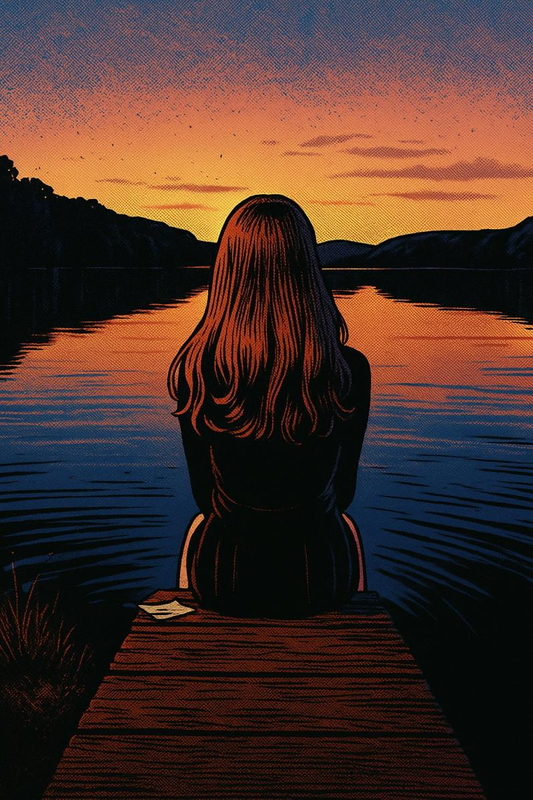
They walked slowly to the very end of the dock. The lake opened wide before them, the distant shore a soft blur, the treeline there catching the last rays of sunlight like kindling. The sky above was rippling now with color—tangerine melting into rose, then mauve, then a velvet blue just beginning to ink its way down from the heavens. A single star blinked awake.
Jennifer lowered herself first. She did it easily, legs folding beneath her as she reached out one hand behind her to steady him.
Ted followed, with effort but no hesitation. He grunted faintly, then let out a soft breath as he eased down beside her, one leg outstretched, the other bent awkwardly at the knee. He leaned back slightly, propping himself on his hands. The sunglasses stayed on. The set of his mouth had softened.
They sat in silence.
The lake lapped gently against the wooden pilings, the rhythm of the water steady and slow. In the distance, a loon called, long and low, its cry rising like a question and falling again unanswered. Somewhere farther off, the thrum of a motorboat receded until it was just a memory.
Jennifer tightened her grip on Ted’s hand, offering what comfort she could in the face of the inevitable.
"Oh Jennifer, don't cry," Ted murmured, his voice barely audible.