
Work Text:
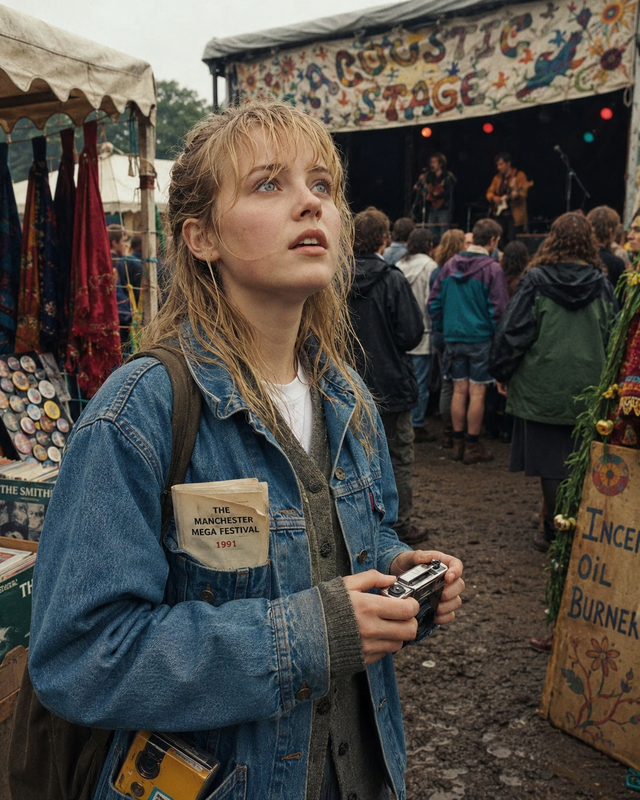
By the time Midnight vaulted onto the side stage, Chloe had already forgotten the names of the three acts before her.
All afternoon she had wandered the Manchester festival grounds in the dutiful, slightly overprepared way she did everything: folded programme in one pocket of her denim jacket, cheap camera in the other, student railcard tucked into her purse as if it might somehow be relevant in a field full of beer cups and amplifier hum. She had come with two girls from her hall who had immediately vanished toward the bigger stages and the boys attached to them. Chloe, left to her own devices, had drifted instead.
That was how she found the side stage tucked between a food tent selling chips in damp paper trays and a row of market stalls full of badges, incense, velvet scarves and second-hand records. It was smaller than the main arena, less polished, more intimate. The boards beneath the performers’ feet looked rough. The speakers were stacked unevenly. The banner above it had been painted by hand and was already curling slightly at the corners in the damp.
It was perfect.
At first she noticed the sound before she fully registered the women making it: a beat with real body to it, not tinny, not polite, not trying to ingratiate itself. Then a voice cut across it, low and commanding, and the little half-bored cluster gathered before the stage shifted as though a current had passed through them.
Midnight did not simply walk onstage. She arrived in it.
She wore oversized dark sunglasses despite the cloudy Manchester sky, and a bright headwrap that seemed to hold several colours at once—deep cobalt, hot pink, and something gold that caught even the weak light and threw it back. Her shirt was loose and bold, slashed with colour and patched symbols that Chloe could not fully make out from where she stood, but the whole effect was like seeing a mural step down off a wall and take hold of a microphone. Bangles flashed at her wrists. Big hoops moved when she laughed. Her trainers were scuffed, practical, made for movement rather than show, but she made even that look deliberate.
Beside and behind her, Luna was something else entirely. Midnight was spark and motion; Luna was tide.
She stood at the decks and then moved forward when it suited her, all fluidness and poise, with a different sort of glamour. She wore a headwrap too, but hers was rich and moonlit rather than explosive, white and yellow with indigo threaded through it, tied so that one end fell elegantly near her shoulder. Her earrings were gold and bold, her skirt long and moving around her legs like water whenever she turned. Shells shone at her throat. Her blouse bared her shoulders and seemed made for heat, for night air, for some brighter coast than this grey northern afternoon. To Chloe, who had never been farther than a family holiday in Wales and one school trip to Paris, Luna looked impossibly worldly. She looked as though she had stepped out of a place where the moon rose larger, where music began before supper and did not end until dawn.
Then Midnight started in earnest and Chloe stopped thinking in descriptions at all.
Midnight had the gift of making a crowd feel personally addressed even when there were a hundred people in front of her. She leaned into the mic and spoke in a rolling, rhythmic force that turned half-sung lines into slogans and slogans into something like prophecy. There was wit in it, bite in it, heat in it. She paced the front of the stage with the contained energy of someone who could explode the whole thing if she liked but preferred to play with the fuse. When the audience lagged, she teased them. When they gave back, she sharpened. When someone near the front whooped too loudly, she pointed and grinned and folded the sound into the set as if they had rehearsed it with her.
Luna threaded through her rather than competing. She shaped the beats, dropped in fragments of melody, added call-and-response in a voice lower than Chloe expected, a little rough and very warm. When she took the mic the tone changed without losing power. Midnight was electric; Luna was hypnotic. She seemed to know exactly how much to say, exactly when to smile, exactly when to let the music do its work. At one point she lifted a hand and the bracelets there chimed faintly beneath the bass, and Chloe felt absurdly, vividly that if she followed that gesture she might be led into some life larger than the one she knew.
Around her, the crowd thickened. A few people who had only meant to pass by stopped properly. Two girls in enormous men's jackets began to dance. A man with a shaved head and a cup of lager forgot to drink it. Somebody near the back held a cassette recorder in the air. The side stage had become, in the space of minutes, the most alive corner of the whole festival.
Chloe stood rooted, mouth slightly open, rain forgotten where it misted into her fringe.
She was eighteen, in her first year away from home, and had spent most of it doing what she had always done well: reading everything set before her, attending lectures, writing careful notes in tidy handwriting, making herself helpful in the kitchen when people were sick or hungover, laughing a little too late when other girls told stories she was still learning how to have. She was not unhappy. It was not as simple as that. But she had the persistent sensation that life was happening a pace or two ahead of her, and that she was forever arriving just after the interesting part, clutching a mug of tea.
Now, watching Midnight and Luna, she felt the odd and exhilarating shock of seeing women who were not merely living but declaring themselves while they did it.
Midnight’s set cracked with intelligence. Luna’s flowed with confidence. Their fashion was not decoration; even Chloe, who would not have put it in those words, could feel that. It belonged to them. It answered no one. It seemed to say that a woman could be bright without apology, political without dryness, beautiful without offering beauty up like a peace treaty.
By the time the final track ended, Chloe’s heart was hammering as if she had been the one onstage.
The applause on the side field was nothing like the great roar rolling over from the main arena, but it had intensity. Midnight laughed and bowed with comic grandeur, one hand across her chest. Luna blew a kiss in a slower, more gracious style that somehow felt more devastating. They exchanged a look as they came off the mic, the unmistakable look of two performers pleased with each other and with the work done.
People surged forward at once.
Chloe did not surge. Surging was not in her. She hovered.
For several minutes she stood at a distance that could, if challenged, be explained as accidental. She watched others greet them: local promoters, a zine girl with a press pass and too much eyeliner, a cluster of boys who wanted autographs on scraps of programme, a Black girl Chloe guessed was about her own age who spoke to Midnight with the fearless ease of someone accustomed to taking up room. Midnight gave everyone something. A line, a joke, a handshake, a real answer. Luna did the same more softly, tilting in to listen, smiling in a way that made people relax.
Chloe’s own courage rose and fell in miserable little tides.
Talk to them, she told herself.
Don’t be absurd, she told herself immediately after.
You’ll never see them again.
And if you do speak, what then? Hello, I’m Chloe, I’m from near Stockport, I’ve read half the books in the student union bookshop and never once looked like that in my life?
She nearly lost her nerve altogether when Midnight turned half away and reached for a bottle of water. That seemed like a closing movement, the end of access. Chloe felt the opportunity slipping and hated herself for it.
Then Luna glanced up.
Not over Chloe’s head. Not vaguely in her direction. At her.
Luna had the kind of face that seemed to register people before speaking to them, as though she took them in with unusual care. She saw Chloe standing there in her oversized cardigan, dark skirt, sturdy little shoes gone muddy at the edges, fringe blown untidy by the wet air, round spectacles slightly slipping down her nose, and whatever she saw made her mouth soften.
She touched Midnight’s elbow lightly and murmured something.
Midnight followed her gaze. Even behind the sunglasses, Chloe felt seen.
“Well,” Midnight said, raising her voice just enough to carry. “You been waiting polite as a church mouse. You coming over or are we supposed to guess what you wanna say?”
The line was teasing, not unkind. A few people nearby laughed. Chloe went hot from scalp to throat.
She went anyway.
“I’m sorry,” she said at once, which was very much the wrong opening and only made Midnight grin. “I just—I didn’t want to interrupt.”
“Baby, festival’s one big interruption,” Midnight said. “You’re all right.”
Up close, both women were even more striking. Midnight’s sunglasses were scratched a little at one edge, which somehow made them more impressive rather than less. Luna smelled faintly of something floral and clean beneath sweat and stage heat, and the shells at her throat were real shells, not plastic. Chloe wanted to remember everything and therefore could not properly look at any one thing for too long.
“You were brilliant,” she said, and heard with despair how schoolgirlish it sounded. “Both of you. I mean, really brilliant. The clothes as well. And the music. And the—the way you do it.”
Midnight barked out a pleased laugh. “The way we do it, huh?”
Luna rescued her with kindness. “That’s a sweet thing to say,” she said. Her voice was exactly as Chloe had heard it onstage—low, rough velvet at the edges, but gentler in conversation. “What’s your name, cariño?”
“Chloe.”
“Chloe,” Luna repeated, as if trying it for music. “Local?”
“Manchester. Well. Sort of just outside, really. But I’m at university here.”
Midnight tipped her head. “You got the student look.”
Chloe blinked. “I do?”
“The glasses. The careful shoes. The face like you’ve got three opinions and two apologies lined up already,” Midnight said. “I mean that affectionate.”
To Chloe’s horror, she laughed. To her greater horror, both women seemed delighted by this.
“I suppose that’s fair,” she admitted.
“There she is,” Midnight said, pointing at her. “That one was the real voice.”
Chloe looked from one to the other, dazed enough now that honesty rose more easily than polish. “I’ve never seen anyone like you,” she said. “Either of you. Not live. Not here.”
Luna’s expression shifted, not darkening, but settling into something more attentive. “Like us in what way?”
It was not a trap, Chloe understood that instinctively. It was a real question, given to her to answer properly.
“In the way you don’t seem frightened to be looked at,” Chloe said after a moment. “Though I know that sounds odd, because obviously you must be looked at constantly. But most women I see onstage here, if they get to be there at all, they’re made to seem either decorative or else they have to act as if they don’t know they’re women. You two looked—” She faltered, flushing again. “You looked completely yourselves. That’s all.”
Midnight and Luna shared a quick glance.
“Well, now,” Midnight said. “You hear that? She actually watches.”
Luna smiled. “That’s not nothing.”
Chloe found herself emboldened by that, or perhaps simply too far in to retreat gracefully. “And your outfit,” she said to Luna, then immediately wished to die. “I’m sorry, that sounds ridiculous. I only meant—it was beautiful.”
Luna laughed, not at her but around her, taking the sting out of it. “You can say my outfit’s beautiful, querida. I put it on hoping somebody would.”
“It’s beautiful,” Chloe repeated, more steadily.
“Thank you.”
Midnight leaned her hip against a road case. “And mine?”
Chloe stared at her, startled.
Midnight spread her hands. “I worked too.”
“You look incredible,” Chloe said, and that at least came out clean and true.
“There you go.”
The rain thickened briefly, then thinned again. Somewhere beyond the tents a cheer went up from the main stage. A gust carried the smell of wet grass, cigarettes and frying onions across them. The festival moved on around their little pocket, but Chloe felt improbably suspended.
Midnight took a swig of water and squinted at Chloe over the top of the bottle, or at least Chloe thought she did. “What are you studying?”
“English literature.”
Luna made an approving sound. “Ah. That tracks.”
“It does?” Chloe asked.
“You look like you’ve got opinions about novels,” Midnight said.
“I do.”
“Best one.”
“Ever?”
“Right now,” Midnight said. “Never trust anybody that answers ‘ever’ too fast.”
Chloe, because she was Chloe, actually considered it. “Jean Rhys,” she said at last. “Probably. Though I don’t know if that’s best or just nearest to hand in my mind.”
Luna lit up. “That’s a good answer.”
Midnight pointed again, triumphant. “See? Three opinions. Two apologies.”
Chloe laughed helplessly. “You make it sound like a disease.”
“Nah,” Midnight said. “Makes you interesting.”
The word landed in her with absurd force.
Luna asked her what she liked listening to. Midnight wanted to know whether student radio here was any good or just young men playing records at one another. Chloe confessed, with embarrassment, that she listened to a lot of records borrowed from libraries and friends because she could not afford to buy many of her own. She named Nina Simone, The Smiths in spite of herself, Patti Smith, some dub a second-year down the hall kept pressing on everyone, and Public Enemy, though she had only lately come to them and felt she had arrived late to understanding.
“Late’s still arrived,” Midnight said. “Don’t let anybody make timetables for your ears.”
Luna nodded. “Exactly.”
Then, because it was true and because there was no recovering elegance now, Chloe blurted, “I can’t quite believe I’m talking to you.”
Midnight’s grin softened at the edges. “Why not?”
“Because you seem…” Chloe searched. “Larger than the day.”
Luna actually clapped once, delighted. “Ay, I love her.”
Midnight laughed so hard she nearly spilled the rest of her water. “Larger than the day? Baby, that’s a line.”
Chloe covered half her face with one hand. “Please forget I said that.”
“Absolutely not,” Midnight said.
Luna leaned in a little. “You write?”
“A bit.”
“You should keep at it.”
“I’m not very good.”
“Most people worth listening to say that too early and too often,” Luna said. “It doesn’t mean much.”
Midnight nodded toward her. “She’s right. Plus, you got eyes. That’s rarer than people think.”
No one had ever said anything to Chloe that made her feel so transparent and so intact at once.
A volunteer in a plastic poncho came by to ask Midnight something about timing and passes and whether they needed escorting to another area. Midnight waved him off with practiced ease. Luna thanked him more sweetly. He left looking startled and pleased.
The interruption broke the shape of the moment a little, and Chloe felt the old panic return. They would go. Of course they would go. They were performers at a festival; they had places to be, people to meet, lives already in motion. If she wanted this encounter to be anything more than a vivid future anecdote, she had only a few seconds in which to disgrace herself properly.
Her pulse climbed into her throat.
“You probably already have plans,” she said.
Midnight made a face. “Dangerous opening.”
“But,” Chloe went on, before cowardice could seize her fully, “I’m in halls just off Oxford Road. Not far. And it’s not much, really, but I’ve got tea. Proper tea, not festival tea. And biscuits. Custard creams, I think. And some records, though now that I say that I realise that sounds terribly unimpressive given who I am saying it to. I only thought—if you didn’t have to be anywhere immediately—”
She stopped because she was certain she had ruined it.
Midnight lowered the bottle slowly. Luna’s brows rose. There was, in the suspended beat before either answered, enough room for Chloe to feel every inch of damp air against her skin.
Then Luna turned to Midnight with naked amusement. “She invited us for tea.”
Midnight pressed a hand theatrically to her chest. “That’s romance where I come from.”
Chloe went scarlet. “I didn’t mean—”
“We know what you meant,” Midnight said, kind at once. “It’s cute.”
Luna’s smile was almost unbearably lovely. “And very English.”
“I am very English,” Chloe said faintly.
“So I gathered.”
Midnight looked past her toward the field, then back. “What d’you think, Luna? We got a little time before we gotta show our faces again?”
Luna tilted her head, considering. “For tea with the student who says we’re larger than the day? I think yes.”
The yes hit Chloe with such force she almost swayed.
“Really?”
“Really,” Midnight said. “Long as you understand you’re taking responsibility for two women, one kettle, and whatever records you bragged on.”
“I wasn’t bragging.”
“Even better.”
Chloe made a helpless sound halfway between a laugh and a gasp. “Right. Yes. Of course. Yes.”
Midnight slung a bag over one shoulder. Luna gathered up a few cassettes and something wrapped in fabric. They moved with easy familiarity around each other, the unshowy kind that only came from repeated practice. Chloe stood uselessly until Luna handed her a flyer bundle to hold.
“Here,” Luna said. “Now you look employed. Less scary.”
“I’m not scared,” Chloe said, then, because both women merely looked at her, added, “I’m terrified.”
“That’s honest,” Midnight said. “I like her more every minute.”
They set off through the grounds together, cutting between puddles, past the queues for beer and toilets and the long restless streams of people heading toward louder attractions. Chloe walked slightly ahead at first from sheer nerves, then corrected herself and fell back, worried she was being rude, then worried that was also rude.
Midnight rescued her again. “Relax,” she said. “We’re not the Queen.”
“No,” Chloe said before she could stop herself. “You’re much better dressed.”
For a second there was stunned quiet. Then Luna folded over laughing, and Midnight threw her head back and cackled loudly enough that two boys with paper cups turned to stare.
“Okay,” Midnight said, delighted. “She’s staying.”
Chloe covered her face. “I don’t know why I keep saying things.”
“Because they’re good,” Luna said.
Manchester beyond the festival was slick with recent rain, all bus fumes and brick and the sodium shimmer of wet pavement. As they walked, Chloe grew marginally steadier. She told them which hall she was in. Midnight asked what the other students were like. Chloe described the girls on her corridor with enough affection and exasperation that both women laughed. Luna wanted to know whether Manchester felt like home yet or merely like where her books currently slept. Midnight asked which lecturers were frauds.
“How would I know that?” Chloe said.
“Instinct,” Midnight replied. “Always trust it before a bibliography.”
The university buildings rose around them, grimy and solid and suddenly transformed by the fact that she was approaching them with these two women at her side. Students lingering under awnings looked up. One boy on a bicycle nearly hit a curb. Chloe experienced the surreal, private pride of bringing glamour and force through institutional corridors that had previously held only wet noticeboards and earnest poster campaigns.
At the entrance to her hall she hesitated.
“It’s very small,” she said.
“Baby, we both started in rooms smaller than people’s coat closets,” Midnight said.
“And if it’s messy,” Luna added, “we will simply assume you are an intellectual.”
“It isn’t messy,” Chloe said, stung into honesty. “I tidied before the festival.”
Midnight shot Luna a look. “Told you. Student.”
The porter barely glanced up as they passed. Chloe led them up narrow stairs that smelt faintly of cabbage and carpet cleaner, then along the corridor to her room. She became acutely aware of every poster on every door, every abandoned mug on every windowsill, every sound of radios playing behind thin walls. The whole building seemed to know what she was doing.
At last she reached her door, fumbled the key once, twice, then got it in.
When she pushed it open and turned on the light, the room was exactly as she had feared and hoped: tiny, neat, unmistakably hers. Books stacked in unstable towers near the bed. An electric kettle on the sill. A line of postcards pinned above the desk. A milk crate of records on the floor. Two mugs, one chipped. A cardigan over the chair. A small vase with supermarket daisies trying valiantly to dignify the place.
Midnight stepped in first, looked around, and gave an appreciative whistle.
“Aw,” she said. “This is a good little room.”
Luna followed, warmer and quieter. She touched the doorframe lightly as she entered, then turned a slow circle, taking in the books, the records, the order of things. “It suits you,” she said.
Chloe stood in the doorway for one suspended second, taking in the sight of them there—Midnight with her bright headwrap and impossible sunglasses in the middle of a Manchester student room, Luna luminous and elegant beneath the harsh hall light, both of them real, both of them smiling at her as if this were the most natural thing in the world.
Then Midnight turned and held up the packet Chloe had nearly crushed in one hand.
“Now,” she said. “About those biscuits.”
And Chloe, still scarcely believing the evening had crossed the threshold with them, laughed and closed the door.
Chloe’s room, once it had people in it, became even smaller and somehow much better.
The kettle went on at once with a blunt little click and a rising metallic hum. Chloe moved in a flurry she hoped looked competent rather than frantic, setting out the two decent mugs and then, after a moment’s crisis of conscience, bringing out the chipped one for herself. Midnight noticed immediately and switched them around before Chloe could protest, taking the chipped mug without ceremony and dropping down onto the desk chair backwards, arms folded along the top rail.
“Oh no,” she said. “Host gets one of the good cups.”
“It really doesn’t matter,” Chloe said.
“It mattered enough that you thought about it.”
Luna, meanwhile, had settled on the edge of Chloe’s bed with the easy grace of someone who could make almost any seat look intentional. Her skirt fell around her knees like poured fabric, and she had taken off one set of bracelets and laid them carefully on the bedside table next to a stack of Penguin paperbacks. Under the hard dorm light her beauty changed shape a little; she looked less untouchable now, younger and more legible, though no less striking. She glanced at the books, then the postcards, then the milk crate of records on the floor, and gave Chloe the attentive little smile that always made her feel as though she had been read and not found wanting.
“You really do live like a literature student,” Luna said.
Chloe, crouched by the kettle with a tin of teabags in one hand, looked up. “Is that dreadful?”
“It’s adorable,” Midnight said.
Chloe tried not to glow at the word and failed.
Once the tea was made and distributed and the packet of custard creams opened with more ceremony than the occasion required, a softer shape came over the room. The rain tapped faintly at the window. Somewhere down the corridor somebody laughed too loudly, then shushed herself. A radio in another room leaked a muffled guitar line through the wall and then was turned down. Chloe’s little lamp cast a circle of amber that made her books look gentler and her walls more private. The whole place had the feeling of a paused breath.
For perhaps thirty seconds Chloe managed to simply sit on the floor with her mug between both hands and look at them in awed silence.
Midnight watched her over the rim of the chipped cup. “You got a question so big it’s backing traffic up in your head.”
Chloe nearly spilled her tea. “Have I?”
“Yes,” Luna said, amused. “Three or four, actually.”
Chloe laughed, embarrassed. “I only—well. I’ve never met anyone from New York before.”
Midnight lifted her brows. “Not one?”
“Not properly. I’ve heard Americans, obviously, but not in a room with me, and not while I could ask things.”
Midnight leaned back farther in the chair. “Well then. Go on, little professor. Ask your things.”
That permission was all it took.
“What’s it really like?” Chloe said at once. “Is it always loud? Are there really places open all night? Does the subway actually run at all hours? Is it as filthy as everyone says? Or is that just one of those things people like saying because it sounds romantic? Do people really just—meet on street corners and start things? Music, I mean, and art and all that? Is it true everybody wears black? I know that sounds silly. And is it frightening if you’re from somewhere else? Or do you get used to it? Is it lonely? Is it exciting every single day?”
She stopped only because she had run out of air.
Midnight and Luna looked at each other. Luna’s mouth was already curved. Midnight’s shoulders shook once with suppressed laughter.
“I stand corrected,” Midnight said. “That was not three or four.”
Chloe covered half her face. “I’m sorry.”
“Stop apologizing for being interested,” Midnight said, not sharply, but with enough force that Chloe actually lowered her hand. “That’s one of the better things you can be.”
Luna sipped her tea. “We can answer in shifts,” she said. “Otherwise she’ll keep us here till breakfast.”
“You say that like I mind,” Midnight said.
Chloe, hearing that, went warm all over again.
Midnight pointed at her with a biscuit. “First thing, yes, it’s loud. Even when it’s not loud, it’s loud. Sirens, trains, people arguing under your window, radios, church bells, somebody’s cousin revving something that should not be revved. You get used to sleeping with a whole city going on around you. After a while silence feels suspicious.”
“That sounds wonderful,” Chloe said.
Midnight laughed. “See? Tourist.”
“It does.”
“It’s also dirty,” Midnight went on. “Anybody telling you otherwise is lying for civic pride. There’s trash, grime, hot weather smell, cold weather slush, pigeons with bad attitudes, blocks that look tired because they are tired. But that ain’t the whole story. Sometimes people talk about the dirt like that’s all they can see because it lets them ignore the life.”
Chloe nodded earnestly, storing every word.
“The trains do run late,” Midnight said. “Not always kind, but late. There are places open all night if you know where to go. Bodegas, diners, little spots with the gate half down where they still pass you food, radio rooms, after-hours joints, church basements, somebody’s kitchen if the night’s gone long enough. New York got an afterlife to it. Whole second shift of the city you don’t really understand till you’ve been up inside it.”
“An afterlife,” Chloe repeated softly.
“Mm-hm. Daytime city and nighttime city. Sometimes they overlap. Sometimes they don’t.”
Chloe turned to Luna. “And Miami?”
Luna gave her a look over the mug. “Ah-ah. Gentle correction. I am from Miami, mi amor. Not New York.”
Chloe blinked. “Oh God. Yes. Of course. I didn’t mean—I only meant you know New York now, and you perform there, and—”
Luna laughed and waved the panic away. “I know. I’m teasing a little. But Miami and New York are not exactly next door.”
Midnight snorted. “Tell her.”
Luna leaned back against the wall, considering how to frame it. “It is like—what would make sense for you here? You asking somebody from London to speak for Paris, maybe. Or Berlin. Same ocean of modern life, yes, same world in some ways, but not the same city, not the same pace, not the same history in your bones.”
“London and Paris,” Chloe repeated. “Or Berlin.”
“Yes,” Luna said. “That kind of distance. People from outside America sometimes hear ‘city’ and think it all folds together. But the country is too big for that. Even the weather can feel like a different philosophy.”
Midnight barked a laugh. “That’s a Luna line.”
“It’s true.”
Chloe leaned forward. “Then what is Miami like?”
Luna’s face altered almost at once. Something in it loosened and deepened, as though she had opened an interior door.
“Hot,” she said first, and all three of them laughed. “Hot in a way that changes how you move. The air sits on you. Storms can roll in out of nowhere and make the whole sky look bruised purple and green. There’s salt in things. Sound carries differently. The city is full of people who came from somewhere else and brought that somewhere with them in bags, in recipes, in saints, in music.”
Chloe listened with parted lips.
“It’s not one thing,” Luna went on. “People try to sell it as beaches and postcards and foolishness, but that is never the whole truth of any place worth living in. For me, it was apartment buildings full of thin walls and too many radios. Old women talking on stoops. Church one day and something older tucked behind it the next. Port work. Heat. Men who think they run things and women who actually keep things standing. Music from everybody, everywhere. Cuban, Haitian, Black American, Puerto Rican, Dominican, Jamaican, all brushing against each other. Sometimes that creates beauty. Sometimes tension. Usually both.”
“That sounds…” Chloe searched, helplessly. “Huge.”
“It was,” Luna said simply. “Even when our apartment was small.”
Midnight gestured with her cup. “That part’s like New York too. You can grow up in a place with no room and still feel like the whole world keeps walking past your block.”
Chloe tucked one leg under herself. “Did you always know you’d leave home?”
Midnight answered first. “Leave? Yes. Belong only to someplace else? No.” She turned the chipped mug slowly between her palms. “People talk like you either stay loyal to where you’re from or you get bigger than it. That’s nonsense. I carry my neighborhood with me when I move. Some folks wear a cross, some folks wear perfume. I wear home.”
Chloe glanced at the bright headwrap, the patched jacket thrown over the back of the chair, the huge sunglasses now resting on her desk beside a battered copy of The Bell Jar, and smiled. “I can see that.”
Midnight caught the smile and returned it, smaller and warmer than the stage grin. “Good.”
Luna crossed her ankles. “I wanted more than one life,” she said. “That’s not exactly the same as wanting to leave. Sometimes girls are told those are identical.”
That landed in Chloe somewhere tender.
Midnight gave a low hum of agreement. “You can want a bigger map and still love the first street you knew.”
The room fell briefly quiet after that, the kind of silence that did not feel empty at all. Chloe broke it, as she had begun to understand she always would around them, by asking another question.
“Is New York truly full of artists?” she asked. “Or is that another story people tell because it sounds glamorous?”
Midnight sucked air through her teeth in thought. “Depends what you mean by full.”
“I suppose I mean… are there really that many people trying to make something?”
“Yeah,” Midnight said. “More than you can count. But the romantic version leaves out that most of them are also trying to pay rent, dodge cops, hold families together, not burn out. Art don’t happen in some floating cloud over the city. It happens with a landlord breathing down your neck and your cousin asking to borrow twenty dollars and your train running late.”
Luna nodded. “And the artists are not all wearing black and saying clever things in cafes.”
Chloe laughed. “I suspected as much.”
“Some are,” Luna admitted. “A few deserve to.”
Midnight grinned. “Others are making whole futures out of busted equipment in a room with one good outlet.”
That image thrilled Chloe more than any polished myth.
“Did it feel like that?” she asked. “For you, I mean. Like making a future out of whatever was there?”
Midnight’s expression sharpened, not unkindly, but with the seriousness that arrived whenever she was offered a real question and decided to honor it.
“Yeah,” she said. “A lot of the time, yeah. People think culture only counts once a label sees it or a paper writes it up. But most of the real thing happens long before anybody official gives it a stamp. Somebody’s aunt lends a room. Somebody drags speakers up stairs. Somebody records over an old tape because that’s what there is. Somebody tells the truth on air because the regular stations don’t care about your block. You build first. Legitimacy comes later, if it comes at all.”
Chloe looked at her as if she had been handed a doctrine.
Luna saw it and smiled a little. “You like that answer.”
“I do.”
“You’re storing it.”
“I am.”
Midnight pointed at her again. “That’s why I like students that still got some fire. You can see the filing cabinet opening behind the eyes.”
Chloe laughed into her tea.
Then came a flurry of smaller questions, eager and earnest and tumbling. Did people in New York really talk to strangers on the train? Sometimes. Did everyone walk fast? Yes, and if not there was probably a reason. Was the Bronx actually as dangerous as British newspapers made it sound? Dangerous, Midnight said, but not in the lazy cartoon way outsiders preferred; neglect was dangerous, landlords were dangerous, cops were dangerous, indifference was dangerous, and yet people lived there, loved there, raised children there, made jokes there, built things there. Was Miami all glamour and pastel? Luna rolled her eyes so eloquently that Chloe nearly choked on a biscuit. Had either of them ever wanted a quiet life? Midnight said, “At least twice a month, usually when I’m carrying equipment.” Luna said, “Only for one afternoon at a time.”
Chloe asked what the food was like. That set off an argument in the most affectionate register.
“New York wins on sheer range,” Midnight said. “You can eat half the world without leaving a few neighborhoods.”
“Miami wins on sunlight in the food,” Luna replied.
“That is not a measurable category.”
“It is to me.”
“That’s because you’re poetic when cornered.”
“And you’re argumentative for sport.”
Chloe sat between them on the floor, smiling so hard her cheeks hurt, feeling as though she had somehow wandered into a much better version of adulthood than the one she had seen modeled around her. Not tidier. Not safer, exactly. But bigger, brighter, more self-possessed. The thing that amazed her most was not even their glamour now. It was their ease with themselves. They contradicted each other without cruelty. They spoke from somewhere rooted. They took her questions seriously without ever flattering her for asking them.
At one point Midnight rose and prowled around the little room, drawn by the records. She knelt by the milk crate and flicked through the sleeves with reverent quickness.
“Well, look at this,” she said. “You undersold your stash.”
“It’s mostly second-hand,” Chloe said.
“Most good things are.”
Luna leaned to see. “What have we got?”
Chloe shifted around on the floor and began naming them, suddenly shy again. Nina Simone. The Clash. Joni Mitchell from her mother. Sade borrowed and not yet returned. A scratched Marvin Gaye. Some dub twelve-inch a girl downstairs insisted would improve her life. A Public Enemy record she had bought after saving for it and then hidden from her father when she went home at Christmas because she could not yet bear the predictable speech.
Midnight glanced over one shoulder. “Your father conservative?”
“Not especially,” Chloe said. “Just… provincial in a very ordinary way.”
“Sometimes that’s the stronger variety,” Luna murmured.
Chloe looked at her sharply, grateful for how precisely she had understood.
Midnight stood, holding the Public Enemy sleeve. “You like this one?”
“Yes,” Chloe said. “Though I think I’m still learning how to hear all of it.”
Midnight nodded approvingly. “That’s the right way to come to something. Too many people treat records like accessories.”
Luna’s gaze slid from the sleeve to Chloe herself. “And what do you hear in ours?” she asked.
The question was soft, but it seemed to gather the whole room toward it.
Chloe swallowed. She could have answered with compliments. She knew enough by now to know that neither woman would be especially nourished by those. So she tried to tell the truth.
“In yours,” she said slowly, looking at Luna first, “I hear… layers. Not just music, though obviously that. I hear weather. I hear the feeling of someone watching carefully before deciding where to place her voice. I hear beauty that isn’t asking permission.”
Luna went very still.
Chloe turned to Midnight, who had not moved at all. “And in yours I hear somebody refusing to let the world describe things falsely. Even when it would be easier. Especially then.”
For a moment the room held.
Then Midnight set the record sleeve down very gently on the desk.
“Damn,” she said, low.
Luna exhaled through a smile. “You really do have ears.”
Chloe looked into her lap, suddenly almost unbearably flustered. “I only mean what I mean.”
“That’s the best kind of meaning,” Luna said.
Midnight resumed her seat, but when she sat this time it was less sprawled and more intent. “All right,” she said. “Now I got one for you.”
Chloe blinked up. “For me?”
“Mm-hm. You ask all these things about New York because you’re curious, which I respect. But that ain’t the only reason.”
Chloe’s fingers tightened around her mug.
Midnight went on, not cruel, simply clear. “You ask like somebody holding the edges of her own life and trying to see how far they might stretch.”
Luna said nothing. She didn’t need to. She was watching Chloe with that same deep, moon-bright attention.
A flush climbed slowly up Chloe’s throat. “Perhaps,” she said after a long moment.
“Perhaps,” Midnight repeated, smiling.
Chloe stared at the tea in her cup. “I know Manchester isn’t small, exactly. Not really. And the university is meant to be broadening and all that. But sometimes I feel I’m only standing near things. Watching other people become themselves from a respectable distance.”
No one interrupted her. That alone made the confession easier.
“And I know that sounds melodramatic,” she added.
“No,” Luna said at once.
“It sounds eighteen,” Midnight said, equally immediate. “Which is not the same as silly.”
Chloe looked up.
Luna’s voice was warm now, but grounded. “There are ages when your life feels like a coat you haven’t grown into yet. You think that means something is wrong with you. Usually it means time is happening.”
“And sometimes it means you need better company,” Midnight added.
Chloe smiled despite herself. “I should like that on a poster.”
“I’ll make you one.”
The rain strengthened briefly outside, whispering against the glass. Chloe hugged one knee to her chest and looked from one woman to the other, the record sleeves, the biscuits, the bracelets on the table, the borrowed glamour now threaded through her own small room. The sense that this night might mark her in some lasting way had become almost tangible.
“So if I came to New York,” she asked quietly, “would it swallow me whole?”
Midnight’s answer came fast. “Not if you arrived knowing you had a self to protect.”
Luna’s came slower. “And not if you remember every city is many cities. There are people who will make you feel small anywhere. There are others who will help you grow. The trick is learning the difference quickly.”
Chloe nodded.
“You don’t have to turn yourself into somebody louder just because the world is noisy,” Luna added.
Midnight smiled crookedly. “Though a little louder wouldn’t hurt.”
That made Chloe laugh again, and this time when the laughter faded she did not feel like a child at their feet. She felt, for one fragile and lovely minute, as if she had been welcomed into a conversation she might someday earn the right to continue.
The kettle clicked in the silence after, emptying itself of heat.
For a little while the room sat inside that soft pause which sometimes comes only when conversation has already gone well and no one is performing politeness anymore. Midnight had slipped her sunglasses up into her headwrap. Without them her eyes were quicker, more expressive, more obviously mischievous. Luna sat with one bare foot tucked slightly behind the other at the edge of the bed, turning her mug by the handle in slow half-circles, listening even when she was not speaking. Chloe, cross-legged on the floor, had begun to relax enough that her shoulders no longer seemed to live permanently near her ears.
It was she, of course, who broke the quiet.
“So when did people first really start listening to you?” she asked.
Midnight tilted her head. “That depends what kind of listening you mean.”
“The real kind,” Chloe said. “Not just hearing noise because it’s loud. I mean when people understood.”
Midnight let out a sound halfway between a laugh and a sigh.
“Oh, baby,” she said. “You can fill stadiums and still have folks misunderstanding you spectacular.”
Luna smiled into her tea. “This is true.”
“No, for real,” Midnight said, already brightening with the pleasure of a story coming back to her. She shifted in the chair and set the mug down on Chloe’s desk beside a pile of library books. “Matter of fact, lemme tell you one.”
Chloe’s whole face changed. There was no hiding how much she liked being told things. She tucked her hands around her knees and looked up as if ready to receive scripture.
Midnight saw it and grinned. “Mid-eighties. Little show, hot as sin in there, one of those rooms where the walls sweat same as the people. Cheap lights, bad monitor sound, crowd packed in shoulder to shoulder. Good energy, though. Wild energy. Everybody felt like they were there for something bigger than a Friday night, even if half of them couldn’t have told you what.”
Luna gave a low hum of agreement. “I remember the kind.”
“Yeah. So I do my set. I’m talking my talk, saying what I say, got a few slogans in there, a little fire, a little history, a little righteous cussing, all the good stuff. Crowd’s with me. At least I think they are.” She spread her hands. “Afterward this young man comes up, maybe nineteen, twenty tops. Sweet face, serious eyes, real earnest. The kind of boy who thinks intensity alone can save the world.”
“University type?” Chloe asked.
Midnight pointed at her. “Exactly your species, yes.”
Chloe laughed and hid her face for a second.
Midnight went on. “He waits till the end, very respectful. Comes up all solemn, like he’s about to report for duty. And he says”—she pitched her voice lower, imitating his deep sincerity more than any specific accent—“Man, who’s this Rico chick and why’d they lock her up.” A pause, a headshake, her reminiscing impression continued. “Damn pigs, man won’t let a lady be free.”
For one beat Chloe only blinked.
Then the line landed.
She folded in half laughing.
It was not a neat laugh, not the careful social one she used in seminars or halls, but something helpless and bright and young, and it delighted Midnight enough that she laughed too, pounding once on the chair back with the flat of her hand. Luna closed her eyes briefly and shook her head with the look of someone who had loved that story for years and still did.
“Oh no,” Chloe gasped. “No. He thought—”
“He thought Puerto Rico was one woman,” Midnight said, nearly choking on her own grin. “A specific lady named Rico. Locked up somewhere. Victim of the state.”
Luna put in softly, “And he was quite upset on her behalf.”
Midnight turned to Chloe. “Homie was ready to free her personally.”
Chloe laughed so hard her glasses slipped crooked. “That’s awful. That’s—oh, that’s so earnest.”
“That’s exactly what saved him,” Midnight said. “Now, if he’d come up slick with it? If he’d been smug? I’d have roasted him till his grandkids felt it. But he was sincere. So sincere I almost didn’t have the heart.”
“Almost,” Luna echoed.
“Almost,” Midnight confirmed. “I said, sweetheart, Puerto Rico is an island. A colony. A nation. Not one imprisoned woman named Rico, though I admit that would make a hell of a concept album.”
Chloe was still laughing into one hand. “What did he say?”
Midnight’s face lit again with the memory. “He freezes. Full body freeze. Then he goes, ‘Oh. Oh, damn. I thought maybe Rico was, like… Angela Davis adjacent.’”
Luna let out a laugh at that, low and rich.
“And you know what?” Midnight said. “That sentence was so pure, so confused, so fully homemade, I couldn’t even be mad. I just told him, no baby, but you got the pigs part right.”
Chloe made a strangled sound and leaned back against the side of the bed, wiping at her eyes. “Did he die on the spot?”
“Near enough. He turned red all the way to his ears. Kept apologizing. Then, because I was made to be tested, he says, ‘Okay, but if there was a Rico chick, I’d still support her.’”
That sent Chloe off again. Luna, laughing now without restraint, put her cup down before she spilled it.
“I liked him a little for that,” Luna admitted.
“So did I,” Midnight said. “That was the tragedy. He was trying. He was just trying several blocks away from accuracy.”
Chloe pulled herself upright with effort, cheeks pink, hair a little disarranged now. “That’s the sort of thing that would keep me awake for ten years.”
Midnight gave her a look. “You say that like it ain’t happened to you already.”
Chloe pressed her lips together, trying not to smile. “Possibly.”
“Mm-hm.”
Luna looked from one to the other. “She is exactly the kind of girl who replays a conversation from five months ago and winces into a pillow.”
Chloe stared at her. “How did you know that?”
Luna only smiled.
Midnight leaned forward, elbows braced on the chair back. “But that story ain’t just funny. That’s the thing. It’s funny, yes. Lord knows I tell it for a laugh. But it’s also what happens when people get close to politics through rhythm and feeling before they get there through history.”
Chloe’s expression shifted. She was still smiling, but listening hard now.
“He wasn’t wrong that something was unjust,” Midnight said. “He just didn’t know the shape of the injustice yet. That’s common. Folks hear a cry for freedom and they go hunting for one locked room, one victim, one villain they can point at. Easier that way. Cleaner. A woman named Rico in a cell somewhere is simpler than empire. Simpler than colony status. Simpler than the long ugly business of one place deciding another place belongs to it.”
The room, which had been all laughter a moment before, settled deeper.
Chloe nodded slowly. “It makes it easier to imagine rescue.”
“Exactly.” Midnight snapped her fingers once. “That’s exactly it. Rescue is a prettier fantasy than liberation. Rescue lets you stay the hero. Liberation asks what you’re standing inside of.”
Luna watched Chloe receive that, and there was pride in her face, not only in Midnight for saying it, but in Chloe for being the sort of girl who would hear it properly.
Chloe drew one knee up again and rested her chin there. “Did people often misunderstand? In that way?”
Midnight breathed out through her nose. “Often enough. Sometimes it’s harmless and human, like little brother looking for the Free Rico campaign. Sometimes it ain’t harmless. Sometimes people hear what they can accept and cut away the rest. They’ll dance to the beat, repeat the line, love the style, and never once ask what the line is pointing at.”
“And sometimes,” Luna said, “they understand more than they admit, and pretend confusion because real understanding would demand something from them.”
Midnight glanced at her and smiled. “That too.”
Chloe looked between them. “Does that make performing political music tiring?”
Midnight thought about it for only a second. “Sometimes. But I don’t need every person in the room to arrive all at once. That ain’t how people work. Sometimes all you can do is crack a window in their thinking. Maybe they laugh later and then go look something up. Maybe they go home embarrassed and read. Maybe they remember a line next year when the news hits different. Art moves crooked. Still moves.”
Chloe nodded with a seriousness that would have been almost comical in anyone less sincere.
“I think,” she said carefully, “that’s part of what I was trying to say before. About the way you perform. It feels like you mean every part of it. Even the funny parts aren’t… evasions.”
Midnight’s face softened at once. “No, baby. Funny parts are how some truths get in the door.”
Luna made a little gesture of agreement with her fingers, elegant even in miniature. “Humor lowers the shoulders. People receive more with their guard down.”
Chloe smiled. “That makes sense.”
Midnight settled back again, though the story still had hold of her. “Anyway, I told him the basics. Puerto Rico, island. U.S. colony. Long history. Struggle older than either of us. He listened so hard I thought smoke might come off his head. Then he says, ‘Okay. So not one lady. Whole country.’”
Luna laughed. “Incremental progress.”
“And then,” Midnight said, “he goes quiet for a second and says, ‘That’s worse.’”
This time Chloe didn’t laugh first. She just looked at Midnight, eyes wide and very bright.
Midnight nodded once. “Yeah. That part stayed with me too.”
For a moment nobody spoke.
Rain whispered along the window. The radio down the hall had changed songs. Somewhere in the building a door banged and footsteps went past at speed, then faded. Inside Chloe’s room the air felt unusually alive, as though the walls themselves had leaned in to hear.
“It’s strange,” Chloe said at last. “Or perhaps not strange. But I think I understand why the story is funny and why it isn’t. He made it smaller because that was all he knew how to hold at once. But the second he understood the real size of it, he understood something morally, immediately.”
Midnight looked at her with open approval. “There she goes.”
Luna smiled. “Yes.”
Chloe ducked her head a little at being right, but went on. “It’s almost… hopeful, in a way. That he could be foolish and still basically decent.”
“That,” Midnight said, “is a very generous reading.”
“Is it wrong?”
“No.” Midnight’s grin came back, slower this time. “No, it ain’t wrong. That’s probably why I tell it with affection. Lord knows I met enough people in those days who got the facts right and the humanity wrong.”
Luna crossed one ankle over the other. “A confused ally is easier company than a knowledgeable opportunist.”
“Put that on a T-shirt,” Midnight said.
Chloe smiled, then tilted her head. “Did he ever come back to another show?”
Midnight barked a laugh. “He did! That’s the best part. Couple months later. Front row. Better informed. Still earnest. Still dressed like a pamphlet had learned to walk. After the set he comes up again and says, very serious, ‘I have done the reading.’”
Luna covered her mouth, laughing.
Chloe nearly slid sideways off the rug. “No.”
“Yes. Word for word. I have done the reading.” Midnight pressed a hand to her chest, reenacting it. “And then he asks if I got any recommendations beyond the reading because, and I quote, ‘I don’t wanna accidentally free the wrong thing.’”
Even Luna bent forward at that one, shoulders shaking.
Chloe was laughing so hard now that she had to set her mug down on the floor before she dropped it. “That poor man.”
“Nah,” Midnight said fondly. “He was all right. Embarrassment built character in him.”
Then, with the peculiar quickness that made her so compelling, her expression turned thoughtful again.
“The truth is,” she said, “a lot of people first meet radical ideas in a room where they’re also trying to feel beautiful, alive, less alone. That matters. You don’t have to split the world into serious politics over here and joy over there. Sometimes joy is the road in. Sometimes style is what makes somebody stay long enough to hear the message. Sometimes a kid comes for the beat and leaves knowing a little more about empire than he did an hour earlier.”
Chloe rested her forearms on her knees. “That makes me feel better about being drawn to all of it. The fashion, I mean. The performance. I worried that might be shallow.”
Luna answered her immediately. “Not shallow. Form carries meaning. Clothing tells truth too.”
Midnight nodded. “People always wanna pretend the surface is trivial. Surface is where lots of people first learn how power works. Who gets to shine. Who gets called vulgar. Who gets called dangerous. Who gets read as art and who gets read as threat.”
That quieted Chloe again, though not unhappily. She looked down at her own clothes, the practical skirt, the cardigan, the softening knees of her tights. Midnight followed the glance and smiled as if she knew exactly what thought had passed.
“You ain’t got to become somebody else overnight,” she said. “Don’t look at us and decide the lesson is costume. The lesson is permission.”
Luna added, very gently, “And discernment. You choose what belongs to you.”
Chloe looked up. “Permission,” she repeated.
“Mm-hm.”
She was quiet for another few seconds, then, because she could not help being herself, asked, “What did he mean by Angela Davis adjacent?”
Midnight howled.
Luna dropped her forehead briefly into one hand.
“Oh, baby,” Midnight said, wiping at one eye. “I truly do not know. I think in his mind there was a whole wing of history occupied by brilliant imprisoned women and he figured Rico lived down the hall.”
That was enough to finish Chloe off again.
The laughter this time ran longer, softer at the edges, braided now with the comfort that had settled over the room. Midnight laughed until her voice roughened. Luna laughed with her head tipped back against Chloe’s wall, one hand over her heart. Chloe laughed until she had to breathe in little gasping pulls, and there was something beautiful in the sound of all three of them together, something that made the room seem less like a student box and more like a place where a life might begin to open.
When at last it eased, Midnight reached for her tea, found it gone lukewarm, and drank it anyway.
“You know,” she said, “if Rico chick ever does exist, I hope she knows she got one very dedicated white boy in 1985 ready to storm the gates.”
“He’d bring a reading list,” Luna said.
“And probably the wrong shoes,” Chloe added.
Midnight pointed at her with delight. “There she is.”
Chloe smiled, flushed and happy and thinking faster than before. Outside, Manchester kept being wet and ordinary and itself. Inside, under the lamplight, with the mugs and the records and the rain at the glass, the world had widened again.
Time thinned in the room almost without any of them noticing.
The biscuits had been reduced to crumbs in the packet. The tea had gone through its second round and then its third, the kettle now sitting warm but temporarily forgiven on the windowsill. Chloe’s lamp made a soft amber island of the room while the rest of the hall beyond her door had sunk into the later, quieter register of student life: fewer shrieks, more muffled footsteps, an occasional burst of laughter that ended in urgent shushing. The radio down the corridor had at last gone silent. Rain still worried faintly at the window, not dramatic enough to announce itself, just persistent, like Manchester tapping its fingers on the glass.
Midnight had wound one long earring thoughtfully between her fingers while telling the end of the Rico story. Luna had shifted from the edge of the bed into a more settled lean against the wall, her skirts gathered around her, her bracelets back on now, chiming gently whenever she moved. Chloe, still on the floor but closer than before, had long since stopped sitting in the defensive posture she began the evening with. She looked mussed now in a way that became her: fringe loosened, glasses slightly smudged, cardigan sliding off one shoulder, the tidy architecture of her seriousness softened by hours of delight.
Then Midnight glanced toward the window, then at Chloe’s small alarm clock on the desk.
“Oof,” she said. “Look at that.”
Chloe followed her gaze and felt the little drop in the stomach that comes when a lovely thing reveals it has, all along, been moving toward its end.
It was later than she had thought. Much later.
“Oh,” she said, trying not to let too much of her disappointment show in the word and failing a little. “Yes.”
Luna turned her head to check the time for herself, then made a soft sound of surprise. “Ay. We really sat down in here and forgot the whole night.”
“We do that,” Midnight said. “Especially when somebody keeps asking good questions.”
Chloe smiled at that, but there was already the sadness in it, however politely she tried to hide it. The room had begun, in her mind, to divide into before and after; before they stood up, after they were gone.
Midnight saw it instantly. She always seemed to see the quick little feelings people hoped they had disguised.
“Don’t make that face,” she said.
“I’m not making a face.”
“You’re making exactly the face of a girl trying to be gracious while thinking no, wait, stay forever.”
Chloe flushed. “That is not dignified.”
“No,” Luna said warmly. “But it is sweet.”
Chloe ducked her head, laughing once in embarrassment. “I only meant… I know you must have somewhere to be.”
“We do,” Midnight said. “At some point. Hotel. Bags. A little sleep if we respect ourselves.”
“Which we do only intermittently,” Luna added.
Chloe’s eyes flicked up at that, hopeful for a moment despite herself, then lowered again. “Of course.”
Midnight rose first, stretching the stiffness out of her shoulders with a low groan of theatrical suffering. “You know what kills me? It always takes longer putting the body back together after a show than it does doing the show. Young people think you just walk offstage and continue glowing.”
“You continued glowing,” Chloe said before she could stop herself.
Midnight paused halfway through reaching for her jacket and shot her a delighted look. “See? This is why I’m spoiled in this room.”
Luna laughed, slower and richer, and stood as well. She smoothed a hand over her skirt, then over the bedspread where she had been sitting, a small absent gesture of courtesy that Chloe noticed at once and loved her for. When Luna straightened, her eyes moved over the room once more: the books, the records, the yellowed poster by the desk, the chipped paint near the window latch. She looked, Chloe thought suddenly, as though she had accepted the room as real and not merely quaint, and that touched her more than she could have said.
Chloe got up too, because the sight of them standing made it impossible to remain on the floor without feeling like a child seeing adults off. The room seemed to shrink around them once more. Their leaving had become tangible.
“Well,” she said, and hated how small the word sounded. “Thank you. For coming. I know it was only tea and biscuits and a dreadful dorm room, but I—”
“Only?” Midnight cut in. “Now why you lying on your own evening?”
Chloe blinked.
Midnight hooked her jacket over one shoulder. “This was lovely.”
“It was,” Luna said, with quiet certainty.
Chloe looked from one to the other, trying to keep the gratitude from turning embarrassingly wet around the eyes. “I’m glad.”
“You should be,” Midnight said. “You hosted beautifully. Asked smart things. Didn’t try too hard to impress us. Very rare skill.”
“I absolutely tried to impress you.”
“Yes,” Midnight said, “but with your actual self. Better.”
That was nearly enough to finish Chloe on the spot.
Luna had wandered toward the desk now, where one of Chloe’s record sleeves still lay out from earlier. She touched the corner of it, then glanced toward Midnight, and something passed between them in that quiet, practiced way they had. Not secretive, exactly. More like two musicians hearing the same note and recognizing it.
She turned back to Chloe.
“Well,” Luna said, “we could stay.”
Chloe stared.
Midnight, halfway through adjusting her headwrap in the reflection of the dark window, looked over. “Could we now?”
“We could,” Luna said mildly. “We are not due at the airport until late tomorrow. We only need enough sleep to remain charming, which is not such a high threshold for us.”
Midnight’s grin broke immediately. “Speak for yourself. I require a full scientific restoration.”
Chloe was still staring, processing. “Stay?”
Luna smiled at her in that luminous way that always seemed half affectionate, half amused. “Here, I mean? Not exactly.” Her gaze flicked around the room, taking in the single narrow bed and the obvious mathematics of space. “Though I admire your hospitality, querida, your university did not design this place with three women in mind.”
Chloe let out the laugh she had been holding in pure nervous surprise.
Midnight perched against the edge of the desk. “No, this room got one saint, one sinner, and maybe a handbag’s worth of margin.”
Chloe made a helpless sound. “I’m sorry, I don’t know why that’s so funny.”
“Because it is,” Midnight said.
Luna folded her arms lightly, bracelets chiming. “What I was about to say, before she got theatrical, is that it might be easier the other way around.”
Chloe’s brows knit. “The other way?”
Luna tipped her head toward Midnight, then toward the little pile of cassettes and notes they had brought in with them and half forgotten on the desk. “You have asked a hundred questions tonight about how things begin. How sounds become songs. How rhythm becomes structure. The foundation of a track is easier to show than describe.”
Chloe’s eyes widened at once. “You mean—”
“I mean,” Luna said, enjoying her now, “that if you were capable of committing a small and survivable act of delinquency and breaking whatever curfew your hall imagines it has over you, we could bring you to the hotel and show you properly. Much easier than dragging our machine all the way back here.”
There was a brief silence in which the rain at the window seemed suddenly much clearer.
Chloe stared from Luna to Midnight and back again.
“My hall doesn’t exactly—” she began, then stopped, because that was the least interesting part of what she wanted to say. “You mean now?”
Midnight pushed herself off the desk, all bright mischief again. “That’s how time works, baby.”
Chloe laughed once, almost incredulous. “Your hotel?”
Luna nodded. “Only for a little while. To show you. Not to keep you till dawn unless you prove unusually useful.”
Midnight widened her eyes solemnly. “Can you carry crates? Coil cables? Brew tea under pressure? These are the real questions.”
“I can absolutely brew tea under pressure.”
“There,” Midnight said. “She passes the first test.”
Chloe was smiling so hard now she looked almost dazed by it. All the sadness of parting had vanished so quickly it left her lightheaded. “I—yes. I mean, if you truly don’t mind. I’d love to. God, I’d love to.”
Luna’s smile deepened, pleased not merely by the answer but by the nakedness of it. “Good.”
Then Midnight made a little considering noise and pointed upward toward the faint tapping at the window.
“And,” she said, “we have been warned about the British weather.”
Luna nodded gravely, matching the bit at once. “Extensively warned.”
“Repeatedly.”
“In ominous terms.”
Chloe laughed. “By whom?”
“Everybody,” Midnight said. “Everybody over here talks like the sky is personally against them.”
“That’s because sometimes it is,” Chloe said, still grinning.
Midnight jabbed a finger at her. “See? Local confirmation.”
Luna added, in mock-conspiratorial softness, “So really we are making a practical decision. Safer to move once, to one hotel, than carry pieces of equipment back and forth while Manchester debates whether to become a river.”
Chloe looked toward the window as if the city itself had just been accused in her presence. “That’s not entirely unfair.”
“There,” Midnight said again. “Case closed.”
Chloe should, probably, have hesitated longer. She was eighteen. She was a good student. She did not usually vanish into the Manchester night with glamorous musicians she had met only hours before, however kindly they had treated her and however much every instinct she possessed insisted this was not danger but invitation of the rarest sort. Somewhere in her upbringing, a whole committee of sensible voices rose to object.
They were no match for the sheer radiance of what was being offered.
“You know,” she said, trying for composure and not quite reaching it, “I think I can probably survive one act of delinquency.”
Midnight clutched at her own heart. “Listen to that. We’re corrupting youth.”
“Youth was clearly waiting to be corrupted,” Luna said.
“I was not,” Chloe said, then, because both women simply looked at her, laughing already, she broke and admitted, “Well. Perhaps very slightly.”
“That’s honest,” Luna said.
Midnight was already scooping up the cassettes and tucking them into her bag with quick, practiced motions. “All right then. Coat, keys, anything you need to keep the porter from thinking we abducted you.”
Chloe, suddenly all motion again, snatched up her cardigan properly, then realized she was already wearing it, then reached instead for her jacket hanging behind the door. Her hands had gone clumsy with excitement. She checked instinctively for her purse, then her student ID, then her room key as if she were preparing for a minor expedition rather than a walk to a hotel with two women who had, in the span of one rainy night, made the world feel thrillingly unstable in the best possible direction.
“I should leave a note,” she said, mostly to herself.
Midnight paused. “For who?”
“My friend in the next corridor. In case—”
“In case you elope with rhythm?” Midnight asked.
Chloe gave her a look that was very nearly bold now. “In case I’m not back before morning and she decides I’ve been murdered by philosophy students.”
Luna laughed, delighted. “Leave the note.”
So Chloe scribbled one quickly on the back of a reading list and slid it under the neighboring door: Gone out, safe, don’t panic, will explain tomorrow. She did not sign it with anything dramatic because she was still Chloe, but the act alone thrilled her. When she returned, both women were waiting by the door as if this were the most natural next movement in the world.
Midnight looked her up and down. “You ready?”
Chloe drew a breath. “Yes.”
Luna opened the door first. Cool corridor air slipped in. The hall beyond was dimmer than before, lined with battered noticeboards and sleeping silence. Somewhere downstairs a television muttered behind a porter’s desk. The building felt half-dreaming already, indifferent to the small revolution taking place inside one of its rooms.
As Chloe stepped out and pulled her door closed behind her, she had the brief, uncanny sensation of crossing a threshold twice: once into the corridor, once into some future self she had only glimpsed at a distance until now.
Midnight saw the look on her face and smiled, softer than usual.
“Don’t worry,” she said as they started down the hall. “We’re just gonna show you how a track gets built.”
Luna glanced over one shoulder, eyes bright. “And maybe,” she said, “how a night gets longer when you say yes to it.”
Chloe followed them into the late Manchester hush with her heart beating high and bright, the rain waiting outside, the city wet and open before them, and every part of her eager for whatever came next.