Work Text:
Harbour Patrol 1978
Delaney’s first credited feature role was small enough that later publicity frequently exaggerated its importance. Harbour Patrol was a modest Canadian-American crime drama set around Vancouver’s industrial waterfront. The protagonist was a middle-aged customs officer investigating the disappearance of cargo from container yards, while Delaney appeared as Erin Walsh, a junior harbour-security officer working irregular night shifts.
Erin had fewer than fifteen minutes of screen time, but the part gave Delaney several qualities that would recur throughout her career. She wore practical uniforms rather than fitted costumes, carried herself with authority despite being far younger than most of the male cast, and was allowed to behave competently without receiving a romantic subplot. Her most substantial sequence involved discovering two smugglers inside a storage facility and attempting to contain them alone until backup arrived. Rather than defeating both men effortlessly, Erin used gates, alarms and the geometry of the yard to prevent their escape.
One of the smugglers eventually knocked her down and escaped, but Erin had already recorded enough information to identify the vehicle used in the operation. The film’s director later admitted that the sequence had originally been shorter. Delaney’s physical confidence encouraged him to expand it during shooting.
The picture received limited theatrical distribution, but Delaney attracted favourable attention among casting directors who needed women capable of action without seeming conspicuously cast against type.
The Fifth Passenger 1978
Released only months later, The Fifth Passenger was a claustrophobic road thriller about five strangers stranded after a bus broke down during a winter storm in the mountains of Washington State. Delaney played Marcie Bell, a young mechanic travelling home after seasonal work.
The film’s premise gradually revealed that one passenger was carrying evidence connected to a political corruption investigation and that two others had been sent to recover it. Delaney was not the lead, but Marcie became essential because she understood the damaged vehicle better than anybody else and refused to allow the group’s increasingly frightened older men to dictate decisions they did not understand.
Her role was more verbal than Harbour Patrol and gave an early indication of Delaney’s natural screen rhythm. Marcie was not witty, flirtatious or aggressively confrontational. She simply spoke when she had something worth saying and ignored attempts to provoke her.
The climax required Marcie to crawl beneath the bus during worsening weather and reconnect damaged electrical equipment while one of the killers searched nearby. Delaney performed much of the sequence herself in freezing artificial rain and melting snow.
Southbound 1979
Southbound was Delaney’s first substantial thriller and the earliest film in which critics began identifying her as an unusual physical presence. She played Dana Harker, an itinerant motorcycle courier travelling from Oregon toward California who becomes entangled in the aftermath of a rural bank robbery.
Dana is initially interested only in continuing south. She is neither a police officer nor an idealist. When she discovers an injured teenage witness hiding near an abandoned service station, however, she realizes the surviving robbers are searching for him and cannot simply ride away.
The film follows Dana and the boy through a sequence of increasingly desperate attempts to evade armed pursuers across small towns, logging roads and dry agricultural country. The motorcycle became central to Delaney’s emerging image. Unlike many contemporary films in which motorcycles functioned as symbols of masculine rebellion, Southbound treated Dana’s machine as transportation, shelter, weapon and practical tool.
Delaney’s fighting style in the picture was notably inelegant. Dana kicked knees, used doorframes, threw dirt into faces and once escaped a larger man by trapping his hand inside a truck door. The roughness distinguished her from female characters whose action scenes were often staged around agility or novelty.
Southbound performed better than expected at regional box offices and began circulating widely through television syndication.
Winter Static 1979
Winter Static was an ensemble espionage drama set during an international communications conference in Montreal. Delaney played Lena Cross, a young technician responsible for maintaining secure communications facilities used by several delegations.
The plot revolved around falsified digital documents inserted into diplomatic networks in an effort to manufacture evidence of secret negotiations between rival governments. Rather than treating electronic communication as mysterious, the film assumed viewers understood the basic premise immediately. The suspense came from authentication, access permissions and the difficulty of determining which version of a document had originated where.
Lena gradually realizes that someone has been using maintenance privileges to alter transmission records. Her investigation places her in conflict with professional intelligence officers who initially regard her as a technician rather than a participant in their world.
The film contained little conventional action until its final half hour, when Lena is pursued through service corridors beneath the conference complex. Delaney’s ability to make running, hiding and exhaustion feel physically credible impressed director Wesley Barr, who would later cast her in a much larger role.
Broken Ground 1980
Broken Ground was Delaney’s first western-adjacent picture, though it was set in contemporary Montana rather than the historical frontier. She played Hannah Keel, a surveyor caught between a mining company and residents of an isolated valley whose water supply has been contaminated.
Hannah begins the film as an employee of the corporation responsible for the damage. She is not secretly virtuous from the beginning. She knows the company cuts corners and has learned to rationalize it as normal industry behaviour. The story becomes a gradual confrontation with the consequences of that complacency.
The action emerges from corporate intimidation rather than organized crime. Vehicles are sabotaged, survey data disappears from shared systems, and residents who attempt to transmit photographic evidence outside the valley discover their communications being intercepted.
Hannah’s physical competence is practical rather than heroic. She understands terrain, machinery and explosives used in controlled demolition. In the final act she uses that knowledge to prevent company contractors from destroying a pumping station that contains evidence of groundwater contamination.
The role expanded Delaney’s dramatic range and was the first film in which she carried long stretches without another major star beside her.
City of Ash 1980
City of Ash was a grim urban police drama in which Delaney played Detective Mara Quinn, newly transferred into an arson investigation unit after several years in uniform.
Mara investigates a series of suspicious warehouse fires initially attributed to insurance fraud. She gradually uncovers a network involving property developers who are deliberately destroying buildings in neighbourhoods marked for redevelopment.
The film gave Delaney her first extended firearms sequences but resisted transforming Mara into a supercop. She spends more time examining maps, reviewing building records and interviewing displaced tenants than chasing suspects.
Its most remembered action sequence occurs inside a burning printing warehouse. Mara enters against orders because she believes a missing employee remains trapped inside. The scene lasts almost ten minutes and emphasizes heat, smoke, confusion and deteriorating visibility rather than spectacular flames.
Delaney’s performance drew attention for its refusal to sentimentalize Mara. The character cared deeply about victims but rarely articulated that concern. Her morality emerged through persistence.
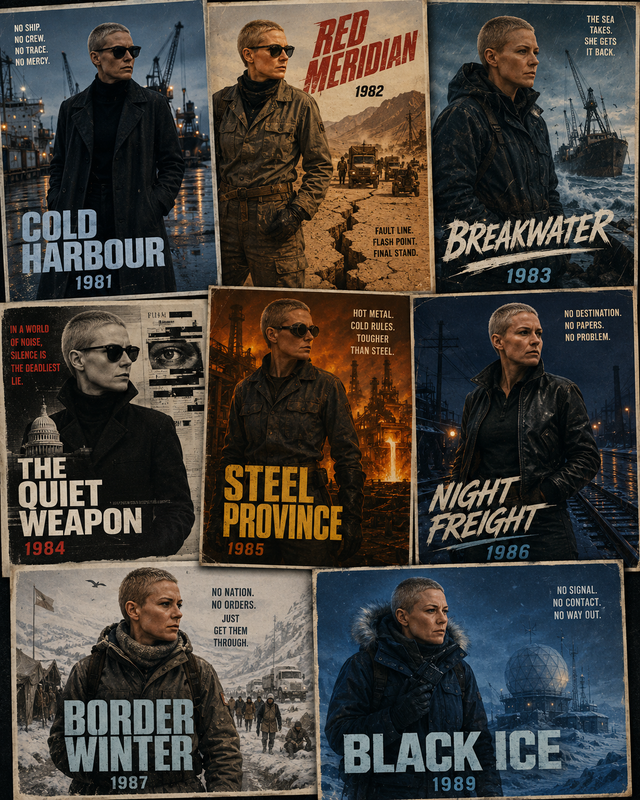
Cold Harbour 1981
Cold Harbour became Delaney’s breakthrough.
She played Maeve Callan, a customs investigator based in Seattle who discovers irregularities involving small shipments moving repeatedly between Pacific ports. What appears initially to be mundane customs fraud gradually reveals an arms-smuggling operation using legitimate industrial cargo as cover.
Maeve is introduced halfway through an ordinary workday without a dramatic entrance. She checks paperwork, argues over container numbers and notices that several shipments have been rerouted through ports that make no logistical sense.
The film’s strength lies in how slowly Maeve builds the case. She uses customs records, shipping databases, port photography and direct observation, increasingly convinced that information has been manipulated inside the network itself.
When the smugglers realize she is close, the film transforms from procedural to action thriller. Maeve survives an attempted abduction, escapes through an automated cargo facility and follows a shipment onto a coastal freighter before authorities can intervene.
The final confrontation aboard the ship established much of Delaney’s later action persona. Maeve is outnumbered and physically battered. She does not suddenly become stronger than every opponent. She uses machinery, narrow corridors, locked compartments and the ship’s own movement to survive.
Cold Harbour became an unexpected commercial success and transformed Delaney from a respected working actress into a bankable lead.
Signal Loss 1981
Made before Cold Harbour became a hit but released afterward, Signal Loss benefited enormously from Delaney’s suddenly higher profile.
She played Teresa Venn, an investigative journalist examining the disappearance of a colleague who had been researching corruption in a multinational telecommunications company.
The film used the increasingly interconnected information environment of the Harbour Lights world as both setting and threat. Teresa understands that deleting information from one machine means little when copies can already exist across several networks. The corporation’s strategy is therefore not simple suppression but contamination: introducing altered documents, contradictory photographs and false accounts until nobody can easily establish which evidence is authentic.
Teresa follows the trail between Los Angeles, San Francisco and Vancouver, gradually discovering that her missing colleague deliberately distributed pieces of evidence among dozens of unrelated people.
The film’s climax occurs not inside a computer facility but at a broadcast station where Teresa attempts to make the evidence public while private-security contractors close the building around her.
Red Meridian 1982
Red Meridian was the film that confirmed Cold Harbour had not been a one-off success.
Delaney played Captain Elise Varga, a former military logistics officer employed by an international disaster-relief organization. She arrives in a fictional Central American country following a devastating earthquake and discovers that relief shipments are being diverted by military officials and private contractors.
Elise is initially determined to remain politically neutral. Her responsibility is to move food, medicine and equipment. The film gradually strips away the possibility of neutrality as she realizes supplies are being deliberately withheld from regions associated with opposition movements.
The action is grounded in logistics. Elise commandeers trucks, reorganizes fuel allocations, manipulates warehouse inventories and eventually leads a convoy through territory where both government forces and armed opposition groups assume she is working for the other side.
The climax consists of a long convoy sequence through mountain roads rather than a conventional shootout. Delaney performs much of the driving herself.
Red Meridian was a major international success and established her as an action star whose films could carry political subject matter without sacrificing momentum.
Dead Channel 1982
Dead Channel cast Delaney as Jo Avery, a former competitive swimmer working as a technical diver for a telecommunications company repairing underwater cable infrastructure along the Pacific coast.
After a maintenance vessel discovers deliberate damage to a major communications route, Jo becomes convinced someone is testing how quickly regional network traffic can be disrupted and rerouted.
The premise reflects the mature communications environment of the setting. Severing a cable cannot simply isolate an entire city because redundancy already exists. The attackers are instead studying traffic behaviour, learning where communications automatically migrate after damage.
Jo eventually realizes the disruptions are preparation for a coordinated theft involving financial networks.
The film became famous for underwater sequences in which Delaney performed unusually demanding physical work. Jo spends the final act trapped inside a partially flooded coastal relay station as the perpetrators attempt to destroy evidence.
Dead Channel further developed Delaney’s association with physical endurance rather than flamboyant combat.
Breakwater 1983
Breakwater was a violent coastal thriller and the first Delaney picture deliberately marketed around her name alone.
She played Rowan Pike, a former Coast Guard rescue specialist who now operates a small salvage boat off northern California. Rowan discovers an abandoned yacht after a storm and finds evidence suggesting several passengers were removed before the vessel was deliberately set adrift.
Her decision to investigate draws her into a smuggling operation involving stolen pharmaceuticals and medical equipment.
Rowan is one of Delaney’s most physically imposing characters despite being written as relatively solitary and introverted. She knows boats, diving equipment, engines and coastal weather intimately.
The film’s signature sequence has Rowan pursued through a shipbreaking yard after dark. She rarely fights directly. She climbs cranes, crosses suspended walkways, drops between hull sections and uses machinery to divide her pursuers.
Breakwater became one of the highest-grossing thrillers of 1983 and cemented Delaney’s public image in boots, heavy jackets and practical work clothing.
Hard Country 1983
Hard Country was more austere.
Delaney played Ruth Mercer, a state investigator sent into an isolated desert county after three apparently unrelated deaths involving migrant agricultural workers.
The local authorities dismiss the cases as accidents. Ruth quickly discovers that all three victims had worked for the same labour contractor.
The film deliberately deprives her of technological advantage for much of its running time. Records exist electronically, but the contractor operates through informal arrangements, cash payments and undocumented transportation precisely to remain outside normal systems.
Ruth must therefore conduct old-fashioned field investigation, following vehicles, visiting farms and persuading frightened workers to trust her.
The final thirty minutes take place almost entirely at an abandoned agricultural processing facility where Ruth confronts the contractor and his armed employees.
Hard Country received less commercial enthusiasm than Breakwater but stronger critical reviews, particularly for Delaney’s restrained performance.
North Line 1984
North Line took Delaney into colder, larger-scale territory.
She played Sofia Rane, an engineer overseeing construction of a railway and communications corridor through remote northern Canada. When equipment failures begin causing deaths, Sofia suspects sabotage rather than incompetence.
The investigation reveals a complicated struggle between corporate interests, regional political actors and an organized-crime group attempting to gain control over transportation contracts.
Sofia is explicitly an engineer before she is an action protagonist. Delaney spent months learning enough terminology and procedural detail to make her comfortable around surveying equipment, heavy machinery and construction plans.
The film contains one of her most famous set pieces: Sofia driving a maintenance vehicle along an unfinished railway during a blizzard while attempting to reach a trapped work crew before saboteurs can destroy a bridge.
North Line marked the beginning of Delaney’s most commercially dominant period.
The Quiet Weapon 1984
The Quiet Weapon was an espionage thriller built around information warfare rather than military hardware.
Delaney played Adrienne Holt, a government analyst investigating a coordinated series of forged photographs, altered recordings and fabricated documents appearing across international networks.
The film’s central idea was that sufficiently sophisticated disinformation could create the appearance of political events that had never happened. In Harbour Lights’ technologically advanced media environment, this was treated less as speculative science fiction than as an extension of existing concerns about authentication.
Adrienne spends much of the film tracing inconsistencies between versions of supposedly identical visual records.
Once she identifies the source, she is targeted by the private intelligence organization responsible.
The film includes relatively little action during its first hour, making the sudden physical violence of its final act particularly effective. Adrienne is forced from an office building into downtown Washington and eventually into a network-distribution facility where she attempts to preserve original records before they are overwritten.
The Quiet Weapon became one of Delaney’s most discussed films because its premise continued to feel relevant long after release.
Steel Province 1985
Steel Province became Delaney’s signature film.
She played Mara Voss, an industrial investigator sent to examine a series of fatal accidents across a vast steel-producing region in Pennsylvania.
Mara discovers that the accidents are connected to organized theft, corruption inside local government and deliberate safety failures hidden through falsified inspection data.
The film’s visual identity was dominated by furnaces, rail yards, warehouses, smoke, rain and enormous industrial spaces. Delaney spends most of the picture wearing work boots, dark trousers, undershirts, jackets and protective equipment.
Mara is quiet even by Delaney-character standards. Much of her thinking is communicated through observation rather than dialogue.
The celebrated central sequence takes place inside an operating steelworks after Mara is discovered copying records. She spends nearly twenty minutes attempting to escape without firing a weapon. Conveyor systems, maintenance ladders, gantries, heat, steam and moving machinery become the landscape of the chase.
The climax pits Mara against the operation’s leader inside an abandoned rolling mill. The fight is prolonged, ugly and exhausting. Delaney’s character is knocked down repeatedly and wins largely because she refuses to stop getting up.
Steel Province became a cultural phenomenon and established the template most strongly associated with Delaney.
Blackwater Road 1985
Released later the same year, Blackwater Road was smaller and stranger.
Delaney played Claire Rourke, a former military driver transporting confidential medical material across Louisiana after severe flooding disrupts normal routes.
Claire discovers that the cargo is not what she was told and that several groups are attempting to intercept the vehicle.
Most of the film consists of road travel through flooded communities, temporary bridges and damaged infrastructure.
Claire is accompanied by a nervous young medical researcher who understands the scientific importance of the cargo but has no field experience. Their relationship is deliberately non-romantic.
The film’s action revolves around vehicles, changing routes and environmental hazards rather than shootouts.
Blackwater Road was initially overshadowed by Steel Province but later developed a strong following.
Night Freight 1986
Night Freight reunited Delaney with director Wesley Barr and became one of her largest commercial successes.
She played Cass Arden, a railway-security specialist investigating theft from high-speed freight routes across the American Midwest.
The stolen cargo initially appears random until Cass realizes specific electronic components are being assembled into larger systems elsewhere.
The investigation leads to a mobile criminal operation using legitimate freight schedules and networked cargo-management systems to predict when valuable shipments will be least protected.
Cass spends much of the film moving between trains rather than remaining in one city.
The action sequences are among the most ambitious of Delaney’s career. She crosses moving freight cars, climbs maintenance ladders beneath bridges and fights inside narrow locomotive compartments.
The film’s final sequence involves two trains moving parallel through an industrial rail corridor while Cass attempts to prevent a hijacked freight unit from entering a densely populated terminal.
Night Freight became a defining action picture of the decade.
Glass Circuit 1986
Glass Circuit was considerably more cerebral.
Delaney played Dr. Tessa Kline, a computer-security specialist brought into a financial institution after a series of apparently impossible transfers.
The film presents computer crime as procedural rather than magical. Tessa does not type furiously until a secret screen appears. She reviews access histories, studies behavioural patterns, interviews staff and gradually recognizes that the system itself is functioning correctly. The crime depends on manipulating trusted human operators.
The antagonist is a former security architect who understands institutional habits better than technical vulnerabilities.
The physical danger begins only after Tessa identifies him.
The climax unfolds across a modern office complex whose automated access systems are progressively turned against her.
Glass Circuit was praised for avoiding the sensationalism common to computer-focused thrillers and became particularly popular among technically literate audiences.
Border Winter 1987
Border Winter was Delaney’s most overtly political action film.
She played Lena Ward, an aid coordinator working along a fictionalized northern border during a severe winter refugee crisis.
Lena is responsible for organizing shelters, food transport and medical movement while governments on both sides argue about jurisdiction.
The antagonist is not initially a single villain but a combination of organized smugglers, corrupt officials and opportunists exploiting displaced people.
Lena becomes involved after discovering that refugees are being deliberately redirected toward dangerous routes so traffickers can profit from transportation.
The film contains long stretches devoted to logistics and human movement. Action emerges organically from those responsibilities.
Its most famous sequence follows Lena leading a group across frozen terrain after their vehicle convoy is sabotaged. There is no music for several minutes, only wind, footsteps and breathing.
Border Winter was nominated for numerous awards and marked Delaney’s arrival as a performer critics could no longer dismiss as merely an action specialist.
Zero Hour City 1987
Zero Hour City was Delaney at her most conventionally blockbuster.
She played Lieutenant June Kessler, a metropolitan emergency-response commander attempting to contain coordinated attacks against transportation and communications infrastructure.
The attackers are trying to produce cascading failures across a major American city by exploiting dependencies between systems.
Because Harbour Lights infrastructure is already extensively networked, the film understands that disabling a single system is insufficient. The threat comes from simultaneous disruptions designed to overwhelm redundancy.
June spends the film moving between command centres, streets, transit tunnels and utility sites while refusing demands that she prioritize politically important districts over more vulnerable neighbourhoods.
The final act involves a race to prevent deliberate flooding inside a transit interchange beneath downtown.
Zero Hour City became Delaney’s biggest financial success to that point.
Under Red Light 1987
Shot between larger productions, Under Red Light was an unusually intimate crime film.
Delaney played Vivian Shaw, a homicide detective investigating the murder of a sex worker whose death has been dismissed by senior officers as unimportant.
Vivian gradually uncovers connections between the murder and a private club frequented by politicians, business executives and police officials.
There is very little action until the final twenty minutes.
The film’s strength comes from Vivian’s relationships with witnesses who distrust the police and her growing realization that her own badge offers less protection than she assumes.
Delaney’s performance is almost entirely internal. Vivian rarely raises her voice and never delivers a grand speech about corruption.
Under Red Light became one of her most critically celebrated films despite modest box-office performance.
The Last Highway 1988
The Last Highway became the largest production of Delaney’s career.
She played Rebecca Dane, a federal transport investigator examining a series of attacks against autonomous and computer-assisted freight systems operating along major interstate routes.
The film’s villains exploit centralized scheduling information to create collisions, theft opportunities and regional shortages.
Rebecca initially believes the attacks are financially motivated but discovers they are intended to demonstrate how dependent modern society has become on coordinated infrastructure.
The picture moves across several states and contains enormous vehicle sequences involving trucks, motorcycles, maintenance convoys and emergency vehicles.
Its celebrated centrepiece has Rebecca riding a motorcycle alongside a damaged automated freight vehicle to reach its manual control access before it enters a populated interchange.
Delaney performed substantial portions of the riding herself.
The Last Highway became one of the decade’s defining action films and made her internationally recognizable even among audiences who had never seen her earlier work.
White Noise 1988
White Noise was a paranoid media thriller in which Delaney played Evelyn Marr, a television producer who discovers that a series of supposedly spontaneous news events are being deliberately staged to influence financial markets.
Evelyn is not a reporter. She works behind the scenes coordinating feeds, verifying material and deciding what reaches broadcast.
Her professional expertise makes her notice repeated technical similarities between footage supposedly originating from unrelated places.
The investigation exposes a consortium using fabricated visual material and planted eyewitness accounts to manipulate public perception for hours at a time, long enough to move markets before corrections appear.
The concept reflects a world in which images circulate quickly and audiences already understand that speed can outrun verification.
White Noise features relatively little physical combat. Its most memorable sequence has Evelyn trapped inside a television facility while falsified emergency information continues being transmitted around her.
Burn Line 1988
Burn Line returned Delaney to stripped-down physical action.
She played Kate Sloan, a wildfire investigator examining several suspicious fires across northern California.
Kate discovers that the fires are connected to land speculation. Developers are deliberately creating destruction in areas where ownership and rebuilding rules can subsequently be manipulated.
The film was shot extensively on location under controlled conditions and placed Delaney in some of the most physically punishing environments of her career.
Kate spends the final act attempting to evacuate residents from an isolated mountain community after the conspirators intentionally ignite another fire to destroy evidence.
The villain dies not in a fight with Kate but because he misjudges the fire itself.
Burn Line was praised for refusing to make nature behave like a convenient action-movie backdrop.
Black Ice 1989
Black Ice became the most important film of Delaney’s final year.
She played Morgan Vale, a private military contractor and former intelligence operative hired to recover stolen classified materials from a criminal group operating across Alaska and western Canada.
Morgan is the darkest protagonist Delaney ever played.
She is competent, disciplined and frequently ruthless. The film never reveals a hidden moral innocence beneath her profession. Morgan has done things she regrets and others she does not.
Her mission becomes complicated when she learns the stolen information contains evidence of illegal intelligence operations carried out by the same people who hired her.
Morgan must decide whether to complete the contract or expose her employers.
The action is severe and sparse. Snow, darkness and isolation dominate the film.
The final confrontation occurs at an abandoned radar station where Morgan deliberately destroys the material she was hired to retrieve after distributing copies of the incriminating evidence through multiple networks.
Black Ice became one of Delaney’s most acclaimed performances and seemed at the time to signal a transition into more complex dramatic roles.
Instead, it became one of her last films.
Long Division 1989
Long Division was a tense financial thriller directed by Ellen Marwick.
Delaney played Nora Bell, an auditor investigating irregularities inside a multinational construction company whose financial records appear perfectly balanced.
Nora discovers that the fraud is not hidden by deleting information but by fragmenting transactions across hundreds of subsidiaries and jurisdictions until no single record appears suspicious.
The story follows her assembling relationships between otherwise ordinary pieces of data.
The danger escalates when company executives realize she has identified the pattern.
Long Division contains only two major action sequences, but both are memorable. Nora survives an attempt to force her car from a mountain road and later escapes from a corporate archive facility after security systems are turned against her.
The film demonstrated Delaney’s continued interest in protagonists whose intelligence mattered as much as their physical ability.
Western Terminal 1989
Western Terminal was the final film Delaney completed before stepping away.
She played Joan Merrick, director of operations at a massive Pacific transport terminal where ships, freight trains, road vehicles and air cargo converge.
A labour dispute coincides with a sophisticated theft operation exploiting confusion created by changing schedules.
Joan initially assumes the missing cargo is simply part of the disruption. She gradually discovers that the thieves have spent months studying how the terminal reacts to delays and are manipulating its automated management systems to create temporary blind spots.
The film combines procedural detail with large industrial action in a way that deliberately echoed Cold Harbour and Steel Province.
Joan is older and more administratively powerful than most of Delaney’s previous characters. She commands hundreds of workers and spends much of the film delegating rather than physically intervening.
Only when the terminal is partially locked down does she become directly involved.
The final sequence follows Joan crossing cranes, container stacks and maintenance bridges while coordinating police and workers through portable communications.
Her last scene is strikingly undramatic. Joan returns to the control room after sunrise, takes off her damaged jacket, sits at her desk and begins reviewing the morning schedule.