
Work Text:
7.
“Come on.”
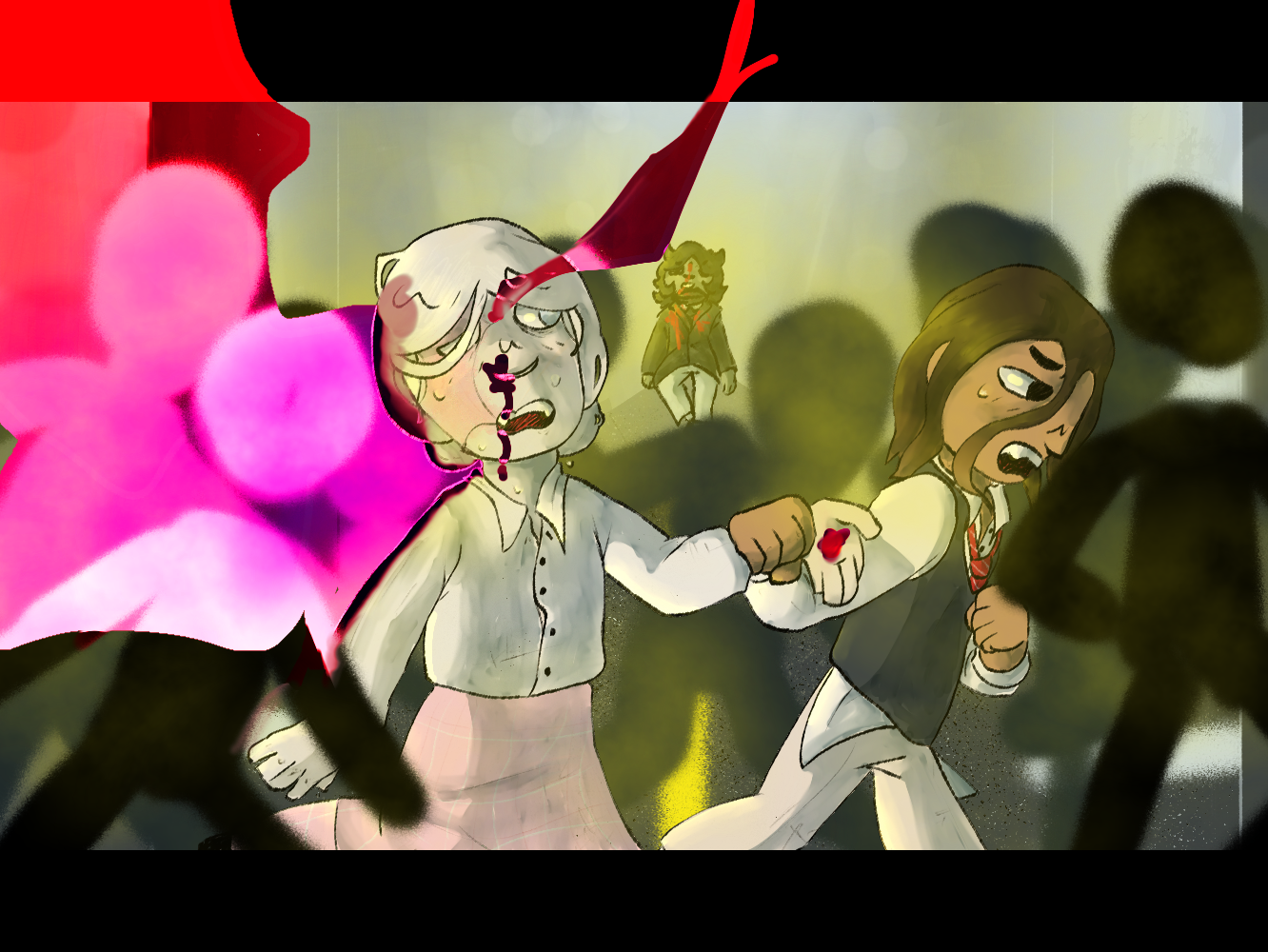
He was crying, voice crushed with tears, and she could taste pops of smoke in her mouth like the scales of some acrid snake. Her feet did not feel like her own, the rough concrete rubbing her soles raw. Her shiny work shoes were long gone, the hems of her slacks run ragged. She could feel every step reverberate up her thighs and dig their claws into her spine. Her elbow ached. Her heart had clambered out of her chest and sat, quivering, in the base of her throat.
Master Vi’s fingers were knotted through her own and held fast, past the point of pain, but a pain so minuscule as to be ridiculous. The pressure of his grip dug the side of his ring into her own pinky. She could feel the tiny raise of a diamond against her skin.
Far in the street behind them, growing smaller and smaller with every second, was the officer in black with the blue scar on his face. Smaller and smaller the slack figure at his feet. The claw clip had slipped out of its hair. It lay curled and crimson on the street beside the body.
All around them the screaming and crying students, their blues and reds and greens and blacks smeared gray with smoke and dust, and the thunder of footfalls impossible to hear through, splintered by the crack of guns and fwooshes of tear gas.
Only a moment ago Mysty had been holding Ivory’s hand as they demanded dignity. Only a moment ago.
1.
“Hey, Secretary!”
A hand slammed down on her desk. Ivory’s fingers flinched from her keyboard before she recognized the band on the pinky before her, a proprietary silver that illuminated itself. She knew that luster by the whispers between the office cubicles, by the papers that crossed her desk. She knew it especially by the warmth of her employer’s smile as he welcomed her to the company.
“Secretary,” said the youngest scion of the Hemlocke family, “you have to come with me.”
Ivory gazed levelly up at Master Vi Hemlocke. His hair was wild and hung almost to his shoulders, pushed carelessly back from his face as though he’d been running his hand through it. Even though he was in the office, he was dressed in jeans and a thin plain shirt with SEOUL NATIONAL UNIVERSITY printed on its front. She had already heard him rebuked by his father twice, publicly, for how he presented himself in the workplace, and yet here he stood before her, arranged as rakishly as he always was, and, she suspected, as he always would be.
“I am working, sir,” she said, reaching out as she spoke to follow the wobbly antline of words across the screen with her finger. It was still a marvel, after years of plain yellow fields and plain yellow clothes, to touch a flat surface and feel the magical sizzle of electricity.
Master Vi shrugged noncommittally. “So what? I’m your boss. You have to do whatever I tell you to.”
She did not say, I answer directly to Master Pyroscythe. She also did not say, I am a typist, not a secretary. Pressingly, she did not ask, Where are we going? even though she was curious. She had only been employed at Hemlocke for a month and two weeks, but in that time, she had observed many curious behaviors exhibited by the Hemlocke family. Master Zam’s propensity for locking doors behind him; Master Muu’s aversion to hweshik. Serapter would have deemed these observations worth investigation, but Ivory was not Serapter. She preferred to wait and watch.
Master Vi shifted his weight onto his arms, which he placed over her computer, and his chin, which he placed on his arms. Unhelpfully, this scattered copy paper everywhere. He said, slyly, “And I have blackmail on you. What would Pyro say if he heard his secretary was shacking up with her coworker?”
Master Pyroscythe would probably say, Okay, or maybe even a misplaced Congratulations, because that was the sort of man Master Pyroscythe was. And at any rate, Master Vi’s blackmail hardly qualified the term; practically every last person in the office knew Ivory shared an apartment with Serapter. It had drawn a whole host of comments until Mr. Pierce put his foot down, which was perhaps the only kindness Ivory had ever known from Mr. Pierce. Evidently, Master Vi had not caught on to the unspoken embargo.
Abruptly Master Vi asked, “How old are you, Secretary?”
Ivory blinked. “Twenty-two, sir.”
“Did you go to school?”
“Yes, sir. In the village I came from.”
“What about university?”
A liquid whisper of fear prickled over the nape of Ivory’s neck, but she did not look up from the stack of papers she had begun to reorder. “Yes, sir,” she said, her lashes lowered. “I sat in lectures at Seoul National Teachers College when I first came to the city.”
“Then,” said Master Vi triumphantly, “you must know about the demonstrations.”
The tight migraine fog that had coalesced in her head slowly dissolved. Master Vi was not inquiring after her strawmat schoolhouse in Dangwol. He was not peering toward the dusty mouth of her grandmother’s grave and the cut of the hanboks she had left behind. He was not looking askance upon the drape of her skirt over her awkward knees. He merely wanted to know if she was an educated and informed employee.
Admittedly, she did not know much. The demonstrations happened at random, without warning, in ebbs and flows. They occasionally blocked traffic in the streets outside the Gangnam Hemlocke building where Ivory worked. They waved signs and flags, and they yelled the name of the president. When she listened closely as she passed by them choking Seolleung-ro or Bongeunsa-ro, Ivory could hear them bay for his blood.
“A little, sir,” she said.
“How much is ‘a little’?”
Ivory hesitated. Master Vi said, again with that hint of shrewdness, “So not really. I figured. I mean, it’s probably just an inconvenience for you. Right? Getting in the way of traffic and stuff.”
Something in his voice, a niggling, searching note, warned Ivory off of the truth, which was that yes, they did occasionally inconvenience her. She herself took the bus, but cars had to be diverted, and sometimes the police would redirect entire crowds heading to work, creating endless shuffling crushes of bodies that Ivory had to thread narrowly through, feeling like an elephant in an antique store all the while. She grasped instead for objective fact, which boiled down to, “I know that they gather outside work sometimes.”
Master Vi sighed dramatically. “Well, yes,” he said, “but that’s not even the half of it. Don’t you know what they’re gathering for? There’s a reason for all this.”
“There is?” Ivory blinked up into Master Vi’s face. She was startled to realize that Master Vi was gazing frankly and intently back, his eyes fixed on the bow of her mouth, not in the way men did when they wanted something, but with a scholar’s singleminded focus, none of his usual careless mischief. His face did not shelter quite the same shadows as his older siblings’ did. He was, she thought distantly, just a boy. “What is it?”
Master Vi lifted his chin. His face transformed, kindled from within, his dark eyes alight and glimmering like stones. Grandly, he said, “Freedom from authoritarian tyranny. With the students and workers united, people won’t be afraid to say the president is repressing democracy. And then they’ll see.”
Ivory thought, quite suddenly, of Mysty. She was the personal aide of Master Pyroscythe, an older girl — a student! — elegant and forbidding, who seemed to have the power to order Master Pyroscythe around. Ivory had to use both hands to count the number of times she had pushed into Master Pyroscythe’s office to drop off copies and stumbled across Mysty speaking smartly to Master Pyroscythe — fussing with his clothes, criticizing his choice of drink, straightening the odds and ends of his endlessly overflowing desk. She always stopped to smile kindly at Ivory and ask about her day. She wore miniskirts to work, and jackets with sharp shoulders that she had snagged off her girlfriends as they scattered for their night classes. She was a student and a worker.
Peaceful protest, she’d told Ivory once, when Ivory had asked after the bandages plastered over both her knees. She gave Ivory a smile that was sibling to a grimace. We got chased out of the street.
Master Vi had been watching her closely, but she’d silent too long: he wilted. “This was stupid of me,” he muttered. “Dunno why I thought— I mean, even my hyungs and noonas don’t get it.”
“No,” said Ivory. “No, I understand. I get it.”
It flew from her mouth before she could think any better of it, because it was the truth. She did get it. Master Vi’s circling, last-child loneliness, the singleminded attention he dedicated to this pursuit of his. It did not matter in that moment that he wore the Hemlocke ring or that he was a first-year student at the most prominent university in their country; it only mattered that he wanted her help.
Master Vi perked up. “Then you’ll come with me?” he asked, sparkling with eagerness.
Ivory felt her lips twitch. “Where are we going?” she asked, finally.
“Where else? To the protest this weekend, of course.”
6.
She hit the ground at a slant, on her side, smashing her elbow into the buckled concrete. Pain exploded in her arm, wild colors spraying out of the corners of her vision, splintering up the fine twinned bone of her elbow, so potent that for a dizzying moment she thought she’d been shot. Her body fell for her.
All around her, feet hailed down. Screams whet the air. A heel crashed onto her limp hand and she nearly bit through her tongue, would’ve died of it if not for the hand that suddenly grasped her by the shirt collar. With a muffled cry, Master Vi heaved her upright. “Secretary!”
“Sir,” she gasped, stars stinging her nose.
“Can you walk?”
“I think— yes,” she decided breathlessly, though she wasn’t certain. Master Vi wasted no time levering her onto her feet. The ground lurched alarmingly, but she managed to stay standing, and when he tugged, she stumbled after him, head spinning like a toy top. She only remembered two steps in what she’d seen when she’d fallen. As the stampede of students roared around them she staggered to a halt and started to shiver.
“Sir,” she said again.
“Don’t look back,” Master Vi said, away from her and into the sea of people pushing past. Even then, through the unbearable din, she could hear his voice shaking. “Don’t, don’t look back. Come on.”
“Sir, I think I saw—”
Master Vi stopped dead, his hand tightening to a vice around hers. Shrill, still not facing her, he shrieked, “Ivory! I’m telling you to follow me and not look back!” His voice broke. “We have to go home!”
The order in his voice silenced her more effectively than any gag or bullet. Master Vi, Ivory had learned, much like Master Pyroscythe, was not given to cruelty. If Serapter were to be believed, which he often was, cruelty did not come naturally to any one of the Hemlocke heirs. It had only been taught to them, in a lifelong series of lessons, at dining tables, at company dinners, over paper cups of icy coffee and crystal flutes and wreckages of meals.
It was this first and stunning act of cruelty that turned Ivory’s head away. She looked back.
In the draining street lined by tall gray buildings she saw a lone, lolled figure. It was on its back, very still, face turned toward the sky, arms straight at its sides, as if it had laid down for a nap. The lapels of its jacket were splayed open. Its head was nearly as pale as the obliterated concrete beneath it, save the small red circle that marked the center of the forehead.
As Ivory watched a thin trickle of crimson worked its way over the hillocks and hollows of Mysty’s white vacant face. Her mask was pulled beneath her chin, the better to be heard, and the little pink of her mouth was tugged open in helpless surprise.
All of Ivory’s blood drained down to her toes.
The officers had broken form and were charging at the students, scattering them every which way. Even though the stinging smog was beginning to clear, tears still pricked at Ivory’s eyes. She could feel Master Vi’s insistent pulling behind her, but it was impossible to follow him. She was rooted to the ground, to this road, permanently, like her village’s guardian tree, or the Hemlocke building on Teheran-ro, those great giants that could never be moved.
An officer slowed to a stop before Mysty’s body. His utter stillness drew her eye. He stood fixed against the chaos around him, a single point of calm. Every inch of him screamed of deliberateness, from the unhurried way he slid his gun in its holster to the glide of his gaze as it met hers.
His helmet was, for some reason, absent. This fact came a distant second to the striking mark beneath his right eye that nearly swallowed his face. It was an asphyxial blue, as if perpetually bruised, lined neatly with the even pocks of pulled sutures. It looked as though he’d had his face broken in half, like a moon, made even more shocking by the utter plainness of the rest of him, his unremarkable policeman’s stature, his flat brown hair and eyes.
He looked deeply into Ivory’s face. His mouth curled at one corner. It transformed his countenance into one of wolflike hunger.
Ivory gasped. Her knees knocked together, and this gave Master Vi enough leeway to rip her off her feet.
“Ivory, come on, come on, come on,” he chanted, dragging her clumsily after him. Ivory went, lest he drag her over the concrete, and it was only after she groped for her hair, the scabbed rubble beneath her left ear, that she realized her mask had fallen from her face.
2.
“I’m sorry about Master Izzy. She wasn’t always like that.”
They were strolling through the market, elbow on elbow. Serapter was wheeling their little wagon behind him, and it clunked noisily over each loose brick in the road.
“It’s okay,” said Ivory. “I don’t think she meant it.”
Serapter winced, which told Ivory that she had thought right, and Master Izzy did mean it, but before she could open her mouth, Serapter said quickly, “Oh, barley! Come on, Ivory, let’s go look.”
Groceries occupied them for the better part of the hour. The street was long, and dusty, and hopelessly gray. Rain had washed over the blocks just that morning, warning off most of the usual vendors, and they had to settle for the farmers who had come from a province away, the ones who could not afford to turn their cars back around. Over a prodigiously battered potato, Ivory said, “What do you mean, she wasn’t always like that?”
“Who? Oh, Master Izzy?” Serapter shifted the sheaf of plastic roofing aside, peering at her around its bright green. “You know how she doesn’t come to meetings? Not business meetings, um… Like, family meetings.”
“I noticed.” She’d thought it was odd. Master Izzy was taciturn, even short, but intelligence sparkled in her eyes. Every time Ivory had encountered her, she had seemed quick and clever, the type to thrive on a household’s painstaking details.
“Well, she used to. She used to go to those meetings all the time. But this one time, Master Zombie…” Serapter grimaced, creasing the pink, five-pointed scar that stretched over his face. “I guess he said some pretty awful stuff to her. Like how her place wasn’t, you know, to be a part of the company. Even though she was so good at what she did.”
“Where did he say her place was supposed to be, then?”
Serapter darkened uncharacteristically. His eyes narrowed to slits, and Ivory looked quickly away, casting her gaze over the chipped crockery laid out on the mat before them.
“He said her— her best use was as, as a wife. Like… to get married off. To make the Hemlockes more powerful. It didn’t matter how smart she was, and how fast she could do calculations, and how good she was at bargaining, and how nice she was to us.”
Master Izzy was beautiful, in that deliberate way Ivory had always vaguely associated with the well-to-do of Seoul, whose children studied at American universities and came back to build new companies. Her skin so clear and white, her neck always sparkling with extravagant stones. Ivory had thought once that Master Izzy must be beyond beautiful when she smiled.
But Master Izzy never smiled. She only cut her eyes across people in cold, clear swipes, summed them up and dismissed them, and sat quietly at the centers of tables, commenting only on the quality of the tea and accepting compliments on her dress.
“She’ll probably get married to that man from Hyundai,” Serapter said suddenly. “That’s what Master Zam said a while back. And then Hemlocke and Hyundai will be even more stinking rich together. It’s so—”
Ivory accepted a cracked little pot of bean paste from the mottled grandmother who presided over the crockery while Serapter struggled for an appropriate word. She found herself hesitating over the grandmother’s patched sleeve — its shaky threadbare stitching so much like her own frayed hemlines, the daenim her own grandmother had let out until the day she died.
“How do you know?” she asked, before Serapter could close his teeth around whatever thought he’d been chewing nervously on.
“Huh? How do I know what?”
Ivory balanced the crock carefully atop their sack of bruised corn husks. “You know so much about the family,” she said, by way of answer. He knew so much about everyone. It was something she admired greatly, but never quite knew how to tell him so, not when he was so unbelievably flippant about his knowing.
Serapter shrugged, passing the handle of the wagon from his left hand to his right. “Word gets around,” he said, as if it were no big deal at all. “Anyway, Master Izzy’s been like that ever since. She doesn’t really talk to us anymore. If she does, it’s not about anything good. She used to get on Mysty’s case until Mysty threatened to take it up with Master Pyroscythe, and, uh, things got pretty ugly.”
“What did she get on Mysty’s case about?”
“You know.” Serapter looked briefly uncomfortable. “Her skirt and things. Old-fashioned stuff. You know Master Pyro, he doesn’t really care about that kind of thing.”
It was funny; she did know. She had worked with Master Pyroscythe closely enough to now recognize that he was not the sort of man she had expected when she had been introduced to the position. She hadn’t really known what to expect, but it had been closer to the man his father was: Master Zombie Hemlocke, CEO of the Hemlocke Group, a man who, in her brief interactions with him, was as stiff and untouchable as a corpse. Her colleagues whispered that he’d dined with the president, that his assets were tangled in political alliances, and that he had sold blood and organs for the privilege of propping a significant percentage of the country’s economy.
Master Pyroscythe was not like that. Master Pyroscythe was as warm and keen and alive as his distant father was not. He spoke not at her but to her, something Ivory had not even known to want until she was standing at a four-way crossroad in the heart of Seoul being shouted at by two different deliverymen who saw her only by her hair and blouse. Master Pyroscythe wanted his employees to live lives outside of his office. He was a singular employer. His regard was not a toxin.
“Yes,” said Ivory. “He doesn’t.”
“It’s probably— I mean, he really doesn’t talk about women at all.”
“Yeah?”
“Yeah. I think… I think he thinks it isn’t his place.”
They subsided into pensive silence. They had reached the end of the market street, which upended them onto a buckled intersection suffocated with trucks and mopeds. Serapter was absently massaging the arm he was wheeling the wagon with. Ivory reached out to take the handle from him, steering the wagon around a wide puddle with an oily skim on the corner of the sidewalk. It wasn’t difficult to navigate; their wagon was not even close to full. They had only bought a few battered pieces of produce, the bean paste, and a coal briquette. After rent, and after the money Serapter sent home to his family, and after what they spent to dress themselves appropriately for the workplace—
As if he’d read her mind Serapter said, almost dreamily, “We have the ingredients for doenjang jjigae.”
It would have nothing but zucchini and cabbage. It would be a far cry from the salty, bubbling pots served at the restaurants closer to the Han, rich with tofu and anchovy paste and even, at some places, strips of meat. And still, at the thought of the paltry hot soup they might make, Ivory’s mouth flooded with saliva.
“Yes,” she said, nodding quickly. “Yes, yes. Let’s get home.”
5.
A stinging hail swept through the crowd, frittering the thrum of song. The sound registered at first as the kernels in the bag when the puffed-grain ahjussi came to town, that rapid-fire pop-pop-pop-POP, and it was only when the throng flattened around her, and that single voice of the people scattered back into its composite many, that Ivory realized the kernels were bullets.
All at once the rhythmic student chant morphed into an animal scream. There was a frantic scramble of shoes, and as one, the crowd lurched away from the sound of the popping kernels; away from the approaching line of men.
They were shoulder-to-shoulder, cut diagonally across by thin black belts, each identical in their shiny black helmets, everything about them black, black, black. Their shapes were indistinct; each limb merged into another. They looked like a many-faced centipede, scuttling slowly toward the scrum of students.
A lone officer broke from the roiling thundercloud of men. He hurled a small something over the bare stretch of street between the police and the protestors. It rolled gently to a stop over the ribbed concrete, right over the day-yellow of a lane line.
And then the little black egg burst into seething, acrid smoke.
Ivory heard a tiny cry escape her as the smoke swept over her crowd. It burned. It ate down into the crooks of her body and chased her skin off of her bones. She’d never felt pain like this in her life, not even when she was scarred by the burning house that consumed her parents, not even when she put her grandmother in the ground, not even that first terrible winter without anyone, not a single person to call her own, and she became a fragile shell wrapped around a tense knot of tendons and an everpresent hollowness that never quite went away. The smoke burned all of those petty pains away. The smoke took that emptiness and filled it with fire.
Everyone around her was crying, choking. Her nostrils ached, and her head throbbed with every cough that sheared its way free of her throat. It was only when Ivory’s hand spasmed futilely that she realized she had lost track of Mysty, who had grabbed her hand when the demonstration began and refused to let go as they marched.
Through the desperate hacking, a voice rose, high and clear and piercing. “Shame!” it cried above the din. “Shame! We are demonstrating peacefully! You have no right to attack us! What do you have to say for yourselves? Shame! Shame!”
Despite the gas, other voices picked up the chant. “Shame!” the students roared, glazed with pain and even stronger for it. “Shame! Shame! Sh—”
The wave of people heaved. Ivory slewed sideways, losing her balance. Through the unbearable heat and smog rang the unmistakable report of a firing gun.
3.
Master Pyroscythe’s office was at the back of the top floor, boxed in on all sides by bookcases as tall as himself. There was no door, just a gap between the shelves, and Ivory shuffled her feet awkwardly until the scrape of her heels over the floor alerted Master Pyroscythe to her presence. The rigid bend of his brows slackened slightly when he caught sight of her. “Come in, Ivory. Please, make yourself comfortable. How can I help you?”
Ivory wasn’t sure how he could help her. She didn’t know what question she wanted to ask, what exactly had pushed her to seek him out. It was a Friday afternoon, close to evening; Master Pyroscythe, she knew, would have dinner with his father’s friends, men whom Mr. Pierce called, disdainfully, “stakeholders,” and return to the office afterward to continue whatever affairs he managed day after day. He was too busy for someone like her.
Still, she said, “I had a question, sir.”
Master Pyroscythe’s face cracked like the rare and gentle shell of an egg. He said, warmly, “I can’t promise I have the answer, but go ahead and ask.”
Unbidden, Master Vi’s eager open expression skimmed through Ivory’s memory. She stumbled, “I— the demonstrations.”
It was as if she’d turned a key. Master Pyroscythe’s mouth froze, then, like magic, furrowed into a damningly familiar line. She hadn’t registered the family resemblance until that very moment, and all of a sudden she was looking at Master Zombie as he might have looked twenty years ago, Master Zombie’s bushy beard trimmed to neat manicured borders, Master Zombie’s half-burnished eyes arranged painstakingly into two chips of charcoal.
His voice remained gentle, but sweat slicked Ivory’s palms as Master Pyroscythe prompted, “That’s not a question, Ivory.”
“No, sir. I’m sorry, sir.”
Master Pyroscythe paused, and a shadow winged over his face. “Don’t— I didn’t mean to frighten you, Ivory.”
“You didn’t, sir.”
“And yet you’re backing away.”
The back of her heel hit the wall before she realized he was right. Her heart was humming behind her breastbone. “You didn’t, sir,” she said again, forcing her fingers into fists behind her back.
Master Pyroscythe studied her a moment longer through lowered lashes, and then — mercy of mercies — he said, “You’re asking about the student demonstrations? What about them?”
What about them, indeed. What were they protesting? Why were they cursing the president? Why did they block the roads and demand his resignation? How was it that they had gotten the attention of Master Pyroscythe’s youngest brother, who was only a student at Seoul National University and was not yet permitted to sit at board room meetings with Master Pyroscythe and Master Zam, and convinced him to skip classes, regularly, in order to attend demonstrations around the city?
What came out of her mouth was, “I don’t understand them.”
Master Pyroscythe sighed. “Truth be told, Ivory,” he said tiredly, “neither do I, some days.”
“Oh.”
He must have heard the thread of disappointment, no matter how she tried to contain it. He rallied with a wan smile. “I can try to explain what they’re doing, but I can’t promise that my assumptions are accurate. I’m just not the best person to ask.”
“But,” said Ivory, incautiously, “you’re the only person I can ask.”
Not even Serapter, who held Master Izzy at a distance because she antagonized Ivory. Not even Mysty, who was a student and a worker and a woman who wore skirts that stopped above the knee. Not even Master Vi, who had invited her to the protest in the first place.
Master Pyroscythe opened his mouth, then closed it. He had always carried a vague air of fatigue, even at the top of the morning on Mondays after a weekend of rest, but now his eyes drooped, and his shoulders bowed inward. He looked, abruptly, as if he bore an impossible weight.
“Did you know, Ivory,” he said, “that President Chun had a hundred students killed in Gwangju seven years ago?”
The skin of Ivory’s knuckles tightened over her fists.
No. At least, not in so many words. But it was there, in her blood. Her grandfather had died thinking she would inherit the land, its dry and bitter fields, the stagnant waters beyond, but her grandmother — she had always known better. “Don’t go tellin’ anyone where you come from, child,” she’d rasped, and Ivory had had no intentions of the sort but it was another thing entirely to come to the city, the beating heart of the country, and realize that here her dialect made her ppalgaengie, Jongbuk, commie, traitor. Now, she spoke like a Seoul woman. But that first red flush of fear never quite went away.
She did not say any of this. But she did think of it.
“Since then,” Master Pyroscythe went on heavily, “there has been student union activity all over the country. They want him to answer for his deployment of military troops in suppressing students. They say his rule is undemocratic.” He paused, then husked, with sudden wrath, “It was a rotten, gutless thing to do.”
“Sir,” whispered Ivory.
With what looked like a great effort Master Pyroscythe gathered together the pieces of his smile strewn over the desk as if he’d spat out all his teeth. He pressed a limp attempt to his face and said, “It’s a complicated situation, Ivory. And right now, we have… mm. Especially few democratically elected leaders in power. That is… another reason.”
Ivory startled. “But there were— I remember, there were elections.” She had just come to the city, and one day when she walked in the offices were utterly empty. She’d wandered the deserted halls, without direction or purpose, until Serapter arrived to fetch her to a polling place.
“There were. But that was years ago. And those in power want very badly to stay in power, even if it’s unconstitutional, even if it goes against their promises, even if it undermines the whole country. They cut secret deals, make arrangements behind closed doors. All that money and power, and they squander it on shooting fish in a barrel. People starving in the street, and the president talks of the Olympics.”
As he spoke Master Pyroscythe’s voice shrank into something tight and contained. He bit off his vowels one by one. His eyes were cast downward, but behind him the windows seared light into his office, and gilded the very edges of his irises in impossible colors.
Quietly, as if half-awake, he said, “What is happening is that people aren’t happy with the government. They haven’t been happy for a long time, and now their spirits are on the verge of bursting into flame. Everyone is fed up.”
“Are you fed up too, Master Pyroscythe?”
She had no idea what compelled her to ask. Why she had thought, if unconsciously, that she had any right to demand answers of him. She was nothing at all compared to him. She had no past, no future, barely a present. He came from a family with incalculable power, the length of its history notwithstanding. His superiority could be demonstrated by the simple fact that he did not go to bed hungry.
Perhaps she saw a little of Master Vi in him, then. Their suits, their shared shoulders, the boyish light that every so often gleamed out of their eyes. As if, by asking, she could reconcile in her head that family whose incalculable power had in turn weakened them, like a shiny red market apple riddled through with worm-holes.
Master Pyroscythe looked up at her. The look on his face cleaved her from her body.
“Ivory,” he said. His voice fell through. He glanced to the window, then to the papers on his desk, and then, painfully, to her again. He cleared his throat. He said, contrite as a neighbor, “Please don’t ask me that again.”
4.
“Come on, come on!”
Master Vi dragged them up the street in relentless three-legged horse, cutting through the crush of bodies like the fin of a massive fish. The back of Ivory’s neck ran wet with sweat, the frantic housefly buzz of nerves or anticipation squeezing her throat. The sun beat down in an unbearable swelter, and her shoulders kept catching clumsily on the shoulders of the other attendees as they shoved past. She felt big and unwieldy.
A hand caught her elbow, smoothed its thumb over the point of bone. “You doing okay?”
“Yes, ma’am.”
“Not a ma’am!” The hand jiggled Ivory’s elbow. With an effort, she peeled her eyes away from the bustle of student shoes to meet Mysty’s keen, unapologetic smile. “Just Mysty. Hey, if you like, you can call me unnie.”
A warmth burst open in Ivory’s chest, behind her lungs, but Mysty didn’t wait for Ivory to respond; her gaze dropped to the inside of her arm, where her toy watch was wound around her wrist, swiveled so that its plastic face was turned towards her. “It’s nearly time. Sir, are we almost there?”
“I think I saw a spot… There! Follow me!” Master Vi all but hauled the two of them over the jutted sidewalk. He pressed himself against the utility pole on the corner of the intersection, and for a moment there was no sound save the muted ocean roar of an anticipatory crowd and their commingled panting breaths.
“Ugh, it’s so hot out here,” said Master Vi finally, mopping his face. “I totally forgot my sunglasses. What time is it, Mysty?”
“Five to two, sir.”
“Okay, good, we’re not late.” Master Vi slumped back against the pole. Sweat gleamed on his forehead and plastered his overlong hair to the sides of his neck. He was dressed too warmly for the weather, in his button-up shirt and university jacket, but in deference to the heat he had unfastened the first two buttons beneath his collar. He looked even more rakish than usual.
Mysty moved in the corner of Ivory’s eye. When Ivory looked at her head-on, though, the expression that had flitted over Mysty’s face had already been replaced with her usual determined calm. She, too, had come wearing her university’s name on her jacket, but had pulled her hair fiercely back and fastened it with a claw clip.
They both looked daring and handsome, utterly at home amid the sea of other daring, handsome students, whose hearts blazed out of their faces. Their shirts blurred together with the other shirts, a symposium of blues and reds and greens and blacks, each young, striking person with their flags over their shoulders, their thick cardboard signposts across their backs, as if they clutched the entire country in their fists.
Ivory felt it move within her then, that spirit Master Pyroscythe had spoken so quietly of. A flicker of pride that licked the insides of her ribs like fire, its warmth so utterly unlike the blinding heat of the summer sun. It was wrong to kill children. It was wrong to starve people. She was here, despite her clumsy feet and creased white work shirt, because she believed what all these roaring, restless young adults believed. Despite her inability, her unloveliness, the hollow scrape in her belly. She too deserved to be heard.
Overhead, the sun soared into the faultless blue sky.