Work Text:
The front room smelled faintly of dish soap and the warm dust that rose off sunlit carpet. Outside, the Alabama summer pressed heavy against the windows; inside, the box fan in the corner pushed around air that was only marginally cooler but sounded comforting as it hummed.
On the couch, Dana sat with her knees tucked under her, eyes fixed on the cartoon glowing on the other side of the room. Beside her, half-leaning against her arm, Holly watched too, thumb parked solemnly in her mouth. Every so often, Dana would point something out to her sister in a low, running commentary—“See, Holly-baby, that’s the bad wolf, but he not gonna get ’em”—and Holly would nod like she understood all of it.
On the floor between the couch and the TV, Glenda moved back and forth in a quiet, purposeful orbit. She had already cleared a rectangle of space and was now layering sheets of yesterday’s Huntsville Times and the local weekly across the carpet, taping the corners down so they would not slide. She weighed the edges with a couple of old magazines, a phone book with its spine half gone. The sound of cartoons—bright voices, canned laughter, music—washed over her as she worked.
She glanced up at the screen, gauging. The little talking animals were still mid-adventure. No sign of the jangly jingle that meant a commercial break. Good. She wanted to be ready when she called the girls over, not have them spinning in circles while she still fussed with tape.
On the newspaper, she began laying out supplies: a row of shallow jam jars for water, two small plastic cups filled halfway; a mismatched collection of brushes with stubby wooden handles; an old baking tray lined with plates where she spooned dollops of tempera paint—red, blue, yellow, green, a milky white, a plummy purple. A stack of thick paper waited at one corner, already curled slightly from the humidity.
It was their first time with paint. Crayons, sure; fat little fistfuls of them, running across butcher paper or old envelopes while Glenda cooked or folded laundry. Pencils, once in a while, when Dana insisted on “real writing.” But paint felt like another step—wetter, messier, broader. It needed some thought.
She filled the last jar with water from the kitchen and returned, setting it down out of easy kick-range, the newspaper muffling the small thud.
On the couch, Dana shifted, leaning forward as the cartoon characters reached a cliff-edge. Holly leaned with her, a beat slower, expression mirroring her sister’s concern. Glenda sat back on her heels and watched them for a moment, the two little bodies outlined in blue TV light. She could call them now, talk over the show, insist. Or she could wait a minute more, let them have the ending.
She waited.
When the theme song finally swelled and the picture shrank into a spinning logo, the volume dipped as the station slid into commercials—jingles about cereal and lawnmowers and a car dealership in town. Glenda wiped her hands on the back of her jeans and pitched her voice just enough to carry, soft but clear.
“Alright, my girls,” she called. “When y’all ready, I got a surprise over here.”
Dana’s head whipped around immediately, curls bouncing. “A ’prise?”
“Uh-huh.” Glenda patted the newspaper in front of her. “Come see what we’re doin’ today.”
Holly stayed still for a second longer, blinking between the screen and the sound of her mother’s voice, then slid off the couch in a careful little scoot. She paused at the edge of the cushion, one hand still hooked on the upholstery. Dana hopped down in a less measured tumble and automatically reached back.
“C’mon, Holly-baby,” she said. “We go paint.” The nickname slipped out as naturally as breathing; it had been there since the hospital, a little verbal blanket Dana wrapped around her sister whenever she was near.
Holly took her sister’s hand, small and slightly clammy, and let herself be led. She was shy in a way that folded inward rather than fleeing; she stayed close, eyes wide, taking everything in before she dared to act.
Glenda waited until they were both standing at the edge of the newspaper island before she spoke again.
“Okay,” she said, smiling. “Step on the crunchy part, not the carpet. This is y’all’s art studio today.”
Dana’s eyes got big when she saw the paint. “We getta use *real* colors!” she breathed, almost reverent.
“Mm-hmm. Real colors,” Glenda said. “But we got some rules go along with ’em.”
She reached for a brush, held it up like a conductor’s baton.
“Rule number one,” she said, gently, “paint stays on the paper. Not on the couch, not on your sister, not on Mama’s jeans. Just the paper, hear?”
Dana nodded solemnly. “Just paper.”
Holly echoed, softer. “Jus’ pay-puh.”
“Good.” Glenda dipped the brush into the blue, then into one of the water jars, swishing it gently. “Rule two: when you wanna change colors, you give the brush a little bath, like this. Swish-swish, then you rub it on the side, get the extra drips off, so it don’t run everywhere.”
Dana watched with the intense, unblinking concentration that had startled adults since she was a baby. Holly leaned around her sister’s hip, head tipped, thumb halfway to her mouth before she seemed to remember it and dropped her hand again.
“And rule three.” Glenda set the brush down, handle pointing toward them. “If you can’t reach somethin’, you *ask*. You don’t climb, you don’t lean ‘til you fall over and knock everything down like a baby giraffe in roller skates. You say, ‘Mama, can you move that?’ or ‘Dana, can you pass me the green?’ Alright?”
Dana bobbed her head. “I can do that. I a good passer.”
Glenda smiled. “I know you are. You can be Holly-baby’s paint helper.”
At that, Holly’s shoulders eased a fraction. Having Dana officially in charge of something made the space feel safer.
Glenda slid two sheets of paper onto the newspaper, one in front of each girl. “There. You pick where you wanna stand.”
Dana immediately chose the spot closer to the couch, claiming it with both hands on the corners of her paper. Holly took the other place, toes almost at the edge of the newsprint, like she was afraid of stepping too far in.
“Alright, artist number one.” Glenda handed a brush to Dana. “You wanna try?”
Dana took it in her fist at first, then adjusted when Glenda gently repositioned her fingers.
“Like you hold your pencil, baby,” she murmured. “Remember how Nika showed you?”
“Oh yeah,” Dana said, shifting her grip, more delicate. She dipped boldly into the yellow paint, tongue peeking out at the corner of her mouth as she dragged the brush across the page in a wobbly arc.
“What you makin’?” Glenda asked.
“A sun,” Dana said, as if it were obvious. “A big ol’ sun smilin’. Look, see? These the rays.” She jabbed the brush outward in chubby streaks, narrating under her breath.
Beside her, Holly watched, body held still except for the slight flex of her toes inside her socks. Her own brush lay untouched on the newspaper.
Glenda saw the hesitation and didn’t rush to fill it with words. She crouched a little closer instead, so she was level with Holly’s shoulder.
“You wanna try, sugar?” she asked quietly. “You don’t gotta make a sun. You can just make… swirls. Or dots. Any little marks you feel like.”
Holly swallowed, then reached out for her brush, her grip clumsy but determined. She copied Dana’s motion, dipping into the yellow. The brush sank too deep; when she lifted it, a globby bead of paint wobbled at the end, threatening to fall.
Glenda’s hand moved, quick but gentle, catching Holly’s wrist in a warm cradle.
“Easy, now,” she said. “You see how much is on there? That’s a lot for a baby brush. Here, step back a ’lil. Dana, can you show her how to wipe some off on the side?”
Dana brightened at being asked. “Yeah! Look, Holly-baby. You go like this—” She took her own brush, already streaked with yellow and a bit of green, and showed her sister how to press it against the rim of the jar, dragging the excess off in a small waterfall back into the water. “See? Rub-rub. Then it don’t drip.”
Holly nodded seriously, mimicked the motion. The glob thinned to a more manageable smear.
“Good job,” Glenda said, releasing her wrist. “Now go on, put that sunshine on your paper.”
Holly leaned forward—too far, her little body tipping as her free hand reached instinctively for the green paint on the tray, just out of reach.
Glenda saw the angle of her shoulders, the way her toes curled for balance, and she spoke before the jar could go over.
“Uh-uh, baby,” she said, one palm coming to rest at the small of Holly’s back to steady her. Her tone was firm, not sharp. “That’s what I was talkin’ about. You feel how far you leanin’? That’s how we spill everything.”
Holly froze, eyes flicking up, wary—not of anger, but of having done it wrong.
Glenda softened her voice, but didn’t back off from the point. “You’re not in trouble,” she said. “You just gotta take care of your body, same way we take care of the paints. If you can’t reach somethin’, what do we do?”
Holly’s voice was small. “Ask.”
“That’s right. So… who can you ask?”
Holly looked sideways at her sister.
“Dana,” she whispered.
Dana puffed up a little. “I right here,” she said. “Whatchu want, Holly-baby?”
“Gween,” Holly said, pointing, the word round and soft in her mouth.
Dana reached, easily snagging the green plate and sliding it closer to Holly’s side, careful not to drag it over the edge of the newspaper. “Here. Now you don’t gotta fall down.”
Holly’s shoulders relaxed. She dipped her brush again and, with a held breath, dragged a trembling line of green across the paper, perpendicular to her sister’s yellow sun.
“Lookit that,” Glenda smiled. “That’s pretty. What’s that gonna be?”
Holly hesitated, then glanced at Dana, as if checking whether she was allowed to decide.
“It can be whatever you want,” Glenda added, letting the idea hang.
Holly pressed her lips together, thinking hard. “Grass,” she decided finally. “Is… gwass.”
“Ooh,” Dana said approvingly. “My sun goin’ over your grass. They friends.”
That seemed to delight Holly more than the painting itself. She giggled, a quiet, breathy sound, and dipped for more green.
For a while, the room filled with the small domestic orchestra of children concentrating: the soft swish of brushes in water, Dana’s low commentary, Holly’s occasional hum, the clock ticking faintly in the kitchen. Glenda moved among their orbits without crowding—nudging the water jars back an inch when feet got too close, turning the stack of fresh paper so it was reachable, wiping a runaway smear of red off the side of a jar with an old rag.
She didn’t hover, but she watched.
Dana, never content with just one idea, began to layer. She dipped into the blue next, circling the sun with a broad halo that quickly bled into the yellow, making an unplanned green.
“It’s okay if it mix,” Glenda said when she heard her small noise of annoyance. “Sometimes colors do that. Sometimes that’s how we get new ones.”
Dana frowned, considering. “Like… they friends too?”
“Yeah,” Glenda said. “Like they friends too.”
“So this,” Dana said, pointing to the muddied edge, “this is… um… bluellow.”
“That’s as good a name as any,” Glenda laughed.
Holly, wide-eyed, repeated carefully, “Bwoo-yow.”
She watched her sister create a second, smaller circle beside the first. Then, adopting a more cautious version of Dana’s strokes, Holly attempted one of her own—what was supposed to be a round shape but came out like a lopsided potato. She didn’t seem bothered; she sat back to look at it, head tilted.
“What’s that one, Hol?” Dana asked.
Holly lifted her brush and tapped the shape lightly. “Baby sun,” she said.
“Aww,” Dana said immediately. “You made a mama sun and a baby sun, jus’ like you and me.”
Glenda felt something warm catch in her chest at that, sharp and tender all at once.
“Is *Holly-baby* sun,” Holly corrected, more confident now, and dabbed a tiny green dot beside it as if to underline the point.
There were near-misses, of course. At one point, Dana, absorbed in explaining the concept of “bluellow” again, lifted her brush without looking and sent a drop of red flying toward the clean corner of the wall. Glenda’s hand flashed up, catching it on the rag mid-flight.
“Eyes on your brush, sweetheart,” she said, steady, not scolding. “The paint goes where you send it. It’s like… driving. You remember how Daddy says you gotta look where the truck’s goin’, not where the radio is?”
Dana sighed. “Uh-huh.”
“Well, same thing. You look where your brush is headed.”
“Yes ma’am,” Dana replied, the words automatic but not resentful.
A few minutes later, Holly, emboldened, dipped her fingertips directly into the purple, fascinated by the thickness of it. She smeared a line across the top of her paper, then looked down at her own hand, now glistening violet from knuckle to fingertip. Her expression shifted from astonished delight to a tiny crease of worry.
Glenda saw the wobble in her mouth and slid over on her knees, holding out the rag.
“Hey now,” she said softly. “It’s alright. Paint’s for paper, remember—but if it gets on you, we just wipe it off.”
Holly held out her hand, palm up, wary again. Glenda took it gently, wrapping the cloth around each little finger in turn, rolling the paint away.
“Feels funny, huh?” she murmured.
Holly nodded, eyes on her hand. “Tickle,” she said.
“Little bit,” Glenda agreed. “You wanna keep usin’ the brush, or you wanna make a handprint while we already messy?”
Holly’s eyes lifted, searching her face for any hint of trap.
“A *real* handp’int?” she whispered.
“Sure,” Glenda said. “One. On the paper. Nowhere else.” Her tone held the boundary, clear as a line on a map.
Holly’s shoulders rose in a tiny excited shiver. “Wan’,” she said.
“Okay.” Glenda guided her hand back toward the purple, this time flattening it gently onto the plate and pressing down so the paint coated evenly. “Now you lift it up, put it here—” She pointed to an empty corner of the paper. “Press, hold, and… one, two, three… up.”
Holly obeyed. When she lifted her hand, the print left behind was imperfect—some fingers blurred, the thumb faint—but unmistakably hers. She stared at it like it was magic.
“Tha’s *me,*” she said, awed.
“Sure is,” Glenda said. “That’s Holly’s hand. When you bigger, you can look and see how tiny you were.”
Dana, not to be left out, immediately demanded a turn.
“I want a sun hand,” she declared. “A *yellow* one.”
“Alright,” Glenda chuckled. “One for you, too. Same rules.”
By the time the cartoon had finished its second round of commercials and started up again, the girls were too engrossed to notice. Dana’s page was crowded now—two suns, three clouds that looked like lopsided marshmallows, something that was either a tree or a broccoli sprout, and a yellow handprint anchoring the corner like a seal of authorship. Holly’s paper was quieter: a field of green strokes along the bottom, two uneven circles, one purple handprint, and a careful cluster of blue dots she’d begun adding, one at a time, counting under her breath.
“Un… two… fee… fo’…”
When she reached “ten,” she glanced up at Dana.
“I got stars,” she announced. “For the baby sun.”
Dana looked over and nodded gravely, as if approving a major architectural decision. “They pretty,” she said. “You did good, Holly-baby.”
Holly’s cheeks pinked at the praise. She ducked her head and added an eleventh star.
Glenda shifted her weight, the back of her thighs protesting from the time on the floor. She could have stood, stretched, gone to rinse a few of the brushes while the girls were so absorbed. The sink was only a few steps away. But something in her told her to stay where she was just a little longer.
She watched Dana lean over, pointing, explaining something about how “the sun gotta be up here or it’s night,” watched Holly lift her brush and adjust her baby sun’s position by adding more yellow on top, as if obeying an unspoken law. She watched the way Holly’s free hand crept, without thinking, to rest on Dana’s calf, grounding herself there; watched the way Dana barely registered it except to shift a fraction, making more room.
In them, she saw so many echoes—of her own childhood, of Lucille’s firm, steady presence, of Phoebe’s patient hands guiding her through scissors and glue and early songs. Glenda had been given structure without suffocation as a girl; she had sworn to pass the same on. And she could see it taking root—here, in yellow suns and purple handprints and the small, serious way Dana reminded her sister to swish the brush before grabbing more blue.
The fan hummed. Outside, a cicada started its shrill summer song. Inside, the TV ran on unwatched, light flickering across the couch their small feet had abandoned.
Glenda drew her knees up a little and wrapped her arms loosely around them, the newspaper rustling under her. She didn’t speak, didn’t redirect, didn’t instruct for the moment. There was nothing to fix, nothing to prevent. Just a scene unfolding that she wanted to memorize exactly as it was: two little girls, bare feet planted on crinkled newsprint, discovering that they could make the world appear on paper in colors of their own choosing.
By November, the light in the kitchen came in thinner, a pale, slanting strip that crossed the table and stopped halfway, like it had grown shy of the far wall. The afternoon was cool enough that the window over the sink was cracked an inch, letting in a thread of air that smelled like wet leaves and distant woodsmoke. Somewhere outside, a dog barked twice, then thought better of it.
Glenda stood at the end of the kitchen table, the heel of one hand in the small of her back, watching the newsprint settle as she smoothed it flat. She’d torn open the stack of old papers Mason kept “for changing oil and emergencies,” and now their headlines—election years and football scores—were disappearing under the tape. The table was already scarred with years of family living: faint knife marks, a ring from a forgotten hot pot, crayon ghosts she’d never quite scrubbed all the way out. The newspaper layer turned it into something else. A workspace. A stage.
She added plates for the paints—a chipped dinner plate for warm colors, a plastic picnic plate for cool ones—and set the jars of water where little arms could reach, but not quite little feet. The brushes lay in a fan at the center, handles pointing outward, like sun rays waiting for hands.
Her fingers paused on the back of one chair. She let her palm drift, almost without thinking, to rest low under her apron, where a new, quiet heaviness lived. It wasn’t obvious yet, not to anyone who wasn’t looking for it. But she felt it in the way she tired faster, in the way coffee sat wrong on her tongue these days, in the way her body seemed to be humming a separate rhythm beneath the ordinary one. She stayed there for a heartbeat, hand spread as if grounding herself, then lifted it again and wiped her palm on a dish towel.
From the living room came the sound of an argument that wasn’t really an argument.
“It not like that,” Dana insisted, voice high and earnest. “The house was *round,* Holly-baby. ‘Member? It didn’t got corners.”
“It got a door,” Holly replied, with the certainty of a two-year-old who knew at least one fact and intended to sit on it. “Door is a corner.”
There was a rustle, tiny feet on carpet, a soft thump as someone bumped into the couch. Glenda smiled to herself.
“Hey, my artists,” she called, not too loud. “Whenever y’all ready, the studio’s open.”
There was a brief hush, like both girls were considering whether “studio” meant something new or just “Mama bein’ silly.” Then Dana’s head popped around the doorframe, curls frizzed from an afternoon of play, eyes already bright.
“We paintin’ again?” she asked.
Glenda nodded. “Mmhmm. Got it all set up. Aprons an’ everything.”
Holly appeared a second later, half-hidden behind her sister’s hip, thumb hovering uncertainly near her mouth. She peered into the kitchen, scanning the table, the jars, the brush pile. Her gaze caught on the paints and stuck there, pupils widening.
“Colors,” she breathed.
“Lots of ’em,” Glenda said. “And this time, I was thinkin’ we paint somethin’ special.”
Dana stepped fully into the kitchen, dragging the back of one sock along the linoleum with a squeak. “What special?” she demanded.
Glenda wiped a patch of imaginary dust from the table, giving the question a little space to land.
“Well,” she said, “I was rememberin’ a certain place we went, back when it was hot-hot outside. Where Miss Scarlett lives. ‘Member that?”
Before she’d even finished the sentence, Dana’s mouth had gone into a wide O.
“The farm!” she shouted. “With the goats and the swing and the big, big sky!”
Holly’s whole upper body nodded. “Goats,” she echoed, suddenly less shy. “An’ the chicken. An’ the house got no top.”
“It had a roof, baby,” Dana corrected automatically, then frowned, reconsidering. “Well… not like here. It was… it was…” She made a vague, circular motion with her hands. “Like a hat for the sky.”
Glenda let herself sink into one of the chairs, lowering carefully. “That’s the one,” she said. “Miss Scarlett’s place. Thought maybe y’all might wanna make your own version of it. Put what you remember on paper.”
Dana climbed onto the chair nearest the wall, knees first, then spun and plopped onto her bottom. Holly stood by hers, small fingers worrying the edge of the seat until Glenda reached over and steadied it.
“Up you go, sugar,” she murmured, sliding an arm around her middle and lifting. Holly settled onto the chair, feet swinging far above the floor, eyes just level with the table edge.
Glenda slid a sheet of heavy paper in front of each of them. The fan overhead ticked slowly, moving the cool air in a lazy circle.
“A’ight,” she said, leaning back, letting the chair hold her. “Rules ain’t changed. Paint stays on the paper. Brushes get a bath between colors. If you can’t reach, you ask. Y’all know the drill.”
Dana nodded, already reaching for a brush. “I know. I a big kid now.”
“You are,” Glenda agreed.
Holly looked from the paper to the brush pile, then back to Glenda, face solemn as a judge. “We makin’ ’Scarleh house?” she asked.
“You makin’ whatever you remember,” Glenda said. “Miss Scarlett’s house, the animals, the trees, that swing that nearly threw Miss Dana into orbit…” She let the tease sit there, gentle.
“It did *not,*” Dana protested, though her grin belied it. “Jackson push real high, but I hold tight.”
“Mm, sure you did,” Glenda said lightly. “Well, you put it how you see it. That’s the point.”
She folded her hands in her lap and, deliberately, did not reach for anything else—no dish towel to rearrange, no counters to wipe down. The table was theirs now. Her work was to watch.
Dana went for the blue first, which didn’t surprise her. Ever since the trip, Dana had been talking about “the big blue over the top” as though the sky there had been a different species than the one above their own house. She dipped her brush decisively and swept it across the top half of the page, thick strokes that overlapped and left small peaks where the paint clung.
“This the sky,” she announced. “It go *all the way* to Miss Scarlett house.”
Holly, who had hesitated, chose yellow. She dabbed her brush into the paint, then looked at Glenda for confirmation.
“That’s good,” Glenda said. “Yellow’s brave.”
Holly’s mouth curled inward at the corners in a quiet smile. She dragged the brush down the page in a single streak, from top almost to bottom.
“What you makin’, Holly-baby?” Dana asked, already leaning sideways, ever curious.
“Road,” Holly decided. “The road we go on. It long.”
“Oh!” Dana said, delighted by the idea. “Yeah, we drived for *ever,*” she added, drawing the word out. “’Member when Mama say, ‘Not much farther now,’ an’ then it was still far?”
Glenda huffed a small laugh. “Hey now. It wasn’t that bad.”
“You say ‘not much,’ three times,” Dana informed her, matter-of-fact. “So it was three much.”
“Three much,” Holly echoed, tasting the phrase. It satisfied her; she nodded once, as if the arithmetic checked out.
Brushes swished in jars. The water clouded, first blue, then green as Dana changed colors. Holly stayed with yellow, adding smaller, sideways streaks at the bottom of the page.
“Grass?” Glenda guessed.
“’Sun grass,’” Holly corrected. “’Cause it hurt my toes.” She said it without complaint; it was just a fact about that place, like the goats or the drums.
Glenda remembered that—Holly lifting her feet high as they walked, unused to the stubbly poke of the dry Texas field. She’d carried her for part of the way, hip aching, heart full.
Now, she watched her daughters conjure it without needing to move at all.
Dana switched to brown and began making square shapes along the yellow road. Her tongue peeked out the corner of her mouth as she concentrated.
“Whatcha got there?” Glenda asked.
“’Member the little houses?” Dana said. “Not Miss Scarlett’s, the other ones. Like… littler. Some was round, but some was square, ‘cause they still buildin’ ’em. I makin’ the square ones.” She drew in doors, tiny, careful lines. “This one where the tall girl lived. The one with the braids and the dog.”
“Onawa,” Glenda supplied.
“Yeah. She had that dog with the two colors eyes. He my friend,” Dana said confidently.
“You met him for five minutes,” Glenda said.
“I met him,” Dana insisted. “I say ‘hey dog,’ an’ he look at me. So we friends.”
“Seems fair to me.”
On the other side of the table, Holly had moved on to green, dabbing small circles near the middle of her page. They were not quite animals, not quite bushes—just round, insistent shapes.
“What’s that, sugar?” Glenda asked.
Holly didn’t answer right away. She was counting under her breath, each circle earning its own number.
“Five… six… seben…”
“Don’t rush her,” Glenda reminded herself silently, the thought soft rather than chastising. She shifted in her chair instead, easing her weight, one palm flattening against the table to steady herself as a faint wave of dizziness rolled through and passed. She rode it out with a slow inhale, exhale, her gaze never leaving the girls.
When Holly finished her eighth circle, she sat back and looked at the cluster with a small, satisfied sigh.
“Goats,” she declared. “All my goats. They say ‘meh.’”
Dana peered over and snorted. “Goats don’t say ‘meh,’ they say ‘maa-aa.’”
Holly squinted at her. “Maa… meh,” she said. “They say both.”
“Well, out there,” Glenda said mildly, “I think they said all kinda foolishness. Long as you know what *you* mean.”
Holly nodded, reassured, and added a ninth goat for good measure.
For a few minutes, the only sounds were the brushes moving, the soft tap-tap as wooden handles bumped plates, the occasional clink of a jar nudged a little too hard and then righted. Dana began to narrate under her breath, a habit Glenda had seen in her since she could string sentences together.
“…an’ this the big house, the round one, where Miss Scarlett keeps the drums,” Dana murmured as she drew. “An’ this the field where we runned, an’ this the tree where Daddy say, ‘Don’t climb too high, remember you not a squirrel.’ I *could* be a squirrel,” she added, louder, lifting her head. “If I want.”
“Maybe,” Glenda allowed. “But squirrels don’t get peanut butter sandwiches, so I’d think on it.”
Dana grinned and went back to her work.
Holly’s brush slowed. She watched her sister’s page, eyes tracing the shapes. Eventually, she reached over—carefully, arm stretching across the middle—toward the brown on the plate.
The brush tip was aimed true, but her elbow knocked the water jar, making it wobble, water licking at the rim.
Glenda’s hand moved before her mind had fully caught up, fingers landing lightly on the near side of the jar, steadying it with a quiet, decisive touch. Her tone stayed low.
“Easy, baby,” she said. “See how close that is? You feel it almost goin’?”
Holly froze, pupils jumping from the glass to her mother’s face. There was no fear there, just alertness.
“You not in trouble,” Glenda added, because she believed in saying it out loud. “You just gotta notice that in your body. When you feel yourself *stretchin’* too far, that’s your cue to ask for help.”
She shifted her eyes to Dana. “Who you think you can ask if the brown’s too far?”
Holly answered first. “Dana,” she said.
Dana straightened. “I right here,” she said, proud to be named. “What you need, Holly-baby?”
“Brown,” Holly said, withdrawing her arm, folding her hands in her lap as though to prove her compliance.
Dana reached across, dragged the plate a few inches toward her sister, then planted it firmly in a safer zone. “Now you can reach,” she said. “No spillin’.”
“Thank you,” Holly whispered, with an earnestness that made Glenda’s throat go tight.
“You welcome,” Dana replied, already dipping into the red now, onto her own page. She began to dot it along the roofs of her drawn houses. “This one got a red roof,” she announced. “’Member that one, Mama? The one with the flowers on the side?”
Glenda did remember; though in her mind the flowers had been a washed-out pink under the sun, and the roof more brown than red. But on Dana’s paper, under Dana’s sky, it was a bright, cheerful crimson, and that seemed right too.
“If that’s how you saw it,” she said, “that’s how you put it.”
The smell of tempera paint and newsprint mixed with whatever was left of dinner—pinto beans still lingering in the air, a faint hint of onion. The kitchen clock whirred, then ticked over to the next minute. Somewhere down the hall, Mason’s boots thumped once as he moved in their bedroom, getting ready for his night shift at the garage. The whole house felt like it was breathing in time with the small movements at the table.
Glenda’s hands itched, briefly, with the old muscle memory of wanting to join in—to take a brush, to show them how perspective worked, how the road could get narrower as it went back, how the animals might look more like goats if you added little horns. But she stayed where she was, fingers laced loosely, thumb absently tracing the knuckles of her other hand.
This was *their* memory, not hers. She’d had her commune, her wild open spaces and star-thick skies long before these two were even a thought. This place they were painting belonged to them now as much as it did to Scarlett.
Dana had moved on to adding people. She chose purple, for reasons known only to her, and made a tall figure near the big round house—long legs, long arms, a head topped with what looked like a crown but might have been hair.
“This Miss Scarlett,” she explained. “She tall, so she gotta be big on the paper.”
Holly abandoned her goats for a moment to peer over. “She got no face,” she observed.
“Ima do it,” Dana said, slightly defensive. “I just not there yet.”
She added two dots and a curve, quick, then paused, brush hovering.
“What kinda mouth Miss Scarlett got?” she asked, glancing at Glenda. “Like… is it smilin’ all the time? Or is it like—” She screwed up her own face into an exaggerated serious line.
Glenda’s mind flashed with images—Scarlett laughing so hard she nearly dropped her cigarette; Scarlett’s mouth thin and fierce at a protest; Scarlett singing, lips parted around a note that seemed to drag half the room with it. None of those belonged on a children’s painting.
“She got a *big* mouth,” Glenda said finally, warmth spreading through her voice. “Not ‘cause she loud all the time, but ‘cause she got a lot to say. But… you can put whatever mouth she had on that day. What you remember.”
Dana considered. Then, with a decisive flick, she gave the purple figure a wide, U-shaped smile.
“Happy mouth,” she said. “’Cause she let us feed the goats.”
“And she push swing,” Holly added. Her own brush had returned to the goat cluster, but her attention was split. “An’ she say I brave when I not cry.”
Glenda remembered that, too—the way Holly had clutched the swing’s rope so hard her knuckles went white, eyes wide, not crying, just taking the air in like a challenge. Scarlett had knelt in front of her afterward, grave as a ceremony, and told her she was the bravest little thing in Texas. The words had settled into Holly like a pebble into a pond, ripples still reaching out months later.
On Holly’s page now, a small figure appeared beside the goats: a short body, stick legs, a round head. No arms yet. Holly pressed her lips together, focused, and added two lines that stuck out sideways.
“Tha’s me,” she said softly. “I feedin’ the goats.”
“You gonna put Dana in there too?” Glenda asked.
Holly looked stricken for half a second, as if she’d been caught in a terrible omission. “Oh!” she gasped. “I forgot.” She hurried to add another figure, taller, next to the first, smearing the paint slightly in her haste. “Thas Dana,” she said, breathless. “She tell the goats be gentle.”
Dana looked over, clearly pleased. “I do,” she agreed. “I telled ’em, ‘Don’t eat my sister.’”
“You say that,” Holly giggled, shoulders shaking, “an’ the goat go ‘meh.’”
They both dissolved into soft laughter, the kind that folded in on itself and rose again in waves.
Glenda let it wash through her. Her own laughter stayed inside, a pressure behind her ribs that felt perilously close to tears but never quite tipped over. She stretched one leg under the table, easing a cramp in her calf, then let her knee bump lightly against Dana’s swinging foot. Dana glanced up, met her eyes, and smiled—quick, bright, back to the page.
The paintings grew busier. Dana added a sun in the corner, rays stretching down toward the commune, and decided it needed sunglasses. Holly, inspired, dotted tiny blue blobs between the goats.
“Wha’s that?” Dana asked.
“Stars,” Holly said.
“In the daytime?” Dana sounded skeptical.
“They hiding,” Holly replied, unconcerned with astronomy. “They there, just little.”
Glenda watched Dana open her mouth to correct her, then close it again. “Oh,” she said instead. “Okay. Hiding stars.”
That small choice—that decision to let Holly’s version of the world stand untouched—hit Glenda with more force than any big milestone might have. She felt her hand slip, again, to the edge of the table, fingertips curling under, anchoring herself in the solid wood.
She thought, fleetingly, of the months ahead—the way this kitchen would feel with more chairs pushed up to the table, more small hands reaching for brushes, more voices arguing the precise shape of goats’ mouths. A flicker of worry passed through—about money, about time, about how many plates of food and stacks of paper a life like that required—but it was quickly swallowed by something else. Something steadier. A low, persistent joy that felt like a bass note under everything else.
“Mama?” Dana’s voice pulled her back.
“Yeah, baby?”
“You lookin’ funny,” Dana said, squinting. “You okay?”
Glenda smoothed her face before she even knew she was doing it, softening whatever had flickered there. “I’m alright,” she said. “Just thinkin’.”
“’Bout what?” Dana pressed.
She could have said any number of true things. Instead, she nodded toward their papers.
“’Bout how lucky I am,” she answered. “I get a front row seat to the best show in town.”
Dana rolled her eyes, but the corners of her mouth turned up. “It not a show,” she said. “It’s work.”
“Hard work,” Holly added seriously, as she dabbed another hidden star.
“Well, excuse me,” Glenda replied. “Front row seat to the hardest work in town, then.”
She let the conversation drift after that, settled back into her chair, and simply watched.
She watched the way Dana’s brush had grown surer since that summer, strokes more deliberate, shapes closer to the things they meant to be—and how she still left room for wildness, for a sun with sunglasses and a house with a door as tall as a person. She watched the way Holly’s marks were small but insistent, clusters of meaning packed into tight spaces, animals and people and stars all nearly on top of each other, as if she couldn’t bear to leave anyone out.
She watched the two of them lean into each other’s spaces without thinking—knees knocking, elbows bumping, never truly annoyed. She watched Holly’s hand drift, mid-paint, to rest briefly on Dana’s forearm, as if to check she was still there. She watched Dana absentmindedly pat that hand once and slide her paper an inch over, making more room.
The kitchen around them was ordinary: a fridge humming, a pot in the sink waiting to be washed, a dish towel slung over the oven handle. But at the center of it, at that battered table wrapped in yesterday’s news, something holy was happening, whether anyone named it or not.
Glenda stayed seated, feet planted on the cool linoleum, hands folded now and then unfolding to cradle a cooling mug of tea. She made no move to rush them, to tidy, to redirect. Time lengthened, then thinned, sunstrip on the table crawling lower as the afternoon sank.
When the papers were finally more paint than blank space, when the water jars had turned a murky gray and the girls’ attention began to fray, Glenda rose, slow and careful, to fetch the cloths and the drying rack. But before she reached for a single brush, she paused.
The girls were still bent over their work, adding last-minute details only they would ever understand—a squiggle that was “the drum circle,” a red dot inside one goat that was “its heart.” Both tongues out, both brows furrowed, both utterly present.
Glenda, still standing by the table now, watched them with a quiet, gathering pride that felt too big for her chest. It wasn’t loud, that feeling. It didn’t come with fanfare. It was a slow, deep warmth, settling into her like evening light.
She let herself have one more moment—just standing there in her small, lived-in kitchen, bare feet on the scuffed floor, the weight of new life a secret anchor inside her, and her daughters at the table turning memory into color.
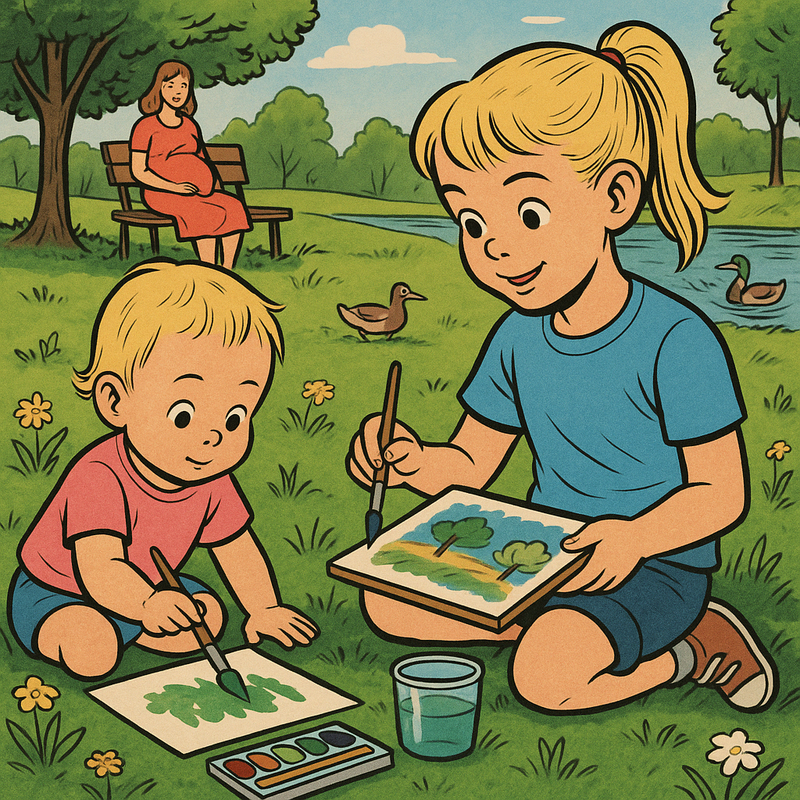
By late March the Huntsville park had traded its gray winter look for something softer. The grass was still patchy in places, brown and green stitched together like an unfinished quilt, but the trees were budding, little fists of leaves pushing out along the branches. A line of azalea bushes near the playground had decided it was time whether the calendar agreed or not, throwing out clusters of pink and white blooms that glowed against the duller shrubs.
Glenda walked slow along the path from the parking lot, a canvas tote of supplies bumping against her leg. In her other hand she carried a folded stack of newspaper, edges already going soft. The spring sun was bright but kind, the kind that warmed the crown of her head and the back of her neck without weighing her down. A breeze nosed at her hair and the hem of her dress, carrying the smells of damp earth, cut grass, and whatever the ice cream truck had been selling near the main road earlier.
Ahead of her, Dana and Holly hopped along the edge of the path like it was a balance beam. Dana led, arms out wide, narrating her own steps.
“I walkin’ on the line,” she announced. “If I fall off, the alligators get me.”
“There no ’gators,” Holly pointed out, her small hand hovering an inch from Dana’s back, ready to catch her though she was the less steady one. “It’s just grass.”
“Imagination ’gators,” Dana clarified. “They not real-real, but they real in my head.”
Holly thought about that, nose wrinkling. “They friendly?” she asked.
“Yeah,” Dana decided. “They just wanna play.”
Glenda let their chatter float back to her without interrupting. She was pacing herself today, listening to the quiet complaints of her body and accommodating them without drama. Seven months along made itself known in the small adjustments—how often she shifted the tote from one hand to the other, how she placed a palm at the small of her back when the babies rolled in some private, underwater dance.
They cut across a stretch of grass toward a picnic table under a sweetgum tree. Its bare branches were spiked with pale green nubs; in a few more weeks it would throw real shade, but for now the sun came through in lacy patches. The wooden table was scarred and carved with the usual declarations—initials, dates, someone’s attempt at a heart—but it was solid.
“This our spot,” Glenda said. “Artists need a good view.”
From here they could see almost everything: the little pond with its rim of cattails, where a pair of ducks drifted like decorations; the playground to the right with its metal slide and swing set; a hill sloping down toward a cluster of dogwoods, just starting to glow white at the tips. Somewhere behind them, a lawnmower droned, trimming the open field.
Dana scrambled up onto the bench, kneeling so she could peer over the tabletop. Holly climbed more cautiously, using both hands, one knee at a time. Glenda set the tote down, unfolded the newspaper and smoothed layer after layer across the boards.
“Make it crunchy, Mama,” Dana said, pressing a hand down so the paper crackled. “Crunchy mean it ready.”
“That so?” Glenda asked.
“Uh-huh.” Dana slapped it once more for good measure. “Now we can paint.”
“Almost,” Glenda said. She eased herself down on the opposite bench, lowering her weight carefully until her hips found the slats. The babies shifted in response, a slow, rolling push against her ribs. She set a hand there an instant, a protective reflex now so habitual she hardly noticed it.
Holly watched the movement with solemn eyes. “The babies say hi?” she asked.
“Might be they do,” Glenda said. “Maybe they stretching. Maybe they say, ‘What’s all that walkin’ about?’”
Dana leaned over the table to get a better angle on her mother’s belly, clasping her hands like she might around a microphone. “We at the park,” she informed the curve of fabric. “There’s ducks an’ trees an’ me an’ Holly-baby. You can’t come out yet, but you can listen.”
“An’ see the paint,” Holly added, though she seemed uncertain exactly how that would work. Her gaze flicked from Glenda’s belly to the still-closed tote.
“They’ll see it later,” Glenda said. “We can show ’em when they big enough. For now they can feel how happy y’all are. That’s somethin’, too.”
She began unpacking the supplies: the same jam jars they’d used in the kitchen, now with their lids off; plates for paint; brushes of different sizes. She lined everything up, the motions practised now. The girls wiggled with anticipation, kneeling up taller, hands hovering over the table.
Glenda glanced once around to take in the wider scene, the way she always did: a dad pushing a stroller on the path, a pair of teenagers slouched on a distant bench sharing a Walkman, an older woman in a visor tossing crumbs to the ducks. No one too close, no immediate hazards besides the usual ones—dirt, gravity, the potential of wet paint meeting nice clothes.
“Okay,” she said, settling her weight, setting the jars in the center of the paper. “Same rules as home. Say ’em with me.”
Dana rolled her eyes with theatrical patience but complied. “Paint stay on the paper,” she recited.
“Not on your dress, not on your sister, not on my good church shoes,” Glenda added.
“On-ly paper,” Holly chimed in, tapping the surface with one finger.
“Brushes get a bath between colors,” Dana continued, already reaching for the nearest jar to demonstrate. “Swish-swish, wipe-wipe.”
“And if you can’t reach?” Glenda prompted.
“You ask,” both girls said together, the words slipping out in a sing-song rhythm. Holly added, “Ask Mama or Dana,” as if clarifying.
“Good,” Glenda said, and let her tone carry the approval. “Now. Today we’re paintin’ what we see. You look around. What’s somethin’ you like? Somethin’ you wanna put on your paper?”
Dana twisted on her knees, scanning the view like a director scouting locations.
“The big tree over there,” she decided, pointing at a tall pine near the pond. “An’ the ducks. An’ the… the fluffy flowers.”
“Dogwoods,” Glenda supplied.
“Yeah. Dogwoods. I’ma paint all of ’em.”
“That a lot of things,” Holly said doubtfully.
“I got a lot of space,” Dana countered, flattening both palms on her blank sheet. “What you gonna paint, Holly-baby?”
Holly’s gaze circled slower. She took everything in: the water rippling; a squirrel making a bold dash toward a trash can; a toddler on the swings squealing every time they went forward.
“Flowers,” she said finally. “An’ the babies. They can be in the flowers.”
She looked to Glenda then, checking whether this plan was acceptable.
“That sounds beautiful,” Glenda said. “Flowers ’round the babies. Like a little nest.”
Holly smiled, small but clear. She picked up a brush, holding it now with a grip far different from those first clumsy attempts months before.
Glenda started spooning paint onto the plates—blue, green, brown, yellow, a new soft pink she’d bought just for today. The air already carried a faint chemical tang, mixing with the earthier smells of the park.
“Okay, artists,” she said. “You may begin.”
Dana didn’t need telling twice. She dipped her brush into the blue as far as it would go.
“Remember not to drown it,” Glenda reminded her. “Brush don’t need a bath till it’s dirty.”
“Oh yeah,” Dana said, drawing it back and scraping the extra off on the side of the plate. She swiped a broad slash of sky across the top of her paper, then another, building a band of blue that wobbled but held.
Holly chose green, very carefully, barely touching the surface of the paint. She made short vertical strokes along the bottom of her page, a row of grass.
“The grass over there,” she explained, nodding toward the nearest patch. “But not pokey.”
“Good idea,” Glenda said. “We make it soft on the paper.”
A gust of wind came then, unexpected, plucking at the edges of the newspaper and threatening to lift one corner of Holly’s paper entirely. The page fluttered like it meant to fly.
“Whoops—hands,” Glenda called, quick but calm.
Dana slapped a palm down on one corner of her sheet. Holly grabbed for hers a heartbeat later.
Glenda leaned forward, stretching carefully across the table, one hand braced on the edge as she reached for the roll of masking tape she’d tucked in the tote. She could feel the babies shift again at the lean; she exhaled through it, keeping her voice easy.
“That’s the wind sayin’ hello,” she said. “We’ll just say hello back and ask it to leave your paper be.”
She tore strips of tape and secured each corner of the girls’ pages, smoothing them down with the flat of her fingernail.
“There,” she said. “Now if the wind wants to play, it can do it somewhere else.”
“Like with the ducks,” Dana suggested. “Make ’em go fast.”
“The ducks doin’ just fine,” Glenda said, glancing toward the pond where one of the birds had indeed turned sideways to let the breeze ruffle its feathers.
With the pages anchored, the girls fell into a rhythm. Dana’s brush moved in big gestures; she was trying to fit the world onto her rectangle. She blocked in the pond with a sweeping oval of blue, then dabbed brown along one side where she decided the bank must be. She attempted a tree, trunk first, then a cloud of green on top.
“No, it not like *that,*” she muttered to herself, studying the actual pine, its tall, straight trunk and triangular spire of branches. “It more… pointy.”
She adjusted, dragging the green up into a rough triangle, adding lines for branches.
“It’s good you look back and forth,” Glenda said. “That’s what artists do. They look at the thing, then their page, then the thing again.”
“I a real artist,” Dana said absently, already moved on to adding ducks—small, banana-shaped blobs of white with orange dots for beaks.
Holly’s world was smaller, but no less intent. She’d filled her lower half with green, then begun dropping small circles of color into it—pink, yellow, a bit of red.
“Flowers,” she said again when she saw Glenda watching. “These ones.” She pointed at the nearest azalea bush. “They in a circle, like a hug.”
“That’s a good way to put it,” Glenda said quietly.
Holly added two larger circles near the center of her grassy field, side by side. They were more oval than round, but she approached them with unusual care. She used pink for one, blue for the other, then outlined both in a thin, wobbly line of yellow.
“These the babies,” she announced. “They sleepin’.”
Dana leaned over to look, careful not to let her brush drip. “They in eggs,” she said, approvingly. “Like birds. When they crack, they gonna *scream*.”
Holly giggled. “No,” she said loyally. “They gonna be nice.”
“All babies scream some,” Glenda put in. “That’s how they tell us what they need. But I got a feeling these two are gonna be sweet, same as y’all. Just got… loud ways of sayin’ ‘I’m hungry’ is all.”
Dana pursed her lips. “They gonna paint too?” she asked. “When they big?”
“When they big enough not to eat the brushes,” Glenda said. “We’ll have to get a bigger table by then.”
She pictured it without meaning to: four little heads bent over papers instead of two, the chaos of more voices, more hands, more opinions about what the sky ought to look like. The thought scared her a little in its scale, but the fear was thin around the edges, easy to see through. Underneath was something else—a stubborn gladness that surprised her with its strength.
“Mama, look,” Dana said. “I made you.” She jabbed her brush at a figure near the bottom of her page—a tall shape in the middle, with a round bump in front. Stick arms radiated out, and there was a little one on each side.
“Is that so?” Glenda leaned in. The figure’s head had a wide U-shaped smile and two blue dots for eyes. The bump was almost comically large, like a beach ball.
“That’s your belly,” Dana said. “’Cause it big. Not… like… huge,” she amended quickly, glancing up to gauge her mother’s reaction. “Jus’… big ’cause there’s two.”
“I know what you meant,” Glenda said, amused. “I like it. You caught my best side.”
“What side?” Dana asked.
“The one where I’m smilin’ at my babies,” Glenda answered.
Dana grinned, satisfied, and added two smaller figures below the bump—no arms, just heads and tiny circles. “These the twins,” she said. “They inside still, but they *dreamin’* about the park.”
Holly, not wanting to be left out of the representation game, dipped her brush in brown and added small dots at the top of each of her baby ovals—a suggestion of hair. Then she picked up a clean brush and, after a moment’s thought, painted a smaller circle next to them with a halo of green.
“Who’s that?” Glenda asked.
“Me,” Holly said simply. “I watchin’ them. So they not lonely.”
The answer landed somewhere deep in Glenda’s chest. She felt it like a hand on the inside of her rib cage, pressing.
“That’s very kind of you,” she said, keeping her voice steady. “They lucky to have you lookin’ out for ’em already.”
Holly ducked her head, cheeks rounding with a bashful smile. A gust of wind tugged at her hair, lifting a few wisps; she pushed them out of her eyes with the back of a paint-smeared hand, leaving a faint streak of green on her temple without noticing.
A jogger passed the table, feet thumping on the path, earbuds in. He glanced over, did a double-take at the sight of two little girls painting beside a very pregnant woman, then smiled and lifted a hand in a brief salute. Holly’s shoulders twitched; she pressed closer to the table, head lowering.
“He just sayin’ hi,” Glenda murmured. “You ain’t gotta wave back if you don’t want. It’s okay to keep your hello for people you know.”
Holly relaxed, reassured that there was no required performance. She went back to her flowers.
Dana, less concerned about strangers, waved boldly after the jogger anyway. “We paintin’!” she yelled. “We makin’ the whole park!”
“He got his own world in his ears right now,” Glenda said. “But you can tell the ducks if you want.”
Dana did exactly that, twisting around on the bench and holding up her paper in the direction of the pond.
“Look, ducks!” she shouted. “It’s you!”
One of the birds turned its head, the kind of random motion that had nothing to do with her call but felt, to Dana, like direct acknowledgment. She beamed.
“They like it,” she reported.
“Mm, I bet they do,” Glenda said.
Holly watched the ducks too, then daubed a small blue dot near her babies. “This one’s a duck,” she decided. “A baby duck. He their friend.”
“So your painting got flowers, babies, and a duck friend,” Glenda summarized. “That’s a nice neighborhood.”
A small crisis flared when Dana, reaching for more green, forgot about the “no leaning” clause and overreached across the jars. Her elbow clipped one, sending it skidding toward the edge of the paper. Water sloshed up, lipping the rim.
Glenda’s hand was there in an instant, catching the jar before it tipped. Her fingers were gentle but firm as she straightened it.
“Whoops,” she said. No sharpness, just a pointed little exhale. “Feel that? How close that was?”
Dana’s face went instantly contrite. “Sorry,” she said. “I forgot.”
“I know you didn’t do it on purpose,” Glenda replied. “That’s why we practice. You got long arms now. You gotta remember you take up space.”
Dana nodded, chastened. “Can you move the green, please?” she asked, almost formal.
“I can,” Glenda said. “Or you can ask your sister.”
Dana didn’t hesitate. “Holly-baby, can you slide me the green?”
Holly straightened with the pride of a junior assistant. She set down her own brush, used both hands to grip the edge of the plate, and inched it across the paper until it was within Dana’s safe range.
“There,” she said. “Now it won’t spill.”
“Thanks,” Dana said. The ease between them, the way they folded the correction into their routine without bitterness, eased something in Glenda’s shoulders.
Time passed in that slow, elastic way it sometimes did on good afternoons. The sun shifted, shadows lengthening. A cloud drifted lazily across, dimming the light for a moment before moving on. The girls kept working, occasionally pausing to stand on the bench so they could compare their paintings to the actual landscape, then sinking back down to make adjustments.
“Holly’s grass is brighter than the real grass,” Dana observed at one point.
“It happy grass,” Holly replied. “It glad the babies are there.”
“Huh,” Dana said, tilting her head. “I guess my pond water is bluer than the real pond too.” She jabbed her brush toward the paper. “It a magical pond where you can see the sky in it.”
“Water do that for real,” Glenda said. “Sometimes. On still days.”
“It doin’ it now?” Holly asked, squinting at the pond.
The surface was rippled from the ducks and the breeze; the reflected sky was broken into shimmering pieces.
“Little bit,” Glenda said. “Enough to put in a picture if you want.”
Holly nodded, satisfied. She added a faint band of blue along the top of her field, a strip of sky just for herself.
After a while, Glenda’s hips began to complain in earnest. She shifted again, then carefully pushed herself to standing, one hand on the table, the other under her belly.
“Y’all keep goin’,” she said. “I’m just stretchin’ my legs.”
Dana looked up, worried. “You okay?”
“I’m alright,” Glenda said. “These two just remindin’ me they in there.”
She walked a small circle beside the table, rolling her shoulders, then came to stand behind the girls, hands braced lightly on the back of each little neck. From this angle she could see both paintings at once.
Dana’s page was busy, full of movement and things—trees, ducks, herself, her mother, an exaggerated sun with rays reaching down into the pond, two small circles labeled as twins in her head even if she hadn’t drawn them yet. Holly’s was quieter but no less alive: a meadow of flowers, two egg-shaped babies under a guard of yellow, a tiny blue duck, a small green circle of herself standing watch.
Glenda let her palms rest there on the warm skin of their necks, feeling the small, steady thrum of their lives under her hands and the heavier, slower weight of the twins inside. Four hearts, all beating within arm’s reach.
“You know what I see?” she asked.
“What?” Dana said immediately.
“Mm.” Glenda pretended to think. “I see two girls who remember things real good. Colors, feelings, places. Two girls who gonna be such good big sisters their babies won’t never doubt they loved.”
Holly’s brush paused mid-air. “We good?” she asked, looking up, color high in her cheeks.
“You’re good,” Glenda said. “You’re more than good.”
Dana gave an exaggerated shrug, but her smile was shy at the edges. “I gonna teach ’em the rules,” she announced. “No spillin’ paint, no runnin’ with scissors, no hittin’ nobody, no eatin’ crayons—”
“No eatin’ paint,” Holly added.
“Yeah, that too. An’ I’ma show ’em how to swing, an’ how to climb, an’ how to draw ducks.”
“That’s a lot of lessons,” Glenda said.
“I got time,” Dana replied.
A gust of laughter bubbled up in Glenda before she could stop it. She let it out, soft and incredulous.
“I reckon you do,” she said.
A couple passed, a woman about Glenda’s age and a man carrying a camera. The woman slowed, watching the girls for a moment.
“They’re beautiful,” she said, nodding toward the paintings. “You’ve got little Picassos there.”
Glenda gave a small, polite smile. “Thank you,” she said. Holly went very still, eyes fixed on her paper. Dana straightened with a flash of pride, then pretended not to care as soon as the strangers walked on.
“We famous now,” she murmured to Holly once they were out of earshot.
Holly whispered back, “We not,” but she was smiling.
The sun slid a bit lower, the light turning warmer, deeper. The girls’ strokes slowed, moving from bold marks to tiny details—the last dot of color here, a little correction there. Attention began to fray in the way Glenda recognized: more fidgeting on the bench, more glances toward the playground, less focus on the page.
“Alright,” she said at last, voice gentle but decisive. “How ’bout we let these beauties dry, and y’all can go get your sillies out on the swings.”
Dana looked torn. “But I not finished,” she protested, even as her hand had been hovering over the same spot for the last full minute, not quite willing to commit.
“There’s always one more thing you can add,” Glenda said. “That’s just how art is. But sometimes we gotta decide it’s enough for today.”
She tapped a knuckle lightly on the table beside Dana’s elbow. “You look. You feel in your belly if you can see what you meant to say here. If you can, then you can call it done, even if there’s a blank spot or a funny line.”
Dana studied her page, chewing her lip. Holly, having already put her brush down, watched her sister, holding her own painting flat so the wettest parts didn’t drip.
After a long moment, Dana nodded. “I can see it,” she said. “The ducks, an’ you, an’ the trees, an’ the twins dreamin’ in the park. It’s all there.”
“Then it’s enough,” Glenda said. “Good work.”
She helped them slide their paintings to one end of the table, propping them carefully against the trunk of the tree where the breeze wouldn’t flip them. Colors shone wetly in the late-afternoon sun, edges already starting to dry and darken.
Dana and Holly squirmed off the bench, feet thumping onto the grass. Glenda handed each a damp cloth from the tote.
“Hands,” she instructed. “Faces if you got any on there. Clothes we’ll worry about later.”
Dana scrubbed at her fingers, leaving streaks of pale green on the cloth. Holly dabbed delicately at the streak on her temple, then held the cloth out to Glenda like evidence.
“You missed a spot,” Glenda said, and leaned down to kiss the unpainted side of her forehead.
“Now it perfect,” she added.
She watched them run toward the playground—Dana in front, Holly half a step behind, as always, but not as far behind as she once had been. The swing chains rattled as they grabbed them, the rubber seats bending under their weight. Their voices floated back, braided and bright.
Glenda eased herself back down onto the bench, this time turning slightly so she could rest her spine against the table edge and let her belly have the open air. She placed both hands there, one above, one below, palms open.
“See what you got waitin’ for you?” she murmured to the curve of her dress. “World’s already colored in.”
A small kick answered her, then another, like twin knocks from the inside.
She tilted her head toward the tree, toward the drying paintings, toward the swings where her daughters arced back and forth under the baby-blue sky. Huntsville was just a small city, this was just a small park, this was just one afternoon on one bench—but it felt, in that moment, like the center of something vast.
Glenda sat there, the damp newspaper crackling under her, watching her girls launch themselves into the air and drag the day out as long as they could, and her heart swelled.
Karen’s house did not smell like a house with small children in it.
No talc, no sour milk, no faint undertone of diaper cream. The air in the D.C. rowhouse was all lemon oil, good coffee, and the faint metallic chill of air conditioning pushing back the July heat. Light poured in through tall windows, glancing off glass and wood and framed photographs of marches, symposiums, and award dinners. The place was quiet in a way Glenda’s home never could be with newborn twins, even at rest.
That quiet came to an abrupt, cheerful end as Dana’s sandals slapped up the polished hallway and Holly’s smaller feet pattered behind.
“You live in a castle,” Dana announced, craning her head back to look at the high ceiling.
Karen, coming up the stairs after them with an overnight bag on each shoulder, laughed once. “It’s just a townhouse, baby. I promise the Queen does not live next door.”
Dana didn’t acknowledge the correction; she was busy counting doorways. “One, two, three… you got *so many* rooms.”
“I got enough rooms,” Karen said. “Which is why you two are gonna help me fix up one of ’em.”
She kicked the last door at the end of the hall gently with her foot. The guest room door swung inward on well-oiled hinges.
The room was beautiful, technically. Karen’s eye had seen to that. Cream walls, a wide bed with a navy coverlet smoothed to hotel tautness, matching lamps on sleek nightstands, a small writing desk in the corner beneath a framed black-and-white print of the Capitol. The carpet was a soft gray that muted footsteps; the curtains were linen, the color of unbleached flour.
It was also, Karen thought, sterile. The kind of room where people slept for two nights and left no trace. Perfect for visiting colleagues. Less so for two little girls who had spent the last two months negotiating the new chaos of twin babies at home.
She watched their faces as they crossed the threshold. Dana trotted right in, eyes swinging left and right, drinking it all in. Holly paused just inside the doorway, one hand on the jamb, thumb tucked into the crook of her other palm—not in her mouth like when she was tiny, but still there, a little anchor.
“This… our room?” Holly asked, small voice echoing slightly off the smooth surfaces.
“For the next couple days, yeah,” Karen said. She stepped around them, crossing the room to the far wall where a neatly folded drop cloth lay like a secret. She set the overnight bags on the chair under the window. “But it’s not finished.”
Dana’s head snapped toward her. “Not finished?” she repeated, scandalized. “You forgot somethin’?”
Karen shook her head, slow, letting the suspense build. “I left it like this on purpose,” she said. “’Cause I had a feeling I’d be gettin’ two expert designers out to D.C. and I didn’t want to do it without their input.”
Dana straightened a full inch. “We designers?”
“If you want the job,” Karen said. “Pay is decent. You get snacks.”
Holly’s eyes narrowed in consideration. “What we gotta do?” she asked.
Karen crossed to the closet and pulled the door open. Inside, where a guest might have expected spare blankets or an ironing board, were two large rolls of white paper, a stack of smaller sheets, a crate of paints, markers, colored pencils, and a jumble of brushes in a mason jar. Beside them, a plastic tub held masking tape, safety scissors, and a few lengths of bright ribbon.
Dana gasped like she was witnessing fireworks. “Ohhh,” she breathed. “Oh, wow.”
Holly took one hesitant step closer. “It’s like… Christmas,” she whispered.
Karen let herself savor their reaction before she put words around it. This was the part she lived for—the moment when possibility lit up on someone’s face. She’d seen it in seminar rooms, on picket lines, backstage at concerts. Seeing it on the faces of a three-year-old and a two-year-old hit something raw in her.
“I’ve been livin’ in this city almost five years,” she said, sliding a roll of paper out and tucking it under one arm. “This room’s been beige the whole time. I decided that was long enough.”
She set the roll on the bed and gestured grandly. “So. I’m officially hiring you two to help me redesign it. Think you’re up to it?”
“Yes,” Dana said immediately. “We can fix it. It don’t gotta be beige. Beige is like… toast with no butter.”
Holly’s mouth quirked. “Or rice with no sauce,” she added, borrowing one of Glenda’s household metaphors without fully grasping it.
“Exactly,” Karen said. “We are anti-plain-toast in this house, just so you know. But first…”
She moved with practiced efficiency, shaking out the drop cloth and spreading it over the navy bedspread, weighting the edges with pillows. The cream rug got a layer of taped-down newspaper. She’d already slid the nightstands a few inches farther from the walls that morning, anticipating the wild arcs of small arms.
“The rules,” she said, straightening. “You ready?”
Dana nodded, face serious. Holly, recognizing the ritual, climbed up onto the drop-clothed bed and sat cross-legged, folding her hands in her lap as if for church.
“Rule number one,” Karen said, holding up a finger. “Paint and marker stay on the paper. I love you, but I’m not about to explain to my landlord why there’s a blue unicorn on the wall.”
Dana giggled. “A blue unicorn would be *cool,* though,” she argued.
“It would,” Karen agreed. “On the paper. Rule number two: we walk, we do not run, when we got brushes in our hands. Don’t swing ’em around like drumsticks, don’t poke your sister’s eye. This is a no-emergency-room day. Everybody hear me?”
“Yes ma’am,” Dana said, the politeness automatic but not stiff.
Holly bobbed her head. “No pokin’,” she echoed.
“Rule three,” Karen continued. “If you can’t reach somethin’…” She let the sentence hang.
“We ask,” Dana finished. “Mama say that.”
“Smart woman, your mama,” Karen said. “You can ask me. Or, if I’m on the floor tryin’ to remember what my knees felt like at twenty, you can ask each other. Teamwork. Deal?”
“Deal,” Dana said, solemnly.
Karen looked at Holly. “What about you, baby?”
Holly’s gaze met hers, shy but steady. “Deal,” she said, and tucked a stray curl behind her ear, paint-less fingers already itching.
Karen felt a flicker of relief settle in her chest. Leaving Glenda back in Alabama with newborn twins, eyes ringed in tired shadows, had been harder than any late-night flight or emergency meeting. This little trip was supposed to be a gift—a few quiet days for Glenda and Mason to find their footing, a small adventure for the girls so they didn’t feel lost in the shuffle. Now that they were here, in her sterile beige guest room with its drop cloths and hidden art supplies, it began to feel real.
“Alright, designers,” she said. “Phase one. We’re gonna make ourselves some wallpaper.”
She tore off a long strip of the big paper and held it against the wall. “These,” she explained, “are our panels. We’re gonna tape ’em up all around the room, and whatever you draw on ’em—that’s the new look. When I got boring adults stayin’ over, they can sleep under whatever you come up with. Sound fair?”
Dana’s eyes shone. “Yes! We gonna make a… a *forest,*” she said, grabbing the idea out of the air. “Or a castle. Or a forest *and* a castle.”
Holly frowned, thinking. “We can put the babies in the forest,” she suggested. “So they got someplace nice to sleep when they visit.”
“The babies ain’t comin’ on a plane yet,” Dana said, practical. “They too small. They scream the whole time.”
“They’re not that bad,” Karen put in. “Not any worse than most grown men on a delayed flight.”
Dana squinted at her. “You ride with screamy men?” she asked.
“More times than I can count,” Karen said dryly. “Now, help me with this tape.”
They worked in companionable chaos for the next few minutes. Karen held the paper against the wall while Dana solemnly tore strips of masking tape, sometimes too short, sometimes absurdly long, handing them over with an air of importance. Holly’s job, self-assigned, was to smooth the taped edges down with her palm, patting each one three times, whispering, “Stay, stay, stay,” under her breath.
Soon, one wall was papered with three big panels. The room already felt different, less like a hotel, more like a project.
Karen stepped back, hands on her hips. The movement pulled across the muscles of her lower back, a reminder of the drive from the airport and the two days of bending, lifting, entertaining. It was a good ache, she decided. The kind that meant she was doing something that mattered.
“Okay,” she said. “Now the fun part. What goes on this wall?”
Dana hopped from one foot to the other. “A map,” she declared. “Of… of everything. Huntsville, an’ Mama’s house, an’ your house, an’ the hospital where the babies came out, an’ Scarlett’s place with the goats—”
“An’ the park,” Holly put in quietly. “With the ducks.”
Karen’s chest tightened at the casual mention of it all—the way their world had grown in three-year-old increments: house, park, commune, hospital. These girls had collected more distinct landscapes in their short lives than a lot of adults she knew.
“A map,” she repeated. “I like that. Okay. One map wall, comin’ up.”
She unscrewed the jars and poured out tempera paint onto plates—blue, green, brown, yellow, a soft lavender, the red that always made Karen a little nervous near upholstery. She lined the brushes in a neat row, big to small.
“Remember, big brushes for big things,” she said. “Little brushes for details. If it feels like you’re painting with a mop, maybe grab a smaller one.”
Dana immediately seized the second-largest. Holly reached for a medium one, but paused, eyes flicking to Karen.
“That one’s perfect,” Karen said. “Wanna try the green first?”
Holly nodded.
Soon the first wall began to fill. Dana planted their home in Alabama as a big square house in the lower left corner, roof red, yard green. She put Glenda in front of it as a stick figure with an enormous round skirt.
“That supposed to be her dress or her superpowers?” Karen asked.
“Both,” Dana said. “It’s her… her *mama shield.* It go ‘whoom’”—she flung her free hand out in an arc—“an’ nothin’ bad can get past it.”
“Accurate,” Karen murmured.
Holly, on the same panel, painted a smaller square beside the big house, with four tiny circles inside—two at the top, two at the bottom.
“Who lives there?” Karen asked, leaning just enough to see.
“The babies,” Holly said. “An’ me an’ Dana. It a sleep house. So Mama can sleep in the big house sometimes.”
Karen’s throat tightened. She forced her voice to stay light. “That’s very considerate architecture,” she said. “Everybody get a nap.”
“’Cept Daddy,” Dana added, focused on adding little stick arms. “He awake all the time. He walk with the babies, an’ sing songs in the night. He sound like the radio when it don’t work.”
Karen laughed, picturing Mason pacing in the dim, humming tunelessly. “He’ll find the tune,” she said. “He always does.”
The map expanded. Up near the top of the panel, Dana planted D.C.—a cluster of tall rectangles, one topped with a tiny triangle, another with a circle like a domed building. In one window she painted a small brown figure with a big mass of hair.
“That you?” Karen asked.
“No, that’s you,” Dana said. “This your house. You got high hair ’cause you important.”
“Thank you for noticing,” Karen said dryly, reaching up to pat her own curls.
Holly, still working in greens and blues, linked Huntsville and D.C. with a long, wavy band of blue.
“That a river?” Dana asked.
“It’s the sky,” Holly said. “It follow us. From home to here.”
Karen stared at the wavering blue path connecting the two corners of the map and felt something loosen in her chest. Out of the mouths of babies, she thought.
“That’s a good thing to remember,” she said quietly. “Wherever you go, same sky.”
They moved to the second panel. This one became Scarlett’s commune—round houses with smoke curling from the tops, goats rendered as lumpy ovals with stick legs, a swing hanging from a tree. Dana painted Scarlett as a tall purple figure with long hair and a drum. Holly planted herself in the scene, a tiny green dress beside a baby-blue circle labeled as “baby goat.”
“Scarlett gonna be real flattered you made her purple,” Karen said.
“She a superhero too,” Dana replied. “She fight bad guys with her loud.”
Karen swallowed a smile. “That she does.”
On the third panel, they agreed, would go the guest room itself—this room, this moment. The girls set to work capturing it as they wished it to be. Dana drew the bed bigger than everything else—“’Cause it the most comfortable,” she explained—then added pillows with flowers exploding off the edges. Holly dotted stars on the ‘ceiling,’ yellow flicks in a blue band at the top.
“These stars for the babies,” she said. “So they know where we are. They can’t come yet, but they can see.”
Karen dabbed her own brush in the palest gray and, almost surreptitiously, added a small rectangle near the corner—a door—and inside it, two infinitesimal dots of pink.
“What’s that?” Dana demanded, catching her.
“That,” Karen said, “is the part of my brain where I keep worryin’ ’bout whether your mama’s actually sleepin’ while you’re here, or if she’s cleanin’ the tops of cabinets with the babies in a sling.”
Dana frowned. “She supposed to rest,” she said. “Nana say so. Nana say, ‘Glenda, you sit your tail down or I’ma glue you to that chair.’”
“That does sound like your Nana,” Karen said. “Well, consider this my way of keepin’ her in that chair. If I wear you out enough, maybe she’ll get ten minutes to herself.”
Dana looked pleased with that plan. “We can be wore out,” she said. “We got lots of energy.”
“Speak for yourself,” Holly murmured, but there was a tiny smile on her mouth as she dotted another star.
Time slid. Karen encouraged, redirected when necessary, but mostly she watched. She watched the way Dana’s whole body moved when she was excited, brush carving bold arcs. She watched the way Holly anchored herself—one knee folded under, toes curled on the drop cloth—and built her world in small, sure increments. She watched them negotiate space: “Can I put a tree there?” “Only if it don’t cover my goat.” “Okay, I do a little tree.”
At one point, Dana, over-ambitious, lunged for the red and nearly toppled the water jar. Karen’s hand shot out, catching it just in time.
“Freeze,” she said, voice calm but firm.
Dana went statue-still, eyes wide.
“Take a look at your arm,” Karen said. “See where it is?”
Dana looked, saw her elbow jutting right over the edge of the table. “Oops,” she said softly.
“Not oops. Just information,” Karen corrected. “Your arms’re gettin’ long. That’s good. Means you can reach higher shelves, eventually help me get stuff off the top of the closet. But it also means you gotta know where they are. Check your elbows before you move fast, okay?”
“Okay,” Dana said. “Can you move the red for me?”
“I can, or you can try that third rule,” Karen said.
Dana hesitated, then turned her head. “Holly-baby, can you slide me the red?”
Holly, who had been quietly painting tiny yellow flowers along the bottom edge, perked up at being asked. She set her brush down with exaggerated care and used both hands to scoot the red plate closer to her sister’s safe zone.
“There,” she said. “Now you don’t fall.”
“Thank you,” Dana said. “You a good helper.”
Karen felt the exchange like a small chord resolved. This, she thought, is why Glenda trusted her with them—because she would protect more than their bodies. She would protect this easy hierarchy of care between them, this budding sense of themselves as capable and kind.
Later, when the first wall was gloriously full and drying, Karen shifted them to the bed with the smaller sheets and a box of markers.
“Phase two,” she said. “Accent pieces.”
“What that?” Dana asked, flopping onto her stomach.
“Little pictures we can frame or hang,” Karen explained. “We’ll pick our favorites later and put ’em up proper. Then, even when you’re back home bossin’ your baby sisters around, your artwork stays here remindin’ me how loud my house can be.”
“We can be louder,” Dana promised.
“I believe you,” Karen said.
They sprawled, drawing. Holly made a series of tiny portraits—circles with distinctive hair: Glenda’s curls, Mason’s short waves, Karen’s big halo, Scarlett’s long fall. Each got a different colored shirt. She labeled them with single letters in shaky print: M, G, K, S. It was the first time Karen had seen her write initials; pride pricked her like a pin.
“You’ve been practicin’,” she said.
Holly nodded, cheeks going pink. “Mama show me,” she said. “So I can write ‘Amy’ an’ ‘Tracey’ when they big.”
Dana, on her own page, drew herself with a cape.
“What’s your superhero name?” Karen asked, genuinely curious.
“Big Sister Girl,” Dana said instantly. “I got eyes in the back of my head. An’ snacks in my pockets.”
“That’s a solid skill set,” Karen said. “Any weaknesses? Kryptonite? Broccoli?”
“Sleep,” Dana admitted. “If I don’t get the sleep, I turn into a grouch monster. Mama say so.”
“Mm. She might know what she talkin’ about.” Karen ran a hand absently along Dana’s back, feeling the small vertebrae under her palm. “We’ll make sure Big Sister Girl goes to bed on time while she’s in D.C., then.”
As afternoon folded into evening, the light in the guest room changed. It came in warmer now, slanting across the floor, catching on the wet paint and making certain colors blaze. The city sounds shifted too—the hum of traffic thickening on the distant avenue, a siren wailing somewhere far off, someone’s radio drifting up faintly from an open window down the block.
Karen ordered in Chinese food—one of the perks of city living the girls regarded with awe, as if she’d conjured the delivery man by magic. They ate sitting cross-legged on the hardwood in the living room, cartons balanced carefully, Karen watching how Dana insisted on using chopsticks “like on TV” and Holly methodically transferred rice from box to mouth with her fork, getting most of it where it needed to go.
After dinner, baths, and a brief phone call home—Glenda’s soft, tired voice crackling down the line, babies squawking in the background, all three of them assuring each other they were fine—the girls ended up back in “their” room in clean pajamas, hair damp and curling.
The guest room looked utterly different now.
The map, the commune, and the self-portrait wall gleamed from over the bed. Smaller drawings had been taped between the panels: Big Sister Girl flying over a cityscape, a duck wearing a crown, a field of Holly’s flowers labeled “baby garden” in her careful letters. The framed Capitol print still hung over the desk, but now it was flanked by two new pieces: a cluster of multicolored stars and a simplified version of Glenda’s face, all eyes and smile and big hair.
Karen leaned in the doorway, one shoulder against the frame, and watched the girls climb into the bed with the solemnity of ceremony. Dana took the left side, Holly the right, both sitting up to inspect the room one more time.
“It look like us now,” Dana said, satisfied.
“It look like home,” Holly added, surprising Karen with the word.
“Does it?” Karen asked.
Holly nodded. “A diff’rent home,” she clarified. “But… we in it. So it home.”
Karen swallowed around an unexpected thickness in her throat. “I’ll take that as a compliment,” she said.
“When the twins come,” Dana said, “we can show ’em pictures. Say, ‘This our D.C. room. We made it. You can come when you bigger and not scream no more.’”
Karen crossed the room, smoothing the covers over their legs, tucking in one corner, then the other.
“They’re gonna love it,” she said. “I’ll take pictures in the mornin’, send ’em to your mama. She can show Amy and Tracey when they’re not busy tryin’ to eat their own feet.”
Holly giggled, then yawned, hand going automatically to her mouth. She caught herself at the last second, pressing her knuckles to her lip instead of sliding her thumb all the way in. Karen pretended not to notice the little victory.
“Can you leave the light on a ’lil?” Holly asked. “Not all the way. Just soft.”
“Nightstand lamp okay?” Karen asked.
Holly nodded.
Karen clicked off the overhead light, leaving one lamp on low. The room softened immediately, edges rounding. The painted panels glowed in the gentler light, their bright colors muted but still vibrant, like dreams pinned to the walls.
She sat on the edge of the bed for a moment, one hand resting lightly over Dana’s blanketed shin, the other on the mattress near Holly’s hip.
“You two did good work today,” she said. “I’m real proud of you.”
Dana smiled sleepily. “We good designers,” she murmured.
“The best,” Karen said. “Now shut those eyes. We got a whole city to wear you out in tomorrow.”
“Can we see the big building with the pointy top?” Dana mumbled. “An’ the… the water with the man sittin’ like a big statue?”
“We’ll see some things,” Karen promised. “We’ll take it easy. I ain’t draggin’ you to a Senate hearing, don’t worry.”
“What that?” Holly asked, already half under.
“Nothing you gotta know about tonight,” Karen said softly. “Tonight all you gotta know is that bed is soft, this room is safe, and your mama loves you so much she let me borrow you.”
Holly’s eyes slipped closed at that. Dana’s followed a heartbeat later.
Karen sat there longer than she needed to, listening as their breathing evened out, watching small muscles relax one by one. She took in the sight of the room: the high ceiling, the neat furniture, and now the riot of children’s color layered over her careful adult minimalism. It was, finally, a lived-in room, even if only for a few days.
This was why she had stepped in without hesitation when Glenda’s voice on the phone had sounded frayed. This was why she’d rearranged meetings, charmed her way into a last-minute airfare deal, made up excuses to the people in D.C. who thought her world began and ended here. Because her real map had always been bigger—the communes and small-town parks and Alabama kitchens and D.C. rowhouses all connected, like Holly’s blue sky band on the paper.
She stood at last, easing herself off the bed so it didn’t jostle them. At the doorway, she turned back one more time.
Dana had rolled onto her side, one hand flung out toward the wall where Big Sister Girl flew. Holly slept on her back, small face turned toward the baby garden, lips parted. The lamp pooled a soft circle of light between them, catching on a streak of green paint still faintly visible near Holly’s hairline, a badge of the day.
Karen, still standing in the doorway, watched the girls sleep in the room they had remade, and a warm, steady pride rose in her—not exactly anything she had words for, but real enough to anchor her there for a long, quiet moment.