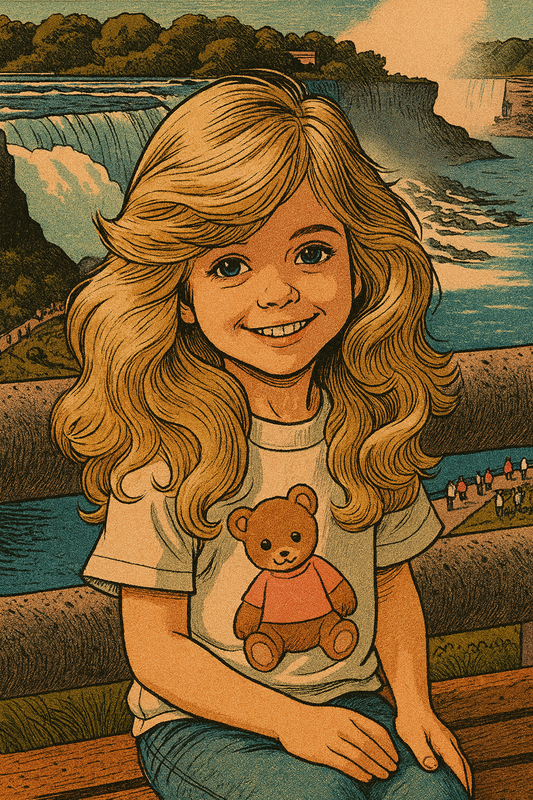
Work Text:
Elevator cables murmur their iron rosary/
counting floors like seasons, like bruises, like years/
A moth reads the lampshade’s paper map for ferry routes/
the harbor is a socket filled with tears.
The walkman sat warm in Glenda’s palm, its clear window showing the tiny spools turning, a slow-ticking heartbeat under the room’s hush. The foam pads of the headphones feathered her ears, one cushion lifted just off so she could keep the world half inside with the music and half open to the rest of it. The rows of connected seats around her were mostly empty—perforated metal backs, vinyl in that weary airport blue—and the late afternoon light spread a thin glaze across the carpet, all zigzags and coffee stains and little threads spiked loose. Her foot tapped, barely, to the song’s patient drum, a road-song guitar humming like a line on a map. A cassette she’d made late last night: three old favorites, two new discoveries, one track that always made Mason laugh because he swore it sounded like rain hitting a tin roof.
Across the room, Mason knelt with the girls at the tall window. Dana pressed her hands flat to the glass, fogging it into cloudy ovals and tracing circles with one finger. Holly’s little shoes dangled from the bench under the window, her legs straight instead of bent, toes trying to reach imaginary footholds in the air. The toddler’s fist closed around the sleeve of Mason’s denim jacket like an anchor. The tarmac beyond looked like a play mat: toy-size luggage carts, a tug rolling a line of cases like beads, a plane nosing forward with its wing lights blinking—slow, steady, reassuring.
Glenda rolled the Walkman’s wheel down to hear them. The world widened: the distant gargle of a vacuum somewhere, an overhead announcement warbling for a different gate, the muffled laughter of a pair of teenage boys flipping through a magazine two rows over. The tape kept moving—she didn’t need to hear all of it to feel it—and she left the left ear open to her family.
“Look, look, look,” Dana said to the glass, breath moistening it, “Daddy, the big bird’s blinkin’. It blink blink.”
“Navigation lights,” Mason said, and Glenda could hear the smile in his voice. “They help other pilots see where the wings are.”
“Wings are arms,” Dana decided. “Arms go flap.” She flapped her arms so hard her little sweater rode up, exposing a round of belly.
“Sometimes,” Mason said solemnly, “arms do flap.”
Holly’s attention surged and retreated in shy pulses. She craned her neck for a better view, then tucked her chin into her collar, then peeked again. “Buh—buh—big,” she whispered, eyes on the plane. She was mostly a thumb-sucker and a watcher, her words arriving like sparrows: here, then gone, then back when you least expected.
Glenda tried to tuck the moment into memory—Mason crouched, Dana’s elbows splay-winged, Holly’s profile like a comma at the end of a soft sentence—and then let the music thread through it. She adjusted the tape with her thumb, not stopping it, just feeling the forward motion. The Walkman’s clip pressed against her thigh where she’d fastened it to the strap of her bag. A little hiss when the song shifted to the quieter part, the singer’s voice hushed as if leaning over a dashboard at night.
Mason pointed toward the nearest plane’s tail where a mechanic in a reflective vest was checking a panel. “See the person down there? That’s someone making sure the plane is ready to go. Everything gets checked.”
“Check, check,” Dana echoed. “Like doc visit. Say ‘aaah’.” She dropped her jaw dramatically, tongue out.
“Exactly like that,” Mason said.
Holly risked one of her bright-out pulses then, pointing hard with two fingers. “Man!” Her voice startled even her, and she grinned as if she’d surprised herself. “Man—down.”
“That’s right, Holly-baby,” Dana said, the nickname unspooling in the automatic sweetness she used when her sister took the tiniest step forward. “Man down dere. He fix.” Dana leaned into Holly’s shoulder lightly, and Holly tolerated it, leaning back for a second before retreating, thumb finding her mouth again.
Glenda’s eyes pinched with a happy ache. The belated honeymoon stretched out ahead of them like a ribbon they’d finally found the end of. The spring after the wedding had filled with other people’s emergencies, other people’s schedules, and money that always went to car repairs or rent instead of moonlit dinners. They’d promised each other—next year, then the next—and now here it was: a long weekend with passports, a silly camcorder Mason had insisted on borrowing from a friend, and the impossible fact of two little girls to share the wonder with. Not newlyweds on a beach—and she didn’t envy that, not one bit—but a four-piece family watching planes together as light slanted through glass.
She eased the left ear pad back fully onto her ear for a minute, closed her eyes, and let the chorus crest. The song was bright and then faded into a guitar figure like a finger tracing a shoreline. She saw water when she heard it, an imagined curtain of Niagara spread in her mind—white and unending, with a mist that would bead on Holly’s lashes and turn Dana’s hair into dark comma curls. Glenda smiled at that picture and took one ear off again, unwilling to miss anything at the window.
“See the flaps?” Mason said, and pushed his index finger along the glass to show the trailing edge of the wing flexing. “They help the plane lift.”
“Like when I go up,” Dana said. “When Mama throw me.” She corrected herself strictly: “Not throw. Up-up. Lift me.”
“Lift you,” Mason agreed, “with big strong arms.”
Glenda stood, slung her bag higher on her shoulder, and crossed the thin river of carpet between the seat rows. With the ear cup still tilted, the song bent into the murmur of the terminal, a private soundtrack stitched into public sound. She stopped just behind them, taking in the static cling of Holly’s hair to the hood of Mason’s jacket, the little sock lint anklets above her shoes, the way Dana bounced in place as if she had coils under her feet.
An elderly couple passed slowly, the woman smiling at the girls with a look that said, You’ll never be bored again, will you? The man nodded at Glenda’s Walkman, a small approval at seeing someone traveling with music. Overhead the clatter voice of the announcement board changed something—her own gate?—and then settled back into an indistinct hum.
“Mommy,” Dana said without turning, “it blinked ‘gain.”
“I saw, bug,” Glenda said. She brushed a hand over the back of Dana’s sweater, then let her palm hover for a second on Holly’s shoulder, making a warm spot there through the tiny knit. “Blinking is good. It means hello.”
Holly cut her eyes up at Glenda, thumb still in her mouth, as if to say, We are in a giant, glittery place and you are here, and this is okay. Then—her brief bravery blooming—she lifted her free hand high toward the plane, fingers splayed. “Hi,” she whispered. “Hi-hi.”
“Hi-hi, Holly,” Dana chirped, echoing her and her own nickname at once, pleased with the overlap.
Mason angled himself, one knee popping as he stood, and met Glenda’s gaze over their daughters’ heads. It felt like a touch across distance. He waggled his eyebrows—the silly signal he’d used since their first grocery run together—and then tipped an invisible hat toward the Walkman. “Good?” he mouthed.
She half-mouthed back, “Perfect,” and tapped the side of the headphones. The little tape wheels kept spinning. Even if the batteries died, she thought, she’d still hear it, the inside-music of this exact moment.
“Tell you what,” Mason said aloud, hands going to the girls’ waists in a way that promised movement, “before we board, how about we practice being airplanes?”
Dana spun immediately, arms shot straight out, nearly clipping a passing briefcase. “Whooooosh,” she said, veering into the aisle between the seats, then stopping because she remembered the rules and checked Mason’s eyes for permission to go further.
“Slow whoosh,” Mason said. “Tiny whoosh. Airport whoosh.”
Dana complied, transforming clumsy velocity into a careful glide, feet sliding in exaggerated quiet. Holly stared at her, then tentatively lifted her own arms out from her sides. The moment she realized no one would laugh at her—no one ever did, not here—her face relaxed and she let the arms hover. A small plane, cautious, ready.
“Like dis?” she asked, woolly with her thumb pulling at her words.
“Like that exactly,” Glenda said, lowering herself to their height, the ear pad slipping full against her head again by accident. She pinched it off, because missing them felt like missing air. “You’re the captain.”
“Cap’n Holly,” Dana decreed, instantly agreeable. “I’s… me da copilot. I do buttons.”
“Copilot Dana,” Mason said, straight-faced. “Captain Holly, Copilot Dana, your flight plan is to the snack bag and back. Smooth air, minimal turbulence.”
“Tur-buh-lints,” Dana tried, delighted at new syllables. “We go get crackers.”
“Cacka,” Holly echoed softly, and then, unexpectedly bright again, a giggle bubbled out of her. It surprised a small laugh from Glenda in return—those giggles always did, sneak attacks of pure sound.
They walked the tiny route in formation: Mason’s hands hovering a respectful inch from small ribs, Glenda shadowing on the other side as if to keep the wind steady around them. The terminal watched and didn’t watch, the way strangers do when a family is making its own private weather. At the end of the aisle, Mason made the formal pivot. Dana executed a complete, squeaky-sneaker turn. Holly’s pivot was more of a pause-and-scoot, but she lifted her chin with the serious dignity of a pilot in sunglasses.
Glenda tucked the headphones around her neck, the tape still moving, a soft whirr under her collarbone. She thought, We’re already on the trip. Even before the gate call, before the seatbelts and little paper cups of ginger ale, it had begun here: a window, a song, the girls’ reflections laid over the tarmac like ghosts of themselves, and Mason’s grin that said, We made it. The plane outside blinked again, steady as a metronome. Holly lifted her hand and waved a second time, less shy now, the hello turning into see you soon. Dana leaned into her side, warm through the sweater, and whispered to her out of the corner of her mouth, as if sharing classified information, “Mama, Holly is brave.”
“She is,” Glenda said, smoothing a curl. “We all are.”
The terminal’s light fell in long bars across the carpet, bright as chalk lines on a schoolyard. Wheels whispered over the patterned floor—suitcases, strollers, a golf bag—and somewhere a cleaning cart beeped as it reversed, slow and apologetic. Glenda’s bag strap dug a friendly crescent into her shoulder, the Walkman a compact weight inside, and she bent to Dana’s height, knees popping just enough to make the three-year-old grin. She brushed a runaway curl from Dana’s forehead, smoothing the soft baby hair at her temple with the backs of her fingers.
“Yes, we’re going on the plane soon,” she said, eyes level with eyes. “We’re going to see mountains and lakes and maybe even real moose!”
Dana’s face opened like a window. “Real mooses?” she breathed, then corrected herself with a small frown of concentration. “Moose. One, two… lots. We see ‘em all?” Her hand found the zipper pull on Glenda’s jacket and slid it up and down, up and down, a metronome for her thoughts.
“Maybe one if we’re lucky,” Glenda said, keeping the maybe bright, not stingy. “They like quiet places. Big woods, big water.”
“Big woods,” Dana repeated, pleased. “Mount’ins is big hills. Lakes is big bathtubs.” She looked sideways to check if this was funny or true; Glenda nodded solemnly as if both could be right.
Holly, not to be outdone, popped up on the balls of her feet, the ruffles at her sock ankles shivering. “Moosie! Go! Go!” she chirped, and flung her arms wide, palms flat, little wrists cutting the air—planes taking off, bouncy and brave. Her cheeks were pink from the effort, her mouth a perfect O for the “go,” breath fogging in the cool of the air-con.
Mason slid into their little circle, the tickets tucked safely into his shirt pocket, the camcorder strap crossing his chest. He cocked his head, watching Holly’s flight path. “That’s a high-performance model,” he said gravely. “Very efficient ‘go go.’”
“Vroom,” Holly added, inspired, then squeaked when her own sneaker sole chirped on the polished patch near the moving walkway. She looked down at her shoe in wonder, then tried to make it squeak again, triumphant when it did.
“Do moose have… big hats?” Dana asked, searching for the word and lifting her hands above her head in a tentative crown.
“Horns,” Glenda supplied. “Antlers. Like tree branches.”
“Tree hats,” Dana decided, delighted. She made two careful antlers with her fingers, then switched to wings again, conflicted as to which animal to be. “Do they say moo?”
“That’s cows,” Mason said, eyes laughing. “Moose kind of huff. And snort.”
Dana obliged with a dignified “Hff,” then dissolved into giggles at her own seriousness. “Holly-baby, you hear? The moose go hff.”
“Hff,” Holly echoed, solemn as a judge, then bounced again. “Go!”
Overhead the loudspeaker unspooled another gate change in a voice like warm water. Nearby, a woman in a red coat took a photo of a man holding a foam finger; somewhere else, a baby cried and then hiccuped herself back into calm. The smell of coffee drifted from a kiosk where a barista drew a leaf into the top of something creamy; a stack of postcards on a spinning rack flashed past—Toronto skyline, a maple leaf, a glossy photograph of a moose standing knee-deep in a blue-black lake.
Mason caught the rack with two fingers and spun it back. “Look, copilot,” he said, and thumbed the moose card free. The animal’s wet nose shone. “Evidence.”
Dana touched the postcard with a careful fingertip, as if the photo might smudge. “He standin’ in the bathtub,” she whispered, satisfied with her earlier theory. “He tall.”
“Tall as Daddy,” Glenda said.
“Tall-er,” Dana said, and jutted her chin.
The moving walkway thrummed, carrying people along like leaves on a stream. “You want to try the slow belt?” Mason asked, tipping his head toward it.
Dana’s eyes went huge. “Yes,” she breathed, then remembered rules, glanced to Glenda, and added, “Please,” like a quick stitch on the end.
“Please,” Holly echoed, because echoes were safe. She reached for Glenda’s finger with her whole hand, attaching like a button.
They stepped onto the belt together, small jolt under their feet. Dana planted herself square and felt the ground carry her; her smile widened, astonished all over again. “We moving but not walking,” she reported. “Magic.” She made her arms into wings again and held them carefully in, mindful of passersby, the seriousness of a pilot in a busy sky.
Holly tried the same and wobbled, then pressed her cheek to Glenda’s thigh for balance, giggling against the denim. “Go,” she said into the cloth. “Go-go.”
“Mountains,” Dana said, thinking ahead in bright leaps. “We see one and two and… all the mountains. Do they have… snow sprinkles?”
“Sometimes,” Glenda said. “On top, even in summer. Like powdered sugar.”
Dana gasped, a hand to her chest. “Cake hills.”
“Cake hills,” Mason confirmed. “And the lakes are mirrors.”
“Like in the bathroom, when I make faces,” Dana said, already picturing herself reflected in a sheet of water big as the world. She made one of those faces now—lips out, eyes exaggeratedly wide—then checked Holly to see if she laughed. Holly did, a small eruption, then hid her smile against Glenda again, peeking around the edge of her coat seconds later like a rabbit out of a burrow.
They stepped off the walkway—heel-toe, little hop—and the floor felt solid in a satisfying way, the way a boat dock feels when you’ve been at sea an hour. Glenda rose from her crouch and then bent again without thinking, her hands automatically neatening: smoothing Dana’s sleeve cuff, pushing Holly’s sock ruffle down where it had flipped up. She could feel the tiny electricity of the girls’ hair under her palm, the way airport air always coaxed flyaways out to float.
“Will the moose be nice if we say hi?” Dana asked, suddenly concerned for the moose’s feelings more than her own. “We be gentle. We say ‘hello Mr. Moose, we love you.’”
“We’ll be gentle and we’ll be quiet,” Glenda said. “And we’ll look from far away. Moose like their space.”
“Like Holly-baby,” Dana said, sage. “Sometimes she like space.” She leaned in and kissed her sister’s hair anyway, a quick soft peck. “But I love you space.”
Holly tolerated it, then poked Dana’s cheek back with one finger, ritual complete. “Love,” she said, decisive, and then—just as quickly—threw her arms wide in another takeoff, because that was the word of the moment and her body knew it. “Go!”
A gate agent’s laugh carried across the aisle—someone telling a story with their hands. The big windows flared with a flash from a taxiing jet’s tail. Mason checked their boarding time with a glance and made the universal “ten-minute” shape with his fingers. Glenda nodded, gathered the girls with a shepherd’s little motions, and set them heading toward the row of their gate.
“Mountains, lakes, maybe moose,” she reiterated, the promise turning into a refrain they could hum. “Snacks. A cozy bed in a high room.”
“And… earmuffs,” Dana added suddenly, remembering noises the way she remembered colors. “For Holly-baby. When water say shhhh-loud.”
“We brought them,” Glenda said. “Pink ones.”
“Pink,” Holly echoed, pleased, and patted the side of her head where they would go, a rehearsal.
They passed another postcard rack, another smell of cinnamon, another soft announcement rising and falling like a lullaby. Dana hopped twice to keep up with an adult’s stride, then took Glenda’s free hand and swung their joined arms. “Mama,” she said, leaning in, voice low like a secret, “this is big good.”
“It is,” Glenda said. She kissed the top of Dana’s head and bumped her shoulder gently against Mason’s as they walked. Holly’s fingers drummed a tiny rhythm on Glenda’s knuckles—go-go, go-go—and her arms itched to lift and be wings again. Somewhere out on the tarmac, a plane blinked its hello. Somewhere ahead, the mountains waited like cake with sugar on top, and a postcard moose stood shin-deep in mirrored water, huffing a quiet greeting only very good listeners could hear.
The jet bridge smelled like rubber mats and warm dust, a hollow tunnel that turned footsteps into a clatter of echo. Dana insisted on walking the whole way herself, gripping the edge of Glenda’s coat with one hand and her own tiny travel bag—a plastic pouch with a duck printed on it—with the other. “We go in da bird,” she said to the floor, as if the carpet needed reassurance. Holly rode on Mason’s hip, face turned inward at first, cheek pressed to the worn denim of his jacket. Every few steps she peeked over his shoulder at the rectangle of bright at the far end and the curved silver mouth of the airplane door beyond it, then tucked back in, thumb already stationed.
“Big step at the end,” Mason murmured into Holly’s hair. “Captain says watch your step.”
“Cap’n,” Holly repeated softly, testing the word.
“Captain Holly,” Dana corrected, turning to walk backward for a second like a tiny marshal leading a parade. “’Member? I do buttons.”
“Copilot, right,” Mason said, grinning. “Copilot gets us to our seats.”
At the door, the flight attendant had the practiced smile of someone who had seen a thousand first flights and knew the cue for all of them. “Welcome aboard,” she said, and pitched her voice just above the engine thrum that seeped through the fuselage. She waggled a tiny pair of plastic wings pinned to her vest for Holly to see. “First trip?”
“First birds,” Dana said. “We go up. We get snacks.” Then, earnest, “We sit buckle.”
“Perfect plan.” The attendant’s eyes crinkled. She offered a hand for a high-five; Dana slapped it, then looked to Glenda to make sure the ritual was allowed. Holly stared at the wings, then hid again, then—on a sudden bright tide—leaned out and gave a tiny, stiff-fingered wave. The attendant’s smile deepened as if a small sun had just edged from behind cloud. “Hi,” Holly whispered, almost to the pin.
Glenda felt the reflexive inventory: diapers, wipes, the little Tupperware with crackers and apple slices, the battered board book with the rabbit whose fur was rubbed gray at the edges. The Walkman had been tucked into her shoulder bag, tape paused mid-song, its weight a hummingbird at her side. She touched Mason’s wrist as he shifted Holly higher. Nothing needed saying. Belated didn’t matter now; they were here, the two of them under all the layers of parent and planner and pack-mule, their old private ease flickering in the smile they shared over the girls’ heads.
They moved down the narrow aisle, the airplane’s insides a bright corridor of tiny ovals: window after window like keyholes to the outside. The air held that peculiar clean-smelling stale of recirculated breath and metal, with a ghost of coffee, the sharp thread of jet fuel, and something sweet—gum, maybe—from a seat somewhere ahead. Dana counted rows out loud, skipping numbers and then marching back to fix them. “Tree-foh-sihs… seben… seben again. Seben is funny.”
“Here we are,” Mason said, stopping at their seats: two on one side, two on the other. “Port side,” he added, for no reason except that words were fun tools in his mouth and Dana loved to borrow them.
“Port,” she said reverently, as if they’d come to a harbor.
Glenda took the window with Dana in the middle; Mason slipped in across the aisle with Holly, who immediately tucked herself toward the window’s curve and pressed her palm to the cool plexiglass. “Cold,” she reported, surprised, and then touched it again to be sure. Her breath fogged a small circle. She drew a single line through it with her finger, a short silver trail.
“Let me see those belts,” Mason said, and the little clicks became a private percussion. Dana’s hand darted, eager to help with Glenda’s buckle, and then her own. Click. She threw both arms up after, triumphant. “Buckled!” she announced to the overhead bin, to the window, to the plane’s invisible captain.
“Buckled,” Glenda echoed, smoothing Dana’s sweater down, then laying a palm on the waistband of Holly’s tiny jeans as Mason guided the metal tongue into place. Holly watched, solemn, then tried to click it again with Mason’s hand still there, wanting to practice. “It’s set, peanut,” he murmured. “We keep it on, and then we fly.”
“Fwy,” she said, pleased with the shape of it.
The plane breathed around them—fans stirring, an occasional thunk somewhere below as cargo shifted, the soft code of the attendants’ latches and latches un-done. A man two rows ahead folded a newspaper as wide as a sail; a college-age couple shared a set of foam headphones and leaned their heads together. Behind them, someone coughed, then apologized in a whisper, as if the cough had broken a spell.
A second attendant knelt to show the safety card to Dana, because children always wanted to take it out, and it was faster to show them first. “See,” she said, tapping the drawing of the little plane. “This is how we buckle,” tap; “this is the exit,” tap; “and here is the vest you won’t need today.”
Dana took the card seriously, as if it were a new picture book. “He float,” she said, pointing to the cartoon man serenely bobbing on a drawn sea.
“He floats,” the attendant confirmed. “But we’ll just float on air.” She went through the oxygen mask pantomime with the economy of someone who had once overexplained and learned to keep it light. Dana mimed back, hand moving to a nonexistent mask, then to an imaginary child. “Gotta help Holly-baby first,” she said—unprompted, proud. Then the seriousness cracked and a smile gushed through. “I do it fast.”
“You’re a good copilot,” the attendant said. She winked at Glenda, mother to mother, traveler to traveler, and rose, her hand finding the seatback like a dancer touching the barre.
The engine whine deepened, a tone you could feel in your ribs. Through the oval, the ground crew shrank and grew as they busied themselves. The nearest orange wand lifted, circled, and waved a code Glenda didn’t know but trusted anyway. Mason held up two fingers across the aisle to Glenda—ready?—and she pinched them gently in the air with two of her own—ready. She tucked a curl back behind Dana’s ear as the plane lurched backward, molasses-slow. Dana’s mouth became a round O. “We moving,” she breathed, as if the plane might not know already.
Holly stiffened at the backward sensation, chin tipping down, thumb disappearing into her mouth as if to anchor something. Mason’s hand cupped her knee. “Just a little scoot,” he said. “Like the chair at the kitchen when Daddy pulls you in.”
“Ch’r scoot,” she agreed, almost soundless, and relaxed a fraction.
On the taxi, the tiny runway scenes slid by: a truck with a ladder like a folded insect, a flock of little birds erupting from a puddle, a lone worker in his vest with a thermos at his lips, drinking something steaming and private against the cold edge of the day. Glenda felt the muscles in her shoulders inch by inch unseen, as if they’d been braced for months and only now remembered to let go. The window showed the curve of the wing like a promise made of aluminum.
They paused near the head of the runway. The plane waited, heartbeat gathered. The girls waited because the plane did, and they were its echo. Dana whispered something to herself, the way she did to make sense of the moment. Glenda leaned to hear: “Ready set go.”
Then the engines unfurled their power all at once. It wasn’t a shout; it was a deep, physical statement. The plane pressed them into their seats as if it were giving each person in the cabin a firm, confident hand on the chest. Dana crowed—an involuntary bubble of delight. Holly’s eyes went wide, and she grabbed Mason’s sleeve, and then—finding her center, feeling the steady—she surprised them all by laughing, a crackling, astonished sound that turned Mason’s face into summer.
Glenda let her head tip back against the cushion and watched Dana’s cheeks lift toward her eyes; watched the blurry field become a stripe, then a stippled sequence of greens and browns, then a quilt of tiny squares crossed with the thin floss of a river. Dana’s hand sought hers, found it, and squeezed hard. “We up,” Dana reported, as if Glenda might not have noticed. “Mama, we UP.”
“We are,” Glenda said. She kissed the tips of the fingers that still gripped hers, then pointed to the wing where it flexed minutely, muscles under skin. “See how it moves?”
“It waving,” Dana decided. “Hi, ground.”
Mason passed Holly’s sippy cup across the aisle at a lull in the bustle, and Glenda guided it to Holly’s lips at the edge of her own seat belt’s reach. “Little sips,” she said—ears, she didn’t say—and Holly drank dutifully, thumb returning to its post between sips as if it needed to hold the world in place. “Tankoo,” she murmured into the lid. The suction made a soft plastic chirp.
Clouds met them like a slow exhale—first wisps, then a thin, gray-ish lace that became thicker, then the sudden, disorienting white world where the windows were just light. Dana pressed her nose to glass and made shapes with her breath. “We in milk,” she said, reverent. “A big milk.”
“Meringue,” Mason offered from across the aisle, voice low. “Ice cream. Whipped cream. Frosting.” He waggled his eyebrows at Glenda again, and she smothered a laugh.
“Whip krim,” Dana repeated, rolling the words around like candy.
Holly, bolder now that the climb had steadied, did her own small echo. “Cweem,” she said, the word a pearl in her mouth. She lifted her free hand and patted the window as if to test if it were soft.
Because the clouds lifted, because the plane leveled, because the cabin lights changed to that softer cruise glow, people slackened in their seats. The newspaper rustled again. A briefcase snapped shut. Somewhere a baby cried and was shushed and settled. The attendants began their aisle ballet with the cart, the tiny clink of ice an overture.
Glenda dug in the bag for the snack box and the book, feeling the happy, stupid ache behind her sternum that always came when the four of them made something ordinary into their own. She handed the rabbit book to Dana, who solemnly “read” it to Holly across the aisle: “Bunny hop. Bunny hop. Bunny go ni-night. The end,” with variations. Holly listened, thumb still working, eyes wide in the way she listened to everything Dana did—skeptical at first, then devoted. “Mo’,” Holly demanded when the three-page story concluded, the outgoing flare again.
“Encore,” Mason said under his breath.
Glenda glanced past the girls at the sliver of world the window allowed: the quilt below, the thread of a highway, a thin blade of river catching light. Somewhere ahead was the fall of water they’d promised to come see, the waist-high rail where they’d lean together in their coats and point. She slid the Walkman an inch in her bag and felt the shape of it like a held thought—later, soundtrack—with another thought layered on top: honeymoon isn’t a place, it’s this, you, me, the girls, a shared window and a feeling like forward motion.
When the cart reached them, the attendant had a practiced patter ready and a wink for the copilot. “Juice for takeoff champions?” she asked. Dana chose apple with the gravitas of a judge and then forgot to drink it because the ice cubes were fascinating. Holly, when offered her own little cup with a lid and a straw, looked at the stranger, then at Glenda, then back—decision in motion—and took it. “Tankoo,” she said again, distinct and clear this time, proud of the sound.
“Thank you,” the attendant echoed softly, as if grateful to be thanked by such a small and serious person. She glanced at Glenda’s eyes—Are we okay?—and Glenda tipped her head back—We are.
Dana finally leaned against Glenda’s arm, gummy ice clacking in her cup, and whispered like a conspirator, “Mama, Holly flyin’ good.” The nickname arrived like a petal, soft and automatic.
“She is,” Glenda agreed. She looked across the aisle to where Mason had tucked a blanket over Holly’s knees; to where his hand, idle now, absently drew little circles at the edge of the fabric, a motion he’d done for Glenda in old movie theaters, on buses, in the line for the marriage register. He lifted his eyes and found her and raised the corner of his mouth. Outside, a river stitched from light walked slowly below them, east toward a country line someone had imagined and everyone agreed to, toward a city where they’d check into a hotel with too-white sheets and a view of a skyline Dana would call “all sticks.” The plane hummed on, and inside that hum the girls’ small breaths, the clinks of cups, and the low laughter that had always been the real honeymoon, whether they’d known it or not.
The cabin hummed like a big, contented refrigerator, and the oval window beside Dana framed a slice of tarmac busy with wands and flashing beacons. She was wired bright—bare feet tucked under her in her socks, chin nearly on the window ledge, eyes skipping from cart to cart as if she could learn the airport’s language by watching. “Will it be cold in Canada, Mama?” she asked without taking her forehead from the cool plastic, breath fogging a small half-moon.
“A little bit, sweetie,” Glenda said, tugging the lap belt snug across Dana’s belly and smoothing the sweater back down. “But we packed you lots of warm clothes. Remember your pretty lil’ snowsuit?”
Dana peeled her gaze away to look up, the question already turning into a plan. “The purple one with stars,” she said, wiggling with satisfaction. “And my tiger mittens. Rawr.” She tried a rawr that sounded more like a purr and grinned anyway. “Can we make snowmen, Mama?”
“If it snows while we’re there, absolutely,” Glenda said. “We’ll roll big round bellies, and you can pick the buttons.”
“I do eyes,” Dana decided. “Two coins. Peb’les. And a nose for him—carrot nose.” She pinched the air, measuring a carrot that grew larger with each pinch. “A big one. He’ll see us good.”
Across the aisle, Holly sat sideways in her seat, knees up like a little tent, thumb stationed, watching all of this as if the plane were a stage and her family the show. At the word “snow,” her eyes sparked. “Sno,” she said softly, then a little brighter, “sno-sno!” and patted her own hatless head as if she could feel flakes land there already. When Glenda lifted the earmuffs from the bag to show her—pink, plush, friendly—Holly touched the padding with a reverent fingertip. “Pink,” she echoed, and beamed.
They had shuffled before taxi—Mason trading places to sit next to Dana for the “zoom part,” as she called it, while Glenda slid in beside Holly with the sippy cup and a hand ready for ear squeezes. Mason stretched his long legs as far as the row allowed, leaned toward Dana, and tipped his head toward the window. “Snowmen and moose and hot chocolate,” he murmured. “Big week.”
“Hot chok-lut,” Dana repeated, making it sound like a magical spell. She pressed her nose to glass again. “Is Canada right out there?”
“Canada’s a little farther than the parking lot,” Mason said, keeping a straight face. “But we’ll get there quick.”
The seatbelt sign pinged, a bright note that made Dana’s shoulders jump with happy nerves. Up front, the attendant’s voice floated: final checks, tray tables, a little pantomime with the seat belt ends. Dana followed along earnestly, matching the mime with her own buckle: click. She checked Holly’s across the aisle with the authority of a copilot. “Holly-baby, buckle good?”
Holly displayed her clasp, solemn, then stole a look at the blinking light at the tip of the wing. “Blink,” she reported softly. “Hi.”
“Hi,” Dana replied to the wing, and then dropped her voice to a whisper that still found its way to Mason’s ear. “Mama says we might see mountains. With sugar on top.”
“Powdered sugar,” Glenda confirmed, smiling. “Even in summer sometimes.”
Dana’s mouth made a small O of awe. “Cake hills,” she breathed, and she and Mason both nodded as if that were a thing geographers said.
The plane nudged backward, the low, physical thrum running through the seats into ribs and knees. Dana’s hands flew to the armrests; then, realizing the thrill was good, she laughed—quick, breathy. Out on the tarmac, the orange wands wheeled; the tail of a nearby jet winked. They trundled forward, stopping once, then again, and Dana narrated in a whisper to keep the magic inside: “We scoot. We wait. We scoot ‘gain.”
Glenda reached across the aisle as they paused, brushing a knuckle along Holly’s shin under the little airplane blanket. “Little sips,” she reminded softly, and Holly nodded, taking in a pull of water like a baby bird, thumb returning immediately after. “Tankoo,” she murmured into the lid.
The turn onto the runway felt like a decision. The engines deepened, a polite rumble turning into intent. Dana bounced once, twice, as if she could help. Mason angled his body toward her, grinning, trying not to jostle. “See anything interesting yet, firecracker?”
The nickname tickled; she squinched her nose very seriously and scanned. “Um… trucks. Lights. A ‘nother plane. And da stripey road for planes.” She licked her lips, concentrating as the cabin pressed back against her shoulder blades. “Ready set—”
The thrust arrived like a hand on the small of their backs. Wheels jittered; the wing outside flexed like a living thing. Dana’s laugh burst out of her before she could think to hold it in. “We’re fast!” she crowed, then clapped a palm to the window, fingers spread. “We’re so fast!”
Across the aisle, Holly’s eyes went wide again and then, finding Mason’s thumbs-up and Glenda’s calm, she let the thrill lift her too. “Go-go-go,” she chanted, voice high and breathy, feet drumming a tiny rhythm under the blanket.
They lifted—a smooth peel, a weightless note in the middle of the engine’s song—and the ground fell away into tiles and threads: fields like quilt squares, roads like pencil lines, a pool shining like a coin. Dana’s hand stretched toward the view, as if touch could anchor the wonder. Her cheeks were pink, breath fogging an oval that she immediately traced through with one finger. “Mama—Mama, we UP,” she said, needing to say it to make it more true.
“We are,” Glenda said, her voice warm and low. She tipped her head toward the wingtip light. “And look, it’s waving goodbye to the ground.”
The horizon tilted, leveled. A soft white seeped in at the edges of the window—first wisps, then a gauze, then cloud like spindrift. Mason squeezed Dana’s hand. “Cloud seas, ahead,” he warned playfully.
Dana stared hard, not wanting to miss the world while it still behaved like a map. The white drew nearer, then they kissed it, and everything outside went milk-bright. Mason, beside her, chuckled, excitement slipping through his gentle teasing. “See anything interesting yet, firecracker?”
She squinted, nose wrinkling, willing shapes to appear. The disappointment that came was small and honest. “Nope,” she said finally, soft but frank. “Just… clouds.”
Mason tilted his head, considering the blank. “Clouds are sky-snowmen,” he said after a beat. “All the pieces before they fall down and let you roll them.”
Glenda added, “That’s where the powdered sugar lives.”
Dana let that sink in, the idea of their snowman waiting in pieces around the plane. Her shoulders unhitched. “Okay,” she allowed, and nudged her forehead to the window again, making a fresh fog circle. “Hi, sugar,” she told the white, conciliatory. “We’re coming.”
Across the aisle, Holly tapped the glass with one fingertip as if to knock. “Hi,” she echoed, and then, almost to herself, “Sno.” She tucked her thumb in and leaned into Glenda’s arm, content to listen to the plane breathe.
The engines softened to a cruise hum. Dana’s feet stopped kicking, not because she’d tired, but because she settled into the looking, into the long middle of going somewhere. “Mama?” she said after a moment, voice small and hopeful. “If we see moose, I say hello quiet. I say, ‘Mr. Moose, we love you,’ and I don’t touch. I just look.”
“That’s perfect,” Glenda said. She brushed Dana’s hair back again, the strand that never wanted to stay. “We’ll look and we’ll love and we’ll be warm in your snowsuit. Canada will be ready for us.”
“Ready,” Dana echoed, and slid her hand into Mason’s without looking, the way she did when something big had just happened and she wanted to keep feeling it. Outside, the world was only clouds for now, but inside the seat row—father’s low laugh, mother’s steady hush, sister’s soft go-go—the new country had already started.
Across the aisle, Holly, perched precariously on Glenda's lap, strained towards the window. Unfortunately, even with
the slight boost from her mother's lap, she couldn't quite reach the vantage point needed to see outside. Her lower lip wobbled for a moment, threatening to erupt into a full-blown tantrum.
Sensing her daughter's frustration, Glenda scooped Holly up into her arms, positioning her so she could see out the window. "There you go, little one," she soothed, patting Holly's back gently. "Now can you see?"
Holly peered out, her brow furrowed in concentration. Then, a gasp escaped her tiny lips. "Shiny!" she exclaimed, pointing a chubby finger at the sun glinting off the clouds.
Glenda laughed. "That's right, sweetie. It's pretty shiny, isn't it?"
Meanwhile, Dana had spotted something out her window. "Daddy! Daddy! Look!" she shrieked, tugging on Mason's sleeve. Mason leaned closer, his own curiosity piqued. "What is it, Dana?"
"A house! A tiny house!" she cried, pointing excitedly. Below them, a miniature world unfolded – a patchwork of green fields, winding roads, and houses that looked like dollhouses from their altitude.
Mason's grin widened. "That's right, Dana. We're way up in the sky now, so everything looks smaller."
The sight captivated Dana, and for the next few minutes, she kept up a steady stream of commentary, pointing out
houses, cars that looked like beetles, and a long, winding river that snaked through the landscape. Holly, content with the view of the "shiny" clouds, babbled along in her own toddler language, occasionally pointing at something that
caught her eye.
Ontario Place unfurled like a toy city built on the lake—white bridges threading between pavilions, gulls tracing bright loops over the water, the wind carrying a clean smell of wet wood and sunscreen. The Children’s Village rose ahead in a cheerful tangle of ropes and towers, its climbing nets strung like giant spiderwebs between wooden posts. Dana stopped at the gate, hand to her forehead like a scout. “It’s a castle of nets,” she declared. “We go up, up, up.”
“We’ll go up together,” Glenda said, tightening the strap on Dana’s sandal and brushing a streak of dust from her knee. Mason passed over the paper wristbands and the last of the pretzel, salt crystals catching in his palm.
Holly hung back for a heartbeat, thumb stationed, considering the busy chorus inside—children whooping down slides, rubber soles squeaking on platforms, the soft thrum of feet on rope. The moment she caught a glimpse of a small boy wriggling through a net tunnel with a laughing “Watch me!” her caution shivered, then cracked. “Go?” she asked, eyes tipping up to Mason.
“Go,” he said, and she nodded, decisive in miniature.
Inside, the nets moved like breathing. Dana tackled the first pyramid with the practiced gusto of a playground monarch, knees wide, fingers testing, then trusting, then hauling. Glenda shadowed below, palms lifted an inch off the rope as if she could catch a slipping thought. “You’ve got it,” she coached, voice steady. “Let the net hold you.”
“The net is huggy,” Dana panted, testing a bounce. “It hug my feet.”
Holly touched the bottom rung with two fingers, then put her full small hand on it, then—brief bravery ignited—set a sneaker on the lowest rope. She glanced at her mother, then at the rope again, as if the net and Glenda were conferring behind her back. “Up,” she whispered to herself, and lifted her other foot. Mason stepped in close, hands hovering, the human version of a safety rail. “Captain Holly,” he murmured, because titles were talismans, “permission to climb.” She nodded once, gravely, then grinned because the nod had made the net shimmy and that was funny.
They negotiated a wobble bridge—Dana first, feet wide, knees soft, announcing the bounce like a stationmaster: “Wobble… wobble… wobble!”—and peered down through the squares at Glenda’s smiling upturned face. Somewhere behind them a bell clanged at the top of a slide, a triumphal peal, and a girl zipped past in a blue windbreaker, hair snapping behind her like a flag. The air in the Village held a bright alloy of things: sun-baked wood, warm plastic, the faint caramel of someone’s cotton candy drifting through.
At the twin slides, Dana chose the longer, twisting one—the dragon’s tail. She sat with ceremony, scoot-scoot-scoot, hands flat on the rails. “Ready, Holly-baby?” she called back, gently bossy. “I’ll catch you at the bottom.” Then she vanished with a rushing hiss and a squeal that yanked a laugh out of Glenda three stories below.
Holly lowered herself onto the shorter slide, legs stiff, soles squeaking in tiny questions. Mason crouched beside the mouth, one hand bracing the rail, the other ready. “You can go slow,” he said, and showed her a palm on plastic to make friction. She copied seriously, then released an inch, then another. The slide took her with a soft sssh, and the bottom arrived sooner than her worry, Dana already there, arms out, triumphant. “You did it!” Dana crowed, and grabbed her in a quick, clumsy hug that jostled them both into giggles. “Holly-baby went fast like me.”
“Fast,” Holly agreed, bright with the success. She patted the slide as if to thank it. “’Gain?”
They did it again. And again. They climbed a net tunnel that swayed as if the lake wind had found its way inside; they balanced on a beam with Mason’s hand just at Dana’s back like a spell against gravity; they sat on a platform to drink water and watch a line of ducklings stitch across a glittering channel beyond the fence. When a bigger kid thundered past, Dana pressed a palm to Holly’s knee to keep her steady, an absentminded sister’s safeguard. “We little,” she said, matter-of-fact. “We take turns.”
A pair of teenage girls in matching Ontario Place shirts knelt near the ball pit, offering a basket of foam blocks to an indecisive boy. One of them smiled at Glenda, the flicker of recognition between women who had once been the runner and were now the watcher, and Glenda returned it, a little breath leaving her chest she hadn’t known she’d been holding. The day felt like something she could pour herself into—wide and crackling and simple.
By midafternoon, the sun softened and all the brightness made a slow draw on the girls’ batteries. Dana’s emphatic hop at the bottom of the slide turned into a careful step. Holly’s hands began to rub at her own eyes between climbs, a tell that arrived as surely as a yawn. Mason checked his watch, then the shade line creeping across a bench under a maple, and held up a bottle like a truce flag. “Refuel,” he said. “Then we practice being very quiet statues.”
Dana protested on principle—“I not tired”—even as she sagged against Glenda’s hip, head heavy, hand finding the hem of her mother’s shirt and curling into it. “Just a small statue,” Glenda bargained, already moving toward the bench. “A statue who gets her hair petted.”
Holly went boneless the second Glenda sat, folding into the cradle of her lap with a sigh that lifted and dropped her entire small body. Glenda settled, one leg outstretched, one bent to brace both girls, and arranged them with the fluent choreography of a thousand naps: Dana lengthwise, face turned in toward Glenda’s waist, knees bumping against the wooden slat; Holly crosswise, cheek pillowed on the soft of Glenda’s thigh, two fingers still tucked in her mouth at parade rest. Mason draped a lightweight cardigan over their legs, a small tent of shade within the bigger shade.
The park eased around them. A stroller clicked by, its wheels negotiating a crack in the boards with a friendly thunk. The far-off hiss of the big slide rose and fell like waves. Two boys traded a soccer ball back and forth on the path, one calling, “Heads up!” every two passes whether it was needed or not. Over the water, a day boat muttered and left a ribbon of wake that tapped the retaining wall in patient rhythms. Glenda stroked the curve of Dana’s ear, felt the immediate, instantaneous melt in her shoulders, and closed her own eyes for a breath or two, not to sleep, just to set the memory. Mason, on the other end of the bench, leaned his head back against the maple’s ridged bark and watched the leaves stipple the light over her face and the girls’ lashes. “Honeymoon,” he said under the noise of the place, the word a smile.
“Belated and perfect,” Glenda murmured, not opening her eyes.
They stirred when the shadows had cooled the back of Glenda’s hand. Dana’s wakefulness returned in a tangle—arms stiffening, a soft hum in her throat, eyebrows lifting like awnings. “We still at da castle?” she asked, orienting herself to the ropes and the wind.
“We are, my love,” Glenda said, and knuckled a sleepy curl off Dana’s forehead. “But the castle’s queen needs dinner and a movie.”
“Movie,” Holly echoed, sitting up with a sway, hair flattened on one side, cheeks stippled with bench-mark dots. She leaned into Glenda’s chest and then out again, ready to plug back into the flow. “Moobie!”
As evening nudged the park, Ontario Place shifted colors—sun on the pods turned from bright silver to honeyed; the boardwalks caught a copper sheen. At the Cinesphere, the great dome rose like a moon set down at the water’s edge, its ribs crossing like a giant woven basket. Dana tipped her head back to take it in until balance suggested she stop. “It a… bubble?” she guessed.
“A big story bubble,” Mason said, steering them toward the ticket-taker. “We go inside and the stories go whoosh around us.”
Inside, the cool air tasted like popcorn and metal. A poster in the lobby showed a whale arcing in a spray of blue; another showed a starfield that looked like sugar shaken onto black velvet. Glenda accepted two booster cushions from an usher and handed one to Dana, who pressed it to her stomach like a shield, pleased with her job. “I carry it careful,” she promised. “It’s important.”
Their row was halfway up, sweet spot for the screen that wrapped like a sky. The seats were deeper than Dana expected; she climbed and wriggled and then settled with the booster, small legs jutting straight as sticks. Holly planted herself, then scooted closer to Glenda until their hips touched, close enough to trade breath. The lights fell to a dark that felt kind, and a hush rolled through the dome that was part awe, part habit. The projector’s first hum was a secret revealed.
When the whales arrived, they were sudden and impossible—huge bodies unrolling from the edge of the world, sound swelling so low and deep that it vibrated in the chest. Dana’s hand flew out toward them, fingers wide, the reflex older than language. “Big fish!” she blurted, half whisper, half shout. “Hi!” Then, remembered taxonomy: “Not fish. Whale. Hi whale.”
Holly gasped and grabbed Glenda’s sleeve, then dared to reach too, palm up as if to catch the whale’s shadow. The creature’s fluke slid past, water beads thrown into the screen-space like diamonds. “Big,” she said, not to anyone, just naming the fact. Then, emboldened by her own courage, she laughed—a surprised little burst—and tried again, wrist flexing, reaching into the curve of the dome.
Mason’s profile was all boy for a second, mouth open, eyes reflecting blue. He leaned toward Dana. “I can almost feel the splash,” he whispered, and tickled the air near her forearm. She shivered happily, then leaned in to whisper back, because whispering in a huge place made words feel important. “They nice? We say hi quiet.”
“Quiet,” he promised.
After whales came canyons and forests, the camera diving down a waterfall’s throat so fast that Dana clamped a hand to her belly and giggled with mock alarm. “We inside the water!” she stage-whispered. Holly mimicked, “Inside!” and buried her face half in Glenda’s shoulder, peeking out with one eye to keep the brave parts going. When the film lifted them to stars, the dome went velvet-dark and then lit with constellations so close the toddlers both reached again, automatic and pure. Dana tried to pinch one between her fingers, serious as a scientist. “I get that one,” she said, softly. “I keep it in my pocket.”
“Save me one,” Glenda murmured into her hair.
“I save for Holly-baby too,” Dana added, the nickname falling out tender as a blanket. “A tiny star. She can hold it but not too tight.”
“Stah,” Holly whispered, as if saying the word might call one to her palm. She opened her hand like a small bowl and held it there, patient, while galaxies wheeled above. When a comet grazed the edge of vision, she gasped again. “Hi,” she said to it, because hello was her word for wonder.
The credits came with a swell of music that felt like returning to shore. The lights rose gradually, faces blooming back into view, the dome resolving into a building again instead of a sky. People stretched and exhaled laughter. Dana blinked as if waking, then looked up at Glenda with a certainty that felt like ownership. “I did reach the whale,” she reported. “I touched with my eyes.”
“You did,” Glenda agreed, hand smoothing over her daughter’s crown.
Outside, night had hung its own stars, city-made and sky-made both. The lake lapped softly at the pilings. The Cinesphere’s ribs glowed, and the bridges strung their lights like necklaces across the dark water. Dana stepped to the railing and leaned her elbows as she’d seen grown-ups do, small chin in small hands, considering the skyline beyond—buildings like sticks, stacked and blinking. “Toronto,” she tried the word, slow and careful. “Hi, Toronto. We here.”
Holly pressed her palms to the cool metal rail, then slid them to the open air to make new wings in the night. “Go,” she said, not wanting the motion to end, and tilted her hands like a tiny pilot, banking left, banking right. Mason ghosted a hand near her back, not touching, just making a shape of safety there. Glenda wrapped an arm around Dana and pulled her in until the three of them touched. The wind off the lake tasted like steel and popcorn. Somewhere down the boardwalk, a busker’s harmonica found a tune and followed it, thin and sweet, and the girls’ heads tipped together as if listening was the next ride in the park.
The World’s Biggest Bookstore swallowed them whole in a rush of paper and light—aisles long as hallways, shelves stacked so high that the top rows felt like clouds. The fluorescent fixtures hummed faintly overhead, and the air held a layered smell: new ink, old glue, a whisper of dust shaken from a thousand turned pages. Somewhere a rolling ladder squeaked along a track; somewhere else a cashier’s barcode reader pinged like a tiny game. A cardboard cutout of a smiling Mountie pointed toward “TRAVEL / MAPS,” one red mitten extended as if ushering them into Canada proper.
They found the children’s section by sound as much as by color—giggles, a soft clatter of wooden puzzles, the papery fwoomp of a pop-up book opening and surprising someone all over again. Dana drifted there the way iron finds a magnet. She folded her legs on the carpet without ceremony, belly flat to the floor, elbows dug in, chin propped on both fists. The book in front of her unfolded like a magic trick: a castle sprang from the center seam, turrets budding into three-dimensional life, a drawbridge hinging out with a paper chain clink.
“It go up,” she breathed, half to the paper itself, half to the invisible engineer who had made the trick work. Gingerly, with the reverence of a lab assistant, she pinched a tab printed with a tiny arrow and pulled. A dragon’s head peeped over the battlement—snap. “Hello, sir,” Dana told it, serious. “We are friendly.”
Holly lowered herself beside her in a controlled collapse, the way very small children sit when the ground suddenly needs their whole attention. Her fingers hovered just above the page, testing the air. “Up,” she whispered, amazed. “Up-up.” She glanced to Glenda for permission to touch, found a patient nod, and eased a finger to the edge of the drawbridge. The paper flexed and held. She looked scandalized by the miracle and then delighted by her own gentleness. “Hi, dra-gun,” she added, a whisper with corners.
“Gentle hands,” Glenda murmured, kneeling to tuck a stray curl behind Dana’s ear and to rescue a second pop-up—this one an orchard of apples threatening to snag under a shoe. She set a wire basket on the low shelf, the kind that always grew heavier by accident, and stood for a second just to look: both girls side by side, their small backs rounded like commas, the pop-up world rising between them like a stage. A clerk passed and smiled at the sight, no shushing, only the wordless solidarity of a reader recognizing new readers being made.
Mason peeled off toward TRAVEL with the purposeful drift of a man following a thread. The map racks were a chorus of glossy crackle; he ran a thumb along the spines until he found one big enough to feel like a promise: CANADA in block letters, provinces in cheerful, improbable colors. He unfolded it and the thing dwelled into the next aisle like a tablecloth snapped out for a picnic. “Okay,” he murmured, as if the continent and he were meeting privately. “Let’s see your bones.”
A laminated in-store map pen dangled from a brass bead chain at the end of the rack. He borrowed it and smoothed a corner with the side of his hand. He marked a gentle star near the little airplane icon—Toronto—and a second star near the bottom fold—Niagara. The line he drew between them was a child’s road: not quite straight, a little generous with curves, dot-dash-dash when the pen hiccuped on a crease. He stood back and smiled anyway, pleased with the look of a plan you could show to a three-year-old without needing too many words.
“Daddy,” Dana called without looking up, “the drawbridge go up an’ down without falling.” She demonstrated. “Boop. Boop.”
“A marvel of medieval engineering,” Mason said, arriving with his paper shield under his arm. He crouched and held the map so that it made its own little tent over the pop-up book, the printed lakes glowing through as blue windows. “Look, copilot. Here’s where we are. Toronto.” He tapped the star and then moved his finger south-west in a big swoop. “Here’s where the water falls down like a curtain. Niagara.”
“Ni-gah-ra,” Dana repeated carefully, syllables lined up like blocks. “We go da squiggle road.” She traced his line with one finger and then, in an act of narrative continuity, made the pop-up river run right through her castle’s moat. “He got water. He safe.”
Holly reached to tap the little star, index finger straight as a pointer. “Here,” she said solemnly. “We here.” Then she tapped the other star and announced, with the joyful certainty of someone who has figured out how stories work, “Go.” She looked up, met Mason’s eyes, and smiled because she understood this part perfectly.
“Go indeed,” Mason said, and bent to kiss the top of her head.
Glenda drifted in from the next aisle with a soft curve to her mouth, the basket hooked in her elbow. The slender gray-blue paperback she’d just slipped inside slid against the mesh with a papery lisp. “What’d you find?” Mason asked, even though he’d already seen the distinctive serif on the spine.
“Something to keep me company when the girls nod off in the hotel,” she said lightly, and tapped the basket edge. “Cohen. The new one—the little book of prayers.” She didn’t have to say the title. It was slim enough to disappear in a bag and solid enough to weight a thought, and she liked the idea of Leonard Cohen’s quiet voice moving under the noise of the city as they walked back to the room later. She could already feel the paper between finger and thumb, those spare lines like riverbeds.
“Book for Mama,” Dana decreed, glancing up long enough to render judgment. “I have dragun. Daddy have paper with colors. Holly-baby have…” She looked around and chose with gusto the nearest board book with a moose on the cover, its felt nose glued on. “Moosie.” She slid it over to her sister with ceremony. “Dis yours.”
Holly patted the felt with two fingers, testing the give. “So’,” she said approvingly. “Soft.” She held the book up, tilted. “Hi, moosie.”
“Don’t actually kiss it,” Glenda cautioned, amused, watching the calculation on Holly’s face at the thought of tasting glue. Holly relented and tucked the moose to her chest like a warm tile.
A teenage boy in a staff apron rolled past with a cart of re-shelved books and paused at the pop-up castle, arrested by the perfect way the dragon had just peeked again. “That one scared me when I was five,” he confided to Dana, conspirator to conspirator. “I cried and then I made my mom buy it anyway.”
Dana blinked, impressed by the story’s proportions. “I didn’t cry,” she said thoughtfully. “I say ‘hello sir’ so he know I nice.” She tugged the tab to make the dragon nod. “He is polite to me.”
“He knows who’s in charge,” the boy said, grinning, and rolled on.
Mason spread the map out flat on the low table by the endcap and pointed to patches of green up north. “Someday,” he said, mindful of the immediate schedule and the bigger river of time, “we’ll go up here. Algonquin. Big woods. Canoes. Loons.” He hooted softly, a loon-call reduced for indoor use.
“Big woods,” Dana echoed, pleased to meet an old phrase again. “Tree hats,” she added, and lifted her arms into antlers for a second, inevitably becoming a moose inside a castle with a dragon next door.
“Tree hats,” Mason agreed. He took the chained pen and drew a tiny five-point star beside the printed words NIAGARA FALLS. “We’ll put a star where we stood,” he said. “Right by the rail. We’ll make our own map of Canada—one star for each big thing.”
“One for whale movie,” Dana demanded.
“One for stars,” Holly insisted, surprising herself by speaking into the conversation with that bright little surge that sometimes carried her. She opened her palm, remembered the dome’s sky, and smiled as if it had landed there again.
“One for the world’s biggest bookstore,” Glenda added, and bumped Mason’s shoulder with her own. “Because obviously.”
The children’s section felt like a little city tucked inside the big one—low shelves forming neighborhoods, bins like parks, a bright rug mapped with roads and rivers for stories. The air was warm with paper and glue and something faintly sweet from a plastic bucket of crayons left open on an activity table. A rolling ladder squeaked and then paused, high above them, as a clerk reshelved a stack of hardcovers; down here the world ran on sock-squeak, page-fwoomp, small voices saying “look” and “mine?” and “your turn.”
Mason steered the girls through the archway painted with animals as if ferrying them into a new country. “Base camp,” he declared quietly, parking the folded stroller beside a bin of board books shaped like animals—apple-thick pages with chew marks half the customers had been responsible for. “Explorer rules: gentle hands, quiet feet, show Daddy if you find treasure.” He tapped his chest on treasure, then let them go.
Dana sank to the carpet the way a swimmer ducks under, legs z-folded, elbows braced. She chose a pop-up the size of a pizza box and opened it with theatrical care. The book took a breath for her and sprang into a little stage: a paper castle heaved itself out of the crease, turrets belling, drawbridge hinging forward with a cardboard clack. “It ‘sploded up,” she whispered, reverent. “Hello, house.”
Holly approached on cautious feet, thumb posted, eyes flicking between the paper miracle and Dana’s face to gauge if this was allowed. She hovered a hand an inch over the drawbridge, testing the air as if the book were hot. “Up,” she said softly. “Up-up.” She glanced back at Mason. He gave her a slow nod, the kind that said, I see you, I trust you. She set two fingers on the edge of the bridge and patted; it flexed and held. Holly’s whole face brightened, shyness shedding like a dropped blanket. “Hi,” she told the castle, then, whispering the most important word she owned, “Gentle.”
“‘Member the dragon?” Dana said, wiggling a tab printed with a tiny arrow. She pulled, and a green head peeped over the battlement with a papery “snap.” “Good morning, sir,” she told it, polite as a librarian. “We not scary. We got a map.”
Holly’s laugh came out like a hiccup. “Dra-gun,” she tried, tasting the syllables. “Hi.”
Behind them, a toddler crowed from a ball-bin of small stuffed animals, “Duck! Duck!” to no one in particular. On the far side, a pair of kindergartners built a tower of alphabet blocks, solemnly trading letters. Dana looked over, noticed their progress, and then fished in the nearby crate for an extra block, finding D with fierce satisfaction. She held it up. “It’s me,” she announced helpfully. “D for Dana.” She foraged again and produced H, hugged it to her chest for a heartbeat, then offered it to Holly with ceremony. “H for Holly-baby,” she said, and the nickname slipped out as soft as the page under her hand. “You hold. It your letter.”
Holly hugged the H like a small square pillow, then pressed it against the pop-up drawbridge as if to give the castle a middle name. “H,” she declared to the dragon. “H house.”
A clerk pushing a cart paused at the corner of their rug and, with the easy expertise of someone who’d seen a thousand tiny readers, set down a fabric basket filled with “touch-and-feel” books. “You girls might like these,” she said, pitching her voice low, conspirator to conspirator. “Bunny with soft ears. Fish with shiny scales.” She smiled at Mason. “We try to keep the fuzzy ones near the little hands.”
Dana took this as a formal invitation. She dug it like a raccoon in a creek, emerging triumphant with a book whose cover had a grey oval labeled “Bunny.” Inside, a patch of fur waited. She stroked it with two fingers, eyes going soft. “So’,” she murmured. “Soft bunny.” She turned the page; a kitten’s felt belly was flatter, nubbed with glued pile. “Different soft,” she decided, scientist-serious.
Holly slid the book closer. Her own two fingers, chubbier, more tentative, made several quiet passes over the fur patch. Her hand lingered like a cat settling. “So’,” she echoed, a little breath catching on the f. She pressed her cheek to the page clear as a kiss and then jerked back, scandalized by the glue-scent. She shook her head, a tiny full-body shiver, then giggled at herself for being surprised.
On the wall, paper moons hung from thread. A flannel board leaned against a rack of early readers, its felt sun wearing a smile. The activity table in the middle held a stack of photocopied coloring sheets—moose, lupine, a skyline—and a coffee can full of crayons snapped into stubby cylinders. Dana climbed onto a plastic toadstool chair and took command as if she’d rented the studio. She plucked a crayon and froze midair, deciding. “What color is Canada?” she asked, frowning with the high seriousness of national flags.
“Many colors,” Mason said, amused, easing onto the chair opposite and turning a blank page for Holly. “But I bet moose are brown.”
“Tree hats are brown,” Dana corrected, remembering her antlers. “Mount’ins are cake with sugar.” She chose three crayons: brown, green, the palest blue. Her moose began as a potato with legs, grew antlers like a crown of sticks, then sprouted a smile because she wanted him to be friendly. She drew a rectangle beside him, narrating as her hand moved. “Dat’s us,” she said. “We say ‘hello Mr. Moose, we love you.’ We don’t touch.”
Holly chose blue by its prettiness. She made patient, round scribbles that stayed mostly in the outline’s belly. “Moosie,” she said, satisfied, and then added a floating circle above the animal, because sky needed something. “Balloon,” she decided, pointing, awarding it a name.
Another kid wandered over—older, four?—and parked himself alongside, elbows flared, his tongue peeking out as he focused. He was working on a car. “Hi,” Dana said, magnanimous, the mayor welcoming a new citizen. “You can have green. We sharing. Holly-baby got blue.”
“Holly-baby,” Holly repeated, reluctant to share the private sweetness out loud and yet pleased by it all the same. She slid the blue crayon toward the boy anyway. He accepted it with grave thanks, returned it when he found a different shade, and the table settled into that domestic peace of parallel play.
A staffer at the far end clapped once, gently, announcing story time. “Friends! We’re reading about a princess who saves herself,” she sang, lifting a copy of The Paper Bag Princess. A cluster of children and parents drifted to the story circle rug. Dana’s shoulders angled toward it, caught by the current of words. She stood, consideration furrowing deep between her eyebrows. “I listen,” she decided, because “princess who saves herself” tugged a string inside her. She patted Holly’s hand. “You come?” she asked, and because the ask was soft, not bossy, Holly nodded and negotiated her way off the toadstool, feet feeling for floor.
They settled on the rug like two small roosting birds—Dana cross-legged, hands clasped, Holly half on, half off Glenda’s empty place in the universe, thumb posted, eyes solemn. The story lifted and unfolded: a dragon who burned princess clothes, a girl in a paper bag running clever circles around him. Every time the dragon did something boastful, Dana’s mouth fell open and then tightened, waiting for her. When the princess outwitted him, she bounced once in place. “She brave,” she whispered to Holly, unable not to narrate. “She use smarts.”
“Bwave,” Holly repeated, very pleased to possess that sound. At the end, when the princess skipped off alone because she liked herself more than a rude prince, Dana made a tiny, satisfied sound that was not quite a clap and not quite a sigh. She leaned and rested her temple against Holly’s hair for a breath, a private celebratory press. “She good,” she said. “She like Mama.”
“Like Mama,” Holly echoed, and then peeked around as if Glenda might be standing there to hear it. She wasn’t; somewhere beyond the archway, her laugh floated back—a quiet, low curve of sound as she moved along a poetry shelf, reading spines.
They drifted back to their base camp. Dana found a bin labeled “CANADIAN ANIMALS” and rummaged until she located a board book with a felt nose on the cover. “Moose for Holly!” she announced, triumphant. She wiped her hand on her knee, the way people do when handling precious objects, then presented the book to her sister like a waiter setting down a cake. “Dis yours.”
Holly patted the felt nose with a single finger, a ceremonial tap. “So’,” she said. She held the book up, showing the moose to the pop-up castle as if to introduce neighbors. “Hi, moosie.”
Dana sat and “read” the moose book in her best storyteller voice, which was actually a very earnest normal voice with a little sing-song melted into it. “Moosie walk in da trees,” she said, flipping a page with suspiciously perfect blocking, “and he say ‘hff’ and he don’t like big noises and we be gentle.” She paused, inserted a new plot point from life. “We wear pink earmuffs like Holly-baby when water go shh-loud.” She turned another page. “He have tree hats.”
A mother with twins in matching sweaters paused a meter away to listen and hide a smile. Dana did not notice her audience; she was doing important work, speaking a world into being for a listener of one. Holly listened with her whole face, small frown creasing her forehead with concentration, as if understanding were a thing you could draw closer by tightening your brow. On a page with a beaver, she pointed decisively. “Teef,” she said. “Nom.”
“Nom-nom wood,” Dana agreed, then leaned in to bump Holly’s shoulder with her own—a small, casual affection that always arrived when she was pleased with her little sister’s contributions. “Good job, Holly-baby.”
Holly’s head tipped, receiving the praise like sun. She patted Dana’s knee in return, one-two, and then returned the moose book to its close hug.
The pop-up castle sat open beside them, King Dragon still peeking like a nosy neighbor. Dana tugged his tab again so he could watch. “He not mean,” she explained to Holly, just in case. “He just peeking. I tell him rules.” She turned to the dragon and spoke clearly, the way grown-ups did when stakes were high. “No burn. No loud. Gentle. We share.”
“Mmmm,” Holly agreed shyly, the hum of approval filling in where words failed. She reached out and, with delicate confidence, lowered the drawbridge and raised it again. “Up. Down,” she narrated, and then, delight blooming from the inside out, “My turn.” She did it once more, and then clapped once, soft, as if congratulating the book on doing its job.
On the other side of the aisle, the older kids’ tower of blocks swayed, paused, then fell in a polite murmur of wood. They gasped, then laughed, then set to rebuilding. The ladder squeaked, resumed its track. Somewhere the barcode scanner pinged a sale—a sound like someone saying “yes” into the air.
Mason crouched beside them again, unfolding a map. He held it low, where it became a second rug. “Look,” he said, pointing, voice pitched to the girls’ intensity instead of asking them to climb up to his. “Here we are—Toronto. Here we’ll stand—Niagara.” He had put a tiny star by the printed falls, the pen ink a little kludgy where it crossed a crease, human. Dana slid forward on her knees so fast she squeaked; Holly eased closer, moose book clutched to her tummy, the H block still in her other fist like a passport.
“Squiggle road,” Dana said, tracing the route with one finger, mind in a happy click. “We go dis way and dis way and—” she peeked up, seeking permission for drama—“and see da biggest water.”
“Big wa-wa,” Holly echoed, and patted the star with one finger. “Go.”
“Go,” Mason agreed. “Then we’ll draw another star where we stood and one where we had the whale movie.” He dotted an imaginary star over the Cinesphere and chuckled at his own revisionism.
Dana considered the map’s color for the lake, a blue just a little greener than her crayon. “I draw it,” she offered, scooping the crayon again. “I make a ‘member picture.” She pulled her moose page to the side, fetched a fresh sheet, and drew a long rectangle for a railing. Two little stick figures leaned on it—one with larger hair. She labeled them with careful letters: D A N A over the taller, then a stern H over a rounder one. She drew two small circles hovering over the H. “Earmuffs,” she explained proudly. “Pink ones. For Holly-baby.”
Holly pointed to herself—the H block, the picture, her shirt—making the whole world line up around the idea of “H.” “Me,” she said, a satisfied claim.
Mason’s glance slid up and toward the adjacent aisle—the tiniest tug on the tether—caught the glimpse of Glenda’s blouse, the tuck of her shoulder as she pulled a slim book from a shelf and half-smiled at a single line, already weighing it. The girls did not notice. Their city within a city was enough. Dana moved her crayon back to the map’s printed river and ran along it with the tip, narrating to Holly as they went. “This water is a snake. He go sss and then fall down and then look like white hair.” She gasped with joy at her own metaphor. “Grandma hair. Pretty.”
“P’tty,” Holly echoed, bobbing the moose book in agreement as if it were nodding.
A tired father drifted past, pushing a stroller whose occupant was asleep with one shoe on. He slowed when he heard Dana’s small, clear voice and then moved on, lighter than he’d arrived. The clerk with the cart came by again and, seeing the girls settled and gentle, gave them each a sticker—a red maple leaf, glossy and brave. “For good readers,” she said. Dana pressed hers onto her shirt with fierce concentration; Holly needed Mason’s thumb to lift the corner of the backing, then stuck hers onto the moose book’s cover and patted it as if she were naming the animal.
“Mose leaf,” she said, gravely pleased with her own mashing of words.
“Maple,” Dana corrected, velvety, already distracted by the next bin—a clutch of little golden spines lined like a picket fence. She drew one out by the edge and read the title with her mouth, lips moving soundlessly while her eyes did the work. She flipped to the first page and then righted it, having realized it was upside down without shame. “Once ‘pon,” she began, voice settling into the old cadence. “Once ‘pon a time.”
Holly rested her head against Dana’s shoulder as if to grant the tale permission to continue. The bookstore breathed around them—pings, squeaks, whispers, the far-away phrase of Glenda’s laugh—and in their corner, in the soft city of low shelves and plush chairs, the toddlers made their own world: a dragon that minded the rules, a moose with a felt nose and a leaf badge, a map that could be touched and understood, a story that began “Once ‘pon” and meant, without question, here we are, we are in it, keep going.
They gathered their choices: the pop-up (for reading here again, not buying—Glenda gently explained that some magic lived best right where you found it), the moose board book (for keeps), the map (folded back along a new, imperfect crease that meant it belonged to them now), a pack of colored pencil-stubs from a bargain bin because Mason could never resist tools for drawing lines, the slim book of Cohen slid like a secret along the basket’s bottom. At the end of the aisle, a table of postcards offered a glossy photograph of the bookstore’s own façade—giant sign, letters shouting from the brick. Dana picked one up and turned it over. “We send to… who?” she asked, pen already writing in the air.
“To Grandma,” Glenda said. “We’ll tell her we went to a city made of books.”
At the checkout, the cashier looked at the map’s starred path and smiled in a way people do when they’re briefly permitted into a family’s itinerary. “Nice route,” she said. “Good weather for the Falls.”
“Powdered sugar on the cake hills,” Dana explained earnestly, counting out the coins Glenda let her hand to the counter—two, three, four—like the payment was a game with rules she was proud to follow.
Outside, the street light had gone the color of honey. The map crackled as Mason slid it into Glenda’s bag with the Cohen book. Dana’s fingers stayed inked with invisible dragons; Holly clutched the moose board book as if it might walk off without her. They stepped back into the city’s rustle and found their place in it again—four commas in a sentence that kept unspooling—as the door sighed shut behind them and all the pages they hadn’t touched rustled their soft, patient hello.
The stairs down to the basement curled under the toy store like a secret ramp, lit by a rope of little bulbs that blinked in a slow, starry pattern. At the bottom, a hand-painted sign arced over the doorway—STICKER PLANET—in blocky letters ringed with tiny comets. Inside, the air had the faint plastic-sweet smell of new binders and crinkly cellophane. The walls were a galaxy: dark blue sponged into midnight, planets the size of dinner plates floating low enough for little fingers to touch, constellations stitched in dotted silver paint. Someone had speckled a handful of stars at toddler height; Holly swiped a palm across them and giggled when the paint’s grit tickled her skin.
Bins lined the room like candy barrels, each with a clear front and a paper label: STARS, MOONS & PLANETS; VEHICLES; ANIMALS; LETTERS; FRUITS; “SPARKLES.” The STARS bin didn’t just sit; it shone. A blacklight tucked under the lip made the neon sheets glow—yellow that hummed, pink that buzzed, blue that felt cold just to look at. A little boom box on the counter played a synthy instrumental that was all twinkle and bell, and above it a ceiling fan pushed air with the slow patience of outer space.
Dana stopped dead at the threshold, eyes going wide and round. “It’s a sky store,” she said, breathy, and then stepped carefully onto the painted floor where a ringed planet made a path toward the first bin. “We can take the sky home.”
“Gentle fingers,” Glenda reminded, more ritual than warning, her voice warm. She lifted the stroller’s brake with a foot and parked it under a papier-mâché moon that had a dent the size of a fist, not quite repaired. Mason looked up at the dent and thought about filler, sandpaper, patience. A toolbox lived in a mental closet at the back of his mind, always open a little.
A teenage clerk in a galaxy-print apron perked up at the sight of the girls and gave a small wave. “If you need help finding anything… we’ve got every kind of sticker that ever stuck,” he said with great solemnity, as if this were a truth carved on a monument.
Dana went to work like a curator. She selected a blank sheet from the stack—glossy, the size of a notebook page—and pressed it flat on the low sorting table. “I put the best ones,” she announced, and then put her hands behind her back to look first, as if touching would jinx the choosing.
Holly hovered at Glenda’s knee, eyes big, thumb posted. When the STARS bin lit her fingertips neon, her whole face opened. “Stah,” she whispered. She reached out and—after a glance at Glenda—pinched the edge of a small, glittery gold star between finger and thumb. The sticker lifted with a soft peel, the backing sighing. She held it like treasure, arm extended, unsure what happened next.
“Over here,” Dana said, kindness folded into authority. She patted the top of her blank sheet. “We put it here, then we do ‘range”—she meant arrange—“then we press.”
Holly padded over and hovered her star above the page, tongue peeking in concentration. “Here?” she asked, and lowered it. Dana frowned—not disapproving, just thinking—and rotated the sheet a quarter turn so the star lived in what she decided was the sky corner. “Dat’s better,” she murmured, and Holly accepted this edit with the gravitas of an art opening.
Mason browsed “VEHICLES,” flipping through sheets of school buses with smiling windshields, submarines with portholes, trains in primary colors. “Look, copilot,” he said, holding out a sheet of city buses, each a little rectangle with tiny windows and a destination sign that said simply BUS. “This one knows where it’s going.”
Dana evaluated, then plucked two buses from the sheet with surgical precision. “Bus,” she said, loud, and stuck one at the bottom left of her page. “Bus,” she repeated, softer, and stuck the second beside it, angled so it looked like it was passing its brother. She stepped back and made a tiny approving sound. “Bus, bus,” she recited, satisfied. The rhythm pleased her; her shoulders swayed.
She moved to the MOONS & PLANETS bin, where thin crescents and fat full circles glowed under the blacklight. She chose a pale moon with smiling eyes and a tiny blush. “Moon,” she said reverently, and set it above the buses, as if granting them a lamp for the road. Next came ANIMALS: a parade of creatures rendered cuddly—owls with eyelashes, foxes in scarves, a goat with a pink nose that tilted its head. Dana chose the goat without hesitating, pinched by its expression. “Goat,” she announced, and pressed it into the empty space beside the moon. Then—consulting her internal order book—she reviewed the page out loud, tapping each sticker like a teacher at the chalkboard. “Bus, bus, moon, goat.”
Glenda bit the inside of her lip to stop from laughing at the poetry of it. “That’s a very strong composition,” she said gravely. Mason made a muffled trumpet noise of agreement.
Holly, newly bold, tugged at the “SPARKLES” bin until the clerk scooted over and popped the latch for her. Inside were tiny dots and hearts and lightning bolts, some holographic, some the color of candy wrappers. Holly chose one pink heart the size of a lentil and pressed it—after much migration—between the two buses, as if it were a small signal light. “Pink,” she said, pleased. Then, with the satisfied sigh of a person who has done a correct thing, she peeled another star and stuck it on the back of her own hand. She held her hand in front of her face and turned it left, then right, watching the gold flare. “Stah,” she repeated, as if confirming a diagnosis. She leaned her cheek to Glenda’s thigh, affectionate battery recharged.
“Permission to award Daddy a medal?” Dana asked suddenly, glancing from the STARS bin to Mason like she had put something together in her mind and it needed to happen now.
“Always,” Mason said, and stood straighter, as if called to inspection.
She sifted the stars, ignoring the biggest and most obvious and choosing instead a middle-size silver one with a slightly crooked point. It had character. She peeled it and pressed it, without ceremony but with great feeling, into the pocket of Mason’s shirt. Her small finger rubbed the edges down meticulously. “It’s a fixing star,” she explained, eyes serious. “For your toolbox. You put it on the lid so the tools know they are brave.”
Mason’s throat tightened; the silly music and the blacklight and that phrase collided into something soft in his chest. He placed two fingers over the star to feel the little heat left from Dana’s hand. “I will,” he said. “When we get home, it goes on the lid. And every time I open it, it will tell the screws and nails to behave.”
Dana nodded, satisfied that the ceremony had taken. “Good,” she said. She patted the pocket once, a seal impressed. “Tools like stars. Stars is in charge of night.”
Holly watched this exchange with a small, thoughtful frown—the deeply focused kind, her brows knitting into a tiny, perfect line—then peeled one more glitter dot and toddled over to stick it carefully on Mason’s knuckle. She looked up to check if she had permission after the fact. “Fix,” she offered, a little shy, as if she’d intruded on something grown.
Mason lifted his hand, admired the dot as if it were the most official insignia he’d ever worn. “This is for delicate operations,” he said, lowering his voice to a stage whisper. “In case a toy spaceship needs surgery.”
“’Pace-ship,” Holly echoed, content.
A boy of about five in a dinosaur T-shirt drifted near with his grandmother, eyeing Dana’s page with open interest. “That goat looks like he knows a secret,” he said confidentially.
“He know the moon,” Dana replied, as if that explained everything. “He friends.” She considered for a beat, then peeled a tiny blue star and handed it to the boy. “You can have this. For your shoe. So your feet know where to go.”
He stuck it to his sneaker with ceremony and bowed, the serious kind of thank you kids give when they understand the gravity of a gift. His grandmother mouthed thanks over his head; Glenda dipped her chin in a you’re welcome that said: you’re part of this, too.
At the LETTERS bin, Dana found a sheet of uppercase alphabets in primary colors and plucked D and H, setting them at the bottom of her page, one under each bus. “D for me,” she said, tapping gently, “and H for Holly-baby.” The nickname arrived soft, like a quilt. Holly bent over, stroked the H with a fingertip as if reading by touch, then looked up, cheeks pink. “Me,” she confirmed.
Glenda drifted along the bins, picking a small envelope of red maple leaves—the kind you stick on postcards, it said—a pair of “HELLO MY NAME IS” labels to amuse herself with later, and a sheet of tiny clean circles that teachers used for charts. “For… labeling things,” she said when Mason raised an eyebrow, and he grinned because of course she would label the world if she could.
The clerk slid over again with a knowing smile. “We’ve got a stamp station, if you want to ‘seal’ your masterpiece.” He pointed to a low counter where a rubber date stamp sat beside an ink pad, the day adjusted each morning, the month slightly crooked. “You can mark it with today, so you remember when the sky looked like that.”
Dana carried her page two-handed, sacred, and Mason held it steady while she pressed the stamp, tongue peeking. The impression landed a little light, but perfectly readable: 1984 OCT. She blew on it as if it were hot. “Now it’s a real picture,” she declared.
“Very official,” Glenda agreed. She crouched to Holly’s level. “Do you want to stamp your hand?” she asked, because Holly’s eyes had drifted to the pad like a moth.
Holly’s eyebrows lifted at the prospect of sanctioned mess. “Yes,” she whispered. She pressed her palm gently, came away with a ghost of purple, and then clapped once in surprise. Her faint print on Glenda’s jeans would be there for hours; Glenda didn’t mind. It felt right to wear evidence of a day.
They paid at the counter—per sheet, the clerk stacking the girls’ treasures like thin pancakes while Dana watched to make sure no corners curled. Mason tugged the silver star on his pocket once more, as if to verify its oath. “Straight to the toolbox when we’re home,” he promised softly, to Dana, to himself, to the future. “Top center.”
“Then the tools won’t be scared in the dark,” Dana said, relieved, already sliding her page into a paper bag the clerk offered. She looked up at the galaxy on the wall and lifted her free hand, palm flat, like a farewell. “Bye, Sticker Planet,” she said with formal gratitude. “Tank-you for the sky.”
“Tankoo,” Holly echoed, bright, her shyness burned off for the moment by neon and ceremony. She held her star-hand high and waggled her fingers at the painted constellations. The little grit of silver on her skin sparkled and stuck, a small galaxy she could take upstairs and out into the late afternoon, where Toronto’s real sky would be pale and high and waiting for the four of them to walk under it, headed toward dinner, headed toward tomorrow’s star on a map.
The teahouse was already awake when they stepped in from the street—steam wreathing the air, cart wheels trilling over tile, porcelain making its particular bright music as cups met saucers. A wall of mirrors doubled everything: red lanterns, families leaning close, the slow rotation of a Lazy Susan under a white cloth. A kettle hissed at the service station like a small train. Someone rang the tiny bell on a cart and a wave of heads turned, hopeful, amused.
They were shown to a round table near the window where condensation gathered in a soft blur at the corners. Glenda slid the diaper bag under her chair and put Dana on the booster, the seat just high enough for a small queen. Holly tucked against Glenda’s side first, thumb stationed, taking it all in with watchful eyes—how the lids of bamboo baskets rose in puffs, how the cart aunties laughed as they maneuvered. Mason lifted the teapot by its red plastic handle and poured gently, the tea the color of late afternoon, the scent of flowers and something green. Glenda blew across the cup and offered Dana a careful sip. “Like warm grass,” Dana decided, surprised and pleased. She set her palms flat to either side of the saucer and leaned toward the aisle, hunting for the source of every delicious hiss.
A steel cart rolled to their table with a friendly squeak. The woman behind it had forearms dusted with steam and a smile that arrived before her words. She lifted a bamboo lid and a cloud came with it, the kind that fogs your glasses and makes you laugh at yourself for being a creature with breath. “Look,” Mason said, pointing to the trays tucked in like treasures. “See the steam baskets?”
Dana went still, the way she did when something struck true. The buns inside were white and puffed, round as planets nested in little wooden rings. She gasped and clapped a hand to her mouth as if she’d said something too beautiful. “The buns are little moons,” she whispered, reverent. “Moon buns.” She leaned in, nose almost to the rim, and then pulled back because the heat kissed her cheeks. “They live in clouds.”
The auntie grinned, delighted. “Moon buns,” she repeated, approving the poetry. With a pair of tongs, she set a steamer on their table and stamped the tally card with a purple thunk, the ink leaving a small sunburst where price met category. “Char siu bao,” she said, tapping the lid. “Sweet pork.” Another lid lifted; translucent dumplings glowed pink at their centers, shrimp folded in as if asleep. “Har gow.” Then the open basket of siu mai, little crowns with bright tops. “Good for little ones,” she promised, eyebrows up, because she could smell new parents at a hundred paces.
Mason met the girls’ eyes and nodded. “Yes to the moons,” he said. “And the little pillows.” He glanced at Glenda; she smiled and slid the soy dish closer.
Dana watched the auntie’s stamp hand with fascination. “You makin’ a picture,” she said, pointing to the card. “It say how many moons we ate.” The auntie laughed and gave the card a ceremonial extra tap, right on an empty margin. “For luck,” she said. “And for brave eaters.”
A second cart came with a warmer smell—ginger, scallion, something sweet-caramel at the edge. The auntie behind it had cheeks that rounded like half mandarins when she smiled. She took one look at Holly and cooed, words not all English but the meaning clear as tea: pretty baby, sweet cheeks. She tapped her own face and then hovered fingers in the air, asking permission before her hand came near. Glenda’s small nod and Holly’s serious watchfulness met halfway. The auntie patted the softest part of Holly’s cheek with two fingertips—no pinch, just a touch as if testing a peach—and laughed softly when Holly surprised them both and giggled, the bright kind that bubbled up and made nearby tables glance over and grin. “Such cheek!” the auntie said, delighted. “Bao bao face.” She lifted a plate of wobbly golden sponge cake and set a corner right in front of Holly as if the cake had chosen her. “Soft,” she said. “Good for baby.”
“Tankoo,” Holly said into her thumb, the word shaped through it, and then braved her hand free to pat the cake’s top. It bounced and returned. She looked up at Glenda, eyes wide, not yet tasting, just learning the physics of dessert. “Soft,” she echoed, proud of matching the auntie’s word.
Mason set a moon bun on Dana’s plate and another on Glenda’s. The paper square beneath it peeled away with a sigh. Steam curled up and stroked their faces. “Blow,” Glenda said, a mother’s secret spell, and Dana did—serious, even little pulses—before tearing the bun open with careful fingers. The inside was a pink sunset: sweet pork glistening, a ribbon of sauce. “It’s a moon with a heart,” Dana said, astonished. She took a bite and hummed a note she didn’t know she knew, the sound of a small person being sincerely impressed. She chewed, chewed, then looked at Holly, magnanimous. “Holly-baby, you want a baby moon?”
Holly watched the steam bow, measured her courage, and nodded once. Mason broke a bun in half and let the heat drift away, then placed the softer piece on her plate. She poked it with one finger, then pinched, then lifted. Bite. Her eyes widened. “Mmm,” she said, hand patting the table in approval. “Moon good.”
The Lazy Susan turned with an absentminded nudge from Mason’s knuckles. Soy sauce slid into reach, a little dish of chili oil with seeds glinting like tiny garnets beside it, and a dish of vinegar that smelled like the clean part of a storm. Mason drizzled a line for dipping; Glenda lifted a dumpling by the crimp and dipped the toe. “Little pillows,” she said, offering it to Dana. “Hop on the spoon.”
Dana accepted with the solemnity of ritual, balanced the dumpling, and popped it in. She made a small sound, eyebrows rising, knees bumping the underside of the table. “It jump,” she whispered after she’d swallowed, surprised by how something could be soft and springy at the same time. She looked at the shrimp inside, translucent in cross section, and nodded as if the creature had shaken hands properly. “Hi.”
At the edge of their table, another auntie slowed and put a hand on her hip, considering the girls as if they were a painting she admired. “How old?” she asked Glenda, touching the air above Dana’s head, then lowering her palm over Holly’s like a measuring cup.
“Three,” Glenda said, patting Dana’s shoulder. “And eighteen months.” She lifted a hand toward Holly’s cheek in an echo of the earlier gesture. “She’s shy until suddenly she isn’t.”
The auntie laughed in recognition. “Ah,” she said, as if that explained a cousin, a neighbor, a memory of herself. She pointed to the dumpling cart, then to Holly, then mimed a tiny pat to her own cheek again. It meant: for this one, something soft. She returned minutes later with a small dish of steamed egg custard, pale as morning. “Like cloud,” she promised Holly, and set it down with a flourish that drew “ooohs” from the nearby table of students on their fifth pot of tea.
Holly peered. She dipped the spoon Glenda offered, tipped it back into the dish to test its wobble, then tried a mouthful. The auntie watched the first response with more suspense than any movie. Holly’s eyes softened at the corners. “Cloud,” she affirmed, and the auntie’s shoulders lowered in triumph.
Mason reached for a pair of chopsticks and made a little puppet of them, opening and closing, teaching without making it a lesson. “Pinch pinch,” he said, “not stab.” Dana tried, the sticks crossing and scissoring, her tongue peeking in concentration. Glenda twisted a paper wrapper into a cushion and rubber-banded it to the top to make a hinge. “Training wheels,” she said, and Dana’s laughter popped like a bubble. With the helper, she lifted a siu mai and nearly dropped it twice before setting it triumphantly on her plate. “I did it,” she reported. “I pinched.” She touched the stamp card with one fingertip. “We get ‘nother star now? For brave?”
“We’ll make our own star later,” Mason promised, thumb tapping the silver sticker on his shirt pocket, the one from Sticker Planet like a secret handshake. He leaned toward the next cart, eyeing turnip cake crisping on a griddle, the edges golden. “Two, please,” he said when the auntie offered. She slid the squares onto a plate, the spatula making a satisfying metal scrape. He cut one corner and held it up for Dana. “Taste?”
Dana sniffed, a habit she’d formed around age two and stubbornly kept. “Smells like… breakfast and onions,” she declared, and took a decisive bite. “Good,” she added around the chew, astonished. “Different good.”
A lull came as often happens mid-dim sum: a pause between carts where the table became its own small country. Glenda poured the next round of tea. Mason tapped two fingers on the table to say thank you without thinking, a gesture picked up somewhere along the way that felt right here. Glenda’s foot found his under the table, a little press of foot-to-foot that meant I see you, we’re here, how lucky. Dana turned her moon bun into a puppet for a second and had it tell Holly, in a muffled voice, “I am a moon, I live in a basket,” and Holly laughed so hard she had to put her head on Glenda’s arm to recover.
One of the aunties—the one with the mandarin cheeks—returned, this time with a plate of egg tarts, the custard glossy, the pastry flaking at the edges like a thousand small promises. “For the cheek,” she said, mock stern, lifting her chin at Holly as if to say: these cheeks require tributes. Holly’s hand went to her face reflexively, protecting, then she grinned as the auntie waggled a tart lightly. “Soft,” the auntie said again, and Holly, who now trusted the word from that mouth, took it.
Dana watched her sister’s first bite like a coach. “Slow,” she said, coaching. “We don’t burn. Blow.” Holly did, a solemn puff, then closed her lips around the custard and let it give. Her eyes went dreamy, lids lowering like shades. “Good,” she sighed, and the auntie clapped once quietly for the win.
At the table behind them, a group of elders began to talk louder, happy-loud, hands drawing stories in the air. One man laughed with his whole body and slapped the tablecloth; teacups hopped and no one minded. Dana stood in her seat to watch, elbows on the back of her chair, and echoed the rhythm of their speech with her hands. “They tell jokes,” she confided to Glenda. “They got happy voices.”
“They do,” Glenda said. “Lots of stories in this room.”
The carts began another orbit. Mason pointed to a bamboo tower stacked high, the top basket wearing a ribbon of steam like a scarf. “One last treasure?” he asked, and the girls nodded as if he’d offered a parade. The lid lifted—sesame balls, golden and round, rolled against one another like planets. Dana gasped again at their perfection. “More moons,” she breathed, greedy in the way of people who love beauty. “Moons with jackets.”
They split one, the inside sweet with red bean, the sesame coat warm and nutty. Dana held her half up to the light and admired how the tiny seeds made a pattern against the window, a galaxy mapped onto pastry. “We should put a sticker star on the map where the moon buns live,” she said, the idea occurring all at once. “So we ‘member.”
“We will,” Mason promised. “Toronto: home of moon buns and cheek cakes.”
“Cheek cake,” Holly repeated, awed by her own cheeks’ power. She leaned into Glenda again and allowed a final auntie to pat her face with the lightest touch as they rose to go, the kind of pat that was less a touch than a blessing. “Bye-bye,” the auntie said, and then added something musical that meant Good girl, good family, come again.
“Bye-bye,” Dana echoed, and gave a small bow that she’d invented on the spot. “Tank-you for moons.”
On the sidewalk, the cold met their faces and turned the steam memory into a visible puff as they laughed. Mason lifted Dana’s hand to point at the characters painted on the window. “Those say good fortune,” he said, with the confidence of a father making the world legible. Dana nodded solemnly and touched the glass with her fingertip as if to sign her name. Holly, cheeks still warm from pats and custard, pressed her star-stickered handprint beside Dana’s for a second, then hopped backward, giggling as the cold lifted the heat from her skin. The door swung shut, and behind the glass the carts were already moving again, moons being lifted, cheeks being admired, tea poured, stories told, as Toronto’s Chinatown clicked back into its bright, steaming music.
The ferry’s horn rolled over the quay like a big, friendly shout, and the boat edged away, water shouldering up against its hull in a green-white shove. On the upper deck the wind found everything—Dana’s hair, Glenda’s collar, Holly’s small hands that lifted and flapped of their own accord. A gull coasted alongside at eye level, its wings making barely a sound, just the occasional satin shiver. Dana pointed with her whole arm. “Birdie flyin’ with us!” she crowed, bouncing in a controlled hop as Mason’s hand kept a soft bracket around her ribs. “He go same speed.”
“Riding the slipstream,” Mason said, as if telling her the bird’s secret name. The gull tipped, flashed the gray of its back, and cackled. Dana cackled back, trying on the sound, “Keh-keh-keh,” and then scooted in a tight circle downwind, a chase contained to a patch of deck the size of a rug. “I’m a bird!” She flared her arms, then remembered the rail and did a tidy turn instead, coming back to bump against Glenda’s hip with a small, satisfied thud.
Holly watched the gull with that intent, almost frowning look that meant she was measuring it against things she knew. The bird’s yellow beak caught a stripe of sun; its shadow skated over the water like a thrown ribbon. After a long beat, Holly declared, soft but triumphant, “Hi, bir—,” and the wind caught her word and frayed it. She tried again with both hands up, fingers waggling: “Hi-hi.” The gull answered with a cry that wasn’t hello exactly but felt close enough. She laughed, the high bright kind that made the couple near the ladder smile into their collars.
Mason pulled the Polaroid from his bag, the square-bodied kind that looked like a toy until it sighed out a whispering birth of a picture. “Okay, Copilot, skyline,” he said, dropping to Dana’s height and sighting along the lens toward the blue-saw-tooth of Toronto. The buildings made their own mountain range, panes catching light, the CN Tower needling the sky like a knitting needle stuck in a giant’s hat. “On three: wave at the city.”
“Hi, Toronto!” Dana yelled—at one, because numbers were ceremonial, not binding—and the shutter clicked. The camera huffed the white square into Mason’s hand, ghostly and blank. Dana bounced on her toes. “Is it there?”
“Wait for it,” he said, giving the photograph a magician’s flourish. “No shaking; we let the picture find itself.”
Holly reached her palm up for the second shot as if she could hold it. Mason obliged: a second click, a second white square. He passed the fresh one to Holly. She held it in both hands very carefully, as if it were a pond with a thin sheet of ice. “It sleepy,” she whispered, seeing nothing yet. Slowly, buildings stirred into being—gray first, then the faintest blue, then a toothy edge, the tower growing like a pencil line. Holly’s eyes widened in wonder, then she blew a gentle puff on the picture as if to help it wake. “Hhh,” she went, pleased with her own power.
Glenda wrapped an arm around both girls, the three of them a windward knot, and kissed the top of Holly’s hair. “Keep that one,” she said. “Good job, photographer.” Dana craned in, eyes narrow with concentration, until the skyline finished writing itself. “I see our whale movie house!” she declared, certain. “And the sticks.” She waved again at the city, for luck.
They leaned into the crossing as the ferry cut open the channel and stitched it behind them. Sailboats slouched past, their sails white and fat with wind. A second gull tried his luck at the back of the boat, spiraling up into the ferry’s breath, and Dana did another small chase—contained, precise—sneakers squeaking, laughter blown into tatters. “I almost got him,” she said, breathless, then admitted, “He fast.” Mason showed her how to cup her hands like binoculars; through them, the gull looked important and a little silly, which made her grin.
On the island, the cottonwoods made their own weather. Fluff lifted and drifted on every hush of wind, catching on the girls’ lashes and the blanket Mason spread as if the day had decided to snow in summer just for them. “Snow sprinkles,” Dana breathed, scooping a swirl of cotton into her palm and letting it float away again. “Cake snow.” The shade under the trees felt like a room: dappled ceiling, green walls, a floor of pale grass sprung soft from spring rains. Glenda doled out sandwiches and little orange moons of clementine, a bag of sugar peas, and the last of a bakery bun they’d saved too long and didn’t mind sharing with the sparrows. Holly sat crosswise on Glenda’s lap, knees pointed at nothing, chewing thoughtfully and watching the fluff like it might come when called. She reached one open hand into a cotton drift; seeds clung like glitter. “Sno,” she announced, then rubbed two fingers together and giggled at the tickle.
Mason added the Polaroids to their growing stack on the blanket, weighted with the corner of the map. The skyline square lay beside a photo of the ferry’s wake, white and scribbly, and one he’d snapped of Glenda’s profile under the cottonwoods—caught mid-laugh, Cohen book peeking from her bag, a thread of fluff in her hair. “This one’s a keeper,” he said, satisfied, and Glenda made a face at him that meant: don’t you dare be sappy and also, please never stop.
They walked the path toward Centreville with the slow, content gait of people who’ve already had a good day and are adding ribbons. The air changed: sugar and hot oil, the tinny, cheerful ribbon of a carousel organ weaving between the trees, children’s high calls chopped into bite-size pieces by distance. Dana spotted the tiny fire truck looping a small road, its bell ding-dinging, a child in the driver’s seat shaking the wheel like a hero. “Fire truck!” she yelped, and then remembered to ask, “Can I, Mama? Can I drive it? Please?”
“Absolutely,” Glenda said, fishing in her pocket for ride tickets, the colored paper strips that always felt festive. Mason jogged ahead to the gate and spoke to the teen attendant, who nodded with grave understanding of important missions. Dana was buckled into the red truck seconds later, solemn hands on the wheel, a small plastic fire hat angled perilously on her curls. “You are in charge of safety,” Mason told her, crouched at the rail. “Use your bell wisely.”
“Whee-oo whee-oo,” Dana tried, then rang the bell once—just once—deciding on restraint. The truck jolted forward, and she went very still with concentration, mouth a line, eyes huge. Then the organ’s song snagged something inside her and she smiled so wide the hat slid further over one ear. She turned the wheel in time with the curves, ringing the bell at corners, at parents, at a dog, at Holly, who was clapping from the carousel platform nearby with both hands and her whole body.
Holly had been unsure about the carousel horses—high, painted, a little too gleaming—so Glenda had chosen the bench, a gleaming green sleigh with gold leaves on the side. As the ride began to rise and fall on its slow tide, Holly’s caution melted into a metronome of joy: clap-clap, clap-clap, on the downbeat, palms noisy, eyes tracking Dana each time the fire truck came past. “Dee-dee!” she called—her version of Dana—then corrected herself with intention and pride, “Da-na!” and clapped harder, cheeks pink. The organ’s song turned corners and came back to itself; colored bulbs winked in time. Glenda’s arm held Holly easily around the middle, her chin tucked near the crown of Holly’s head, breathing the warm smell of toddler hair and sweet bun.
On her second lap, Dana let go of the wheel with one hand long enough to salute Holly with her fireman’s hat. “Holly-baby, I rescue!” she announced grandly.
“Bwave!” Holly shouted back, newly confident with the sound, and laughed so hard she hiccuped.
When the ride ended, the world’s volume dropped a notch. Dana hopped out of the truck with a small, official bounce and passed the hat back to the attendant with two hands, as if returning a badge. “Thank you,” she said, and then, conspirator-low to Glenda, “I saved everyone.”
“You did,” Glenda agreed gravely, crouching to put the hat back on Dana for one more moment just to see her eyes light up again. “Chief Dana. Excellent work.”
They wandered toward the carousel exit as a fresh group of riders climbed aboard, brass poles warm from small hands. Holly insisted on patting the nose of the nearest painted rabbit as they passed—a quick, reverent touch. “Hi,” she told it, very polite. On the midway, a man in a cap blew bubbles that drifted through the cottonwood fluff like planets joining a new galaxy; both girls paused to watch them wobble and pop, delight sharpening their faces all over again.
By the time they turned back along the path toward the ferry, the girls were pockets-full tired—stickers on collars, Polaroids tucked safe, sugar on lips, summer “snow” tangled in hair. Dana trotted backwards for three steps to take one last, official look at the skyline between trees. “Bye, Toronto,” she called, formal as a lighthouse. “We go home boat now. See you later.” Holly, echo exact and proud, said, “Bye-bye,” and lifted her hands in a wing-perfect wave, a small gull practicing for the next crossing.
The postcard rack squeaked like a cricket when Dana spun it, glossy rectangles flashing by—waterfalls, the skyline done up in sunset, a moose with lake water beading its knees, a close-up of the Cinesphere like a pearl. The corner shop smelled like gum and paper and a little motor oil from the hardware aisle in back; the bell over the door muttered every time someone came in for smokes or a newspaper. Holly stood with one hand on Glenda’s knee and one finger in her mouth, watching the pictures go by as if you could step into any one if you timed it right.
“Slow, bug,” Glenda said, steadying the rack with a palm. “We don’t want a Toronto blizzard.”
“’Kay,” Dana breathed, reverent, and stopped the spin with careful fingers. She squinted, choosing the first candidates like a judge. “We pick one for Roni,” she said, half to herself, half to the rack. She tipped her head, thinking hard. “She like… friendly pictures.”
Mason drifted a step back to give them space, the little stack of Polaroids tucked safe in his shirt pocket alongside the silver star. He glanced down when the paper rasped his skin and smiled, but kept quiet. This was the girls’ job.
Dana pinched the corner of a card with the CN Tower and the sticks—“buildings,” she’d learned, but “sticks” was more honest—and held it up. “Hi Toronto,” she said to the picture, testing the greeting on Roni’s behalf. She pictured how it would look on Roni’s fridge, under the cat magnet that always tilted. “Maybe.”
Holly reached toward a different square: a ferry slicing white water, gulls riding the wake. She toddled her choice over to Mason and thumped it against his thigh to show him. “Boat,” she announced. “Hi.”
“Good eye,” he said softly, turning it. The ferry’s rail was full of elbows, all small and leaning forward. He showed it to Dana without pushing. “This one looks like today.”
Dana’s eyes did a quick little run between boat and sticks. Then she crouched to the lower rows—kid height always had treasures—and found a postcard with cottonwoods making dappled shade over a picnic blanket, a corner of a wicker basket peeking in. She held it at arm’s length, weighing it. “This is soft,” she decided. “Roni like soft.”
Behind them, the shop’s radio played low—DJ patter, a jingle that sounded like a smile. A man at the counter argued cheerfully with the clerk about hockey. The cash drawer dinged and shut. Holly slid sideways toward the moose and tapped the felted nose someone had glued on a novelty card, surprised when it didn’t give. “Hi, moosie,” she said anyway, and then reached back for Glenda’s fingers, looping them like a handle.
Dana made a short stack on the floor: skyline, ferry, trees, moose. She added a picture of the dim sum table they’d just left—bamboo baskets open like flowers, a hand with chopsticks midair, a little plate with a half-moon bun. “Moon buns,” she said, thoughtful, and then stroked the glossy edge. “Roni would laugh.”
Mason crouched on his heels across from her, not touching the stack. “What do you want Roni to see first?” he asked, voice low enough to sit on the carpet with them. “Her eyes will go right to that part.”
Dana’s mouth pulled sideways as she organized her heart into a picture. “Not the loud water,” she said, almost shy, as if the rack might overhear. She nudged a roaring Niagara to the side. “She like… hello first. Then big things.”
“Hello first,” Glenda echoed, and kissed the top of Holly’s hair. Holly leaned back into it, eyes on the ferry card again. She patted the white wake like it might tickle. “Snow,” she whispered, remembering cottonwood fluff and making the water the same.
Dana picked the ferry, the picnic, and the moose, fanned them like cards, then pulled the skyline back in. She laid them on the floor in a row: boat, trees, moose, city. “We say: we went boat; we did eat; we saw moose—maybe—; we say hi to sticks,” she narrated, tapping each with the flat of her finger. Her nail clicked softly on the gloss. “Order.”
“Your editor will see you now,” Mason murmured, and she gave him a look she’d learned from Glenda that said, I’m busy, thank you. He put his palms up in surrender and stayed quiet.
Holly bent at the waist to inspect the moose again, hair falling forward. “Big,” she breathed. “Hff.” She lifted the card and pressed it to her chest, as if giving it a hug might make the moose friendlier when it arrived in someone else’s kitchen. She looked up at Glenda, an ask in her eyes.
“That one can be for Roni,” Glenda said, understanding. “We’ll add something from us.”
Dana picked the ferry and stood, decision arriving like the click of a buckle. “Dis first,” she said. “Boat is hello.” She tucked the skyline behind it, as if he were the shy one in the group. The moose went on top. “We send moose. We tell about boat.” She slid the picnic back onto the rack with the careful respect of a librarian and picked one more on instinct: the Cinesphere in blue dusk, a whale on a poster in the corner. “Stars,” she said, almost to herself, and set it beside their keeper. “We say we did reach the whale with our eyes.”
The clerk had been watching just enough to be part of the scene without being inside it. “You want stamps, honey?” he asked, leaning an elbow on the counter. He reached under the glass and brought up a little booklet with a stylized loon on the front and maple leaves along the edge. “You can pick which picture goes in the corner.”
Dana looked at the stamp booklet like it was a sticker planet in miniature. “Star one,” she said decisively, choosing the leaf that had a tiny constellation screen-printed behind it. “We give Roni a sky.”
Mason paid, sliding a coin in the dish. The clerk slapped the postcard on the counter gently to square it and then handed it back with a pen that had a red cap tethered by string. “Write right here,” he said, tapping the line. “Neatest you can, boss.”
They took the card to the window ledge where the light was good. Holly stood on Mason’s boot to see; he braced her little calves with one hand. Glenda held the card steady with a thumb so Dana could lean her whole arm on the ledge and write. Dana’s tongue peeked out, a toadstool of concentration. She drew a big, careful R that bulged at the wrong place and then straightened itself out. O, N, I followed, shaky but certain. “Hi Roni,” she said aloud, proud. “I did it.”
“You did,” Glenda said, the praise like a warm blanket. She kept the rest of the message simple, offering a word at a time for Dana to repeat and “write” with pictures: BOAT became a long oval with a smile and three stick-gulls above it; HI TORONTO became a skyline of seven lines and one very tall line with a dot for the restaurant; LOVE became a heart that took two tries. “Holly-baby can add a star,” she said, and Holly perked up, thumb popping free.
Mason dug into the diaper bag and came up with the leftover sticker sheet from Sticker Planet, the corners bent, the silver points still brave. “Official seal,” he said, letting Holly peel one. She pinched the star with her whole hand, tongue out, and then pressed it onto the boat drawing with two thumbs. “Fix,” she declared, solemn, remembering the toolbox. “Brave.”
Dana nodded as if that had been the plan all along. She leaned in and added two dots to the skyline, small circles hovering over one of the little stick people. “Earmuffs,” she explained, and then looked at Glenda, checking. “It’s not too loud in da picture.”
“It’s perfect,” Glenda said. She took the pen back and tucked a short line at the bottom in her smaller, neat hand—miss you, can’t wait to show you the parks—without reading it aloud. Mason, at Holly’s ear, made a quiet humming sound like ferry engines, and Holly smiled, recognizing it.
They stood there a second, all four, looking at the front again. The moose seemed to be listening. Dana squared her shoulders. “Roni can put it on the fridge,” she said, full of ceremony. “Under the cat.”
“We’ll address it to her very best door,” Mason said, flipping it over and writing carefully. The clerk slid them a little bottle of blue ink and the rubber stamp from beside the till. “Want to stamp the date?” he asked, sharing the privilege like a secret handshake.
Dana pounded once, too light, then again, just right. The letters stood crisp: 1984 NOV. She blew on them without being told.
On the way to the mailbox, Dana carried the card two-handed like a tray. Holly marched beside her, serious, the sticker sheet wedged under her arm, a spare star stuck to the back of her thumb. On a corner, a man knelt repairing a bike chain; Mason slowed, watched the way he coaxed the link back into place, and made an approving noise. “Fixing star,” Dana reminded him, patting his pocket without looking. He patted back.
The red mailbox was taller than Dana; she rose up on her toes and still couldn’t reach. The look she shot Mason was very specific: I want to do it but I need the world to scoot down. He lifted her just enough—palms under ribs, a little sail—so that her fingers could push the card through the slot. It rasped over the lip and disappeared. Dana didn’t let go right away, feeling the edge vanish. Then she did, and her hands hovered in midair for a beat, empty and important.
“Go,” Holly whispered, watching the little door flap back into place. She slapped her star-stickered thumb gently on the metal, then kissed the knuckle, an odd and perfect benediction.
“Now it flies,” Mason said. “A slow, safe fly. All the way to Roni’s kitchen.”
Dana looked up at the blue, where no plane showed, and nodded as if she could see the path anyway. “Hello first,” she repeated, satisfied. She slipped her hand into Holly’s automatically, and they turned back toward the corner store for the stroller, toward downtown, toward the ferry later, walking as if they were drawing a line on a map that would make sense to someone five and waiting, someone who would find a moose next to a boat in her mailbox and know she had been thought of every minute they were gone.
The streetcar left them at the corner with a sigh and a clatter, and High Park took over the soundtrack—wind rubbing leaves together, stroller wheels crunching over last week’s gravel, the far-off rattle of kids on the playground. Maples and oaks held their colors like flags: mustard, ember, a few stubborn greens. Dana walked between Glenda and Mason and tried to match the park’s long stride, hopping to clear roots that breathed up through the dirt path. She had one work glove in her pocket—pilfered from the entryway basket before they left the hotel—because “collectors need gear,” she’d declared. Holly rode high on Mason’s hip to start, fingers tucked into the collar of his jacket, head canted to watch light strobe through the leaves overhead. When a gust pushed a confetti of yellow across the path, both girls tilted their faces up, as if applause had fallen from the trees.
They found the little zoo by following the soft chorus of reactions—oohs folded into laughs, a child’s firm “hello” to a goat. The peacocks announced themselves before they were seen, a rusty hinge call that made Dana’s eyebrows climb. “A door,” she guessed, then turned the corner and stopped. Blue like cold flame moved across the path: a peacock at a stroll, neck swan-long, head crowned with a tiny fan that bobbed when he considered things. The bird looked like someone had painted night and then put the whole night on legs.
“Peacock,” Glenda said gently, a name hung at the right height for small ears.
“Pea-cock,” Holly repeated, carefully, as if the word might spill.
One of the peahens, mottled and practical, pecked around a scatter of feed near the fence. The blue male paused in front of Dana and held, as if waiting for her to introduce herself in the proper form. Dana put both hands behind her back the way she did at museums and tipped her chin. “Hello, sir,” she said, more breath than sound. “We gentle. We got nothing for pockets. Not bread.” She pointed seriously at her empty hands, then remembered and pulled the lone glove out, brandishing it like a credential. “I’m a collector.”
As if to reward good manners, the peacock lifted his tail and made a sound like a rustling book. The train rose ounce by ounce, quills ticking, then fanned out all at once: a green-bronze wall, eyes within eyes, the pattern so precise Dana forgot to breathe. The bird shivered the fan and it answered itself, a soft percussive rain. Dana’s mouth stretched into a slow smile that pushed tears into Glenda’s throat without warning.
“It a hundred eyes,” Dana whispered. “Maybe a million.” She eased onto her knees to see the edge of the fan where the colors layered—seaweed into copper into something blacker than black. “He is… fancy,” she concluded, reverent. “He is a parade.”
Holly stayed anchored to Mason’s leg at first, fingers kneading denim, but when the fan flicked a second time, a bright, involuntary laugh popped out of her. She pressed a palm to her own cheek, surprised by the sound, then stepped forward a pace and waggled her fingers in the bird’s direction. “Hi,” she offered, shy turned bright. “Hi-hi.”
A park worker in a knit hat passed with a bucket and gave them the soft, practiced talk: gentle voices, no chasing, don’t feed the birds. “He’ll follow you anyway if he thinks your shoelaces are worms,” she said, amused, and sure enough the peacock took an investigative step toward Dana’s sneaker. Dana froze politely. “They not worms,” she told him with grave clarity. “They are… strings.” She put one foot behind the other just in case and the peacock decided strings were beneath his attention and swiveled away, fan drooping as he folded it back down, the long train whispering along the gravel behind him.
They watched him go until the blue dissolved into the crowd. Past the pens—bisons’ slow chewing, yaks like shag rugs with opinions—they found a low oak whose base looked like a giant’s hand gripping the earth, roots splayed like fingers. Acorns lay under it in cheerful abundance, some capped like little soldiers, some bare and bright. Dana’s collector glove found its purpose. She tugged it on, flexed her fingers like a surgeon, and got to work, narrating. “One hat, one bottom,” she said, marrying pairs and tucking them into the front pocket of her corduroys. “Two hats—no bottoms. Orphans,” she decided, and set them carefully on the root, just in case their partners returned.
Holly crouched nearby, swaying slightly, her own hands empty for the first minute as she watched the ritual to be sure there were rules. When the rules revealed themselves—pick, match, admire—she made a deliberate choice. She plucked an acorn with its cap on crooked, tongue peeking in concentration, and presented it to Glenda as if bestowing a medal. “Hat,” she said, proud. Glenda accepted the offering with the appropriate solemnity. “A dapper one,” she agreed, and fitted the cap snug. Holly giggled at the tiny snug-snap and then tried it again with another, delighted to be strong enough to make the small click the world required.
Mason, meanwhile, found himself automatically widening his circle to pick up the edge of their little gathering—he kicked away a thorny twig in their path, tucked a soda tab into his pocket to relocate to a bin later, held a leaf like a waiter’s hand when Dana wanted to see the underside veins lit by sun. “Tree roads,” she said, tracing them. “They go everywhere.” He nodded, because that sort of truth deserved company.
Pockets bulged. The glove came off so Dana could better judge the smoothness of each find. “This one is good for rubbing,” she declared, and shined an acorn on her knee like a showman’s coin. She gave that one to Holly without comment; Holly rubbed it too and then, satisfied, put it in Glenda’s sweater pocket instead of her own, having decided some treasures should live where hands could find them easily. “’Corn,” she said, a small ledger entry under her breath.
When their feet tugged them onward again, the path took them down through a quiet band of pines where the air changed—cooler, resin-sweet. The light went all the way to the ground in skinny spears. The world felt stitched more closely together there, as if voices should be softer. A squirrel made a dash across their path, head high, tail flagging like a question. Holly, mid-step, stopped, went very still, and then began a great toddling negotiation with her balance and fate.
“Hi,” she told the squirrel softly, and followed.
Mason’s hand hovered an inch from her back. “Go slow,” he said. “He’s busy.”
Holly copied his voice exactly. “Busy,” she said. The squirrel hopped to the base of a tree and scolded them a little—chuck chuck—when it had second thoughts about all this togetherness. Holly stopped, listened, softened her mouth in sympathy. “Okay,” she agreed. She looked down at her feet to make sure they were being reasonable, then crouched and examined the ground for something that would fit the moment. There, in a pool of light, lay a leaf: perfect as a lesson, red washed into yellow with a green vein like a path. She pinched the stem between finger and thumb and held it up, triumph brightening her whole face. “’Weaf!” she announced to the tree, the squirrel, her family, the air. “Mine.”
Dana rushed to share the awe. “It’s a fire leaf,” she breathed, and put her index finger along a vein. “It got roads too. He go to leaf-city.” She wanted one just like it immediately and then, seeing the exactness of Holly’s victory, she pivoted—found a different shape, a big maple like a hand, and declared it the mama of the fire leaf. “They a family,” she decided. “They come home.”
“Family,” Holly echoed, tucking the stem into the cuff of her sleeve so her hands could be free and her leaf wouldn’t escape.
Grenadier Pond lifted into view like a mirror unrolled across the ground. A low wind braided the water into a skin of ripples; geese moved along the far bank with dignified waddle, leaving neat commas of droppings that Mason steered the stroller around with an awareness born of long practice. The cold in the air settled deeper here and felt good against cheeks that had been busy.
“Skipping stones,” Mason said, the phrase sounding like he’d been saving it up all day. He scanned the shoreline for the right kind—flat, light, palm-sized—and came back with a small collection cradled in his hand. “Not all stones skip,” he explained, crouching at the waterline so his shoulder was at Dana’s shoulder’s height, “and that’s okay. Some are just good at splashing. But these have a good chance.”
Dana accepted her training stone with two hands like a communion wafer. It sat cool and serious in her palm. “Show me,” she said, the words exactly, the tone the same as when she asked Glenda where big words lived in a paragraph.
Mason angled himself so she could see the whole story. “Feet a little apart,” he said, placing her sneakered feet with the same light touch he used to set screws just so. “Knees soft. Elbow in. Throw low, not high. Pretend you’re… brushing crumbs off the table.” He flicked his wrist and the stone leapt from his fingers like a magic trick—one-two-three-four-five kisses on the water and gone. The ringed circles chased each other outward until the pond smoothed them down.
Dana went very still, seeing not just the stone but the invisible lines his hand had drawn through air. “Low,” she repeated. She set her feet. She squinted one eye shut to cut the world into pieces, then opened it again, because the pond was better as a whole. “I ready.”
Her first try made one heroic hop and then an honest plop. She looked at the spot where it disappeared as if it had entered a door she hadn’t known was there. “He splashed,” she said, then found Mason’s face with her eyes. “I do ‘gain.”
“Again,” he said, pride woven through the permission.
The second went two hops. “Two!” Dana crowed, forgetting soft knees and doing a little straight-leg jig. “Two-two!”
Across the grass, Glenda clapped for the exact right amount of time. Holly clapped too, because clapping was the park’s new language and she was fluent. Then she folded herself down at the water’s edge with a stone so round it would never skip and pitched it with both hands, a plunk-splash that soaked her shoes an acceptable amount. She gasped at the cold and then laughed at her own gasp, a loop she could live in for quite a while. “Plop,” she catalogued, adding the word to the day’s dictionary.
Mason showed Dana his hand shape again and put a second stone in her palm. “Pretend you’re a frog throwing a pancake,” he offered, because metaphor sometimes did what angles couldn’t. Dana worked this out in her body—shoulder, elbow, wrist—and then threw. One-two-three. She sucked in air and held it, as if the fourth hop needed still lungs. The stone sank, and she let the breath go in a long ribbon and grinned. “Three is good,” she judged. “I want four later.”
“You’ll get four,” Mason said, with the careless confidence of men who are sure of afternoons.
Holly, having decided she’d perfected “plop,” turned her attention sideways. A goose had left behind a feather: white shaft, gray fringe. She picked it up, held it by the spine, and tickled the air with it experimentally. The feather answered by trying to tickle back; she giggled and galloped the feather up Glenda’s sleeve to the inside of her elbow. Glenda jumped as if a spider had thought about sending her a letter; Holly howled with delight and repeated the game until both of them were light with it.
Dana lined up her stones in an order that made sense to her—flattest to bumpiest—and put a leaf between each, as if leaves were commas in a sentence. “These are good skippers,” she explained, “this one is my plopper, this one is… a boat.” She set the boat on the pond as if launching a ship. It drifted, turned, came back. “He don’t want to go,” she observed, and let the boat be a harbor instead.
They stayed until cheeks flushed and noses pinked, until the sun did that late-afternoon trick of implying it had somewhere else to be, until the geese notified the pond of their plans in a honk-argument. Dana tried for her fourth skip and landed another three, which she accepted with grace. Holly found a leaf shaped like a heart with a hole in it the size of her thumb and spent five minutes looking at her family through the hole, reporting “Mama,” “Da-da,” “Dee-na,” with satisfied accuracy each time.
On the walk back up, the acorns clicked softly in Dana’s pocket with each step: her own percussion. She patted them unconsciously every few yards, making sure they were still there, making sure the rules of the world still included the small belongings she could hold. Holly’s leaf rode in the cuff of her sleeve as promised; every so often she checked on it with a gentle finger and said “mine” in a tone that wasn’t greedy but grounded, as if she’d discovered that the way to keep a thing was to keep speaking its name. The sky over the park took on that faint rose that meant the streetcar would be kind when it came. Mason pressed the Polaroids between pages of the map so they wouldn’t curl, and Glenda slipped her hand through the crook of his elbow. A peacock cried somewhere far away—door-hinge into evening—and Dana said, “It’s the park saying bye,” and Holly said, “Bye-bye,” and kicked one last leaf into the air so it could fly with them as they went.
The caretaker met them at the glass doors with a ring of keys that chimed like a small wind chime. He had a wool cap tugged down over his ears and a smile that sat easy on his face, the kind of smile rooms remember. “You’ve got good timing,” he said, glancing at the girls as if they were the important part. “No matinee ‘til tomorrow. Want to see the house?” He leaned on the heavy brass bar, put his shoulder to the velveted door, and the theater exhaled—cool, lemon-polish air and the hush of a place that held its breath when empty.
Inside, the aisle fell away in a soft red river toward the stage. The carpet was plush and tufted, the kind that took a palm print when you pressed it and kept it for a second like a secret. A single work light burned on the stage—a tall bulb on a stand, the ghost light—and made a lonely circle in the middle of all that dark. Up in the gold-leaf ceiling, a chandelier hung asleep, every crystal awake anyway. The caretaker swept an arm at the slope of the aisle. “All yours for a minute,” he murmured. “Climb the soft hill. Mind the brass on the steps—she’s slippery.” He tapped a toe to the line of brass nosing at the edge of each low step. “Treat her sweet.”
Dana took two measured breaths as if calibrating herself to the room’s size, then whispered, “It’s a red ocean.” She set one sneaker onto the plush and waited for the carpet to make a mark of her. It did, a little ghost of a shoe. She turned around and pointed at it. “I made a footprint, Mama,” she announced, a whisper that felt loud. “It’s my turn then the carpet’s turn.”
Holly went still in the doorway, thumb posted, broad-eyed and owlish. The space held everything—seat backs rising in neat ranks like soldiers at rest, lane-lights like tiny stars ticked along the aisle, the long throat to the stage where the ghost light hummed. Glenda bent and let her cheek brush Holly’s hair. “Soft hill,” she said, plotting the world into Holly’s language. “We can climb it.”
“Soft hill,” Holly repeated, the words a warm hum. She slid her hand into Glenda’s and let herself be led, small sneakers squeaking once on the marble threshold before velvet swallowed the sound.
They moved down a few rows, past numbers embroidered in gold at the end of each seat—A, B, C—past an aisle bulb with a little tin shade that made a halo on the floor. Dana ran a palm against the velvet seat backs and then pressed her ear to one, giggling at the muffled hush. “They’re pillows,” she reported. “All the chairs is pillows.” Mason laughed softly, the sound traveling up into the rafters and coming back thinner, amused at its own echo.
“Watch this,” the caretaker said, and clapped once, a plain, authoritative clap that cracked open the room. The sound leapt to the balcony and came back like rain on a tin roof—first sharp, then more of itself, then gone. Dana’s mouth went small and round.
“It clapped back,” she whispered.
“Good ears,” the caretaker said, pleased, and tapped the center of his chest over his wool sweater. “She’s got a thousand hands when she’s empty. Makes you feel bigger than you are. Or right-sized, maybe.”
Mason’s eyebrows lifted, a private agreement. Glenda squeezed Holly’s hand once, then held both arms out. “Three steps?” she asked gently. “Up the soft hill?”
Holly considered the steps with the solemnity of a judge. The brass gleamed a little under the aisle lights; the rise was shallow, kind. “Up,” she decided, and placed her foot on the first step like she was introducing herself. Her sneaker sank into the pile, found the brass edge, and held. She braced a hand on Glenda’s knee without looking, a touch as automatic as breath. “One,” she said to herself, round and proud.
Mason hovered a half-arm’s length behind, fingers ready but not touching. Dana positioned herself a step above and to the side, hands spread like a traffic marshal. “I’m right here, Holly-baby,” she said, voice pitched carefully. “I catch you with my arms if you fall. But you not fall.” She checked the caretaker to make sure he understood the plan. He made a show of zipping his lips and gave them a little bow of respect.
Holly lifted her second foot to the next brass lip with the precision of a cat, the kind of concentration that made her lower lip bloom. “Two,” she said, and the room said two with her, a ghost of her own voice skittering off the walls.
“Just one more,” Glenda murmured. “Then sit.”
“Sit,” Holly echoed in promise, as if the sitting were the treat waiting at the top. She gathered herself and stepped up the third. “Free!” she declared, triumphant in her toddler math. Immediately, exactly as promised, she turned and folded down on her bottom, palms patting twice at the velvet to appreciate it. The carpet gave her a little static kiss and a halo of flyaway hair lifted for a second around her head. She giggled and patted again, a scientist repeating her experiment. “Soft,” she reported, delighted. “Sit.”
In the breath that followed her victory, her hands came together without anyone telling them. She clapped—three bright slaps, small and open-hearted. The theater took that clap in both hands and threw it gently back. The echo arrived like applause from a friendly crowd, multiplied and softened and richer for having traveled. Holly’s eyes startled bigger, then melted into delight so bright it tilted Glenda’s heart. She clapped again. The room applauded again. She looked at her own hands as if they had made weather.
“Do you hear that?” Mason whispered, crouching so his voice folded around the girls. “They’re clapping for you.”
“For me,” Holly confirmed, astonished and entirely convinced. She clapped a third time, then—pure experiment—tapped one palm against the velvet instead. The carpet swallowed the sound and offered back almost nothing; her eyebrows asked a question. “No,” she concluded sagely. “Not clap on floor.” She lifted her hands back up and tried again, palms meeting, her body learning the physics. The empty hall approved, returned her sound a fraction late, like friends joining in.
Dana tested the air with a clap of her own—one sharp, confident pop—and laughed when the echo followed. She tilted her head and cupped a hand behind her ear like an actress on a poster. “They like us,” she informed Holly, very professional. “We got a audience.” She scooted up beside her sister and clapped on two and four, a patient beat for a song only toddlers know. The hall obligingly filled in the rest.
The caretaker, leaning in the aisle with his keys chiming, kept time on his thigh, quiet enough that the girls thought the room did everything by itself. “Give her a little ‘hello,’” he suggested to Dana. “Right at the proscenium. She’ll give it back.”
Dana took a breath like a diver and called, “Hello!” in her best stage voice. The ghost light hummed. “Hello,” came back, softer, farther, amused. Dana’s eyes went moon-round, then she tried, “Holly-baby!” to see what would happen to the nickname in the air. The hall turned it to syrup and handed it back—holly-baaaay-bee—bigger than it went out. Holly hugged herself at the sound of her name growing wings.
“Hi,” she told the air, softly, and got two soft hi’s in return—one hers, one the theater’s. She lifted her arms without standing, made small wings at her sides, and flapped them once, the movement silent. It didn’t matter; the place was listening.
Glenda climbed up a step to sit beside them, the three of them in a row on the velvet, knees silvered by the aisle lights. She smoothed the back of Holly’s head where the static had put a crown and kissed the warm spot it left. “That’s a big room,” she murmured, an observation and a benediction both.
“It makes little sound big,” Dana said approvingly. She clapped again and was answered again, then turned to business. “Holly-baby did three steps. Now I do—” she looked down the run of steps to the stage and decided on a number that felt suitably audacious—“lots.” She stood, planted her feet on the brass, and began to march, slow and decisive, up and up. “One-two-three-four…” Her count was half whisper, half theater voice, the numbers sometimes repeated for pleasure. At ten, she stopped and looked back. The aisle made her mother and sister smaller, as if distance turned them into toys. “I’m high,” she called, underlining the obvious.
“Yes you are,” Mason said, hands in his pockets now that the hovering wasn’t needed, admiring her body’s sudden line. “Chief of the red hill.”
“Velvet,” Dana corrected, feeling the word in her mouth. “Vel-vet.” She stamped one heel lightly and the sound did a clean little jump and came back. She laughed and stamped again. “It’s like a drum everywhere.”
Holly reached for Glenda’s hand and stood, newly brave, and tackled the three again because humans repeat what feels like flying. “One,” she said, setting her foot and then looking up as if to check with the lights. “Two.” The breath came out longer this time, shoulders looser. “Free.” She sat, clapped, received her audience’s love, turned to Glenda with a face that said, You saw me, yes? Glenda’s nod and the stroke of a hand down her back said, I saw everything.
From the back of the house, the caretaker added a gentle clap of his own—a dry, papery bravo that took longer to arrive and came like someone you didn’t know you’d invited. Holly startled a tiny bit at the new voice, then went still to listen for it again. When it didn’t repeat, she offered one more clap; the room gave her the friendly hundred-hands version; the caretaker chimed, one honest clap; Holly giggled at the idea that a building could have a friend, and clapped once more like a conductor. Satisfied, she tucked her hands into her lap and patted them there, a little curtain call.
Mason went down to the stage lip and stood in the ghost light’s circle, not on the boards because the caretaker’s eyebrows said not today, but close enough to feel the stage’s deep quiet. He tilted his head up to the ceiling and whistled a single, pure note. It shot up and ricocheted twice and came back sweeter than he’d sent it. “Oh,” he said, not to anyone. The caretaker smiled with the particular pride of someone who keeps a thing shining and likes when other people notice.
Dana turned the ghost light into a story in three seconds flat. “That’s a moon for when it’s dark,” she declared, having learned the language of protective lamps from nightlights and ferry crossings and maps. “So the room don’t bump itself.” She moved her hand in a circle like a spell and the work light, unaware, kept making its clean puddle.
Holly stretched one leg out and scrubbed her sneaker toe through the velvet nap until she had written a single shaky line. She looked back at it to check that marks stay where you leave them and found it satisfying that they do. The nap rose slowly to fill the path. She made another line, a careful J that dissolved into carpet seconds after it was born. “Mine,” she said, content to let the room keep the letter.
“All right, little players,” the caretaker said at last, checking the face of his watch and the stage door in a single glance that managed to revere them and the schedule at the same time. “We’ve got to tuck her back in. You want to do one more clap?” He stepped back into the aisle light and raised his palms. “On three.”
Dana popped to her feet and took Holly’s hands to stand her up too. Glenda slid her arms around both girls from behind, a half-hug that made them a small choir. Mason joined them at the shoulder, his hand finding Glenda’s without needing to look. “One,” the caretaker said, grin lines deepening. “Two.” He held the two a half beat longer, a theater man’s sense of timing. “Three.”
They clapped together—big hands and small—and the sound leapt to the top balcony, kissed the chandelier, circled the ghost light, and came back warm. Holly laughed in the middle of it; Dana added two petite claps after like extra sparkles. The room settled, pleased with itself and with them.
“Thank you,” Dana said to the aisle, to the seats, to the work light, to the patient ceiling. She bowed with a formality she’d invented three minutes ago. Holly copied the bow exactly and then sat down for one last ceremonial pat of the velvet because rituals should end where they began.
In the lobby, the caretaker held the heavy door and let the city pour its noise around them again. The bell on his keys chimed once more as he lifted a hand to wave. “Soft hill’s always here,” he said, as if offering an address. “Come practice any time.”
“Tankoo,” Holly said into her thumb, newly brave enough to let the word out clear.
“Thank you,” Dana echoed, and then, to the steel and glass and traffic beyond, with the confidence of someone who had just learned how big a small sound could be: “Bye, big room.” The door sighed shut on the hush inside, and the hall kept their claps until tomorrow, holding them in the velvet like warmth.
The bell on the shop door sounded like a coin dropped into a jar—soft, round—and the smell that rose to meet them was an agreeable tangle of things: beeswax and steam-pressed wool, machine oil thin as a whisper, a thread of lavender from a bar of soap collapsed into a saucer by the sink. “Lantern & Ledger Haberdashery” curled in gilt on the front window, half hidden by a cascade of measuring tapes and a fan of hat brims. Downstairs, a treadle sewing machine worked in an unhurried rhythm—hum, click, hum—its operator a woman with a silver thimble who looked over the top of her glasses and nodded them toward the back as if to say, Go on up, the good ghosts live there.
The stairs were steep and narrow, the kind that made you walk sideways with your palm on the wall. Each riser creaked in a different pitch; Holly listened hard and put her foot down to make them sing in the same order on the way up. Dana ran her hand along the rope that had been fastened to the wall for a banister, admiring the way it felt like a ship had lent them a piece of itself. “It’s a ladder,” she decided, “that goes sideways.”
At the top, the attic opened like a story already in the middle. The ceiling timbered low, beams dark with the fingerprints of a hundred years; dust motes spun in the slant from a pair of skylights that had been propped with brass crank handles. A long table ran under the slope with bolts of suiting stacked like bricks, each wrapped with brown paper and tied in cotton string. Along the far wall, a parade of old ship lanterns had been tamed into desk lamps: brass bodies polished to a soft glow, cages rebuilt, thick glass polished clear where it had once lived at sea. Some still kept their original color—one with a green lens, one red, port and starboard remembering their jobs even with cords threaded out the back. On the table, each lamp wore a new cloth-bound wire and a simple toggle switch that clicked under the thumb, the past and present married with patience.
“Take care, the bases are heavy,” the seamstress called up from below, voice sifted with lint and kindness. “He’s wired them cool,” she added, “so the glass warms but doesn’t bite.” She meant her brother, a retired rigger if the framed photograph on the wall told the truth: a man in a cap on a deck somewhere in sun and spray, hand on a line, grin easy.
Mason touched one lamp’s brass collar with the back of his knuckle—habit; his way of asking if a thing would behave—then toggled it on. The bulb inside was small and filamented, not the harsh white of office lights but a comfortable amber, like tea held to a window. The glass took the glow and thickened it, the way syrup takes light and makes it heavy. The circle it threw onto the table looked like a coin. Dana leaned in until it warmed the side of her face; Holly edged up behind Glenda’s knee, thumb posted, eyes enormous.
“Look,” Mason said softly, settling to one knee so he was level with the lamp, with Dana, with the day. “This is the kind of light you can catch.” He turned his hands into a bowl around the glass without touching it, keeping his palms a respectful inch off the lantern’s cage. The glow pooled between his fingers, bouncing off his skin until it looked held. “You don’t grab it,” he said. “You make a little house, and the light climbs in.”
Dana’s mouth parted the way it did in theaters and under domes. She put her own hands up, little half-moons, careful not to bump. “Like a nest,” she said, serious. She cupped her fingers until her palms reflected back at her—lines and whorls and a faint gold. “I caught it.” The certainty in her voice made Glenda’s throat tighten, the small wonder sounding like a bigger one.
Holly watched both sets of hands and then did her exacting copy: thumbs tucked just so, fingers curved as if holding water. She edged closer, paused, measured again, and held her palms where the heat kissed but didn’t scare. “Catch,” she announced softly, face brightening as the warmth painted the soft of her hands. She peered into her own bowl of glow and huffed a tiny laugh when the light touched the webs between her fingers. “Warm,” she added, tasting the word, and lifted her cupped hands to Glenda’s cheek. “You.”
The warmth was the smallest kiss—glass reflected into skin, something you could mistake for imagination if you hadn’t been invited to feel it. Glenda leaned, obligingly, and closed her eyes for an instant. “Me,” she agreed, and then kissed the tips of Holly’s curved fingers as if thanking the porch for letting the sunlight stop there.
“See these?” Mason said, turning the red-lensed lantern on with a click. The attic gathered that red and made it ripe, a late-apple light that softened the edges of everything it touched. He flicked the green lamp next, and the table took on the calm of underwater. He tipped his chin to each, patient. “On a boat, red is port, green is starboard. Left, right. So ships can greet in the dark without bumping noses.”
“Red and green say hello,” Dana translated, pleased. “We wave with colors.” She slid her hands between the two beams until one palm glowed Christmas, the other pine-water, then squeezed her fingers together to make stripes. “Candy,” she said, and laughed. She made a game of moving her hands slowly from one lamp to the other, catching warm red then cool green and back, serious as if learning the rules of an old dance. “Left hello, right hello,” she murmured, the hello of the ferry gull sifted down to this new code.
Across the table, open ledgers lay in a neat stack, their edges foxed and their spines repaired with strips of cloth and care. Dana’s curiosity drifted like a moth; she reached two fingers toward the topmost book and tipped it open. Columns of ink marched down the page in a hand so even it looked like it had ruled itself: names, numbers, notes like “two yards twill—grey” and “buttons, horn—ten.” The dates ran backward to when Glenda had been the age Dana was now. “It’s a story but in tiny ladders,” Dana breathed, and traced a column with her finger without touching ink. “The numbers are steps.” She glanced at Holly, catching herself from explaining too much—this was supposed to be looking—and instead pointed to the narrow pen lines that fenced the entries. “They have little houses too,” she whispered, satisfied that everything had a place.
Holly was more interested in the pincushion on a saucer a little way down the table—a fat tomato with a tiny strawberry riding shotgun. She lifted a hand toward it, then looked at Glenda in the way that meant I remember the rules but allow me to ask again with my eyes. Glenda gave a tiny head-shake. Holly redirected herself without protest, landing on a spool of ribbon with a printed tape—centimeters marching like ants. “Line,” she announced, rolling the spool back and forth until the light from the lantern caught on the numbers and made them shine. She pressed the edge of the ribbon to her own palm and nodded gravely at the verdict. “Big,” she decided, and then measured Dana’s wrist with the tail of the tape. “Little,” she amended, pleased with her authority.
The seamstress’s steps sounded careful and practiced on the stairs; she emerged into the slanted room wiping chalk from her hands with a square of muslin. “You found my brother’s mischief,” she said, fondness leaning her voice. “He drags old things in and gives them jobs.” She touched the green lantern lightly, long familiarity in the gesture, and then adjusted the angle to keep the beam from hitting the ledgers too directly. “They do better if they feel useful.”
“They do,” Mason said, and the silver star on his pocket—Sticker Planet’s benediction—winked once as he bent toward another lamp whose switch was a little stiff. He toggled, toggled again, got nothing, then toggled gentle in that way he had, talking to it without words: I know you; I know you don’t like to be rushed. It came on with a polite hum, light blooming slow. “There you go,” he murmured, to the lamp, to the room, to his own hands.
Dana caught Glenda’s sleeve and tugged her down so she could make her palms into bowls again. “Mama, look, it lives in my hands,” she said, and then moved her fingers wider until the light spilled and sharpened the crescent scars on Glenda’s knuckles, one from a can opener in ’79, one from getting the pram through a door too soon. “It finds you,” Dana said, observant, and touched one scar without pressing. “Hello,” she told it, because that was her way of loving something.
Glenda arched an eyebrow at Mason across the table as if to say, She’s going to run a museum someday and I will have to wear white gloves to visit. He grinned and set his own hands over the red lens to demonstrate how the glow deepened through thicker skin. “The trick is not touching the metal,” he said, because instruction wrapped around wonder made it last. “Just the air right above. That’s where the warmth lives. Feel that edge?”
Dana moved her palms one finger-width at a time until the heat pushed against them like a cat. “Here,” she said, honest and delighted.
Holly tried the green one again, then put her hands around nothing but remembered warmth and watched to see if feeling would arrive anyway. When it didn’t, she laughed at herself and toddled back to the lamp, cupped the air properly, and then touched her own cheeks with the caught green light. “Me,” she said, and then, because she had been thinking about bravery since the velvet steps, “Bwave.” She put a hand out flat in Mason’s direction, light pooling in the palm like a small lake. He made a show of warming his knuckles over it as if it were a campfire. “Perfect,” he told her. “You brought the camp to me.”
Downstairs, the treadle paused, then resumed, the seamstress humming a tune from a radio that wasn’t on. A hatblock on a shelf wore three pins like stars. Dana, watching the lanterns, thought of the ferry wake and the cottonwood fluff and the tiny Cinesphere whales trying to swim out of the posters in the corridor and decided that catching light was another way of saying hello to the world without scaring it. “Holly-baby,” she said in the tone she reserved for good gifts, “you can give me some.” She held her cupped hands beneath her sister’s. Holly tipped her palms like pouring tea, and the green pooled onto Dana’s fingers in a way that felt both like a magic trick and like plain sense.
They took turns “pouring” red and green, mixing them over their knuckles into a brown that looked like nothing but felt like everything. Mason clicked the little brass toggles on and off so they could practice empty/full, night/day. Glenda drifted to a box of buttons—mother-of-pearl turning the room into tiny moons—and let them sift through her fingers until one stuck by static to her knuckle. Dana grabbed it, set it in the circle of light, and decided it was a planet; Holly, laughing, tried to catch that planet too, her palms curving just right to make the glow settle on the button and stay.
The seamstress appeared again, this time with a hand broom to chase a polite drift of thread off the boards. She watched the girls with a half-hidden smile and then, as if she couldn’t help herself, took a small glass chimneylamp from a hook and set it near the others. It had been converted too, but kept its chimney, slender and a little sooty at the lip. “That one’s my favorite,” she confided. “My mother read by it.” She clicked its switch; the lamp grew the kind of light that makes pages purr. The glass sent the glow straight up like a prayer.
Dana and Holly tried their cupped hands against the chimney and giggled at the way the warmth slid off. “It goes up,” Dana observed, watching it like a stream. “We can’t keep it in a bowl.”
“Not this one,” Glenda agreed, running a fingertip along the cool of the chimney’s neck. “Some light likes to climb.”
“Climb,” Holly echoed, prim, pleased to have a new job for light.
Mason checked his watch as if remembering the ferry, the nap window, the way toddlers become pumpkins if you push luck too long. “Two more catches,” he bargained gently. “Then we let the lanterns rest their eyes.”
Dana nodded with the solemn efficiency of a small foreman. She cupped the red one, held it to her heart for a second like she was returning something it had lent her, then did the same for green, then—on a private impulse—cupped her hands around nothing and held that empty open space to her chest too. Holly, understanding more than words would have bragged, copied the nothing-catch carefully and then applauded once for them both. The attic clapped back in soft wood sounds, a memory of a theater just down the street, everything echoing everything else in a town large enough to hold all their new rituals.
On the way down, Dana paused on the second stair to look back at the room made cordial with light. “Good night,” she whispered to the lamps though it was afternoon, then whispered to the ledgers, “do your ladders,” and then, too quietly for anyone but herself, “I’ll keep my hands for catching.” Holly kissed her own fingertips and patted the rope banister, a thanks to the sideways ladder.
The seamstress at the bottom pressed something into Mason’s palm—a tiny brass switch plate with two screws, the sort of thing that would be nothing on its own and perfect on the right day. “In case you have a lamp that needs a voice,” she said, and glanced at the star on his shirt pocket with amusement like she knew a man whose tools mind the night when a star tells them to behave. He tucked it into his wallet like a lucky coin.
On the sidewalk, November sun bounced off windshields and made them blink. Mason crouched, opened his hands at Dana’s eye-level, and cupped the thin, weak, winter light. It pooled silly and perfect in the shape his palms made. “See?” he said, with that light-carrying grin. “Works anywhere.” Dana put her hands over his and caught the same patch; Holly layered her own on top and the three of them stood there, silly and perfect and serious, holding a small, warm nothing-everything between them for as long as the walk sign lasted and a little longer, before laughter jostled it loose and it went back up to the air where it belonged.
The token sat in Glenda’s palm like a secret—a warm brass circle with a raised TTC tucked into its face. Dana bounced in a tight hop at the curb, fingers drumming her thighs as the streetcar’s bell gave a cheerful ding-ding and the red-and-cream CLRV slid toward them on silver rails. Its number box read 501 QUEEN in blocky letters; the driver’s cap brim cut a neat shadow in the front window. The doors sighed open with a rubbery shhh.
“May I?” Dana breathed, eyes on the farebox, hands already at her chest like a magician about to reveal a coin.
“You may,” Glenda said, fishing a second token out and setting both in Dana’s small cup of a hand. “Two for us. You’re the conductor.”
“Con-ductah,” Dana repeated, tender with the syllables. She climbed the steps carefully—one-two-three—and peered down into the metal throat of the farebox. It smelled faintly of metal and people and the paper-dust of transfers, and its glass window held a tiny museum of coins and tokens mid-fall. Dana held her breath and dropped the first brass circle.
Plink. A satisfied, bright note. Then the second—plink—and the little counter clicked its teeth. She flinched with delight, checked the driver’s eyes for approval, and received a dignified nod. He tore a pink transfer from the machine with a neat wrist-flick and passed it over. “For later,” he said, the corner stamped in purple with route and time. Dana pinched it like it might fly away and handed it to Glenda with ceremony.
Mason came up the steps with the pram’s front wheels lifted, back wheels bumping the low rise. The driver pulled the brake lever and leaned so the car sat stiller, then popped the privacy shield and said, “I’ll give you the hump at the back; easier to tuck her there.” The pram rolled into the low space by the rear door, its brake snicked on. Holly blinked at the change from sidewalk to car, read the warm hum in the floor like a lullaby she recognized, and tucked her thumb in as if answering a bell. Her moose book lived face-down on the blanket; one hand rested on it as if to keep the animal from wandering.
They found a double seat with orange fibreglass backs and a view: a window with its small top pane slid open so the day could breathe on them. The hardware was the kind Mason liked—simple, sturdy—and he worked the latch down so the glass stayed put. Air shimmied in, lake-cool, a little diesel, a little bakery. The car jerked happily into motion—skiff on a shallow sea—and the city set itself moving in the rectangle of glass: storefronts and fruit crates and a man with a newspaper folded like a fin, dogs trotting at city pace.
Dana pressed her palm to the window frame and felt the faint buzz of the motors through steel and glass. “It’s like a big rattle,” she whispered, thrilled. “Clang and rattly.” The bell ding-dinged again for a stop and the rails said skreee going through a switch. Overhead, the trolley pole’s wheel stuttered across a frog in the wires; Mason pointed, eyes bright. “Hear that snap?” he said. “We’re drawing our line from the sky.”
Dana tilted her head like a sparrow and listened to the world stack: a rack of hangers clacking in a dry cleaner’s, the slap of a screen door, the hollow thud of tires crossing tracks parallel at an intersection, the tick-tick-tick of the turn signal on its metal stalk in the driver’s booth. “We go on da picture road,” she decided, watching rails stitch silver lines up Queen. “The car is a pencil.”
Glenda tucked the transfer into her wallet, then slid an arm along the back of the seat so her hand could rest on Dana’s shoulder. The window’s little gust teased a curl loose over Dana’s ear; Glenda reeled it gently back, anchor-soft. She watched, too—neon script OPEN, a pawn shop window where a trumpet leaned, a bakery display with butter tarts the color of late afternoon. At a stop, a woman with a paper parcel tied in red string stepped on and sat across, the string tail flipping like a small tail in the wind from the open windows.
The streetcar slowed and lurched, slowed and surged, its floor drum-tapping their feet with every joint in the rails. “Hold the pole,” Mason said, demonstrating two fingers and a thumb around the stainless pipe when Glenda stood to peek back at Holly. “Not your whole fist—you’re not wrestling it.”
“I not wrestle,” Dana murmured, copying his grip exactly, proud of the adult trick. She half stood to see Holly and saw instead that sleep had already folded her like laundry: thumb pat at half-mast, lashes making commas, the breath of her cheeks a faint glass mist on the pram’s canopy. “She doze,” Dana reported with a small, gratified smile. “Stree-car make her cozy.”
At Bathurst, the car took a slow, wide groan of a curve and the motors sang lower, a sound that felt like the city thinking out loud. A man in the accordion of the middle section adjusted his Walkman and mouthed words to himself; a pair of teens traded a magazine, snorting at a picture; a woman in a nurse’s sweater closed her eyes and felt the sway with the gravity of someone who rode this line every day and liked how it carried her weight. The driver rang the bell twice again, crisp as a bicycle bell’s stern cousin, warning a turning truck back into patience.
A gust slipped through the open pane and carried a smell like cut oranges and hot brakes. Dana leaned her nose into it and made a little sound. “Smells like… store and outside,” she decided, which covered it. The bell chimed and at Spadina a cluster boarded, voices bending around each other into a braid. A boy with a paper bag leaned his forehead to the glass and blew a patch of fog, then drew a lopsided heart into it with the edge of his bus transfer; it evaporated before he could finish the second hump. He smiled at the vanishing like it had been the point all along.
“May I ring?” Dana asked when the little black cord above the window presented itself like a dare. Glenda nodded. Dana reached up, stretched, and gave the gentlest pull. “Ding,” went the tiny bell near the driver’s head, answering like a pet. Mason raised his eyebrows in impressed drama. “Excellent technique,” he said. “Measured. Not a panic yank.”
“Not a ‘mergency,” Dana confirmed, satisfied with herself. She watched the driver’s hand flick the lever, watched the street symphony obey: brake squeal, the soft whump of the doors, a chime from the transfer machine as it coughed another pink slip for a woman in a blue coat. The woman tucked it into a hardcover novel like a bookmark and smiled at the girls without exactly looking, the public smile that says, Nice to see you in the world.
The street outside became a picture book of Queen West in motion. A sign painter on a ladder paused with his brush mid-air to watch the car go by; a storefront had three mannequins in summer dresses even though the day asked for sweaters; a bicycle courier threaded through traffic like a needle through cloth. Dana narrated softly to herself as if laying voiceover for the window. “Man on ladder. He paint. Dog with jacket. A lady with a cake. Cake lady careful. A man with a… big guitar—no, cello.” The word arrived courtesy of Glenda, who saw the case first and whispered it, and Dana treasured it like a marble.
Another switch in the wires—tick, snap—and the trolley pole sent down a tiny shiver of blue so quick you’d miss it if you didn’t want to see it. Mason did. He tipped his chin at the window frame. “Lightning’s baby brother,” he murmured for Dana. She widened her eyes and made her mouth the shape of a small oh, then stored that too.
Holly snored just once, a kitten snore, and the pram’s brake ratchet made a sympathetic click as the car swayed. The driver glanced in his mirror, saw the stroller, and smoothed his braking so the stop felt like a long polite bow. Glenda mouthed a thank you to the glass and he tipped two fingers from under the brim without turning his head.
At a red light near a fish market, a man in an apron stepped to his door with a hose and sluiced scales from the sidewalk in quick, practiced arcs. Water found the rails and made a small hiss. The light blinked green with the tiny delay that always made Toronto drivers impatient; the streetcar won the draw by dignity alone and slid forward again, rails humming under the floor, the windows singing their thin open vowel on the wind.
Dana traced the letters across the aisle—NO SMOKING, DO NOT LEAN OUT—and then traced the rivets in the window frame with one finger, counting until she forgot to count and just felt metal coolness. “I hear the track say ‘ta-tam ta-tam,’” she told Mason, serious, finding rhythm where the rail joints joined their notes. “Like a train but littler.”
“City train,” he agreed. “It plays the long song of straight lines.” As if on cue, the car met a patch where the rail had a scar, and the song hiccuped; everyone unconsciously did the streetcar rider’s little balance dance, shoulders adjusting like birds on a wire. Mason grinned. “Sometimes the song has drums.”
At a stop near a bakery, warm sugar pushed through the windows and wrapped them. Dana inhaled so hard she squeaked. “Butter tarts,” she guessed, the phrase now a family member. She braced her knees and looked back at Holly’s sleeping face, hair lifted by the cross-breeze, one star-sticker still anchored on her thumb from Sticker Planet. “She smells them,” Dana said, confident. “In her dreams.”
The driver rang the bell and the car slid past a mural where a painted streetcar rolled through a painted Toronto, small windows in small windows in an infinite regress. Dana saw it and lost her breath. “We are in the picture,” she whispered, a little religious. “We are in the stree-car, and the stree-car is in the picture, and the picture is—” She waved a hand at the rest of the city, at herself, at the day.
Glenda touched her shoulder. “Yes,” she said, with the kind of yes that accepted big thoughts from small people and kept them warm. “And we’re headed to the park, and then to the lake, and then we’ll loop back again.”
“Loop,” Dana repeated, liking the ring of it. She pulled the cord one more time with the same careful hand, and the little bell answered, and the car slowed at their corner—another sigh of doors, another flutter of pink transfers. Mason stood, pressed the pram’s brake hose-hard with his toe, felt it hold. He lifted the front wheels over the low lip as the driver watched in the mirror and held the world steady one more second.
On the sidewalk, the streetcar’s bell dinged twice—part farewell, part warning to a cab nosing into the lane—and the CLRV swanned away down Queen, windows open, air singing through, its red-and-cream flanks shrinking into the mix of awnings and faces. Dana watched it go, hand raised half in wave, half in promise. “Bye, city train,” she said softly. “We come back.” Holly stirred once at the change in motion, sighed a second sigh, and nested deeper in her pram as if the rails were still moving under her, as if the clang and rattle had braided themselves into a lullaby that would ride with her for the rest of the afternoon. Glenda folded the transfer into her wallet beside Leonard Cohen and a map with two stars and thought about how nice it was to be carried, sometimes, on someone else’s straight silver line.
The courtyard wrapped around them like a bright pocket—brick warmed by the afternoon, a shallow fountain whispering in the corner, planters fat with geraniums and rosemary sending their green breath into the air. The Mirror Maze Garden rose waist-high to Glenda and Mason and head-high to the girls: a low labyrinth made of polished panels set in frames, each angled a little off from the next so that the world folded and unfolded in strips. Fingerprints bloomed everywhere on the glass—tiny constellations of smudges where small hands had tested reality and found it agreeable.
“Little mirrors for little people,” Mason murmured, amused, glancing over the maze’s roofline to map the layout with the casual scanning of a lifeguard. He could see the tops of the path bends, the bright flash of other parents’ hair, an attendant leaning his elbows on a rail and smiling at the cacophony of toddlers discovering their own faces a hundred times.
Dana bounced in place on the rubber tiles, then tipped her head toward her own reflection. A dozen Danas tipped back, some stretched, some squashed into comic ovals, all wearing her grin. “I got lots of me,” she announced, impressed but not surprised, because Toronto had already taught her that things can be two at once. She waggled her fingers at herself. “Hi, me’s.” Her voices came back in small, delighted echoes, each mirror collecting an “hi” and handing it to the next.
Holly clung to Glenda’s leg the way ivy finds a trellis, thumb posted, eyes enormous. The mirror nearest offered her a Holly whose cheeks were as round as apples and just as kissable. “Hoh-wee,” she said softly, naming, and the Holly along the row mouthed a perfect copy. She leaned forward until her breath fogged a brief bloom on the glass, and an attendant down the way, watching, slid a basket of microfiber cloths closer for the mothers who liked to tidy the world as they went. Glenda took one, dabbed at the fog circle, and Holly obligingly made another just to see it bloom again.
“Go exploring?” Glenda asked, pitch low, hand slipping from thigh to small fingers without tugging. Holly considered the first corner—the quick right, the tiny left—and then let go, tiny steps committed to the path, thumb still anchored. “Go,” she announced, and the mirrors delivered a dozen go’s back at her, a round chorus that made her mouth bloom open in a surprised laugh. “Go-go.”
The maze rewarded small choices with big results. A turn to the right made Dana grow tall like a willow; a turn to the left made her accordion into three separate Danas marching in a row. She dabbed at the glass with the tip of her nose to make a dot and then side-stepped to see where the dot went in the next panel, delighted when the tiny ghost of her moved an identical distance. “We’re playing copy,” she told Glenda, solemn, as if the mirrors needed the rules stated. “They do what we do.”
Mason crouched a little to be nearer their world. “Hold your hands like wings,” he said, remembering the ferry and the gull and all the ways the day had taught them to make shapes. Dana lifted her arms; a flock of Danas lifted their arms too, and the unslanted panels made the gesture stay true while the angled ones turned the wings into scallops. “Bird parade,” she decided. In a panel that bowed inward, her fingers lengthened to piano keys and she gasped, then laughed. “Long fingers—like Aunt Phoebe,” she joked, satisfied that the family could be invited into this too.
Holly pressed both hands flat to a mirror and watched her palms bloom pale in reflection. “Hi,” she told her twin, the most important word again. “Hoh-wee.” She leaned in and gave the glass a peck with the particular determination of a toddler practicing ownership and affection. The mirror kissed back because that’s what mirrors do. She tried again, then again—three crisp smacks in a row, each echoed by the chorus of Hollys down the run. “Holly-Holly-Holly,” she narrated, delighted by the multiplication of herself, and clapped once at the cleverness of the world.
“Gentle lips,” Glenda reminded, smiling, offering the cloth as if it were a napkin at a tea party. Holly accepted the ritual, dabbed the spot with ceremonial gravity, and then tucked the cloth to her chest like a doll.
At the fountain corner, the path split around a planter where rosemary grew in a green thundercloud. Dana took the left, curious to see herself bend around the rosemary’s shadow; Holly took the right—two steps, three—and found a panel that made her eyes enormous and her mouth like a little jellybean. She barked a surprised laugh at her own comedy, then remembered the earlier kiss-success and planted another. “Hoh-wee,” she repeated, victorious. Behind her, the plant’s terracotta pot kept its particular pot smell—sun and water and the metal tang of wet clay. A chickadee ticked in the ash tree overhead, throwing a note that made the courtyard taller.
Dana reached a dead end where three mirrors met and turned her into forever. She stood very still and watched the corridor of Danas recede: each one with her head at a slightly different angle, each one as real as the next. “There is so many,” she breathed, the grammar of awe bending the sentence into its truest shape. She wiggled a single finger and saw it ripple down the line like a wave. “They go to tiny,” she informed Mason, who peered from above the maze wall and nodded his dignified agreement.
“Back up a step,” he suggested, and when she did, the infinite hallway of Danas swelled again. He glanced over at Glenda and made a tiny sonar ping with his mouth—just for the joke—and the sound bounced off brick and mirror and Holly’s giggle and came back to him twice as sweet.
The maze made sounds into toys. A boy somewhere around the next bend tried a wolf howl and then fell into giggles as his own chorus of not-quite-wolves answered. The fountain threaded its quiet high note, laundering their noise into music. A stroller wheel squeaked; its squeak marched down a panel line, breaking into little squeaks that reassembled into one again where the mirrors returned to true.
Holly discovered that if she hid behind the rosemary planter and then leaned out one inch, three Holly-heads leaned out, one after the other, like a magician’s handkerchief trick. She ducked back and squealed, the sound ricocheting and multiplying so that even she startled at her own voice. “Eee!” she went, then clamped her hand over her mouth to hold the discovery inside. She peeked again, saw three Hollys with hands over their mouths, and laughed too loud for hiding. “Eee!”
Glenda, who could see the top of the planter and the curve of their daughter’s hair, elected to play her role with respect. She put a finger to her lips for Dana—shh, we’re hunting shy girls—and began a slow prowl along the maze, head tilted as if listening for wild things. “Where is my Holly-baby?” she asked the mirrors, not Dana. “I thought I had just one but now I have a hundred. Which one says ‘go-go’?” She tuned her ear to the giggles, the way Mason had taught her to listen to a blocked drain—sound telling you where the trouble—or to the clatter of a good engine—sound telling you everything was fine. Holly’s squeals threw little sonar pings; Glenda followed them around one bend, then another, her smile tucked into the corner of her mouth so it wouldn’t give the game away.
“Ping,” Mason offered helpfully from his vantage, soft and absurd, sending his own sound across the mirrors. “Piiing.”
“Peeeng,” Dana echoed, delighted to be a submarine. She put her palms around her mouth like a megaphone and tried a whisper-yell: “Holly-baay-bee…” In the panel to her right, a tiny Dana copied her with a tiny megaphone; six panels down, a streaky Dana did the same as if from the bottom of a well. It felt like calling down into a canyon and hearing a canyon that belonged to children answer.
From behind the planter, a muffled giggle leaked—Holly’s version of a squeaky balloon when you let the air out slow. Glenda turned toward that music, followed it the way you follow a wind chime in a garden you can’t quite see. She paused at a junction and pretended confusion, tapping her lip, letting Holly wind herself tighter with anticipation. The next squeal cracked in two and then tried to tuck itself back into quiet with a “hff, hff,” the way toddlers fight their own laughter. Glenda pounced, gently, stepping around the rosemary to where the little body crouched with both hands on her knees, leaf stuck in her hair from a previous triumph at the park, cheeks high with holding in joy. “There you are,” Glenda exclaimed in a stage whisper, then softened it: “There you are,” the kind of there you are that means I always knew. She scooped Holly up under the arms and gave her the obligatory three quick smooches on the temple—one for each mirror-kiss earlier. Holly squealed again, arms and legs star-fishing, then collapsed into a laugh-sigh that left her boneless for a second against Glenda’s shoulder.
“Found,” Holly reported, pleased to narrate her own capture. She turned in Glenda’s arms and planted a kiss on the nearest mirror from her new height, leaving an oval the shape of now instead of toddler-height. “Holly,” she told the higher Holly with a diplomat’s certainty. “Me.”
Dana, satisfied that justice and entertainment had been served, rejoined with a plan. She stood shoulder-to-shoulder with a flat panel and discovered that if she pressed her cheek to the glass and whispered, the sound came back in a hush right away, no echo-garden needed. “Secret,” she breathed to her double, and the double breathed secret back. “Wanna know?” she asked the reflected Dana, then turned to the real Holly with ceremonial generosity. “We are in a magic,” she told her, because this was the kind of day where you share conclusions instead of keeping them. “The mirrors make more us so we not lonely.”
Holly thought about that for a full second, serious brow denting. Then she jutted her chin toward the mirror and said, with grave authority, “Friends,” because that was what the world had mostly been giving them: whales and moose and stars and buns and streetcars and now Hollys, all friends. She pressed her palm flat to the glass; in a dozen places at once, Holly hands matched her, smaller and endless.
Mason drifted to a panel angled so sharply it turned everything into a rainbow smear if you moved your head an inch. He caught his own eye—just once—in an undistorted slice and made a face, and the face fractured along the line into funny cousins. “Come see this,” he said to Dana, and when she did, he coached, “Now tilt.” She slid her head left, then right, and screamed laughing when her one eye became three, then one again. “I have extra lookers,” she announced, delighted by the idea of being temporarily more owl than human.
The attendant who’d put out the cloths wandered by with an amused “You hearing a lot of ‘me’ and ‘hi’ today?” to Glenda, and Glenda nodded with a small, helpless laugh. “It’s a chorus,” she admitted. “We’ll need tea after.” The attendant fished a sticker from his pocket—there were always stickers in the pockets of people who watch children make wonders—and offered a tiny silver star to Dana like a medal, then another to Holly, pressing it to the back of her hand so she could study its twinkle later. “For brave explorers,” he said. Dana lifted her star to the mirror and watched a hundred stars lift, then held the hand still and very close to see the tiny ridges of the foil. Holly pressed hers to Glenda’s cheek for a second—press, release—beaming because she’d given light.
They looped and looped through the little corridors until the maze’s geometry was mapped in their feet—right turn by the fountain’s hush, left turn by the rosemary’s thumbprint smell, the shortcut that took you to the “long fingers” panel, the cul-de-sac where the Danas marched into forever—until the edges of their energy softened and the giggles came less like bells and more like a stream’s talk in afternoon. Dana paused at a panel where the mirrors met neat and square and produced just one true Dana. She put both hands on the cool glass and looked herself in the eyes for a small, ceremonial beat. “Bye, me,” she said, perfectly polite. “We going to snacks.”
“Bye,” Holly echoed, patting the glass with the flat of her star-stickered hand as if stamping some official paper. She leaned in for one last kiss—soft, triumphant—then allowed herself to be hoisted to hip height, head dropping to Glenda’s shoulder in that immediate melt Glenda still could not believe was permitted, every time.
On the way out, they walked the border where grown-up sight took over again—ribs of the maze visible above, other parents doing their same slow patrol, gentle correction when small bodies got bound for the wrong gap. Overhead, the ash tree shook a handful of light down onto the panels so that for a moment the mirrors were stippled with green coins. Mason lifted his hands and cupped one coin of light as he’d taught them in the attic, then carried it three steps and set it down on the top edge of the frame, silly and sincere. “For next time,” he told the mirrors, which of course told it back.
“Ping,” Dana added, just to hear her submarine sound ripple away. “Ping ping.” Across the glass, a girl in a yellow coat pinged back without knowing why, and the courtyard’s fountain finished a pour and began another, and somewhere around the side a new toddler discovered her own doubled face and fell instantly in love, and Glenda, following the last breadcrumb giggles, pressed her cheek to Holly’s hair and let the world hand her another small infinity.
Kensington’s streets held the afternoon like a lap—warm, a little rumpled, generous with crumbs. Crates of apples and plantains shouldered up under awnings; bins of spices kicked their perfume out in soft fists—cumin, cinnamon, something sharp like new pepper that made Dana’s nose wrinkle then open again, curious. A fishmonger sluiced his doorstep with a polite arc from a hose, scales flashing in the water like confetti; farther along, a bakery’s door propped with a brick breathed out sugar and yeast. Somewhere, an accordion found a tune and trotted it along; somewhere else a radio played a song in Spanish that had a good handclap in it. Bikes leaned at improbable angles, locked to everything that would stand still.
The first cat made itself known the way cats announce a neighborhood to those who are paying attention: by already being there when you notice. Orange as tea, he lay loafed on top of a milk crate outside a fruit stall, paws tucked like he was pretending to be smaller than he was. The sun caught his whiskers and turned them into silver wires. He blinked slow at nothing; he was busy being warm.
Dana stopped dead and pulled a breath into her chest like the old way you puff up a paper bag to pop it. She let it out in a whisper. “Cat.”
Glenda’s hand slid to rest on Dana’s shoulder, a small anchor. “Ask first,” she said, nodding toward the stall. The woman by the grapes followed Dana’s glance and smiled with her eyes.
“He’ll give you a blink if he likes you,” the woman whispered. “He’s a gentleman.”
Dana knelt, careful as church, palms on her knees, chin low. The cat turned his head a fraction, weighed her with the old scale in his skull, and closed both eyes with that deliberate slowness that is the opposite of threat. Dana’s face changed—didn’t light, exactly, but deepened, like someone had painted a warmer glaze on what was already bright. “Hello, Pumpkin Bread,” she breathed, and the name fit so completely Mason nearly applauded. Pumpkin Bread’s ear twitched. He did not disagree.
Holly approached sideways, thumb posted, putting her small shoes down in the exact spaces Dana’s had left. “Kit-tee,” she said, round as a marble. Pumpkin Bread remained a loaf but lifted one whisker at a time, the way old men lift one eyebrow. Holly reached a hand, stopped an inch out—it was a day for learning edges—and let the warm cat air meet the warm Holly air. “Hi,” she offered, just as solemn. The cat answered with another blink, then a yawn that made his face look like a mask being removed; he folded his paws back under in slow motion, the meeting concluded.
They moved on, but the cats were braided into the Market the way oregano is braided into a kitchen. A tuxedo balanced on a bicycle seat outside a shop that sold vinyl records and army jackets, tail curled into a question mark that flicked an answer every few seconds. He carried himself like someone who had worn a tie since birth. Mason, helpless, lifted the Polaroid like you might lift your hat to a judge. Dana tried the pss-pss sound she’d heard in alleys, light and teasing. The tuxedo looked at her with kind incredulity, then lifted a paw to clean it as if to say, I am busy shining my shoes.
“Bike Gentleman,” Dana decided, pleased with the air in the name. “Sir Bike,” she tried, then shook her head and tuned it. “Mr. Commuter.” She nodded to herself; the name clicked. Across the glass, the shopkeeper looked up from sorting sleeves, mouthed, “That’s Tony,” then shrugged and smiled. Dana nodded back, granting both truths room.
A tortoiseshell sprawled in a window of a vintage dress shop like she was practicing for a painting—sideways, one back leg extended, toes splayed to the world. The glass was cool; her breath made a sun-bowed circle that pulsed as she sighed. “Marble Cake,” Dana said, then amended with the exactitude of a three-year-old editor, “No… Tiger Cake.” The cat agreed by ignoring her. Holly put her own breath circle beside the cat’s on the glass and then proudly dabbed it away with her sleeve; her star sticker from the mirror maze flashed on the back of her hand in the pane’s reflection like a medal she’d forgotten she was wearing.
By the cheese shop, a gray slab of a cat sat behind the counter, arranged into geologic layers. The cheesemonger’s white coat crackled with salt. “That’s the boss,” he confided as he wrapped a wedge the color of buttered straw. “He’s keeping the brie honest.”
“Cheese Inspector,” Dana said instantly, reverence folded neatly into her tone. She put her palms flat on the counter, but no farther. The Cheese Inspector stood, turned three-eighths of a circle, and sat again with a thump that made the glass domes titter against their pedestals. He looked at Dana with eyes that said he had read many books about her kind and found them acceptable. Dana whispered, “We love you,” to cover her bases.
Farther along, in the doorway of a Caribbean grocery where the plantains were stacked in green pyramids and the sacks of rice made low walls, a small cat the color of a shadow with a chalk mark for a nose crouched with intent. Pigeons were making a flock of themselves in the street, chipping away at some dropped something; the cat’s jaw chattered six tiny machine-gun bursts at the idea of them. “Sootbean,” Dana said softly, love in the syllables. “Little motor.” She made the ch-ch-ch sound with her tongue; Sootbean flicked an ear but did not take his eyes off the fantasies he was entertaining. “Working,” Mason murmured, amused, or admiring, or both.
A calico had taken up residence inside a big blue planter where rosemary massed fragrant as a choir. You saw her by the way the rosemary trembled, a sneeze of motion, and then by the calico’s face peeping through—one eye the color of dry leaves, one the color of the lake when it’s in a mood. “Flowerpot Queen,” Dana named, thrilled to get to appoint royalty in public. Glenda held a gentle palm up near the cat’s face and the Flowerpot Queen sniffed it as if reading a note. “We can’t pick you up,” Glenda told the air so her daughters would hear it. “We can watch and be glad.” The Queen lay back down, satisfied that the rabble was obeying palace protocol.
A big gray gentleman on a stoop raised his head as they passed, the rest of him declining to join in. He had the dignity of a man who sat on porches and told stories about summers older than the house. His coat was pewter; his eyelids were half-mast velvet. “Grandpa Cloud,” Dana said, unexpectedly tender, like the name had arrived from someone else’s mouth inside her head. Mason took a Polaroid and Dana shook her head once, remembering—then didn’t shake it, remembering again the driver’s instruction. The picture crawled toward itself in Mason’s hands—first an apparition of whiskers, then the stoop bricks, then the full weight of who Grandpa Cloud was when he allowed himself to be captured. Dana touched the white border where it was safe and said, “We will put this on the map,” as if a map could hold a cat.
There were cats in every material: a painted tabby on a mural shouldering a fruit crate; a brass cat doorstop holding open a secondhand bookshop; a chalk cat someone had sketched on the sidewalk with careful whiskers and a sly, funny mouth. And more real ones: a white cat with one black ear perched on a milk stool in a doorway, surveying passersby with theatrical suspicion. “Moon-Ear,” Dana breathed. The cat’s ear twitched and Dana twitched hers back, a solemn exchange. “Captain Ear,” Mason amended to himself, mental list growing like the ledgers in the tailor’s attic.
At the fish stall, a striped cat with a battered ear and the good manners of a man who knows he must stay behind the line sat on a stool by a screen door, letting the smell of mackerel be his religion. A boy with a mop nodded at him like a colleague. “Captain Sardine,” Dana indicated, then looked at the boy with the mop. “He’s doing a wait,” she explained, gravely. The boy suppressed a smile. “He’s better at waiting than me,” he confessed.
They paused for empanadas from a window where the woman inside wore a flour apron and gold hoops and knew the word “sweetheart” in three languages. Mason balanced the paper tray on one hand like an offering. Dana and Holly shared the corner off one; the steam puffed warm into the cool. Holly chewed with holy concentration, eyes tipped down. Dana licked filling from her lip and, with the focus of a wild animal and a librarian combined, scanned for the next cat.
It was the record store again—inside now—where a skinny black kitten corkscrewed between ankles and made himself long up the spines of LPs like a ribbon shivering up a pole. He leapt onto the counter and landed on a stack of rubber 45 adapters as if they had always been his lily pad. The shopkeeper, a woman with a crop of hair like a dandelion in its second life and a nose ring like a star, looked up. “Name him,” she challenged, pleasure in the game. “We’re taking votes.”
Dana stood in a small, serious stillness. The kitten shook a hand like he’d gotten something sticky on it and then dove into the sleeves of a crate labeled SALSA / MERENGUE. “Disco Noodle,” Dana said, voice low and satisfied. The woman barked a laugh big enough to set the 45 adapters hopping. “Disco Noodle it is,” she said, reaching for a sticky note and a pen. She wrote it down and slapped it to the side of the crate like a municipal notice. “If I vote twice will that be cheating?” Mason asked, deadpan. “Not if you buy a record,” she said, and winked.
Outside again, a bodega cat draped himself across the cash register like a scarf at idle. His paws, impossible and cream, kneaded the air every so often as if remembering biscuits. “Cashier Whiskers,” Dana judged, tapping her own nose as if signing a receipt. The clerk tapped the bell on the counter in reply; the cat didn’t move except for one eye slitting open. “He counts,” the clerk said, flat. “He takes the night shift and the morning shift.”
The sun slid a degree toward sweet; porches found their shade; the accordion took five. A new smell approached and slid past—incense from a store where the door was propped with a dictionary, smoke trailing like a bookmark. Holly’s energy dipped and then popped back like a bird hopping on one leg; she plucked at Glenda’s sleeve and pointed, sure: “Kit-tee.” In a window of the used bookshop, a cat slept belly-up on a dictionary the size of a brick, paws molten in the air, chin tilted to show his soft throat to the heavens. He did not wake. “Nap Dictionary,” Dana tried, then laughed at herself. “Dicta-nap.” She beamed and looked up for appreciation; Glenda bowed a little because words were a string you could pluck and get a bell.
“Gentle hands,” Glenda said again when a tabby rolled on a stoop and offered the invitation of a stomach like a trap. “We admire. We let them choose.” The tabby stretched so hard his toes spread like a fan and then arched, knuckles cracking, the kind of satisfaction you feel in your own spine even at a distance. “Pretzel,” Dana named, and then, generous, “Mr. Pretzel.”
A long white cat with two gray sleeves sat in a doorway where a bell chimed at each open-and-shut; he was making his case to the bell that he had more authority. “Snow Socks,” Dana declared. Snow Socks turned his head toward her, accepted the title, and returned to giving the bell his side-eye. “Inspector Buttons,” she said quickly at the next—black with a dot of white at his throat and three white spots marching down his chest like a uniform in training. “Button-button-button.”
Near a stall where a man roasted coffee in small batches on a contraption with a little drum and a good metal smell, a kitten with a nose smudge trotted out and batted at a blown leaf. He chased the leaf. The leaf evaded. He regrouped. He pounced and skidded on the sidewalk with dignity intact. “Comet,” Dana breathed. “Fast and pointy.” Comet took three kitten steps toward her, considered, and then as if remembering he had a previous appointment with air, attacked the leaf again. Dana gave him a slow blink from her small squatting height; Comet’s blink back was involuntary and perfect. “We are friends,” she told him, and Mason believed her.
All afternoon, Holly simplified the theology. “Hi,” she told each cat, same as she told gulls and whales and mirrors and buns. She pressed her palm in the direction of fur, then pulled it back, rules intact. One brave tabby in a doorway accepted a fingertip on his shoulder and responded with a shoulder roll not unlike a small wave. “Soft,” Holly whispered, like she was adding an entry to a dictionary. “So’.” She held her hand in the sun after, as if the cat might have left a warmth in it she could keep.
Dana’s pockets held evidence: an acorn from High Park, a crumpled purple transfer, a sticker backing, one Maple Leaf sticker stuck to itself in a sad embrace, a cinnamon stick the spice seller had winked and passed to her like a baton. She took the cinnamon stick out now and held it like a policeman’s baton when she announced names—Captain Sardine, Cheese Inspector, Pumpkin Bread—tapping the air once for emphasis. Mason awarded a little click of the tongue for each, the drum major for a parade of titles.
At a mural at Augusta and Baldwin a cat bigger than life peered out of painted jungle leaves. Its pupils were ripe-black; someone had put a yellow crown crooked on its head with a spray can later. Dana stood in front of it, legs braced, and saluted. “Queen Whiskerine,” she declared, important, the baton making a small circle in the air. “Ruler of All Streets.” Holly copied the salute with both hands because two is better than one for this kind of job. “Keen,” she agreed, skipping the hard consonants and making it sound like the word you say when something is crisp.
They ended at a stoop where a small calico kitten too new for the world had fallen asleep in the inside tangle of a bicycle frame, draped like a scarf between the top tube and the seat post. The bike owner sat three steps up, keeping lazy watch, a paperback face-down on her thigh. “She came to me one day and refused another day,” the woman said, the way people scar in and out of Kensington stories. “Today she’s mine again.” She looked at Dana without moving anything else. “Want to give her a good Sunday name?”
The kitten’s coloring made no sense in a way that made all the sense: one ear orange, one ear black, a little white triangle right between her eyes like a small piece of sugar candy stuck there by a great aunt. She snored a minute snore. Dana pressed her tongue to the back of her teeth where names live. “Sugar Triangle,” she tried, then shook her head because that was too much dessert for a creature who was mostly ankle and bravado. “Olive,” she said finally, sure, because of something in the kitten’s green-flecked eyes when she had been awake and the way her body made a little perfect loaf even though she was barely enough bread for toast. The woman nodded, pleased like she’d been waiting to be told. “Olive it is.”
Holly leaned on Glenda and watched Olive sleep like the whole day had been walking toward this exact small breath. Her hand went up to her mouth to gather her thumb and then didn’t; she dropped it again, choosing to hold the seeing with two eyes. “Hi,” she told Olive, barely air. “Nigh-nigh.”
On the walk back toward the streetcar, Dana narrated her census under her breath the way you count your own blessings when you think no one is listening. “Pumpkin Bread, Bike Gentleman, Tiger Cake, Cheese Inspector, Sootbean, Flowerpot Queen, Grandpa Cloud, Moon-Ear, Captain Sardine, Disco Noodle, Cashier Whiskers, Pretzel, Snow Socks, Inspector Buttons, Comet, Queen Whiskerine, Olive.” She skipped in place on one square of sidewalk and then stopped to add, “And that chalk cat. And the brass cat. And the painted cats.”
Mason tucked a Polaroid of Grandpa Cloud behind the bracing map fold where they’d stuck the skyline, along with a fresh square of Bike Gentleman astride his bicycle throne. He had one of Dana’s cinnamon stick in his pocket now too; he’d borrow the smell later in the hotel when the girls slept, a little reminder of markets and cats and sugar in the air. Glenda kissed the back of Dana’s head once, then the same exact place on Holly’s because a fair mother uses maps when she kisses. The Market’s voice thinned into the clang of the car up on Spadina; a gull barked; someone on a balcony laughed like a bell. Behind them, cats resumed their shifts: ignoring, surveying, chattering, warming, being seen, being named, being themselves in a city that had room, that afternoon, for every whisker.
They found the stage door first, tucked along the brick flank like a secret. The alley smelled faintly of rain and cold metal, and somewhere overhead a fire escape rattled when a streetcar went by. Mason tried the knob the way you try a gate you half expect to be locked; it gave, and he peered in. “Hello?” His voice climbed up a dim stairwell, came back softer. A minute later a caretaker in a cardigan appeared, surprised to see a family instead of roadies, then softened at the sight of the pram and two sets of wide eyes. “No show today,” he said, lowering his voice as if the building were sleeping. “You can have a little look, if you mind the ropes.”
They stepped from the bright afternoon into the amber hush of the hall. The air was a mixture of old varnish, velvet dust, and phantom applause—something like the breath a room holds between notes. Dana’s fingers curled around Glenda’s, then let go so she could tiptoe down the aisle with theatrical care. “Is it a church?” she whispered, awed by the pews.
“Kind of,” Glenda said. “It’s a place you come to listen.” She lifted her camera and framed the girls against the curve of the balcony, the way the light from the lobby made a soft rectangle on the aisle. “For your Aunt Jennifer,” she added to Mason, sotto voce, and clicked, then clicked again when Holly leaned her cheek against a polished bench as if greeting a new friend. She’d send the prints to Geneva, an envelope of proof: the babies in this room of echoes, the room that had once carried Jen’s voice like a lantern.
“Auntie Jennifer sing here?” Dana kept her voice small on purpose, testing the acoustics.
“Many times,” Glenda said, and the certainty in it warmed her own ribs. “When she sings, the room remembers how to breathe.”
Dana tried this idea on like a costume. “Does the room clap?”
Mason grinned. “Little bit. People do, mostly.”
“People clap gentle,” Glenda said, taking one more photo of the empty stage and the rope like a shoreline. “The kind that says thank you without shouting.”
Holly, braver in the soft dark, toddled from pew to pew, her hands skimming the smooth tops. “Big room,” she declared. “Sing-sin’.” She looked to Mason for approval, then to her sister.
“Careful, Holly-baby,” Dana said, extending an arm like a little crossing guard as Holly tried to clamber onto the seat. “Lemme help.” She boosted her, then squeezed beside her so their knees stuck in parallel to the pew in front. “We sit nice,” Dana coached, demonstrating a folded-hands posture she’d invented on the spot. Holly copied, proud and very serious, then broke into a grin and clapped once—just to hear the tiny echo bounce back at her like a game.
From the aisle, Glenda watched the two small silhouettes in that long, carved ocean of wood and felt a tug of time: the girl she had been in a cheap theater, trying not to cough in the dark; the woman she was now, teaching small bodies how to belong in big rooms. She thought of Jennifer’s stubborn creed—no records, no souvenir of the breath but the way it rearranged you—and smiled to herself. “Songs live best between people,” Jen had told some young admirer once; Glenda had taken it as instruction, like a recipe you keep folded in your wallet.
“What does it sound like?” Dana asked, chin on the pew back, eyes on the stage. “When Auntie Jennifer sings?”
“Like somebody telling the truth soft enough you still want to hear it,” Mason said, surprising even himself with the gentleness of it.
“Truth,” Dana repeated, tasting the word. “Like… like when Daddy says no running near the street but nice.”
“Exactly that,” Glenda laughed.
The caretaker, having melted into the side aisle to let them absorb whatever they were absorbing, ambled closer and pointed at the balcony. “If you go up there, the sound falls on you like snow,” he offered. “But these’re good seats too.” He patted a pew end, its finial worn to silk by a thousand hands. “Best thing about this place is what it does to your listening.”
Holly slid down from the bench like a seal and wobbled toward the center aisle. She stopped, placed both palms on the carpet runner, and hummed—a low, uncertain note that got braver when it came back to her. She looked up, delighted. “Holly!” she crowed, then softer, testing: “Holl—y.” The room returned “y” like a secret. She giggled and hid against Glenda’s knee.
“Hello, room,” Dana told the stage, diplomatic. “We will listen.” Then she turned to her mother: “Can we send Auntie Jennifer the pictures so she knows we listened?”
“That’s the plan,” Glenda said. She framed one last shot: Mason lifting Holly onto his hip, Dana with her chin raised, both girls oriented toward the stage like compasses. The shutter blinked. “We’ll tell her you called the buns little moons and the boats little toys and you learned to sit nice in a big place.” She lowered the camera and tucked a loose curl behind Dana’s ear. “And we’ll tell her that when we were here, we remembered to be quiet together, which she says is the real souvenir.”
“Sou-veneers,” Dana tried, then amended, “Mem’rems.” She took Holly’s hand, solemn again in that three-year-old way that is part performance, part pledge. “We mem’rem.”
Back in the lobby, the light had shifted into late afternoon gold. Outside on Shuter Street the streetcar bell clanged, the world’s practical music. The caretaker held the door and tipped them a small bow. “Come back when there’s a show,” he said. “Bring those good listeners.”
“We will,” Glenda promised, and meant it. On the sidewalk, she paused to take one last photograph of the red brick and arched windows, the shy grandeur of the façade. Not proof of anything grand—just a marker in their map: here is where we practiced listening. Here is where the girls learned the shape of a room that keeps songs in the air until you catch them and carry them home.
The manager met them at the side door by the posters, a man with a paperback folded into his back pocket and a pencil tucked behind his ear like a companion. “Friend of a friend,” he said to Mason with a crooked smile that made it true. He jingled a ring of keys that smelled faintly of brass and popcorn butter. “No shows till evening. You want to see the bones?”
The “Projectionist’s Closet” was a short hall with a sloped ceiling and a patient hum under everything, as if the building were thinking. Shelves held round tins stacked like hatboxes, lids chalked with grease-pencil notes: reel numbers, running times, a neat star beside a title someone loved. A steel rewind bench sat along one wall—a hand crank at either end, two empty hubs waiting like open hands. The air was a sweet mix of warm dust, oil, and that clean-plastic smell of film, something like new raincoats and old magic.
The manager popped a lid with a practiced twist and lifted out a coil the color of tea. “Seventy,” he said, with the casual pride of a man showing off a good engine. He propped the big reel on a post; the metal flange rang once, a deep note. “Bigger frame, brighter picture. And heavy—don’t try to pick her up.” He tipped his chin at Mason, who was already testing the balance with a reverent palm on the rim.
Dana leaned close, breath held, eyes flicking between the bronze coil and the manager’s hands. “It’s… really big spaghetti,” she whispered, the words barely air. The manager chuckled. “Best kind. Doesn’t get sauce on the seats.”
Mason slid two fingers under the outer loop and pinched it free, careful, then held the strip up to the doorway light. Little windows bloomed in a line—tiny squares with people frozen mid-gesture, a horizon, a hand, a street. Sprocket holes made a zipper of white along each edge. “See these boxes?” he murmured at Dana’s ear. “Each one is a picture—a little step. The projector walks them fast. Twenty-four steps every second. Your eyes put the steps together and it looks like running.”
Dana went very still in that way she did when something true curled inside her. “Tiny people,” she breathed, eyelashes fanning. “They’re having a nap and then they wake up together.” She put a single fingertip to the black edge, not touching the pictures, and felt the cool of the film. “I can see the stairs.”
The manager pulled a short leader from a drawer, the countdown numbers stamped big—8…7…6—circles shrinking like held breath. He clipped it onto the bench, rolled the crank, and the numbers flipped down the strip with a comfortable flick-flick-flick. “This tells the machine when to be ready,” he said. “And the projectionist when to breathe.” He handed the tail to Mason, who let Dana lay a palm flat on the safe, number part, letting the plastic warm under her hand.
Holly stood in the doorway with Glenda’s leg under one arm, a thumb staged, watching the air. The single work bulb over the bench drew a slant of light through the dusty quiet, and inside it, motes drifted like slow snow. She lifted her free hand and batted gently. The dust danced. She giggled, then grew solemn, naming them under her breath the way she did with gulls and cats and bubbles. “Hi,” she told a cluster, her voice full of greeting. “Hi-hi.” She tried to catch a spark on her palm like a moth; light landed and slid off and she laughed again, more surprised than disappointed.
“Good eyes,” the manager said softly, as if complimenting a colleague. He unlatched a narrow door and let them peer into the booth proper: the big projector slept in there like a ship at harbor, platters stacked hip-high for the very long prints, rollers and guides lined in a path that even Dana’s brain, which loved maps, found complicated. The porthole to the auditorium cut a square of darkness, velvet seats beyond catching a ghost of light from an exit sign. The manager tapped the toe of his shoe on the concrete. “You can almost hear it when it’s running,” he said. “A little heartbeat. Ka-chunk, ka-chunk.” He didn’t make it loud, just enough to place the sound in their ribs.
Mason pointed to the perforations along the film in his hand. “The projector has teeth,” he said to Dana, keeping it kind. “They don’t bite—they just hold the steps and pull them. These holes are like… the film’s footsteps.”
“Footsteps,” Dana repeated, pleased, studying how evenly they marched. She put the strip back to the light and squinted one eye. “This box is a lady,” she decided, seeing the shape of a skirt and a hand lifted mid-say. “She’s saying ‘wait, wait.’” She looked up, face serious. “We should be quiet so they can wake up good later.”
“We will,” Glenda said, settling a hand on her shoulder. She glanced down the rack: a reel with a green lens sticker, a label that read SCOPE LENS in neat block letters, a splicer with its little guillotine jaw and a roll of splicing tape the color of honey. A mason jar of china markers lay on their sides like chalk bones. Someone had tucked a crumpled note under the tape—DON’T FORGET CHANGEOVER—written in a looping hand. It made her smile; every room had its rituals.
The manager found a strip of 35mm in a tin of offcuts and placed it beside the wide 70 in Mason’s fingers. “Cousins,” he said. “See the size?” Dana did, eyes ping-ponging between the two, delighted by how huge the tiny got when it had more room. “Big spaghetti,” she whispered again, proprietary now. She looked at Holly, generous. “You can hold the little one.”
Holly accepted the thinner strip with two hands and turned it carefully until the light caught. The squares lit and dimmed as the strip twisted; in one frame a man’s mouth made an O. She made an O too, testing whether the picture would answer. It did not, but the dust animals hopped and she took that as a reply, content. “O,” she said again, to herself.
Mason set the 70 back on its safe flange and tapped the countdown leader with a knuckle. “Want to see the magic trick?” he asked, then answered his own question with a flipbook he made from nothing: he pinched six inches of the strip into a stack, thumbed the edge, and the boxes ran from eight to two with a shimmer. He did it again, faster. Dana laughed, astonished. “They woke up!” she whispered, scandalized and happy. “They ran ’way!” He let her try. Her first attempt was clumsy—plastic slipping under little fingers—then her thumb found the pressure and the numbers sped by obedient as minnows. She gasped and pressed the back of her hand to her mouth the way she did when she couldn’t keep the joy from spilling.
“Here,” the manager said, and snipped two inches from a scrap leader with a pair of silver scissors that had cut miles. “Souvenir.” He made the cut quick, a practiced mercy, and passed the tiny ladder of numbers to Dana. “You can hold this up to the window later and boss the sun around.”
Dana took the offering with both hands like a communion. “Thank you,” she said, fierce with politeness. She lifted the little piece toward the bulb; circles of eight and seven swam in her palm as if they were swimming to her. She held the strip between them. “We have a movie now,” she told Holly, solemn, and Holly nodded, sincerity bright as foil. “Moo-bee,” she affirmed, and patted the air under the light, trying to catch one.
The manager flicked the booth lights down for a second, just enough that the hall went bluer and the dust glowed thicker in the slant. He kept his hand on the switch, ready to rescue them from the dark if anyone’s courage sagged. Holly’s hand opened, fingers spread; she batted at the floating bright with a soft smack and laughed—the laugh that had followed them from ferries to mirror gardens to soft velvet aisles. “Animals,” she declared, having decided. “Sparkle-bugs.”
“Sparkle-bugs,” Mason agreed, his voice low, happy. He cupped his hands just under the bulb the way he had in the haberdashery attic and let the warm light pool between his fingers. “Catch the glow, Copilot.” Dana set her palms over his, serious, and the three of them held a thin coin of light as if it were a thing you could take home in a pocket. Holly pressed her palm against the bottom of their stack, small hands making a soft thud. The manager watched and shook his head, amused at himself for feeling something tug behind the ribs in a room full of metal.
“Want to hear the big girl breathe?” he asked, nodding toward the projector. He turned a switch halfway and the motor gave a test hum, a thrumming purr that sat in the bones of the floor. He didn’t light the lamp—no reason to throw a beam across an empty house—but the movement sang enough: a belt turning, a shutter whispering in its metal box, the sense of a mechanism that would be patient until asked to be marvelous. He keyed it off again quickly; silence puddled back in. Holly blinked at the change and then clapped once, a tiny echo coming back from the booth’s hard corners like a wink.
“What’s that little hole?” Dana asked, pointing at a black dot printed in the top corner of a frame on the 35 strip. “A bug.”
“Changeover cue,” the manager said, pleased by the sharp eye. “A dot to tell the projectionist, ‘Time to wake the other machine.’ Once upon a time it was two projectors, a dance. Now we use the big platters more, run one long snake. But we still read the dots. They’re like… the film waving hello.”
“Hello,” Dana told the dot, dutiful, then looked up at Mason. “We have to wake things good and not too fast.”
“That’s the whole job,” Mason said, and the manager tipped a pretend hat.
Glenda took a step back and framed them all with her camera: Mason kneeling, the manager in his doorway with his keys, Dana’s profile lit by the bulb and the little numbered strip like a flag in her hand, Holly’s palm suspended midair full of dust creatures and delight. She clicked, the shutter a small bird. “One for our album of secret rooms,” she said.
The manager found another gift in a drawer: a lens cloth, soft as flannel, stamped with the theater’s name. “You can polish your toy camera,” he told Dana gravely, and she nodded as if accepting a ceremonial sash. He tucked a tiny empty film can—just a little metal puck—into Mason’s hand. “For bolts and ephemera,” he said, knowing something about men and small containers.
They put the lids back on and the numbers away. The manager spun the rewind crank three easy turns, letting the loose loop snug itself back into the coil with a satisfied whisper. He tapped the tin twice with his knuckles—good night—and slid it home. “Come back at showtime one day,” he said as they edged past him into the bright. “We’ll make the little boxes run.”
“Tankoo,” Holly said into her thumb, the word cottony and perfect. Dana looked up at the strip of afternoon visible down the corridor, then back at the closet as if to memorize the smell. “Bye, spaghetti,” she told the reel with a private smile. “Bye, little steps.” She tucked her leader in Glenda’s bag with the map and the silver star and the transfer stub, an artifact among artifacts.
On the landing, a triangle of sun came through a high window and laid a beam on the stair. Dana held her scrap into it; the circles glowed orange. “Ready,” she whispered, bossing the sun like the manager had promised. Holly held her palm under the light and the dust animals gathered again, obedient, new. The building hummed, pleased, and the day moved forward, threading them back into the city one frame at a time.
The taxi was the color of a yellow school pencil and smelled faintly of vinyl, wintergreen mints, and the ghost of cigarettes that had quit long ago but still haunted the upholstery. The driver had a beaded seat cover that clicked softly when he shifted and a rosary looped over the mirror that ticked the glass on bigger bumps. His name—RAY—was clipped into a plastic sleeve above the meter, and the radio hummed low between ballgames and weather, a DJ’s voice moving like someone reading a grocery list to a cat.
Mason slid the stroller into the trunk beside a soft-sided suitcase, tucking the wheels so they didn’t bite the spare tire. Glenda buckled Holly into the middle with the practiced two-handed pull that left no slack for sudden stops; Dana clambered up on the far side and scooted into the window spot, knees already making their jumping conversation with the vinyl. The door thunked shut with the particular weight of a car that had done a hundred thousand city miles and still had another hundred thousand in it.
“You folks are headed down the QEW, right?” Ray asked over his shoulder, one hand on the wheel, the other already finding the right blinker with a familiarity that looked like love. “Niagara.”
“Niagara,” Mason confirmed. “We’ve got earmuffs for the little one.”
Ray’s eyes flicked to the rearview, caught Holly’s solemn stare, and his mouth tilted. “Good plan. Falls’ll talk right through your bones if you let ’em.” He eased the taxi into the river of traffic, the city blurring into a series of signs and awnings and then something greener. “Clear day. You’ll see the plumes before you’re in the neighborhood.”
Dana pressed her palm to the glass and dragged it along as they took the on-ramp, as if flattening the landscape into a picture they could carry. “We goin’ on da squiggle road, Mama,” she reported, picturing Mason’s star on the map and the line he’d drawn. Glenda nodded, leaned forward to kiss the top of her daughter’s head, and settled back with the camera in her lap, ready for anything that asked to be remembered.
The highway unfurled like ribbon—wide, gray, forgiving. Green signs ticked off names that sounded like cousins: Mississauga, Oakville, Burlington. On the right, the lake winked between buildings and then opened up—real water, big and slaty, with freighters sitting like patient toys. The taxi thudded over the seams in the concrete—ta-tam, ta-tam, ta-tam—and the rosary knocked a small rhythm against the windshield.
Ray drove like a man who knew where every lane got skinny and which trucks had poor manners. “You’ve got a good day for it,” he said, part weather report, part blessing. “I’ve seen it in every mood—fog so thick the river was just a rumor, wind that blows the spray across the road, heat that makes the gorge look like a mirage.” He slid a look at the girls and adjusted his story’s gears without losing speed. “Saw a fellow once—this was back when—go over in a barrel.” He lifted one hand off the wheel and made an absentminded barrel with his fingers. “Right over. Whole crowd watching with their mouths open like they were catching flies.”
Glenda’s eyebrows went up; Mason gave a low, impressed sound that left room for tall tale and memory both. “You saw him go?”
“Back when,” Ray repeated, vague by design, but his eyes stayed on the road with the focus of someone watching an old film that only he could see. “Not close enough to catch his cold, mind you. I was up on the Canadian side near Table Rock, and there he was—those fellas always paint something on the wood… a name, a motto, a ‘goodbye, Ma’—and then the river said ‘yes sir’ and took him. Barrel came up downstream like a cork and men with poles hauled it to the rocks and—well.” He shrugged the end away, kindly, for small ears. “Fool thing to do. Water doesn’t care if you’re brave.”
Holly absorbed “barrel” and “water” and reached for her moose book to consult with it. “Moosie,” she told the moose gravely, then patted the cardboard nose and set the book in her lap like a talisman. Dana went quiet, head cocked, staging the image in her mind: a man, a barrel, a river that said yes and also no.
“Only carrots go in barrels,” she decided, suddenly, fiercely. “Or pickles. Or… apples,” she added, glancing at Glenda for produce guidance.
“Only carrots in barrels,” Mason agreed immediately, with the conviction of a man who knew a good rule when it presented itself. “Carrots and pickles and apples. Not people. Barrels are for sandwiches’ friends.”
Ray snorted a single delighted laugh. “Sandwiches’ friends,” he repeated, and let the phrase sit on the dash like a lucky coin. “You hear that?” he told the windshield in a confidential tone. “We’re rewriting the safety manual.”
The Burlington Skyway rose up ahead, steel trusses scalloping the sky like a cutout. The taxi climbed the long back of it, city shrinking to puzzle-pieces behind, the lake opening on both sides like someone had split a book at the middle and set the pages flat. “Bridge,” Dana breathed, leaning until her seatbelt squeaked. “We’re up-up. Like a gull.” The wind shouldered the car lightly and Ray’s hands did a patient, invisible dance on the wheel without the taxi so much as swaying.
“Look left,” he said, a tour guide for one heartbeat. “Hamilton harbor. Steel mills there—see the stacks?—and the lift bridge tucked under us like a toy.”
Glenda caught the side of Dana’s face in profile against the blue and clicked. Mason tipped his chin to the right. “Sailboat,” he murmured, and Dana found it, a white triangle moving across all that steel and water like a paper airplane someone had dared to fly.
They came down off the bridge and the QEW smoothed into its long, flat breath. Billboards began to trade city polish for farm talk. A sign promised PEACHES; another declared WINERY TOURS with an arrow like a wagging finger. Fields rolled by in neat green stripes, then broken like quilts by hedgerows. On a side road, a man in a cap stood beside wooden baskets piled with something round and gold; two kids fought over a grape pop with a straw and a mother adjudicated with a single look that made everyone behave.
“Fruit belt,” Ray said, proud as if he owned each tree. “Best peaches you’ll ever eat in July. Grapes come October. Smell of the crush, you wouldn’t believe.” He took one wide palm off the wheel and made a lifting motion, as if scooping scent into the car. “Whole town smells like… purple.”
“Purple smell,” Dana repeated, enchanted by the idea. “Grape noses.”
Glenda fished a small bag of sugar peas from the diaper bag and passed them out—two for Mason, three for Dana, one for Holly who accepted hers like a coin and chewed with grave attention. “When we get there,” Glenda told Ray, “we’re finding a rail and not leaving it.”
Ray nodded, emphatic. “There’s a right way to look at big water,” he said. “Back from it. Plenty of thrill right there, at the rail. My cousin—on my wife’s side—worked rescue a summer. Said what scared him wasn’t the daredevils; it was the almost-accidents. Folks leaning too far for a picture. Kids running where the stone is wet. The river…” He shook his head. “You give the river respect, she lets you leave with your shoes dry.”
Mason caught Dana’s eye, easy but deliberate. “Hear that? We’ll use quiet legs near the rail. Slow steps, holding hands. Daddy’s hand, Mama’s hand, the rail’s hand.”
“Three hands,” Dana said, counting with a pea. “Plus Holly-baby’s hand—four.” She finished her pea and carefully tucked the empty pod into the little trash bag as if good citizenship were a ceremony. “We bring the earmuffs.”
“Ear-mu’,” Holly echoed, patting her ears and then the moose book, promising both to be brave and to keep the moose informed.
Traffic thinned; the radio found a station that played a song with handclaps big enough to share. Ray tapped the wheel on two and four and told them, because the road makes strangers into storytellers, about driving nights, about a couple who sang harmony all the way to St. Catharines, about a winter whiteout that turned the QEW into a tunnel, about his first car (“a tank; you could run a parade into it and it’d nod”). Dana asked, with the unassailable curiosity of three, if taxi cars sleep at night. Ray considered. “They nap,” he decided. “And they dream about not stopping at red lights.”
“Not allowed,” Dana told the dash, scandalized on the city’s behalf. Ray lifted his shoulders in surrender. “Sure, sure. Only in their dreams.”
They pulled briefly into a service plaza so the driver could stretch his legs and the girls could be aired. The parking lot was a geography of cars from everywhere—Ohio, New York, Ontario plates like stamped bread. The wind brought a smell of coffee and gasoline and a pretzel someone had let escape its paper. Mason opened the trunk for a minute to let the stroller breathe and to take out the little bag with the pink earmuffs. Dana slipped them on Holly for practice and admired her handiwork. “Holly-baby, you look like a tiny airplane,” she said, proud, and Holly, newly solemn with headgear, nodded once like a ground crewman and then removed them with two hands and a grunt of accomplishment.
Back on the road, the sky seemed to lower a little, as if to listen. Rows of grapes slid by in strict formation, each vine trained along wire like handwriting. “Grape ladders,” Dana observed. “Climb for the purple.” Glenda tucked that one away to tell Jennifer in a letter. Ray pointed with his chin at a low building shouldered by stainless tanks. “That’s a good winery tour if you’ve got grandparents handy,” he said, then caught himself and grinned at his own timing. “File that under ‘later.’”
“Later,” Mason agreed, watching the distance for the first hint of white breath. He checked the map where he’d drawn the star and, without thinking, patted the silver fixing star still stuck to his pocket. “We’ll owe the toolbox a story when we get back,” he told Dana. “How we used rails and quiet legs.”
“The tools not scared,” Dana assured him, remembering. “They got stars. We got ears.”
Holly’s lids dipped and popped. She pushed her cheek to the cool of the window, left a crescent fog, then drew a tiny line through it with her finger before it vanished. “Sno,” she murmured, thinking of cottonwood fluff and ferry wakes, the world inventing snow in summer just for them. Then she blinked twice, decided to wait for the falls before surrendering, and sat up again to watch the shoulder grass flicker past like turning pages.
“Here’s the trick,” Ray said, almost to himself, as they crested a small rise. “You think you’ll see the river first. But you’ll see the air.” Ahead, the horizon trembled—just a little—where it should have been clean. A smear of white stood ghost-tall against blue. “There,” he said, pleased when they spotted it on their own.
Dana stiffened with delight. “Smoke!” she cried, then revised, wise. “Water smoke.” She pressed her forehead to the glass, breath blooming again and clearing. “The river’s cookin’.”
“Cooking,” Mason let himself laugh, charmed. “A big pot. We’ll stay out of the kitchen.”
“Only carrots in barrels,” Dana repeated, sealing the pact.
“Only carrots,” Ray echoed, as if he’d tell it at dinner. “Pickles, apples, sandwiches’ friends. Keep your people out.”
Closer now, the town began to announce itself with motels in retro script and souvenir shops selling postcards of rainbows that looked too bright to be true. A billboard promised MAID OF THE MIST with a spray of painted blue; another showed a boy in a yellow slicker grinning into a storm of water. The taxi merged with a left-turn lane that smelled faintly of river even this far away. Birds crossed overhead in urgent, messy lines, their conversations louder than city birds’, as if the gorge made everyone raise their voice to be heard.
Ray eased them onto the boulevard and hit the meter off with a soft snap before he pulled to the curb, an old-school courtesy that made Glenda like him even more. He turned halfway in his seat and tapped the top of the front bench like a podium. “Rails and hands,” he said, ceremony-light. “No climbing. The river is not a playground.”
“Not a playground,” Dana echoed, almost reverent. She took Glenda’s hand and then reached for Holly’s. “Four hands,” she reminded everyone, and Holly nodded, eyes big, moose book tucked under her arm like he needed to see this too.
“Can I give you a piece of lore you can keep?” Ray asked, crinkling his eyes. “When you get to the rail, lean your ear into the air and listen for the low note. Everybody hears the splash and the roar. But there’s a low note—like a big drum under the music. That’s the one you remember. That’s the one that reminds you to have respect.”
Mason held the advice the way he’d held the lantern light—careful, grateful. “We’ll listen,” he said.
Ray tipped two fingers from his beaded steering wheel. “Enjoy, folks.” He popped the trunk. “And hey—if you see a barrel, buy some carrots.”
Dana laughed so hard the laugh had to come out twice, the second time smaller, like an echo. “We will,” she promised, and the promise felt like a coin dropped into a wishing well—ridiculous and perfect. They spilled onto the sidewalk in a bouquet of straps and buckles and camera and map and earmuffs, and the air changed as they walked—a cool on the skin that had nothing to do with shade, a taste in the mouth like pennies and cloud. Far off and very near, the water announced itself, and the girls’ hands tightened, four together, and the day bent toward the rail.
The poncho kiosk was a little shed with a window and a hand-lettered sign promising “Keepsake Rainwear.” The stacks behind the glass were tidy bricks of color—red, yellow, blue, green—each puckered into a square, each smelling faintly of beach ball and thunderstorm. When the attendant slid the first one through the opening, it made a soft, promising crackle in Glenda’s hands, like a candy wrapper deciding to be helpful.
Dana’s eyes went straight to the brightest red. “That one,” she said, tapping the stack with a finger already vibrating. “Super cape.” She shoved her head into the neck hole once, then decisively pulled it back out and flung the sheet over her shoulders from behind so it flowed. “Cape,” she repeated, righteous. The vinyl rippled to her elbows in creases that caught the pale sun; a little static halo lifted the hair at her nape.
“Okay, caped crusader,” Mason said, working the edge up and around delicately. “But we also put your head through so you can see the world and not just save it from behind.” He found the hole again, held it open like a ringmaster with a hoop. Dana ducked; her face popped out of the tunnel, flushed and triumphant. “Now,” Mason said, tugging the hood loose so it didn’t sit like a pointy mountain, “your cape can be a cape and a jacket. Double hero.”
“Double hero,” Dana agreed, dignity restored, and shook her shoulders so the back flapped with official authority. The poncho answered with a series of crisp crackles that sounded like a tiny parade drum.
Holly went for yellow—of course she did; the color found her cheeks and doubled them—and attempted the same cape maneuver with intense focus. Arm in, head… where? The poncho rotated, became a cheerful snare trap. For a moment she was a bright chrysalis with two sneaker tips sticking out the bottom. There was a muffled “mmph” from inside and then a grin-shaped bulge.
Glenda knelt, laughing already, voice gentled down. “Hold on, sweet pea. We’ll unscramble.” She slid her hands under the vinyl, found a wrist, then a curl, then the tiny warm round of a chin. “Here’s your nose, here’s your brave eyes,” she narrated, drawing the hood forward as if she were midwifing a new creature into the damp light. Holly emerged giggling, breath gusting the clear window of the hood until it fogged. “’Crackle,” she announced, delighted by the sound her own movements made. She lifted her arms; the poncho lifted with them, a small yellow tent. “Cape!” She tried a tiny twirl and almost sat down on her own feet, then steadied, laughing at herself. “’Scramble,” she repeated, proud to own the word.
Glenda tucked Holly’s arms through properly and smoothed the slick plastic down over the little bump of the moose book hidden under there like a secret beating heart. “Moosie’s dry,” she said, tapping the outline of the nose. Holly patted back, satisfied. Mason tugged the hood forward until it framed Holly’s face just so, the clear vinyl panel making her look like a miniature astronaut. Holly touched the window with a fingertip and squeaked when it squealed.
“Color order?” Dana proposed suddenly, eyes gleaming at the symmetries waiting to be invented. She planted her red boots shoulder-width, the cape-poncho billowing. “We walk like a band.”
“Yes to the band,” Glenda said, game at once, flipping her blue poncho open with a flourish and draping it on. The color brought out the dark in her eyes; the hood made a neat bell of her hair. “The Blue Section is ready.”
Mason wiggled into green, fighting the cling with practiced, cheerful shrugs until it settled. “Bass section’s here,” he announced, patting his chest where the fixing star still lived under the plastic. The green made him look like a leaf that had learned to tell jokes.
Dana assigned places like a stage manager who had done this for years. “Red first,” she said, tapping herself, then put a flat hand on Holly’s shoulder. “Yellow second. Blue third. Green last. We do a parade with steps.” She looked up the path—blacktop damp and shining, guardrail beaded with a million pin drops, the air ahead showing the faintest ghost of rain that wasn’t rain. The falls’ voice was a long low note now, felt more than heard, the ground teaching them the song one step at a time.
They lined up. Dana raised one arm, poncho flaring, and called in her best parade voice, “Left—left—left-right-left.” She started them with a solemn stomp that devolved, by the third beat, into a bouncy march. The vinyl answered with its crackle orchestra—flit-flit-snap—each step a little kiss of plastic and air. Holly matched the cadence gamely, tiny legs taking two baby steps to Dana’s one, the hood bobbing so her clear window rose and fell like a boat’s porthole. The laughter that leaked out of her steamed the panel; she wiped it with her sleeve and it squeaked again, which only made her laugh harder.
Glenda fell in behind, blue poncho making soft waves over her hips, camera strap tucked safely inside the plastic. She tapped time on her thigh with two fingers and hummed the simplest tune that would hold them—something like the TTC bell smoothed into a lullaby. Mason brought up the rear doing the bassline he always did when the day asked for pomp: bom—bom—bom—b’BOM, his breath making the note in his chest, the green flashing when light broke through.
Oncoming tourists had the good grace to part without being asked. A college couple in slick black jackets stepped aside and grinned; a grandmother in a transparent poncho clapped her hands once and then again, louder, when she realized she’d accidentally kept time. A man with a camera strap and a new-minted moustache stopped outright and applauded in quick, delighted bursts. “The Rain-Jacket Band!” he declared to anyone, to everyone. “Encore!” His accent made encore sound like a new fruit.
Dana, never one to refuse an audience, performed an official about-face and marched two proud paces backwards so she could bow. The cape-poncho tried to overtake her; she caught it with a hand and tamed it. “We’re the Color Parade,” she announced, important. “Red, yellow, blue, green.” She jabbed a thumb at Holly with the dignity of an emcee. “Yellow is small but mighty.”
“Mi’y,” Holly echoed, thrilled, and executed a small bow of her own that was half knee bend, half poncho collapse. The tourists laughed—not at her, but with the clean joy of recognizing a good joke told by a day. One woman in a silver hood lifted her Polaroid and snapped; the picture breathed out like a little white secret and began to swim into being in the damp air.
They resumed, single file, the path curving and tilting them toward the low roar. A gust came up from the gorge and set their ponchos snapping like sails. Dana leaned into it dramatically, cape streaming, and shouted, “I’m a flag!” The wind turned part of the word to string—“I’m a f—!”—and she dissolved into giggles at her own half-sound. Holly planted her feet, let the gust fill her yellow, and became, for one glorious second, a perfect bright balloon. “Boof,” she said, awed by being big. The vinyl popped back as the gust passed; she stomped once to make the crackle answer. “’Crackle,” she said again, addicted to the onomatopoeia.
At a bend where the rail began, Glenda called a gentle halt with a hand high enough for Mason to see and low enough not to break the spell. They rearranged without discussion—hands checked, thumbs freed from inside plastic, the strap of the earmuffs looped like a necklace ready for later. “Parade rules,” Glenda reminded, smiling. “Hands on the rail when we’re close. Feet say ‘slow.’ Ears listen. We can be silly and safe at the same time.”
“Silly safe,” Dana approved, tasting the pair. “We are both.” She tugged her hood forward and it squeaked another squeak; she adored it. She raised her arm again. “Band, forward.”
They went. The path narrowed a little, the sound widened. The ponchos took on a scatter of silver freckles as the mist thickened—first a few, then a constellation—each dot a cold kiss that warmed quickly on plastic. Mason, in the back, watched their colors pulse against the gray-green of the river’s breath: a moving banner he knew he’d see in his head every time he heard water, forever.
A boy ahead turned to watch them pass and began to clap in time just because it felt better than not. His father joined, then a couple under one umbrella, then the moustache man again, and suddenly their snug joke was a tiny public thing. Dana accepted the applause with queenly cool, then broke into a delighted grin halfway through her dignified nod because the grin was stronger. “Thank you for coming to our show,” she told the path, formal. “We will be here for the rain.”
“Tankoo,” Holly echoed into her foggy window, pressing her nose to the clear circle until it made a pig-nose and the world got briefly funny. She put her palm on the rail because the rail was the next right thing, then looked through her vinyl porthole at the white ahead where the air was learning how to be water again. The low note found them through their shoes. She went still, the way small animals go still when they feel a train before they hear it. “Big,” she whispered, serious and not scared.
“Big,” Dana agreed, hushed. Then, because she could hold two things at once and because the day had trained her in that art, she flicked her cape so it snapped one more giddy crackle, and resumed the march with a softer cadence, the Color Parade now a pilgrim line, counting steps, counting breaths, red-yellow-blue-green down the wet black path toward the rail and the roar, a family band with a very good drummer and the right song in their bones.
Mist found them first, then the voice of the water—a wide, tuning-fork hum under a torn white roar that came through shoes and coat buttons and the soft of your chest. The guardrail wore its own weather: beads of cold clung to the metal and to the vinyl sleeves that lay over it, to Glenda’s knuckles, to the pink curve of Dana’s cheek where she pressed close to see. They took their places as if called by name—Dana anchoring one side of the opening with her red cape-poncho flaring, Mason behind with a hand on the pram’s brake, Glenda at the center with Holly tucked into her hip, small boots hooked against Glenda’s thigh.
The first blast of sound hit Holly like a door slamming in a quiet house. Her mouth opened in a soft O; her eyebrows went high, then knit tight. The mist tickled her eyelashes and she didn’t know yet whether to laugh or blink it away; the world decided for her with another push of noise. She startled, face pinching, and set her palms over her ears hard enough to make her hood squeak. “Too big,” she said, voice small and trembling in its new bigness. “Loud.”
Glenda bent so her cheek brushed Holly’s temple, letting that soft-constant contact say first-you’re-safe while her voice caught up. “I’ve got you, baby,” she murmured, keeping her words low and round. “We’ll make it smaller. Breathe with me.” She breathed; Holly matched her in three hiccuping tries. Dana leaned in under Glenda’s elbow, badge-serious. “Holly-baby, hold my hand?” she asked, the question like a rope tossed. Holly’s fingers found hers, damp and hot.
The river’s voice swelled as if to test their plan. Holly winced and made a tiny, frustrated noise that lived halfway between a laugh and a cry. Glenda lifted a hand, palm up—the signal they had for swapping arms—and Mason slid the pram back a foot, crouched into the diaper bag, and came up with the soft pouch he’d tucked there at the service plaza. “Pink princess technology,” he said lightly, opening it like a magician. The earmuffs gleamed like a toy crown: round cups, cushioned, the headband a friendly loop.
Holly’s eyes registered pink first and softened—not convinced, not yet, but paying attention. “These are crowns,” Glenda said, keeping the story snug to Holly’s own ideas. She set the band lightly over the hood’s clear window, adjusted it until the cups hugged the right place. “Princess crowns for brave girls. They make the boom quiet so you can hear the good parts.”
Holly hesitated, waiting for the trap that didn’t come. The roar pushed; the cups gentled it. Her shoulders dropped a half inch. “Crown,” she repeated, tapping one side cautiously. Vinyl on plastic made a little click; she blinked at the oddness and tried again. The world’s edge rounded off just enough. She tapped both cups with two fingers—tap tap—and a grin slid up, surprised at her own power. “Boom gone,” she announced, relief and wonder braided into two tidy words. She tapped again, just because she could. “Boom gone.”
Mason exhaled through his nose, a quiet laugh. “That’s the ticket.” He pulled the second, smaller set from the pouch—yellow—and offered them to Dana with a flourish. “Herald, do you require a crown?”
Dana, affronted in the best way, adjusted her red cape and accepted the yellow with ceremony. “I’m the Knight of Not Loud,” she declared, jamming them over her hood until the cups sat a little crooked. The big noise melted to a purr under glass; she tried a whisper and giggled when it sounded huge in her own head. “Hi,” she whispered to Holly, then a normal voice: “Hi!” Both versions reached their sister; both made Holly’s mouth make a little surprised O before it went back to smiling. “Hi-hi,” Holly returned through a thumb she’d forgotten to need.
They edged to the rail as a family—no push, no lean, just hands and metal and the good weight of each other. Dana laid her palm flat and felt the rail hum, that low note the driver had promised, big as a drum made of earth. “It’s singing,” she told Mason, eyes wide, voice reverent inside the muffs. “The ground sings.”
“That’s the low note,” he said, the words simple enough to be true forever. “Under the splash and the talk. Feel it in your hand; that’s the part you remember.”
Glenda pressed her own palm down beside Dana’s, fingers overlapping, the three of them making a small chord. “We remember,” she said, not loud, so the mighty thing wouldn’t think they were competing.
Holly watched their hands, then placed her own tiny palm on the rail between Glenda’s fingers and the curve of Dana’s thumb. The metal’s cold kissed through the poncho sleeve. The shiver in her bones this time didn’t scare; it told a secret. She looked up at Glenda with solemn delight. “Mm,” she hummed, affirming the hum. “Song.”
Down in the gorge, a tour boat in blue ponchos nosed toward the froth, toy-like until you saw the way the deckhands braced themselves. A gull rode a bubble of wind and seemed to hang in place, white against all that white. The spray kicked a rainbow up off the boiling air—first a faint brushstroke, then a sharp band when the sun shrugged out for a second. Dana pointed with her entire arm. “Colors,” she gasped. “Our parade made a sky.” She twisted to show Holly, one hand never leaving the rail. “Look, yellow princess. A yellow stripe—like you.”
“Yeh-yo,” Holly breathed, tapping her crown again, as if to keep the rainbow tuned. “Boom gone,” she added, more certain now, and patted her earcup with the exact same gesture she used when she congratulated herself on fastening a stubborn button.
Two tourists drifted near and smiled without intruding. One—a young woman with a scarf in her hair—held up her own camera in a silent question. Glenda nodded and cuddled Holly closer, chin on the crown. The woman clicked once, then giggled when Holly, thinking she was being addressed, tapped her muffs again and declared to the lens, “Boom gone!” The woman gave a thumbs-up and mouthed something like brave princess; Dana accepted on her sister’s behalf with a bow of ridiculous elegance that set her cape-poncho cracking.
“Tell me what you hear now,” Glenda said, mouth near Holly’s crown so her warmth joined the question. “If the big boom is smaller, what’s left?”
Holly listened, face tilted like a bird’s. “Rain,” she said after a beat—the patter of mist on plastic, on hoods, on the rail. She considered, then offered, “Bird,” for the gull’s raw laugh. She leaned into Glenda’s chest, eyes half-lidded, and added, softest of all, “Mama,” because the sound of a mother’s breath counts as a sound when you are eighteen months old and the world is mostly music.
Mason took it in like a man seeing a blueprint he loved become a building. He thumbed the Polaroid from his pocket and held it chest-high, eyeing the frame. “Okay, team,” he said, half announcer, half pilgrim. “Princess crowns, Knight of Not Loud, Blue Section and Green Bass, on three we face the river like champions.” He counted them in—one, two, and Dana, still at three-perfect, turned with her grin so wide it nearly scooped her face in half. The square sighed from the camera and he tucked it under the lip of his jacket to develop without mist; when he pulled it out, the four of them wrote themselves into the white and the white wrote itself back in a braid of grey, the river’s breath visible as a veil.
Dana studied the falls like a map. “That part is the edge,” she narrated for Holly, tapping a careful finger against the air. “Like the top of a page. Then the page crinkles.” She made a crinkling sound with her mouth and it was so exactly the right thought that Glenda laughed, surprised, then kissed her forehead through the hood. “Crinkles,” she agreed. “And keeps going.”
A gust blew harder; the mist turned to a fine thrown rain. Dana leaned into it with a whoop, cape snapping; Mason set his palm at her shoulder blade without looking, a small correction the way a metronome sets a tempo. Holly squinted, then reached to wipe her clear panel with the flat of her hand; the squeak made her blink and then giggle mid-wipe. “Squeak window,” she declared, and smeared a little circle clear so she could peer out like a periscope. The crown stayed true. She tapped again, ritual now. “Boom gone.”
“Would you like to feel the water without the loud?” Mason asked, pointing to the flat of his own tongue, a joke and not a joke. He stuck his tongue out a millimeter into the spray and tasted the penny-clean of river in the air. Dana mirrored him immediately, then shrieked with laughter at her own seriousness. “Tastes like… clouds,” she announced, authoritative, and Holly tried it too, a quick pink dart, then clapped her hand over her mouth as if catching the taste would make it last longer. “’Cloud,” she said, proud, and then: “Mine.”
They stayed long enough for the colors in the rainbow to thicken, for the boat below to swing its bow and become a new toy from a new angle, for the low note to write itself into their bones so well it felt like they had always known it. Glenda rubbed slow circles on Holly’s back under the poncho, the same circles she’d made when the thunder rolled back in Alabama and Dana, a baby then, had declared thunder to be “loud sky drums” and then had gone back to sleep with her head under Glenda’s jaw.
“Do you want to walk a little?” Glenda asked when legs began to fidget. “We can keep the crowns on.” Holly nodded, a decisive little bob, content in her new palace. Dana adjusted her yellow and saluted the falls. “Good job, water,” she told it gravely. “You are very good at your job.”
They peeled their palms from the rail, breath fog rising and blowing away, and turned single file, colors back in their parade order without anyone saying so. The roar slid behind their shoulders to a softer thing; the crowns stayed on because power feels good the first ten minutes you own it. As they passed the kiosk, a man selling postcards raised his hands in mock reverence. “Princesses!” he proclaimed, and Holly, who now knew exactly what she was, tapped her earcups one last time as if knighting herself.
“Boom gone,” she said, not to boast but to bless the rest of the day with the spell’s true name, and the path carried them onward, dry under vinyl, wet at the edges, bright in their own weather, the big voice in their bones made friendly.
Mist drifted like a sheer curtain over the Table Rock promenade, coming and going with the river’s breath. The walkway shone black and slick; a man with a squeegee worked a lazy figure eight near the souvenir stand, pushing little seas back into the seams. Coinscope viewers stood like tin periscopes along the rail, their eyepieces beaded with water. You could taste metal in the air—the guardrail, the pennies of the river, the cold.
“Look at the edge,” Glenda said, slowing them with a palm and angling the girls toward the opening. “Right there, where it folds.” She traced a little arc in the air with one finger. At this angle the lip of the Horseshoe was a clean band of color—green as old glass, green as a bottle held to the sun—and then instantly white, the water turning to lace the moment it leapt. It wasn’t a line so much as a thin, alive ribbon: smooth, then shattered.
Dana pushed her red hood back a smidge and leaned, keeping her belly button behind the rail because that had been the rule since staircases existed. “Green milk,” she whispered, awed. “It’s like the water is grass first and then… it’s snow.” She pointed again with her entire arm. “Look, Holly-baby. The green part is the begin.”
Holly’s pink princess crown sat snug over her hood, the clear vinyl panel in front of her face fogging a little with each bright breath. She squinted, then wiped a swath with her sleeve—squeak—and peered out her own little window. The green stunned her. She made a small, involuntary “oh,” and her hand found Glenda’s thumb without looking. “Gween,” she said, reverent. She tapped one earcup—tap tap—checking her spell. “Boom gone,” she reminded herself, calmer now that the world obeyed.
Mason slid his green sleeve along the rail until his palm found the hum. “You hear the roar,” he said, pitching his voice to reach them under the crowns without jostling the quiet they’d built, “but what you feel in your hand—that’s something else. That’s a million tiny hammers.”
Dana’s head snapped toward him, intrigued before the metaphor had fully landed. “Hammers?”
“Little ones,” he said, squatting so his eyes were level with hers and the rushing line. “Every drop hits the rocks and the water below—tap tap tap—so fast the taps melt into one long sound. Like when rain drums the porch roof, times a zillion. The foam is all the little hammers arguing with each other.”
“The white is the argue,” Dana breathed, delighted by the logic. She laid her hand flat beside Mason’s, feeling the rail buzz, and then drummed two fingers lightly in sympathy. “Hammer water,” she declared, tasting the words. “Hammer water! Tap-tap-tap.” The phrase pleased her so completely she said it again, louder, and the mist took it and made it soft and gave it back.
A tour group shuffled by wrapped in matching blue, their guide raising a little pennant in the steam like a truce flag. A woman in a knitted hat paused long enough to grin at the girls. “Princess crowns,” she mouthed to Glenda, thumbs up. Holly caught the shape of admiration and tapped her earcups primly, very businesslike. “Crown,” she confirmed, then tried her palm on the rail. The cold kissed through the poncho; the hum entered her hand and climbed her arm. She looked up, serious and bright. “Song,” she said, an entry in her ever-growing dictionary.
Glenda lifted the camera from under her blue and framed the green-white seam, the girls’ ponchos bright as flags against the pearled air. She clicked once when Dana’s finger cut a perfect line toward the lip. She clicked again when Holly, scientific, wiped her window in one flat circle to keep the view clear, squeak-squeak, her mouth round with concentration.
“Feel how it goes smooth… then breaks,” Mason said. He held his palm over the railing, out in the spray—not past the rail, never past the rail—and let the mist bead there into cool freckles. “Up here it’s a sheet: all the water holding hands. Then it lets go and the noise starts, because everything starts talking at once.” He laid his wet hand back to the rail so Dana could stack hers over it. “Millions of tiny hammers,” he repeated, gentler, making it a drumbeat they could keep.
Holly looked where Glenda pointed, following the finger’s arc like the second hand around a clock. At the exact spot where the green ribbon fell apart, a ragged lace of air stitched itself through the water, and the light inside it flickered. She gasped, then laughed at her gasp. “It ’prinkles,” she announced, inventing a word that felt right in her mouth. “Gween ’prinkles, then white ’prinkles.” She tapped her crown with one finger—tap—and whispered, “Boom gone,” again, like a blessing.
Wind shouldered up out of the gorge and turned everyone’s ponchos into sails. Dana set her feet and leaned, laughing when the red lifted and popped. “I’m a kite!” She spread her arms and let the cape snap, then remembered the rail and wrapped a hand around it again, proud of herself for doing both things at once. “Hammer water!” she shouted into the mist, then giggled at how her own voice came back as a small warm thing under the crowns.
The river flung up a rainbow that kept blushing and sharpening and then going shy again—momentary and extravagant. “There,” Glenda breathed, tilting so Holly’s window could catch the yellow in the band. “Do you see your color?” Holly nodded, solemn as a judge. “Yeh-yo,” she said, then, after hunting. “Gween.” She jabbed at the lowest green with one small finger and hit it. “You,” she told the stripe, satisfied.
Mason found a smooth pebble lodged in the seam of the walkway and passed it to Dana, an artifact of someone’s shoe or someone’s pocket or the river’s long habit of leaving gifts. “Give it a job,” he said. “Tap the rail gentle. Listen.” Dana, forehead creased in concentration, made a tiny click against the metal—a baby metronome. The rail accepted the sound, folded it into its own thrum, and disappeared it. Dana’s eyebrows shot up. “It eat it,” she whispered, impressed. “The big drum ate my tap. It is hungry.”
“Always hungry,” Mason said. “We feed it with watching instead of coins.”
A gull knifed through the spray at eye level, wings stiff and clever, letting the updraft trampolines toss it just enough. It hung a moment, white against white, then slashed sideways with a laugh like a rusty hinge. Dana answered with her own version—keh-keh—proud of their ongoing conversation. Holly’s eyes tracked the bird, mouth open, forgetting to breathe until the gull was gone, then sucking air in a small, comic “hff” and grinning at herself.
A man in a plastic-fedora poncho fished a postcard out of his pocket and showed it to his friend: a photograph of the falls in summer sun, all crisp edges and bravado. The reality in front of them was different—softer, bigger, nearer. Glenda liked this better. She lowered her camera and let the picture be a moving thing, the kind that sits in your chest.
“Tell me the job of each part,” she said, because naming helped Dana carry the world. “What does the green do?”
“The begin,” Dana said immediately, eyes back on the ribbon. “It’s the smooth. It’s the… quiet-smooth. Then white is the hammer part. Foam is the argue. Mist is the breath. The rainbow is the… smile.” She considered, pleased with herself, then added, “Rail is the rule.” Her hand patted the wet bar, firm. “Rule means no going bye-bye.”
“Rule means we get to come back,” Glenda said, soft and grateful.
Holly had been watching the lip so long her face went thoughtful-squinty—sometimes a sign of sleep, sometimes the sign of a new word arriving. “Edge,” she tried, clear and tiny. She reached up, tapped her crown once, and then touched two fingers to the air in front of her, just above the green band, as if blessing it. “Hi, edge,” she said. “No.” She looked very satisfied with her own instruction.
A teenage boy down the rail raised his arms and whooped into the white; the falls swallowed him kindly and threw his joy back in vapor. Dana lifted her chin and tested another sentence. “Hammer water is busy,” she told the gorge, almost formal. “We watch only. We clap in our bones.” She made her hands into a polite, small clap, crowns muting even that to a thistledown of sound. Holly copied, delighted—two soft pats, then a tap to the crown, then an approving nod. “Boom gone,” she said for the hundredth time, because the spell kept working and thus deserved to be spoken.
Mason took his time tucking the pebble back into the seam, shored by the obvious rightness of the little act. He thumbed a line of condensation off the rail as if clearing a window, then settled his green sleeve around Glenda’s blue as the girls pressed close between them, a four-piece band in color order facing the long drum. The mist jeweled their hoods; the low note wrote itself deeper into their wrists.
“Ready to walk on?” Glenda asked at last, the question not about leaving so much as changing the angle. Dana nodded, still watching, and saluted the lip with two fingers because it was doing excellent work. “Good job, edge,” she said again, businesslike. “Keep hammering.” She turned, red snapping, and set their parade back in motion—yellow, blue, green falling in line—while the river went on breaking and remaking itself, the green ribbon folding into white lace, the air turning to rain and back again, the hammers tapping so fast they became a hymn, and Dana, satisfied, narrating under her breath as they drifted down the promenade: “Hammer water, hammer water, hammer water,” a child’s litany to match the gorge’s.
Glenda squinted into the bright and lifted her own thumb like she was hailing a very small taxi. “New game,” she announced, conspirator-soft. “Thumb-rainbows. You hold your thumb up—right here—until a tiny rainbow sits on it like a bird.”
Dana whipped her arm straight into the air, red poncho crackling, thumb presented with grave authority. The arc ahead was shy and then not—green sharpened, yellow beamed, a lip of red showed its teeth. Dana’s thumb bobbed and missed. “He slippery,” she muttered, adjusting in place, feet finding a better plant. Glenda guided with two fingers on Dana’s elbow. “Lower a little… tiny bit left… hold your breath like a statue.”
Dana held the breath. The world did her a favor. The rainbow thickened and the yellow stripe—Holly’s stripe—cozied onto the pad of her thumb for one perfect heartbeat. “Sits!” Dana squeaked, breaking her own statue rule, and then steadied again, re-catching it with concentration so intense her mouth made a careful little O. “Sits-sits,” she whispered, triumphant. The yellow rode her thumbnail like a cat choosing a lap, green hugging the knuckle.
Mason’s breath came out in a low laugh. He raised the Polaroid but didn’t dare break the spell with a click yet. “Don’t move,” he grinned. “You’re wearing the sky.” Dana lifted her eyes, not her hand, and went very solemn, as if being crowned. “Hello, bow,” she told the color. “You can sit. I steady.”
Holly watched through her fog-window, breath catching, tapping her pink crown once—tap—out of habit, as if to keep the noise tame for this delicate work. “Rain-bow,” she pronounced, splitting the word and tasting both halves. She put her own little thumb up immediately and found nothing but mist. She frowned the tiniest academic frown. “No sit,” she reported, honest.
“Your bird wants a better branch,” Glenda said, shifting her stance into Holly’s view and angling her own thumb to demonstrate. “See how my thumb is under the yellow? You do small scoot-scoots to the side and bend your knees like a frog. There. Scoot… scoot.” She scooted with her shoulders to make the move a joke and Holly scooted back, giggling, knees rubbery, the yellow poncho squeaking approval.
Dana slid sideways, teacher now, her free hand hovering near Holly’s elbow like a railing. “Little left,” she murmured in her best serious voice. “Left a pea. No, right a pea. Bend. Hold still. Statue.” She demonstrated a heroic stillness that lasted three full seconds, then wobbled with a grin. “I be a statue that smiles.”
Holly mirrored the squat and tilt and planted her thumb so earnestly it trembled. The rainbow flirted with the edge of it and slid off. She made a tiny “hff”—half laugh, half grunt—and reset, tongue peeking at the corner of her mouth. Glenda nudged her chin up with one finger. “Eyes here, star,” she whispered, redirecting Holly’s gaze from her own thumb to the light. “Let the bow come to you.”
Wind shouldered; mist tossed silver freckles across their hands. The sun shrugged out a little more. The arc burned brighter. Dana saw it first. “Now,” she breathed, low as a spell. “Now, Holly-baby. Up a smidge. Smidge! Hold—”
The yellow got very interested in Holly’s thumbnail. It perched for half a second, then sat like it meant it.
Holly went stock-still, eyes ballooning, breath missing her on purpose. The stripe warmed her nail—nonsense, but true. The green gave her knuckle the softest kiss. “Sit,” she said, astonished to hear her own certainty. She dared a blink, then tapped her crown once with a free finger—tap—just to keep ritual satisfied. “Boom gone,” she added gravely, as if the quiet had made room for the bow to sit.
Mason couldn’t help it; he clicked. The camera sighed the white square into his palm. He tucked it under his jacket for a second to let the picture find itself, then pulled it out and showed them two thumbs crowned—Dana blazing, Holly’s tiny thumbnail lit like a lantern—mist and grin and the green-white lip behind. “We caught a rainbow,” he said, mock-surprised. “We’re going to have to let it go.”
A teenager in a plastic fedora poncho drifted near, saw what they were doing, and tried it with exaggerated cool. His girlfriend laughed and lined his thumb up for him like a stagehand. He nailed it; they gasped together; their sober relief when it slid off made them laugh more.
Dana reset for a second round, pursuing excellence. “Red stripe,” she murmured, ambitious. “I want the red.” She angled, changed her height by a hair, found the far end of the bow where the red fattened, and—there—landed it, just on the halo of her skin above the nail. “Gotcha,” she whispered to the idea of it, not grabbing, letting it perch. “Red bird.” She glanced sideways at Holly to share the glory without bragging. “You did yellow; I do red; we are a team.”
“Team,” Holly echoed through a smile she couldn’t quite control. She tried again—scoot, bend, thumb up—then seemed to remember something important and reached to touch her mother’s thumb with the tip of her own, a tiny tap. “Mama bow,” she commanded gently. “You do sit.”
Glenda obligingly found the arc, practiced and patient. She lifted her blue-sleeved arm, thumb up, eyes narrowed, and, with a tiny adjust, let the green settle where it wanted. “Hah,” she said softly, pleased without peacocking. “Mine too.” She looked at Mason over her shoulder. “You next, bass section.”
Mason rolled his wrist under the mist like he was checking a watch. The bow slid to his knuckle, perched, then moved on. “They don’t sit on old carpenter thumbs for long,” he said, rueful. “Too many nicks.”
“Birds like trees with stories,” Glenda corrected gently, and waited until the green stripe jumped back to his skin for an instant. “See? Good stories.”
A woman in a scarf paused on the other side of the rail and, seeing the game, lifted her own thumb. It took her two tries and then she crowed—in Polish or joy, maybe both. Her little boy, held high on his father’s hip, thrust up a chubby thumb in imitation; the bow ignored him completely. He frowned, then put his thumb in his mouth and declared the day a win anyway.
Holly kept at it, not because she needed proof anymore, but because repetition felt like prayer. “Sit,” she whispered every time the bow landed, as if asking the world to live there. Sometimes she missed. She never minded. When the arc went shy, she turned her head and rested her cheek against Glenda’s shoulder for a blink, taking in her mother’s steadiness like a sip of water. Then she popped back into her own small work, tapping her crown just once to keep the quiet and raising her thumb again with the gravity of a conductor.
Dana tried coaching in new words. “Up a pea,” she said, then giggled, loving the measure. “Down a pea. Left a pea.” She hopped her feet a finger’s width to help Holly shift her view. “Bend your knees like a frog stone,” she added, combining all the day’s tricks, and Holly obliged, tiny squat, proud as a gymnast sticking a landing.
For one floating second the sun brightened and the whole band thickened—red to violet unskipped—and Dana gasped. “All the colors!” She tried to count them on the fly. “Red, orange, yeh-yo, green, bloo, pur-ple,” she rushed, then turned to Holly with ceremony. “You got yellow. I got red. Should we share green?” Without waiting, she slid her thumb beside Holly’s and together they made a two-thumb perch. The green settled in the tiny gap between, shared, and the sisters looked at each other with a satisfaction so complete it pressed Glenda’s throat like a thumb.
“Share bow,” Holly said, awed by the rightness. “We do.” She kissed the air near the color as if kissing the cheek of a fidgety aunt. “Hi,” she told it, then, as always, “mine,” not greedy but grounded.
The arc thinned and went pale as a cloud leaned in. They watched it loosen its grip and slip away up into mist. Dana lowered her arm slowly, ceremonially, like a flag at evening. “It went to eat lunch,” she decided, magnanimous. “We can do thumbs later again.” She wiggled fingers to shake out the statue stiffness and bowed to the rail for being such a good rule. “Thank you, rule.”
Mason blew on his damp knuckles and rubbed them together to rewarm, then tucked the Polaroid into the map a safe page away from Grandpa Cloud’s photograph. He bounced once on the balls of his feet—the way he did when the happiness was more than his shoes could keep. “All right,” he murmured. “The Thumb-Rainbow Club is officially in session and officially adjourned.”
“Adjourn,” Dana repeated, loving the chew of it. “We had a meeting.” She took Holly’s hand, soft through vinyl, and gave it a squeeze that said teacher and sister and team all at once. “We go walk now. Maybe there is a bow that sits on toes.”
“Toe bow,” Holly repeated, delighted by nonsense, and followed, tapping her crown one last time just to make the day keep behaving. “Boom gone,” she noted with quiet authority, as if updating the minutes of their meeting, and they drifted down the promenade in color order again—red, yellow, blue, green—thumbs still tingling with a stripe of light that had sat, briefly, politely, exactly where they’d asked it to.
The Rainbow Bridge rose out of spray and steel, a neat sweep of rivets and lattice that made the gorge look like a book you could read from both sides. The pedestrian gate clicked them one by one with a friendly clack—Mason pushing the pram; Glenda holding it steady with one hand while she smoothed the other over Holly’s yellow poncho window; Dana hopping her red cape so it wouldn’t catch. A flag on the Canadian end tugged itself full, then rested; across the span, another flag lifted in answer. Cars hummed past with a low tire-whistle, and the whole bridge had a polite, thrumming heartbeat underfoot, like a cat purring in steel.
“Hands and rail,” Mason reminded, because that was the rule on days with edges. He dropped the pram brake just enough to feel its bite, then let it roll again. Glenda hooked her fingers over the guard’s cold top bar and Dana did the same, chin up, eyes wide, her ponytail stuck by mist to the back of her hood.
Halfway out, the wind climbed up from the gorge to say hello. It wasn’t mean; it kissed their cheeks cold and tasted like pennies and pine and faraway snow. The mist here was less roar and more breath; the crowns could stay, but they didn’t have to. Holly tapped hers—tap—and left it snug because she liked the feeling of being prepared. “Boof,” she said seriously when the gust puffed her yellow into a bell, then laughed when the poncho collapsed back down with a vinyl pop.
“Look there,” Glenda said, chin-tipping toward the long green ribbon that had turned to white lace and was now a thundering cloud behind them. Ahead, on the far rim, the U.S. side stepped down in terraces and trees, stair rails flashing silver in the sun. A teen on that path leaned over and waved at nothing in particular. “Two neighbors,” Glenda murmured to the girls. “This bridge is their front walk.”
Dana slotted that picture into place, pleased. “We’re on the sidewalk between houses,” she declared, important. She peered through the chain-link at the river far below—blue-black, stippled with white, muscled and busy—and went still the way she’d learned to do when the world was big: one breath, two. “Hi, River,” she told it quietly. “We stay up here.”
Glenda’s camera clicked once, catching Dana’s profile against the mesh, the curve of the pram canopy, the flags in a diagonal like punctuation. Mason’s green sleeve found the small of her back and rested there; the fixing star on his pocket winked when the sun shrugged through.
They reached the little plaque stamped into the walkway—the tiny brass truth that said here, exactly here, the line ran: CANADA on one side, UNITED STATES on the other. A coin-sized maple leaf; a coin-sized eagle. The girls couldn’t read it but they could feel it; even the bridge seemed to clear its throat.
Mason crouched so he was level with knees and shoelaces. “This is the halfway,” he said, easy. “Canada says ‘hello’ this way, America says ‘hello’ that way. Want to practice?”
Dana lit up as if someone had put a lantern behind her eyes. “Duet,” she decided, remembering the velvet steps and the way empty rooms clapped back. “We do hellos like a song.”
“Song,” Holly echoed, pleased, and gripped the rail with one hand while the other tapped her princess crown—tap—out of habit. “Boom gone,” she reminded nobody and everybody, then turned her head toward the U.S. side and lifted her fingers in a tiny wave that made her look like royalty greeting her court.
Mason pointed gently. “Okay: on three, Canada says hello to America, and America says hello to Canada. Two lines in a song. Knights and princesses, ready?”
“Ready,” Dana said, planting her feet. She put her free hand on Holly’s shoulder like a conductor’s steadying baton. “I be Canada first. Holly-baby be ‘Merica.” She leaned down to the brass line, solemn, and whispered, “We share,” to it, because it looked like it wanted someone to say the right thing.
“One,” Mason counted, the bridge’s hum doing the bass. “Two… three.”
Dana lifted her chin, filled her chest, and sang it out, bright and sure: “Hello, America!” The word went clean and high into the wire and wind.
Holly, a beat behind, found her courage and sent hers back, round and small and perfect: “Hi, ‘Nanada!” She clapped once for herself, because the echo in her head felt good. The wind answered with a playful push.
Glenda laughed into her scarf and traded them roles with a finger-twirl. “Swap.” She pointed to the Canadian rim and then to the terraces across. Dana nodded gravely. “Now I’m ‘Merica,” she announced, diplomatic. She drew in air and tried out her big voice again. “Hello, Canada!” She waved with the seriousness of a three-year-old ambassador.
Holly pursed her mouth and looked across the water, measuring the big with a small ruler. “Hi, ‘Merica,” she called, louder this time, pleased with herself when the word didn’t break. She made the wave more emphatic: fingers and wrist and a little elbow, the whole hello. A couple on the U.S. side, just dots in blue ponchos, saw the little yellow dot on the bridge and waved back in reflex, because small people waving makes big people human. “Wave,” Holly narrated, delighted by proof that she had moved something. “They wave.”
The breeze stroked their faces again—soft, then stronger, then soft. It reached through the mesh and ruffled the crowns, set the ponchos talking. Glenda turn-and-turned the clear window on Holly’s hood with her thumb, polishing the fog so the view stayed crisp. “You feel that?” she asked, lowering her mouth to Holly’s ear. “That’s what Daddy called the low note, but up here it’s a whisper.” She tapped the rail with her knuckles; the cold-and-hum answered. “Just a kiss from the gorge.”
“Kiss,” Holly repeated, turning her cheek into the wind to present it. “Gorge kiss.” She blinked at the tickle and then laughed at her own blink.
Dana pressed both palms to the chain-link and then, remembering the rules, pulled one back to the rail. “We’re like a telephone,” she told Mason. “We say things across.” She considered, then called one more: “Good job, edge!” because it seemed fair to include the water in their diplomacy.
Mason took the Polaroid out just far enough to frame them straddling the tiny brass line—red and yellow in front, blue and green behind, flags bookending the span, the long rib of the bridge marching away on both sides. “All right, ambassadors,” he said. “One official portrait.” He counted them in—“one, two”—and Dana, who loved three, gave him exactly the three-smile he wanted. The camera sighed its square; he tucked it in the map to develop under a dry flap where Grandpa Cloud already lived.
“Do the duet soft,” Glenda suggested, because this felt like a place for both kinds of voices. She started them, low: “Hello, America…” Dana joined, matching the pitch without thinking; Holly made a second, higher note that twined with her mother’s. “…Hello, Canada,” they finished, the three of them, braided. The wind took it and made it thinner and sweeter, then handed it down to the river, which kept singing its long song under everything.
A truck rumbled by and the walkway groaned a friendly two-note warning; the pram shimmied a bit and Mason’s hand steadied it without looking. The girls watched the wheels flicker past the chain-link diamonds and said “whoa” in unison, delighted at the bridge showing off.
“Okay,” Glenda said, when cheeks were as pink as they could be without chapping and the mist had jeweled everyone’s eyelashes. “Two more waves and we head back to our side.” She made a big, ridiculous bend-from-the-waist wave toward the U.S. terraced path and then a small, dignified queen-wiggle toward the Canadian rim. Dana tried both and chose the wiggle as her official diplomacy move. Holly considered and invented a third—both hands up like she was holding a big ball, then a gentle bounce—and decided that was right for her.
“Bye, ‘Merica,” Holly said, wrapping her wave around the word. “See you.” She patted her crown once—tap—then added, satisfied, “Boom gone,” because the world had been too loud a minute ago and now it wasn’t.
“Bye, America,” Dana said, echoing with more syllables, and then turned to look back down the length of the bridge toward the ticket booth and the wet pavement and the squeegee man making polite eights. “Hi again, Canada,” she said for practice, soft, like promising. “We coming.”
They retraced their steps in color order without anyone saying so—red, yellow, blue, green—the breeze at their backs now, the flags watching them with the kind of still approval only flags have. Dana kept a palm on the rail until the gate, as if the bridge might take attendance. Holly toddled bird-small beside the pram, humming a two-note song that matched the tires, her hand in Glenda’s, looking over her shoulder every so often to wave again just in case someone across the gorge needed a bonus goodbye.
At the little plaque, Dana stopped, tapped the maple leaf with one finger and the eagle with another because it seemed polite to tag both bases, then kissed her fingertips and pressed them to the line like a child’s blessing. “Thank you,” she whispered, to the idea of halfway, to the sidewalk between houses, to the breeze-kiss that had let them be two places at once and still be held. Then she took Holly’s hand and tugged, gentle. “C’mon, Holly-baby,” she said, proud and practical. “Canada’s this way.” And Holly, pleased to be necessary in a song that needed two parts, said, “’Nanada,” like the last note of a duet, and stepped into the wind.
The Floral Showhouse breathed on them when they pushed through the heavy glass door—warm, sweet, and soft as a damp towel draped over the back of the neck. The air smelled like cut melons and soil after rain, like leaves when you rub them between finger and thumb and release the green. Glass panes overhead wore a million pearled beads; fat drops slid down the ribs and plinked into the gutters like a clock with no interest in minutes. The brick floor was the color of cinnamon and a little slick from mist. Inside voices were the only ones that made sense.
Glenda fanned the front of her blue poncho twice, laughed at herself, and peeled it off to drape over the pram’s handle. The sudden change in temperature had fogged her camera lens; she lifted the little cloth the projectionist had given Dana—soft as a handkerchief—and wiped the circle clear with a reverence that was half joke, half true. Holly’s yellow poncho turned into a small sauna; she tugged at the hood, and Glenda eased it back so her cheeks—already pink as peony hearts—could breathe. The princess crown stayed on as a headband by request. “Crown,” Holly confirmed, patting it once—tap—and then swiveled toward a stand of hibiscus the size of dinner plates. “Flowah.”
Dana’s red cape became a skirt when she tucked it under itself; she planted her fists at her hips and made an important face, then lost the performance completely when she saw the koi pond. It lay in a shallow oval like a dark mirror someone had scattered gold coins into; the koi shouldered through with the patience of old men in a warm bath. “Look,” she whispered, already on her knees. “Big fish-letters.” The orange backs wrote slow shapes in the water; the lily pads nodded as if editing.
“Gentle hands,” Glenda reminded automatically, kneeling too. “Two fingers to the edge.” Dana set two fingers on the damp brick exactly, claimed the world by naming and not by grabbing. “Hi, Pond,” she told it gravely. “We not touch your soup.” She squinted at a white koi with a red spot on its head. “That one has a hat,” she announced, satisfied. Holly reached her hand as far as safety allowed and tapped the air an inch over the surface. “Hi fish,” she offered, and the fish’s slow eye rolled forward as if greeting back.
A gardener in green overalls appeared as quietly as a fern unfurling. He had clippers tucked into a leather holster and a sprig of something lemony behind his ear. His beard held three drops of condensation like dew. “You’ve brought good noses,” he said, amused, nodding at the girls as if they were colleagues. He tweaked the lemon sprig and held it out; the air around them sharpened. “Scented geranium. You can rub and sniff—no picking.”
Dana took the leaf between forefinger and thumb, rubbed it once, and inhaled like a detective. “Lemon candy,” she judged, eyes going bright. Holly pinched and sniffed and squeaked at the sudden loud smell; then she grinned and rubbed it again, because sometimes loud is excellent when it’s in your nose. “’Mon,” she said, approving.
They drifted—past a shelf of begonias with leaves like stained glass windows (red veining, green panes), past orchids like tiny, complicated faces (shy cousin, haughty aunt), past a row of low white labels that made Latin look like a poem. Dana sounded out one syllable under her breath—“phy-llum”—and decided that was a friendly dragon’s name.
Condensation made a soft rain inside the room; single drops let go from the ribs of the house and fell, quiet. Mason cocked his head to listen and smiled. “Indoor weather,” he said. He touched the fixing star on his pocket through his shirt as if to make sure it still knew how to keep things. The girls’ hair found its curl in the humidity; Holly’s little wisps ringlet’d and stuck to her forehead. Glenda licked her thumb and smoothed one curl back. It sprang forward again, disobedient as a kitten. “It has opinions,” she murmured, affectionate.
At a bench piled with potted pansies—cheerful faces, velvet-mouthed—Holly stopped and leaned in until her nose nearly smudged a petal. “Soft,” she reported, reverent, remembering the rule and laying one finger very gently against the purple. The petal yielded like a cheek. She gasped at the feel and glanced up to be sure she hadn’t broken the world. “Good touch,” Glenda certified. “One-finger touch.”
The gardener—whose name, according to the stitched patch on his overall pocket, was JOSE—watched the holy ceremony of toddler and pansy with a smile that made his beard more bearded. “I have an idea,” he said, keeping his voice low, conspiratorial. “We have a rule: only gardeners pick, so the plants don’t get sad.” He let the rule sit; Dana nodded solemnly. “But gardeners are allowed to make presents for traveler’s books. One safe bloom, snipped tidy, for pressing.” His hand went to his holster. The clippers came out with a friendly click.
Dana’s hand went to her chest the way it did when something important came in. “We have a traveler’s book,” she whispered to Glenda, just to check that reality would support it. Glenda smiled. “We do,” she said. “With your transfer and Grandpa Cloud, and the star wrappers, and the little film numbers.” Dana held still the way museum guards love to see.
Jose considered his candidates like a jeweler. He bypassed the show-offs—the hibiscus, the orchids—and bent instead to a low corner where a line of Johnny-jump-ups had seeded themselves into a cheerful crowd along a brick edge. He chose a blossom half-open and unblemished—yellow with a scribble of purple at its throat—and snipped with a Suh-chk that made Holly jump and then laugh at herself. “Viola tricolor,” he said, offering the bloom in a palm big as a shovel and careful as a saucer. “Safe for little hands. Smells like green. For the traveler’s book.”
Dana received it with both palms up, a ceremony she seemed to have been practicing all her life. The flower lay like a note from the day. “We promise,” she told Jose seriously. “We put it to bed flat.” She offered it to Holly so she could look her fill; Holly leaned in and breathed the green smell and then—because this was who she was now—kissed the air near it without touching. “Hi,” she told the viola, and then added her most solemn word: “Mine.” Not to own, but to claim responsibility.
They circled the rooms with their treasure. The palm room met them with fronds like hands over their heads and a thunder of leaves that wasn’t sound at all, just the sensation of being under a living ceiling. A few butterflies—the polite brown kind with eyespots and the impatient white kind that refuse to be seen properly—blundered along like thoughts that wouldn’t hold still. “They forgot their jobs,” Dana said, delighted. “Their job is to sit, but they do fly.” She watched a butterfly land on the red sleeve of a standing woman’s coat and nearly come apart with joy. “It sits!” Then it flew. “It not sits,” she amended, undaunted.
Every few steps, Holly pointed her free hand at something new and cataloged it into her tiny expanding dictionary. “Tall,” for papyrus brooms shouldering up through a pool. “Spiky,” for the agave with its warning posture. “Drink,” for the mist as she opened her mouth and caught a drop. “’Cloud,” she said, remembering the taste of the falls. “Mine.”
They found a quiet bench under a shelf of ferns that draped like green hair. The bench was warm from other bodies. Glenda tucked the viola into the empty little film can the projectionist had given Mason, nestling it in a square of tissue from her bag so the petals wouldn’t bruise. Dana supervised with the alert gaze of a librarian handling a first edition. “Goes to sleep,” she murmured to the flower, borrowing the night voice she used for dolls. “We tuck you.”
Jose reappeared with a discrete nod. “If you come through the other room,” he said, pointing with his chin, “the chrysanthemum display is peacocking. No picking, of course. But looking is a kind of keeping.” He tipped a finger at Dana’s little can. “You’ve already got your souvenir.” He winked at Holly’s crown and added, “Your Majesty,” without making a fuss. Holly tapped her earband once, automatic, pleased to be recognized.
The chrysanthemum room was a burst of fireworks paused mid-explosion—spider mums and football mums, bronze and cream and chartreuse, petals like piano keys and needles and ribbons. The air there was warm enough to fog their eyelashes. Glenda lifted the camera and clicked three slow frames, the lens cloth earning its keep between each one. “These will go like jewels next to the pansy,” she said. “We’ll make a page just for this greenhouse.” Dana nodded, then had an idea. “We can glue a dot of the lemon smell,” she proposed, logical as gravity. “So we remember with our noses.” Glenda pretended to consider it gravely. “We’ll draw a lemon and pretend,” she compromised. “Books don’t like actual sticky.”
The heat at last coaxed Holly toward drowsy. She climbed into the pram of her own accord, thumb halfway posted, crown slid down to her neck like a necklace. “Nigh-nigh flowah,” she murmured to the can, patting the lid twice—pat pat—with a ceremonial gentleness that made the gardener smile as he passed by with a watering can. “Sleep,” she told the viola, giving it permission to flatten.
On the walk back to the car, the humidity let them go slow, cooling along the path under Norway maples that clacked their leaves like a slow applause. Dana held the can with both hands like a pilgrim holding a candle. “We should write the flower’s proper name,” Mason said, smiling at her concentration. “Viola tricolor,” he repeated, careful. Dana said it back in the careful tone she used to recite addresses. “Vee-oh-la try-color,” she practiced, then translated herself, pleased. “Three colors.”
That night at the hotel, after baths that left both girls smelling like almond soap and damp hair, after the polite tug-of-war with sleep that Holly lost first, they opened the traveler’s book on the desk. It was the tan, spiral-bound kind they’d picked up downtown—thick paper that made a nice sound when you turned it. Inside lived: a pink TTC transfer tucked under a corner, two Polaroids of Grandpa Cloud and Bike Gentleman, the silver sticker backing from the star the mirror-maze man had given, the tiny leader strip with its 8 7 6, a map sliver with a tiny dot where the haberdashery hid, a crayon drawing Dana had made of “hammer water” that looked like green lines turning into a white scribble.
Glenda laid a square of wax paper on the page. “We’ll give her a bed,” she said. Mason opened the telephone book and the hotel’s thick directory to serve as the press; the Leonard Cohen paperback waited on top like a dignified paperweight. Dana unscrewed the film can and tipped the viola into her palm. It had already softened the tiniest bit, as if understanding the plan. “Hi,” she told it one more time. “We promised.” She placed it carefully—face up, face down, then decided face up so its little yellow heart could be a sun under the wax.
Holly, heavy-eyed in Glenda’s lap, lifted one hand and patted the air above the page. “Nigh-nigh,” she whispered, barely sound. “Sleep flat.” Her thumb found her mouth before the last word; her eyelids made their own pressing.
“Now we tuck,” Mason said. He set the wax paper over the flower and closed the cover gently. The telephone book went on top, then the directory, then Leonard Cohen. Dana laid her palm on the stack and held it there as if she could feel the petal edges settling. “Shh,” she breathed, a librarian’s shh for a very small patron. “We do pressing. We make a memory.”
Glenda wrote with her good pen in the bottom corner in her plain, clean hand: Niagara Parks Floral Showhouse — viola (Johnny-jump-up), from Jose “for the traveler’s book.” Beneath it, she let Dana sign her name in big careful letters that crowded the line and made it better. Dana added a drawing of a tiny crown next to the flower because Holly had made the crown part of the day.
“Tomorrow,” Mason said, giving the stack one last friendly pat, “we’ll check her and if she’s not flat yet, we’ll let her sleep longer. Flowers, like people, do better when you don’t rush them.”
“Rush is for trains,” Dana agreed, yawning wide enough to be a koala. She climbed into bed and arranged her arm as if the book were still under her palm. “Good night, traveler’s book,” she said to the desk. “Good night, flower. Good night, lemon.”
“Good night, hammer water,” Glenda added, turning out the lamp.
“Good night, bridge,” Mason murmured to the map star.
From the pram, where the moose book lay like a loyal guard, Holly made a tiny sleep-noise that sounded like a yes. The pressed flower began its slow transformation under paper and words and the weight of a poet, becoming the flat kind of souvenir that holds a whole roomful of air and heat and fish and glass in one small petal, ready to be carried wherever they went next. And the traveler’s book, heavier by just that, kept breathing on the desk, the green smell of the day still on their hands.
They came out of the showhouse into a softer air, the day’s damp heat traded for a mild, green afternoon. The path unspooled past a lawn that ran down to a fringe of shrubs and late asters—purple starbursts and scrappy goldenrod shouldering each other like cousins—and the falls’ low note throbbed under everything, as if the ground were humming to itself. A few maple leaves lay face-down on the grass, the red kinds that look like the shape children draw when they mean “leaf.” Somewhere a gull shouted about nothing; somewhere else a bee took the straight road home.
The monarch arrived as if painted midair—pumpkin orange laced with black, white freckles on the edges—flap, flap, glide, a small priest in a bright robe. It lifted from the asters with a shrug and crossed the lawn at a height exactly equal to a child’s wonder.
Dana saw it first. She went still the way she had learned to when the world got delicate, her red poncho caught over one arm now like a cape at rest. “Butterfly,” she breathed, the word barely a breath. Then, in a whisper shaped like a rule, “Follow but gentle.”
Holly took the instruction as if it were a hand to hold. She set the soles of her sneakers down with ceremony, copying Dana’s posture so exactly that even her elbows bent the same. “Gentoh,” she echoed, mouth round on the o. She lifted her knees too high by accident in her tiptoe and then corrected, smaller, softer, almost floating.
“Soft feet,” Glenda murmured—habit and blessing—and laid her palm on Holly’s back for one second, a warm press that said both I see you and you’re doing it right. Mason gave the pram brake a quiet snick and let it sit in the shade while he palmed the Polaroid, not raising it yet, not willing to add a click to a moment that didn’t ask for one.
The monarch made a neat parenthesis around a clump of clover, lifted, tested the air above a milkweed that had already gone to silks, and then drifted low, so low that Dana’s breath trembled the grass. “Pumpkin wings,” she whispered, delighted at her own private rhyme to Pumpkin Bread back in Kensington. “Holly-baby, we are flowers now.”
They crouched at once, two small humans auditioning for plant roles—knees together, hands turned into petals, faces soft and quiet. Holly pushed her cheeks up with both fists to make them rounder because a pansy had looked like that earlier and the pansy had been perfect. “We fwowers,” she agreed, solemn and thrilled. She tried a tiny flower noise—“mmm”—and then hid a smile behind her petal hands.
The butterfly took its time the way small holy things do. It rose, glided, flickered in a figure eight as if drawing a map only it could read. It tested a blade of grass with the tip of its foot, decided against, and stepped off the air again, the wings a metronome nobody could hear. The sunlight made a little fire in the orange each time it rolled toward them; then the black lace cut that fire into shards.
“Don’t reach,” Dana reminded herself aloud, because sometimes the rules feel better when you put them on like a jacket. “We let him choose.” She didn’t know if this monarch was a him or a her; it didn’t matter. The pronoun was just another kind of gentle.
Holly’s hand rose one inch of its own accord and stopped because of what Dana had said. She could feel the air move on her knuckles when the butterfly passed; her thumb twitched to go home to its place; she told it no and felt, for the first time, that telling herself no could be a happy power. “Hi,” she whispered, permission offered. “You sit?” She did not point. She did not wiggle. She made the shape of a good perch and held.
The monarch turned one more quiet circle—and settled. Not on a finger, not yet, but on the bright red of Dana’s boot, right where the rubber toe cap made a little hill. It folded its wings to a blade, then opened them like a book, then blade again, as if practicing breathing. Dana’s eyes went very wide and then very small, the way hers do when she is trying not to explode into noise. “He picked my shoe,” she whispered, the sentence a tremble of pride and restraint. “I’m a flower with a boot.”
Glenda was already kneeling, the camera unslung, but she still didn’t fire. She looked instead, let the picture draw itself onto whatever page lives behind the eyes. “Hold still, love,” she said, only because her mouth needed to say something. Mason drew one careful breath and lifted the Polaroid like a cup you do not bump.
The monarch sipped. You couldn’t see a straw, not really—just the bow of a small head and the whisper of a move that was more intention than action. Holly’s mouth made a silent o again. “He dwinks,” she breathed, theology confirmed: of course there is drink in a red boot if you are a traveler who knows how to find it. She glanced up at Glenda for confirmation that this was not breaking any rules and found approval in the soft edges of her mother’s eyes. “Mine,” she added automatically, not greedy—responsible.
A breeze poured across the lawn from the gorge and combed the grass; the monarch leaned into it, held its place like a kite with a quiet hand on the string. “They go on a very long trip,” Mason whispered, his voice a leaf. “Longer than our car ride.” He watched the small, perfect engine of it and felt the usual complicated envy of creatures that know their way without a map.
Dana eased a breath out through her nose, the nostrils barely flaring. “I’m not a statue,” she told the butterfly, confiding, “but I can do statue thinking.” She went still in the mind way, the way she had under the ghost light and at the rail. It worked. The butterfly opened its book again, perfect orange pages, and the low hum of the falls slid through their feet like a metronome keeping the quiet.
“Would you like your flower hand to be next to my boot flower?” Dana asked Holly, voice so small the grass had to lean in to hear. Holly nodded once, exaggerated slow, and slid her hand toward the boot without dragging the leaf litter. She held her fingers out together, curved like a tiny, respectful branch.
The monarch knew what to do with a branch. It stepped. One foot, then another, so gentle that Holly didn’t feel it at first; only the shadow flicker told her she was chosen. Her eyes startled, then softened into a smile so big it almost tipped her backward. Dana’s free hand hovered behind her sister’s shoulders, not touching, just the shape of safety. “He sits,” Holly whispered, reverent. “Sit.” She tilted her head a fraction, as if the angle of seeing might make the moment last longer.
Mason pressed the button; the camera sighed. He tucked the square under his jacket to develop out of wind and mist, hand on it like a warm stone. Glenda finally lifted her own camera and clicked once—no flash, no apology—catching fingers and wings and the red boot, the lawn going soft as a painting behind.
The monarch stayed for three breaths. Four. Then it turned its head in a way that suggested greetings in a language without words, lifted on a whisper, and went—up to the level of their chins, then their foreheads, then over their small crown-smooth heads, heading for the asters again. Dana resisted a chase. Holly did too. They followed with eyes and not with feet.
“Thank you,” Dana called, still whispering, because that seemed like the kind of thing you should say to something with a job that big. “Good luck on your trip.” She put a hand on her own chest and felt her heart doing the fast, tidy beat it did after a hill. “My inside is fluttering,” she told Glenda, amazed, “but my feet were quiet.”
“Best kind of flutter,” Glenda said, and kissed the crown of her hair. “You made a soft space and something trusted it.” She touched the place on Holly’s fingers where the weight had been as if she could read the memory there. “Did you feel his tiny feet?”
“Tickle,” Holly reported, delighted. “Like rice,” she added, trying to find a word small enough for it. She blew on her fingertips, gentle, to see if a ghost of wings would lift again. Only the fine hairs stirred; it was enough. “Bye butt-fly,” she called toward the asters, choosing the best syllables and refusing to apologize for the rest.
The monarch bobbed once over the purple and then sailed toward the far hedge, orange winking through leaves. Dana watched until it became not-butterfly but motion and then just the idea of motion. She lowered herself to the grass and lay on her back without asking, the way children do in good clothes when the floor is clean and the sky is present. Holly lay beside her, copying, their shoulders touching, hands tucked on bellies as if to hold the flutter in place. The noise of the falls seemed farther away up at sky-level, more like weather and less like drum.
“What are you two doing?” Mason asked, smiling because he knew and wanted to hear it said anyway.
“We are pretending to be the sky,” Dana answered, important. “So he knows we are friends with up.” She turned her face toward Holly without lifting her head. “We followed but gentle,” she said, needing it on the record.
“Gentoh,” Holly agreed, and lifted one hand straight up, fingers together, a small runway for anything that needed a landing. For half a second a stray cottonwood fluff fooled them; they gasped and then laughed and then decided being fooled by light things was part of the game.
When they stood again, the grass had printed a few green freckles into the backs of their ponchos. Glenda brushed them off with the side of her hand. “You did good flower work,” she told them, serious. “Let’s put it in the traveler’s book.” She meant the story, not the wings.
Dana nodded, busy already, writing in the air with her finger: BUTTERFLY—PUMPKIN WINGS—FOLLOW BUT GENTLE—SAT ON HOLLy’s HAND (she spelled it out loud, the y a long, laughing ribbon). “I will draw his book wings,” she decided, “open and close.” She made two shapes in the air—page, blade, page—then took Holly’s hand for the walk back to the path. “You were a very good branch,” she informed her, proud and practical.
“Bwan,” Holly echoed, pleased to accept a title. She opened and closed her fingers like a little hinge; the motion made a whoosh like paper. “Bye, b’fly,” she said again toward the asters, but softer now, like leaving a room where someone is sleeping.
They moved on with soft feet and ordinary voices—no clapping now, no parade—just the quiet glow of having been chosen by a small bright traveler. The Polaroid finished developing under Mason’s jacket; he slid it out for a look. Two small hands, a red boot, a slice of lawn, an orange book of wings mid-page. He slipped it into the map beside Grandpa Cloud, already knowing where it would live on the next scrapbook spread: between the pressed violas and the crayon scribble of “hammer water,” a little square that said, Today we were gentle, and gentle worked.
The bronze stood at elbow height, greened in the grooves where fingers had learned it a thousand times. A compass rose bloomed in one corner, the N like a tidy arrow; the river ran through as a long, dark ribbon; the lip of the Horseshoe crouched in a scalloped edge that looked too delicate to be loud. In the legend, little raised letters spelled out TABLE ROCK, RAINBOW BRIDGE, GOAT ISLAND, AMERICAN FALLS. On the edge, a band of dots marched in neat ranks—Braille—its bumps a secret sentence.
“Perfect,” Mason said, his voice gone playful-serious, the way it did when a project arrived. He tugged a blank page from the traveler’s book’s back pocket and set it down. The breeze off the gorge tried to take it; Glenda laid a forearm along one side and lifted her blue poncho like a wing to make shade and a bit of calm. “Field tent,” she announced, grinning, and the crinkle of vinyl made a small roof-sound.
Dana watched the paper settle like a pond. “We make the map come out,” she decided, thrilled by the idea. Mason handed her a fat crayon with the paper peeled back—graphite-gray that would make good shadows. “Sideways,” he coached. “Lie it down and push. Like you’re sliding the sky over the hills.” He made the move once with his own hand—long, even strokes—then ceded the job.
Dana placed the crayon like a sleeping mouse and began. The first pass looked like nothing. The second found the lip of a letter and surprised her with a dark, sudden M. She gasped, bit her lip, and kept going, the side of the wax whispering its little sandy song. Under the paper, the bronze told its story: the gorge stood up, the river cut a trough, the terrace steps became a tidy ladder. “It appears,” she breathed, reverence folded into the word. “The rock comes up to say hi.”
Holly slid closer, the pink crown slipped back around her neck like a necklace now, cheeks still dewy from the showhouse. She put two flat fingers on the paper near the Braille and felt the bumps through. “Bumpies,” she announced, delighted. “Map bumpies.” She made a soft drumming with her fingertips—not enough to shift the sheet, just enough to say I am here. The bumps told her a secret in a language of dots; she nodded as if she understood.
“Let the gorge tell on itself,” Glenda murmured to Dana. “Light touch.” Dana eased the pressure until the strokes were more breath than push. The bay of the Horseshoe bloomed like a fossil. “Green milk,” Dana whispered, remembering. She tilted the crayon just a hair to catch the edge and the scallop brightened on the page. “Hammer water,” she added, satisfied that the map held the busy as well as the quiet.
Tourists sidled, slowed, looked, moved on when they saw a child doing work that asked for stillness. The breeze mused at the paper edges; Mason’s hand anchored a corner with two fingers, his fixing-star sticker flashing once when the sun shrugged out. He pointed with his chin to the compass. “That N is north. That’s the way the lake sits. If we point the paper that way…” He rotated the sheet so the drawn river pointed toward the real one and Dana’s brain made an approving click. “North is ‘N for now,’” she said, pleased to bind a big word to a feeling.
“Wanna try?” she asked Holly, generous. She guided her sister’s hand down the crayon’s back, her own hand over Holly’s like a bigger glove. “We do soft,” she murmured. Holly nodded, very serious, and made one small stripe and then another, surprised at how the gorge arrived under her push. “It comes,” she breathed, astonished. “’Pears.”
“Here, use blue for the water,” Glenda suggested, fishing a stub from the side pocket of the diaper bag—the one that had collected a lifetime of useful smalls. Dana took it and set it on its side, dragged it gently only over the river’s ribbon. The wax found the channel and darkened it, and for a second it truly looked wet. Dana made a minnow noise under her breath. “Swim-sound,” she explained to no one, and Mason smiled down into the tent of poncho-shadow where their world had gotten very precise.
“You are here,” he read from the tiny little star embossed on the plaque and then found the same spot on the rubbing and touched it. He drew a soft dot with the gray where the star would be on paper. Dana fetched a red crayon from the bag and made the dot a star by adding four quick rays, then a tiny crown over it because of course. “We are here,” she confirmed, official. Holly tapped the crown on the map with her finger and then tapped the real crown at her throat. “Crown,” she said, how the game connected everything.
The rubbing grew in quick, quiet layers: the bridge’s arc as a low, gentle band; the terraces as teeth; the tiny north arrow shaded until it looked like a proper spear. Holly drifted to the Braille again and did a rubbing just over the dots; on the paper they rose as an orderly sprinkle. She ran her finger across the sprinkle and laughed at the tickle. “Rice,” she decided, borrowing her own word from the butterfly feet. “Rice letters.”
“Legend,” Mason read, sounding it out so Dana could hear the shape. “That box is the list of names. We can read those at home.” He traced the rectangle lightly on the paper so it wouldn’t disappear under shading. Glenda leaned out of the poncho and took a picture—a peep of their little field-tent operation, Dana’s head bent, Holly’s serious mouth, the river beyond. She wiped her lens with the projectionist’s cloth like a ritual and tucked the camera back dry.
Dana held the page up by its two dry corners like a baker presenting a pie. The gorge stared back in gray and blue; their star winked in red. “Magic,” she pronounced, and then corrected herself, proud: “Map magic. We made the rock copy.” She turned the sheet so the real gorge lay behind, cloudy and loud; the paper gorge sat in front, quiet and obedient. “See, Holly-baby? This is the hammer place.” She tapped the white-scribble lip she had made with brisk, tiny strokes. “And this is the breath.” She brushed the blue, soft.
Holly kissed the corner of the paper with a careful air-kiss—she’d learned about gently—and then leaned her head into Glenda’s hip to take in the big and the little at once. “Mine,” she said of the map, an oath, not a grab. “Us.”
Mason laid the rubbing flat on his thigh and took a pencil from behind his ear like the manager back at the cinema. “Route,” he said, pleasure lit. He dotted from their star at Table Rock along the promenade—tick-tick-tick—to the midpoint of the bridge. He made a tiny wave-hand icon there and wrote HELLO, AMERICA in baby letters that made Dana snort. The dotted line marched back again—tick-tick—to the Showhouse, which wasn’t marked on the bronze, so he drew a little greenhouse—one triangle, one rectangle—and wrote FLOWER NAP. He dotted along the path where the monarch had become a friend and drew the simplest butterfly—two circles for wings, one line for a body. “Pumpkin wings,” Dana whispered, thrilled to see the day turn into signs.
“Rainbow thumbs,” Glenda suggested, and Mason drew two little thumbs under the arc of the falls and colored a tiny stripe of yellow across each. Dana bounced, triumphant. “That’s our club,” she said. “Thumb-Rainbow Club.” She added a very small crown to one thumb so the picture could be exactly true.
He folded the page then, not into a square, but along the route they’d made: one crease from the falls to the bridge, another back past the Showhouse, a last little fold that brought their red star to the outside like a compass. “Pocket route,” he said, pleased, and when he held it up, the paper stood like a low-relief of the day—gorge rising where the shading had been heavier, a sort of paper topography full of good wrinkles. He slid it into the fold of the map they’d been using in the car, lining north with north so the two agreed upon what the world was.
“Star,” Dana said, touching the still-stuck silver on his pocket. “We give one to the map?” Mason considered, then peeled the point just enough to test, and decided to make a drawing-star instead, because the real one had become part of his shirt in a way he didn’t want to undo. He took the red again and made a neat five-point just beside their You Are Here. “Fixing star,” he said, tapping it. “Holds today in place.”
“Hold my breath,” Holly repeated unexpectedly, thinking of statues and rainbows and gentle following. She put her palm flat on the paper and then flat on the rail and then flat on her own chest, serious as a scientist. “Hold,” she said, satisfied at how a day could live in three places at once.
Glenda dated the corner in her small, clean hand—today’s numbers—then added a line that read: Map-stone rubbing at Table Rock — route to bridge, flowers, butterfly. She handed the pencil to Dana. “Sign it, cartographer.” Dana printed D-A-N-A slowly, her tongue peeking, then added a flourish that looked absolutely like nothing and absolutely like hers. “And Holly gets to draw…” Glenda hesitated, inviting. “A bumpy,” Dana supplied, and Holly, delighted, made a row of dots with the pencil tip that mimicked the Braille. “Rice letters,” she declared, fond of her own cleverness.
They slid the folded route into the traveler’s book with ceremony, under the wax-paper bed where the viola slept, beside the Polaroid of small hands and monarch. The rubbing made the book huff a little—the way paper does when it has become important. Mason smoothed the cover and patted it once as if to seat the new weight. “We’ve got our march,” he said. “Red to yellow to blue to green, in lines we can hold.”
Dana held the book against her ribs for a second and then handed it back to Glenda, grown-up hands better at zippers and damp. “The gorge came out,” she told the path as they turned, needing to tell somebody. “The rock drew itself.” She took Holly’s hand and tapped the crown at her neck, a habit, then the new red star on the paper through the cover of the book, and then—out of reflex and gratitude—the rail. “We remember,” she added, not loud, and kept walking, the paper gorge folded more neatly than the real one, both of them belonging to the same day.
The gift shop bell made a polite tinkle as they stepped in, and a wash of warm air gave back the smells of paper, sugar, and wet vinyl drying—postcards in spinning racks, maple-leaf candies in cellophane, a parade of snow globes with their own weather waiting in glass. Somewhere a tiny fan hummed; somewhere else, a refrigerator case clicked and settled. Dana stood on her toes to watch a tray of “Maid of the Mist” keychains glint; Holly, still wearing her pink princess crown as a headband, pressed both palms to a bin of plush beavers and said “soft” with the gravity of a verdict.
“Look at these,” Mason murmured, tipping his chin toward a low display under the front window. A row of bright red viewers—binocular-shaped, all friendly curves—sat beside fat cardboard envelopes with round windows showing reels inside. The reels were little suns: white with a circle of tiny color slides, each with a neat caption in type so clean you wanted to pat it. The top one read NIAGARA FALLS – 3-D in cheerful blue.
Behind the counter, a woman with silver hair pinned up in a clip glanced over her glasses and smiled at the girls. “Demo?” she asked, already untethering a viewer with a cloth cord attached. The red plastic made a small, satisfying “thup” when she slid the reel home. “Stand by the window—light’s your friend.”
Dana took the viewer in both hands as if it were a field instrument. It was exactly the right weight for her: solid enough to feel like something real, light enough to be a toy. She set her face to the twin eyepieces and the world outside the plastic narrowed to two small round suns. “I see… circles,” she reported, patient. The clerk reached over without hurry and gave the lever a gentle click.
The falls leapt.
Dana gasped—a tiny, pulled-in sound that felt like an elevator starting up—and then another gasp landed on top of the first one. “It’s coming at me!” she squeaked, then laughed at her own thrilled panic and steadied her stance as if bracing for a friendly wave. “Not scary,” she decided at once. “Happy coming.” Her thumbs squeaked on the plastic as she adjusted, flush with concentration. “The water is… up.” She tried to explain with her hands and realized her hands were busy being the machine. “It’s like the hammer water put a little piece of itself in here.”
“Two tiny pictures,” Mason said, sliding into teacher-voice, soft enough to respect the hush of wonder. He crouched beside her and nodded toward the eyepieces. “One for each eye. Your brain glues them together and makes it look solid. Glue eyes.”
Dana lifted the viewer a fraction, keeping it pressed to her face, and whispered, “My brain is a glue.” She clicked again.
Click—new frame. The boat nosed into the white, blue ponchos salt-and-peppered across the deck. The hull popped toward her; the spray hung like glass beads. “Baby boat!” Dana laughed, and then amended, reverent, “Real boat but like a toy in my eyes.” Click—winter. Columns of ice like organ pipes dangled from the lip; the gorge wore a white beard. Dana sucked in a breath so fast it squeaked. “Snow castles,” she breathed. “Green milk went to sleep.” Click—night. The falls wore pink and violet like a party dress. Dana made a low, involuntary “ooo,” mouth a round coin in the viewer, then clicked again greedily to get back to the daytime rainbow. “There!” she crowed. “The bow is sitting on the water. It’s sitting.” She started to angle her thumb into the round window of the viewer before remembering the rules of optics and laughing at herself. “Thumbs outside,” she decreed, amused.
Holly wanted in, of course. She took the viewer from Dana’s careful hands with both of hers, turned it, and pressed the flat red face against her own cheek so the eyepieces looked out. The shop snapped into two small circles, tiny people far away in the plastic. She blinked, surprised, then made a delighted noise that lived somewhere between a hiccup and a chuckle. “Tiny-tiny,” she announced. She pivoted, turning slowly in place so the shop passed through the circles like picture coins—Dana’s red, Glenda’s blue, Mason’s green, the postcard rack with a shush-shush, the counter lady’s face split into two small moons. Holly wiggled her fingers in front of the wrong-end eyepieces and squealed when her hands became little puppets. “Peek!” she giggled. She tapped her crown once—tap—because ritual was glue too. “Boom gone,” she told the viewer earnestly, in case it was wondering about the loud, then flipped it around the right way with both hands and shoved it back to her eyes, proud of herself for figuring the flip.
“Here,” Glenda said, tipping Holly gently toward the bright window. She used the soft cloth from the projectionist to swipe a tiny fog of breath from the lenses. “Let the light pour in.” Holly planted the eyepieces, the world on her face, and Mason guided her thumb to the lever. “Gentle,” he coached. “Up, then it springs back. Don’t force.”
Holly’s thumb pushed and the lever clicked, the sound a tiny tin cricket. The round pictures jumped—boat, ice, night, bow—and Holly laughed between each click as if the machine itself had tickled her. “Hi, boat!” she told the tiny circles earnestly, and waved with the hand not operating the lever. “Hi water. Sit.” She paused on the winter frame, serious. “Cold,” she declared, even though the shop was warm, because the picture carried its own weather. She tapped the viewer, not hard, like you tap a neighbor’s door when you know they’re home. “Knock,” she explained to Glenda, businesslike.
Dana took another turn and held the viewer up high, chin tipped, because she liked how the light made the colors jump. “It’s like the film numbers woke up inside,” she told Mason, recalling the smell of oil and plastic and the way frames ran under her thumb. “Little boxes that run fast—except here they sit, but my glue eyes make them jump.” She clicked past the boat and then back again, discovering the tiny half-step you could do if you didn’t push the lever all the way. “Slow-slow,” she murmured, proud of her mechanical finesse.
The clerk nodded, delighted, and plucked two more reels from the rack: TORONTO SKYLINE and BUTTERFLIES OF ONTARIO. “Trade,” she proposed, sliding the falls reel out and tucking butterflies in. The girls watched the white wheel spin and seat with a “thup.” Dana lifted the viewer and nearly fell backward into the window. “Monarch!” she yelped, then stifled the shout for the shop’s sake. “Pumpkin wings right in my face.” The butterfly hovered against a milkweed backdrop, its legs out. Dana held still automatically, as if it might land on her nose in plastic. “Follow but gentle,” she whispered on reflex. She clicked—black swallowtail, cabbage white, a comma with its ragged edges, a fritillary, a monarch again. “They forgot their jobs and then remembered,” she narrated, looping the day.
Holly grinned, viewer pressed so hard to her face that the plastic left two pale crescents on her cheeks when she pulled away. “B’fly,” she confirmed. She turned it the wrong way again just for the laugh and peeped at Dana through the two little moons, then spun the lever so quickly it ratcheted forward without advancing. The click made a cartoon of itself; she cackled. “Tick! Tick!” She tried putting the viewer on her head like a hat; the strap bounced off and she squealed. “Crown,” she argued to the toy, and then accepted that some crowns went on eyes.
Mason slipped a hand into his pocket and came up with a pen. He wrote the date and DANA & HOLLY on a small sticky label the clerk offered from a roll and affixed it to the edge of one reel’s envelope. “This one’s ours,” he said, sealing the pact.
“Pick,” Glenda invited softly, unfolding the budget in her head and making room for what memory asked for. “Falls for sure. One more.”
Dana’s eyes flicked between SKYLINE and BUTTERFLIES and fell back to the snow castles on the falls reel like a magnet finding north. “Winter,” she decided, surprising herself. “We have the summer in our heads. We need the sleep-castles.” She looked to Holly for democracy. “Holly-baby, want boat or b’fly?” Holly planted her hand on the butterflies reel and patted it twice, a tiny stamp of approval. “Mine,” she said, ceremonial, and the clerk smiled. “Good choice.”
They paid—clerk ringing the register, drawer sliding with that satisfying metal sigh—and the woman slipped the reels into a thin paper bag that crackled like good secrets. She added a tiny square of tissue for wiping lenses and, with a conspiratorial wink, tucked in a spare ring binder sleeve—the kind with little pockets—“For your book,” she said. Glenda’s gratitude came out as a look that said you understand the sort of people we are.
Outside, under the awning where the light was clean and generous, Mason loaded the falls reel one more time so Dana could show him her favorite frame. She found it without being bossed—daytime, big bow—and held the viewer up so he could peep through as she controlled the lever. “Thumb bow,” she whispered, still a little drunk on how the day braided itself. “Sit.” She laughed and handed it off to Holly, who took it like a chalice and crowed “peek!” through the wrong end again just to keep the joke in rotation.
Back at the hotel that night, the new treasures got their place: the reels slid into the binder sleeve stuck onto a fresh page in the traveler’s book, the envelope label facing out with Dana & HOLLY in Mason’s neat block letters. Glenda wrote beneath: View-finder reels—Falls (summer/winter/night) & Butterflies. Dana drew a wobbly pair of circles to stand in for the eyepieces and added a lever with an arrow—CLICK—then printed GLUE EYES because the phrase pleased her. Holly contributed two dots for “tiny windows” and a one-inch scribble that, if you knew the code, was obviously a monarch.
Before the desk lamp went off, Dana lifted the red viewer one last time and held it toward the lampshade so the light could pour through the tiny slides. “Good night, water,” she told the framed roar. “Good night, boat.” She clicked to winter and tucked the viewer face-down like putting a doll to bed. “Sleep,” she said to the snow castles, and next to her, Holly—already drifting, crown slipped to her neck, thumb a quiet punctuation—giggled in her sleep at something that, in her dreaming mind, was probably two tiny moons and a tick that kept the world moving at exactly the right speed.
The gift shop felt like a dry pocket tucked out of the mist—warm, papery, slightly sugary, with the faintest whiff of wet vinyl where ponchos steamed themselves back into patience on pegs by the door. Postcards stood in spinners like decks of bright cards mid-shuffle; a pressed-penny machine clinked occasionally, all brass elbows and gears; shelves of maple candies wore little cellophane roofs. On the front table, under the best strip of window-light, a row of red plastic viewers sat like friendly binoculars, each with a fat white reel peeking through a round window on its belly.
“Look,” Mason said softly, tipping his chin toward them as if pointing out a nest. “Field equipment.”
Dana drifted over with a reverence she usually reserved for new crayons and old maps. The shop lady—silver hair twisted up with a pencil slid through, name tag reading “Marta”—was already untying a demo from its cloth cord. “You can try,” she murmured, conspirator-quiet, and slotted a reel stamped NIAGARA FALLS — 3-D into the back with a small, perfect thup. “Stand there by the window so the light can come in. This one has summer, winter, and night.”
Dana set the viewer to her face with both hands and went absolutely still. The red plastic kissed her eyebrows and the bridge of her nose; her thumbs found the tiny ridges molded there like a secret handshake. Marta reached across and curled Dana’s forefinger around the lever. “Press and release,” she instructed. “Let it spring back for you.”
Click.
Dana sucked in a breath so fast it squeaked. “It’s… it’s coming out,” she whispered, scandalized and delighted at once. “It’s popping.” The Horseshoe filled both circles, the green-white lip suddenly not flat but round, a bowl tip-tilting toward her. Spray turned to beads hanging in the air. The boat below—tiny blue ponchos dotting its deck—felt close enough to tap. She braced her feet, steadied the plastic with a fingertip on the nose, and clicked again.
Click.
Winter. The lip wore a beard of ice; organ-pipe icicles clung like a cathedral under the world. Dana’s shoulders rose as if the cold could climb through the viewer. “Snow castles,” she breathed, half to herself. “The hammer water fell asleep.” She clicked again too quickly, then slowed, listening to Marta’s “let it spring, darling” and feeling the tiny spring do its tidy job under her thumb.
Click.
Night. The falls draped in pink and violet lights like a dress; the mist turned to gauze. Dana’s mouth made a soft o inside the red viewer. “It dressed up,” she said, reverent. “It put on a party.”
Holly crowded close, the clear window of her hood pushed back to a headband now, the pink princess crown still perched as an important habit. “Peek,” she demanded happily, lifting her hands as if the viewer were a cup she knew how to drink from. Dana lowered it with the care of a librarian shelving a rare book and let her sister take over.
Holly pressed the flat red face to her cheek and peered through the wrong end, the eyepieces looking outward at the shop like two small moons. The gift shop compressed into twin coins—Marta’s face became two little friendly circles, Glenda’s blue poncho a twin blue smudge, Mason’s green a pixie-sized leaf. Holly turned slowly in place and the shop drifted through the port-holes like scenery on a tiny stage. She wiggled her fingers in front of the eyepieces, then squealed at the puppets her hands became. “Tiny-tiny,” she announced, and giggled so hard she had to put one hand on Mason’s knee to steady the world.
“Other way, Goose,” Glenda said, laughter tucked into her voice. She turned the viewer gently, aligning it with Holly’s eyes, and tipped her toward the window. “Let the light pour in.”
Holly planted the eyepieces, serious now, and Mason guided her thumb to the lever. “Gentle press,” he coached. “It likes to do the springing itself.”
Click.
“Boat!” Holly crowed, whisper-loud, then clapped the back of the viewer with one palm in pure appreciation and nearly lost her place. She froze, remembered “statue thinking,” and held still. The boat hung there, fat and near. She waved at it with the hand not operating the lever. “Hi, boat,” she told the circles earnestly. “Hi, ’water.”
Click.
“Brrrr,” she declared solemnly at the icicles, then tapped the red housing lightly with a forefinger. “Knock-knock,” she explained to Glenda, businesslike, as if she were politely informing the winter picture that it was its turn.
Dana, too charged to wait, bounced on her toes in place. “I want to see the bow,” she breathed, as if the reel could be bossed. Marta leaned in, smiling. “Two clicks along,” she whispered, stage directions for a tiny play.
Click. Click.
Dana slapped the viewer back to her face and gasped again, softer this time, like she and the machine had an agreement. The rainbow sat in the mist like a bridge made of crayons. “It’s sitting,” she announced, triumphant. “The bow is sitting right on the water.” She tried to sneak her thumb up into the eyepiece circle to make a thumb-rainbow in the picture and then laughed at herself when the plastic got in the way. “Thumbs outside,” she decreed, adding the rule to their growing book of sensible laws.
“Wanna know a trick?” Marta asked, delighted at how politely these small people were meeting her favorite toy. She took the viewer, thumbed the lever halfway until it made a tiny click without advancing, then let it go. “You can make it hover between frames. Not always, but sometimes.”
Dana tried, careful as a surgeon. The lever moved a hair, the picture shifted a breath, and the boat seemed to hang an inch closer, like a toy she’d pushed across a table. “Slow-slow,” she whispered, drunk on the control. “Glue eyes,” she added, remembering the projectionist’s closet and how her brain made little boxes run. “My glue eyes make the pop.”
“Exactly,” Mason murmured. “Each eye gets a tiny picture from a slightly different place. Your brain glues them together and says, ‘That’s solid.’ It’s called parallax.” He said it like a seed you tuck into a pocket for later.
“Para-lax,” Dana repeated, pleased to own a big-sounding key. “A pair of looks.” She nodded to herself, satisfied that the word knew what it was doing.
Holly clicked again and discovered that sometimes the lever made its own funny little sound if you did it quickly without letting the reel advance—tick-tick-tick. She cackled, made the sound back with her mouth, and then did it again with the lever. “Tick!” She pressed the viewer too hard to her eyes and when she pulled it away it had stamped two pale crescents on her cheeks. She touched them with two fingers, intrigued. “Moon,” she decided, and put the viewer to her face again to make more.
Glenda wiped the fog off the tiny lenses with the soft cloth the projectionist had given them, tender as if polishing glasses for a doll. “Light likes clean,” she told Holly, and Holly nodded, adopting the wisdom without question. “Clean,” she repeated, ceremonially swiping the air a second time with an invisible cloth of her own.
Marta swapped the Falls reel for a second one with a magician’s neatness. “Behind the Falls,” she said, conspiratorial. “These are the tunnels. You can see the back of the water.” Dana clicked and squeaked at the long wet corridor in tiny perfect relief, the sheeted water beyond the portal like a curtain made of chandelier strings. “We were there,” she whispered, mind mapping an earlier step into the small circles. “The roar was too big and then… boom gone.” Holly, hearing the phrase that fixed the world, tapped her pink crown once—tap—and smiled in reflex at her own bravery remembered.
“We should get one,” Mason said to Glenda, watching the girls’ faces more than the reels. Glenda nodded, already rearranging her pouch to make space. “We’ll choose a Falls reel for today and a second to be argued over in the car.”
“B’fly,” Holly declared, decisive, remembering pumpkin wings against milkweed. Dana wavered between skyline and butterflies and then surrendered to the triple logic of the day. “Butterflies,” she agreed. “We have the skyline in our eyes already.”
Marta rang them up, the register drawer sighing open like a little old man settling into a chair. She slipped the reels into paper sleeves with round windows and, after a moment of rooting in a drawer, produced a transparent page with little pockets. “For your scrapbook,” she said, as if she’d been in their hotel room last night. Glenda met her eyes and grinned with the relief of being seen by a stranger who understood what kind of people you were.
Before they left, Mason knelt to Dana’s height and held the viewer so he could click and she could peep. “Show me your favorite,” he said. She found it without hunting—daylight bow—and held the viewer at an angle that made the colors swell. “The bow sits,” she told him, solemn. “It sat on my thumb and now it sits in my eyes.” Mason kissed the top of her head through the hood like stamping a passport.
Holly insisted on a goodbye turn and, because she loved a joke, deliberately lifted the viewer to the wrong side one more time. She peeped out at the gift shop through the twin moons, wiggled her fingers, and cracked herself up, the laugh so complete her knees gave a little. “Hi, tiny ‘Nanada,” she told the shop through the wrong end, then flipped the viewer around and gave it a proper, earnest “Hi, water,” through the right side, so both kinds of seeing had their due.
Outside under the awning, the light was good and large; they tried one last look before tucking the box into Glenda’s bag. Dana pressed the lever, slow-slow, and whispered each picture’s name like a spell—“Green milk… snow castles… party dress…”—as the day folded itself again into the small red machine. Holly leaned on Glenda’s leg, chin to thigh, content to be the chorus. “Tick,” she added at the right moments. “Peek.” “Moon.” And when the reel came back to the first frame and the bow sat just so, she put one careful finger on the outside of the viewer and tapped it twice, a ceremony. “Boom gone,” she told the plastic, confident the toy would keep the loud as small as it needed to be.
That night the reels slipped into the new pocket in the traveler’s book, the labels facing out with their neat blue words. Glenda wrote underneath with her good pen: View-finder reels—Falls (summer/winter/night), Behind the Falls, Butterflies. Dana drew two circles with a lever and printed GLUE EYES next to a little rainbow. Holly, happy to contribute, made two dots and a tiny tick. When the lamp clicked off, the red viewer sat face-down like a sleeping animal on the desk, and somewhere in the quiet, if you listened as softly as Glenda sometimes did, you could almost hear a tiny spring remembering what it meant to be patient until morning.
They were lining up a self-timer at the rail—Mason squinting down with one eye, elbow out to steady the little legs of the Polaroid on the flat of the post—when a couple paused with that look that means, Do you want us to? The woman’s veil was the faintest bit of tulle tucked into a ponytail, a bobby pin catching diamonds of mist; the man wore a cheap boutonnière with a maple leaf tucked behind the petal like an extra flame.
“Can we?” the woman asked, already holding her hand out for the camera. “We’re practiced. It’s our honeymoon—we’ve been doing tradesies all day.”
“Oh, and congratulations,” Glenda said, warmth coming up easy. She shifted so Holly’s yellow hood window faced the light and smoothed the ear-band crown down where it had crawled toward hairline. “Here,” she said, passing the red square into the woman’s careful hands. “Press and hold to wake her, then just one good click.”
“We’re on our belated one,” Mason added, half apology, half pride, while he backed into blue-and-green position and touched Dana’s shoulder. “We’ll even behave for a whole second.”
“Parade order,” Dana reminded solemnly, arranging them like a tiny drum major: red, yellow, blue, green. She fixed her eyes very seriously on the lens. “Statue faces, then smiles,” she decreed. “No wiggling.”
Holly reached out for the rail, pat-pat, found it, and tapped her pink crown once—tap—like checking the batteries. “Boom gone,” she whispered to herself, an incantation and a report.
“Ready,” said the man with the boutonnière, framing them with his elbows tucked to keep the mist off the lens. The falls hulked in the background like a friendly beast; the rainbow hovered faint, waiting to decide how bright to be. “One… two…”
“Three,” Dana breathed, because she always stole the three, and the woman clicked.
The camera coughed its square with that soft mechanical sigh that makes adults turn eight for a heartbeat. The woman pinched it by the white edge, surprised into a delighted “oh!” as the picture came out dead and then thought about being alive.
“Under your jacket,” Mason said, reflex, moving forward with the kind of tenderness that looks like over-caution to people who don’t know how much he loves paper. He slid the square into the shelter of his green and held it there with a palm over the chest pocket where the fixing star lived, warming it as if it were a chick.
“We’ve got one too,” the man grinned, patting the 35mm around his neck. “But nothing beats watching a picture introduce itself.”
“Where are you two from?” Glenda asked, comfortable in the little pause while the chemistry thought. “You’ve got the glow.”
“Detroit,” the woman said. “Drove across. Ate peaches on the way, got married yesterday, decided to let the river say the big words today.” She squeezed her husband’s wrist. “I’m Priya. This is Nate.”
“Glenda,” Glenda said. “Mason. Dana. Holly.” She gave the girls’ names like a spoon of honey. Dana lifted her hand in a dignified tiny wave. Holly lifted both because it felt better.
“Moment of truth,” Mason murmured, and angled the square out into the light.
They all leaned. First the suggestions: four pale blurs resolving into four bodies, blue and green puddling into shapes, red and yellow blooming like flags in fog. Then the edge behind them sharpening—green ribbon, white lace. Then the faces: Dana’s trying-not-to-grin mouth, Holly’s lips round in a soft “o” of effort, Glenda’s cheek bent to crown, Mason’s eyes crinkled, the way his hand on the girls’ shoulders showed even though it was cropped out.
And then a stroke none of them had ordered arrived: a clean diagonal of color washing from the upper right down across the frame, a soft-edged streak like someone had drawn a prism-line with a brush—red through orange, yellow fat as a butter stripe, then a cool green that intersected the curve of the falls as if the rainbow had changed its mind and decided to sit on the picture instead.
“Oh,” Glenda breathed, so quietly it came out like fog. “Look at that.”
Dana clapped her hands once, then remembered statues and froze them mid-air. “It made a bow on us,” she whispered, reverent. “The bow sat.”
Holly’s finger went straight to the color, stopping just short of touching the wet emulsion with the seriousness of a museum guard. “Bow,” she repeated, satisfaction deep as a nod. She tapped her crown—tap—and double-checked her spell with a small grin. “Boom gone,” she told the photograph, just in case the loud lived in pictures too.
Priya laughed, soft and a little wet in the eyes. “That’s luck,” she said, as if introducing a guest. “We got a flare like that once in Goa—my grandmother said a blessing walked through the lens.”
“It’s the spray,” Nate said, engineer-ish, then made a little shrug at himself and softened the words. “And the angle. And yes, blessings.”
Mason held the square at different tilts, admiring how the streak stayed—part of the chemistry now, not a trick of the light. “I’ll take river-blessed,” he said. “Better than keeping your thumb out of the frame.”
“May I?” Priya asked, and when he handed the picture to her, she looked at it the way you look at a perfect piece of fruit you’ve been given. “You all look like a band.” She pointed to their places. “Red, yellow, blue, green.”
“We are,” Dana said, pleased to be understood. “We’re the Color Parade. We march silly safe.”
“We clap in our bones,” Glenda added, smiling, and the words made Priya’s mouth do a soft little oh of agreement.
“Let us take one of you,” Mason said, passing the kindness back like a baton. He slotted a fresh sheet in without thinking, the muscle memory of the day making a tidy, tender ritual: check the edge; keep the mist off the glass; let the spring do its work. Priya and Nate went cheek-to-cheek without being told, his boutonnière bumping her veil, both of them incapable of not grinning huge. Dana, as director, moved them half a step left. “Bow sits better there,” she explained, businesslike. “The sky has a plan.”
Click. Whirr. Tuck. Warm. Reveal.
Their picture came out with a brother of the same streak running the other way—violet kissing the veil, green across the maple leaf, yellow banding the bottom border like a stripe on a medal. Nate whooped. Priya pressed it to her chest and then remembered and let it breathe. “We’ll keep this forever,” she said, as if making a vow, which she had practice at.
“Write on the border,” Glenda suggested, digging her pen out from the safe inside pocket where the projectionist’s cloth lived. She offered it to Mason first; he wrote along the white strip carefully, the way he trimmed boards square: Niagara—Table Rock. Our four + a rainbow’s thumbprint. He dated it, then handed the pen to Priya, who wrote under theirs: Priya & Nate, day 2, the river says yes.
Dana added a tiny crown in the corner of theirs, a doodle no bigger than a freckle, to mark the moment as the one where the princess crowns had made loud into quiet. Holly held the picture close and blew on it once, soft, as if to finish the job of drying with good breath.
“Thank you,” Nate said, sincerity square in his palm as he shook Mason’s hand. “Best wedding present so far.”
“Good omen,” Priya added, touching the streak with a fingernail but not quite, the way you trace the air above a sleeping baby’s cheek.
“Good job, water,” Dana told the gorge, giving credit where it was due. She turned to the camera and bowed because she’d been taught to thank the tools. “Good job, camera.”
The crowd flowed around them, unbothered. A boy in a poncho fed a gull a pretzel; the gull laughed rudely and did not say thank you. The rainbow on the real air faded a little, then thickened, then faded again. The streak on the picture stayed put, nailed there by science and accident and whatever else walks through lenses when nobody’s watching.
They traded addresses—back-of-the-envelope penciled quick against the railing—because Priya wanted to send a copy when their 35mm came back from the lab, and Glenda promised to tuck a Polaroid of the girls with the pressed flower into a letter when they got home. Holly banged her soft fist on the rail twice, condensing her opinion of strangers who become not-strangers into a percussion: good.
“Have a wonderful rest of your honeymoon,” Glenda said, meaning it. “We’re going to go teach our traveler’s book about lucky streaks.”
“May all your pictures have rainbows,” Priya said, half blessing, half goodbye.
When they drifted away, Mason slid their square into the deep safe pocket with the map-rubbing route and the butterflies reel sleeve, then, at Dana’s request, brought it out one more time for admiration. The streak had settled into itself, no longer bleeding, a soft diagonal banner across their four faces.
“It looks like the sky drew on us,” Dana decided, satisfied. “Like a crayon that knows how to be water.”
“Sky crayon,” Holly echoed, and tapped the crown at her throat, the picture, and then the rail—tap, tap, tap—closing the little circuit she’d been building all day. “Mine,” she declared about the luck, but then corrected herself, generous. “Us.”
Back at the hotel, the square would get its own corner in the traveler’s book: a dot of paste at each edge, the caption in Glenda’s clean hand along the bottom border, a tiny rainbow Dana would draw in the margin with stubby pencil. For now it rode warm against Mason’s heart, a little window where color had decided to sit down and call them a family, just in case anybody needed reminding.
The fountain sat back from the path like a patient listener—low, round, its stone rim worn smooth by elbows and daydreams. Water arced from four bronze leaves at the compass points and fell into a shallow bowl with a sound like soft coins already; in the sun the falling threads threw a small, steady curtain you could almost see through. The basin floor was a galaxy of copper—pennies bright as fresh toast and others turned to riverbed brown, with the odd nickel winking like a show-off star. A maple leaf had drifted in and was doing dignified laps of the perimeter, bumping the rim every few seconds with a polite kiss.
“Here,” Mason said, digging into his pocket for the small weight of change, the gesture half reflex, half sacrament. He sorted by feel and then by color, pressing cool circles into warm little hands: one for Dana, one for Holly, one for Glenda, one for himself. He kept a fifth in his palm, thumb covering the Queen’s profile. “House wish,” he said, conspiratorial. “One for the world.”
Glenda skimmed the rim with her fingertips, reading the room the way you test bathwater. The falls’ low note was still a hum under everything, but here it sounded like it had put slippers on. She tipped her chin toward the sign mounted on the low fence—PLEASE, NO THROWING OBJECTS INTO THE GORGE—and then pointed to the neat plaque at the fountain’s base: WISHING FOUNTAIN—PENNIES ONLY, PLEASE; PROCEEDS TO GARDENS FUND. “This is the right place to toss,” she reminded gently. “The river is for eyes and ears. The fountain is for wishes.”
“Rail is the rule,” Dana recited, pleased to show she remembered. She bounced once on the balls of her red boots and peered into the bowl, hairline making a wavering avatar on the water. The pennies made constellations; she connected three with her gaze and declared them a kite. “Do we tell?” she asked, looking up at Mason. “Or it runs away?”
“Family rule,” he said, weighing the coin on his knuckle. “You can whisper it to the person you trust if you want, or keep it in your pocket. But either way you throw gentle.” He demonstrated the gentle—no arc to show off, just a low kiss off the surface so the ripples pushed outward like someone had exhaled.
Holly studied her coin as if it might have writing that would tell her what to do. It was cold and it smelled faintly like hands and pennies—pennies smell like pennies and like the inside of your mouth if you think about it, and she did. She pressed the coin to her cheek, surprised at the little electric of metal on skin, then to the clear window of her hood band, where it made a round fog—moon kissed glass. “Mine,” she told it solemnly, as if adopting a pet for ten seconds. She tapped the pink crown once—tap—out of habit, then set her elbows on the rim in imitation of the grown-ups and waited for instruction like a small, eager radio.
Dana flattened her penny on her palm and laid another palm over it as if warming a potato. “We close our eyes?” she asked, executive. “And do statue thinking?”
“We do,” Glenda said. “One breath for picking the wish, one for picturing it, one for tossing.”
Dana squeezed her eyes shut so hard her lashes touched her cheeks. One breath. Two. She saw it immediately: the little boat nosing into the white, a second boat behind it like a twin, a third showing its nose—more boats, not to keep the first from its job, but so the river had more toys to wear; more boats so more people could do the brave laugh and the polite clutch and the clapping that was in your bones. She opened her eyes and aimed at a clear patch between two old wishes. “I wish for more boats,” she whispered, just to Glenda’s sleeve, because sleeves are good at keeping secrets. Then she bent her wrist and let go.
The coin skimmed, kissed, sank. Ripples walked out in perfect round sentences. Dana watched her circle bump into older circles and smiled like an engineer whose plan had worked. “Go,” she told the wish. “Work nice.”
Holly took her time picking words out of her small, well-used pile. “Big…” she began, eyes wide, drawing the syllable out as if stretching a ribbon. “Big b’fly.” She checked Glenda’s face for approval and got it—a low, sincere nod that said You know things. “Big b’fly,” Holly repeated, firmer, and lifted her coin to her mouth. She didn’t kiss it—rules forbid—but she breathed on it once for luck and watched the fog bloom and vanish. Then she set her little wrist over the water and dropped with the seriousness of a doctor. The coin fell straight, bright, and then wasn’t, leaving a dot and rings that ran to the edges just the same.
“Big butterfly?” Dana echoed, delighted. “Like as big as your hat? Or big like it sits and it feels big?”
Holly considered, hands on the rim, mouth pursed. “Sit,” she said finally, certain. “Big sit.” She opened and closed her fingers in a slow hinge to show the wings and then patted the water with one palm—air only, not touching, but close enough to feel the vapor cool her hand. “Hi,” she told the invisible butterfly. “Come.”
“Good wishes,” Mason said, feeling his heart make the small, tidy beat it did when the universe was being correctly arranged by three-foot people. He held the house coin up between thumb and forefinger. “All right, gardens,” he murmured, glancing at the beds that made a soft ring of color beyond the stone. “For more flowers and fewer weeds and for all the gardeners’ knees.” He flipped it low; it plopped like punctuation. A pair of sparrows hopped closer to the rim and then away again, finding the ritual sufficiently interesting to merit a report back to their superiors.
Glenda turned her coin over twice, read the year, and thought of the pressed viola sleeping in the book under Leonard Cohen, of Jose’s clippers saying Suh-chk and Holly patting the lid—pat pat—like a priest. “For safe hands,” she whispered, not quite into the world—safe hands at rails, safe hands with cats and lenses and leader strips; for soft feet that know when to be statues and when to march in parades; for good rules that feel like love. She dropped it in with the same soft flick, and the fountain accepted it gently, folding the wish under without splash.
“Can I have one for practice?” Dana asked, because economy is a concept you learn slowly if you are three and your head contains a festival of ideas. “For splash practice. Not for wishing, for technique.”
“One practice penny,” Mason allowed, impressed at the use of the word technique. He placed it in her palm with mock ceremony. “Demonstrate to the panel.”
Dana squared her shoulders, bent her knees a smidge the way she always did when getting serious, and tried a skim with more wrist than elbow. The penny skittered, caught the water, and sank with a small tick that pleased her immensely. “I’m hired,” she declared, and then glanced at the sign again as if to reassure it. “Only in the fountain.”
A teenager in a satin jacket leaned elbows on the opposite side, watching with a half-smile. He made a coin appear and disappear between his knuckles like a street trick and then dropped it in with unnecessary flair. It made a splash that flicked two drops toward them. One landed on the clear vinyl of Holly’s headband and made a perfect circle. She poked it with one finger and laughed when it ran. “’Prinkle,” she said, promoting her own word to official status.
“Let’s write it down,” Glenda said, because getting the wish to live on paper is one way of making sure it knows where to go. She dipped into the diaper bag and came up with the traveler’s book, flipping to a blank page. Dana fetched the stubby pencil from the spine. “Write ‘wishes,’” she commanded, and Glenda, who's hand was neat as a careful street, printed it at the top. Dana dictated, her voice a busy drum: “Dana—more boats (safe boats). Holly—big butterfly (sit). Daddy—flowers and knees. Mama—safe hands.” Glenda added the date; Mason drew a tiny fountain—a circle and four arcs—and shaded the water with little sideways strokes like the map rubbing, pleased at himself for learning from the rock.
“Coins,” Holly contributed, pointing at the page. “Dots.” Glenda nodded and let her press the pencil point in four soft taps under the list. “Rice letters,” Holly murmured, remembering the Braille, and Dana leaned over the paper to add three more dots in a little triangle—their family star, improvised secret code. “Fixing star,” she announced, and passed the pencil to Mason, who put the book under his palm and rubbed the cover like a cat, affection and superstition both.
“Okay,” Glenda said, closing the spiral with a soft snap. “Last look, then we let the fountain keep it.” They all leaned in. The coins glowed up from the bottom like city lights seen from a plane. The maple leaf completed another lap and bumped the rim in the same place as before, as if that were where you go when you’re done for now. A rainbow, weak as a bruise at first, sharpened across the spray for a breath when the sun came clean—just a stripe of yellow and green—and slipped away, the fountain’s own little sky crayon.
“Bow sat,” Dana whispered, satisfied to see the day’s language obey them even here. “Tiny bow.”
“Tiny bow,” Holly repeated, patting her crown once—tap—and then pressing her fingertips to the rim in two polite knocks, closing the ritual with the exact gravity of someone signing a paper. “Tankoo, fountain,” she told the stone. She patted the air for the river, too, just to be thorough. “Tankoo, ’water.”
They backed away, the way you leave a sleeping cat in a sunny window: without making the room change its mind. Mason sorted the last of the coins back into his pocket and lifted the book so it rested spine-up like a tired bird, its pages holding the wet of the day in different ways: butterfly, map, film numbers, rainbow streak. Dana walked two small, tight hops then remembered herself and set her feet flat, solemn again. “We did wishes,” she reported to the path, to the gulls, to anyone who offered to hold the news. “I did more boats. Holly did big b’fly.”
“Big sit,” Holly said, correcting kindly, and when a moth flickered up out of the ivy and went lunatic for the sun, she laughed and shook her head. “Not you,” she told it, as if it had put in for the job and failed the interview. “B’fly.”
“Patience,” Mason said, amused, and tipped his chin toward the line of milkweed by the lawn where the monarch had blessed them earlier. “We’ll keep our eyes open. Wishes like to take a walk before they answer.”
“Walk,” Dana agreed, slipping her hand into Holly’s and then into Glenda’s, making a chain. She looked back once more at the fountain, at the circles already erasing their circles, at the leaf bumping dutifully where it had before. “Go work,” she instructed the water, and then, satisfied that she had given the universe reasonable tasks, she marched them down the path in color order—red, yellow, blue, green—toward whatever part of the day wanted them next.
Clifton Hill wore the rain like a coat—neon smudged into the puddles, signs fizzing in pink and blue, soda straw wrappers pasted to the curb. The “WAX MUSEUM” marquee blinked with the patience of an old carnival, each bulb negotiating with the damp. Their ponchos gave those familiar candy-wrapper crackles as they ducked under the awning; vinyl squeaked against vinyl when Glenda hugged the pram’s handle to shake off the beads. Inside smelled like carpet shampoo and old perfume, a faint warm wax sweetness under everything, as if the place brewed its own nostalgia and kept it in a closet.
A young usher in a vest the color of theater curtains tore four tickets with tidy thumbs, eyed Holly’s pink earband crown approvingly, and tipped his head toward the red velvet rope like he was letting them into a time machine. “No touching the figures,” he stage-whispered to Dana, not unkind. “They’re very sleepy.”
“Sleepy people,” Dana repeated, solemn as a docent, and led the Color Parade down the first dim lane—red, yellow, blue, green. Spotlights made islands: an explorer in a frost-rimed parka forever pointing at a painted horizon; a tuxedoed crooner frozen in a note no one could hear; two queens in stiff velvet and beaded collars locked in a polite, eternal conversation. Glass eyes found the middle distance. The wax faces shone very slightly where the bulbs loved them.
Holly, all brave behind the crown, lifted a hand and gave a tiny wrist-only wave. “Hi, ’tatue,” she tried, careful, then hid against Glenda’s leg when one gentleman’s mustache seemed to stare back a little too persuasively. Glenda bent, her mouth near Holly’s hair. “They’re pictures that stood up,” she murmured. “We can say hi and keep walking.”
Dana took on the job of translator. “They’re not real,” she explained to Holly over her shoulder, the way an older sister explains thunderstorms. “They’re pretend-people. They got waxed.” She peered at a silent-film star with painted eyelashes and tried on a pout. “Her mouth says ‘oh,’” she reported. “Like yours at the falls.”
Mason played along in that low, steady bass he used for keeping the air unscary. “Museum rules still apply,” he intoned with mock gravity. “Quiet feet, looking eyes, hands in pockets.” He waggled his fingers and tucked them demonstratively into his green jacket. Dana mirrored, then slipped one hand out to hold the rope because rules felt better when you could touch one.
They lasted three rooms. The diorama of a ship’s captain tilting at a painted storm got Dana’s full attention; a cowboy with a sequinned shirt earned a respectful nod; a wax minister with one candle too close to his cheek made Glenda inhale softly and switch sides of the aisle. Then, somewhere between the “Famous Scientists” nook and “Legends of Song” (which Dana called “the sing-men room” and tried a dramatic bow), the gift shop caught them like a magnet.
It was bright as a candy store and twice as forgiving: postcard spinners twinkling, racks of magnets shaped like the Horseshoe lip, shelves of plastic rainbows whose LEDs were too shy to try under fluorescent light. On a waist-high table near the window: the snow globes.
They were arranged like a little town. Big domes and baby domes; wood bases and acrylic; some with the Horseshoe in resin-white; some with a blue boat nosing toward a tiny storm; one with a moose the size of a thumb standing noble as a librarian. A small sign read PLEASE SHAKE GENTLY, a request that Dana read with great interest and then obeyed within an inch of its life.
“Mini blizzards you can carry,” Glenda said, smiling at the lot of them. She slid a fingertip along a globe’s curve and found her own face there, small and round. “You shake, and the weather happens just for you. Not the big loud kind—friendly storm. For shelves.”
Holly’s palm was already pressed to the glass of one with a blue boat. “B’zzard,” she tried, minding her syllables like steps. “Shake?” She looked to her mother for permission with the righteousness of a scientist requesting access to a lab.
“We shake gentle,” Glenda said, making the motion with two fingers in the air: a single swirl and stop. “Just enough to wake the glitter. Then we watch.”
Dana selected one with a tiny, perfect Horseshoe—the green lip painted on in a thin gel of color—and a winter scene in the back half of the base; it promised snow castles if you did it right. She held it with both hands like a bowl of soup and gave one careful swish. The globe filled in slow white. The flakes tumbled with that syrupy grace that felt like a secret—too heavy for water alone. “It’s like the falls learned how to snow,” she whispered, delighted. “Green milk went to sleep. Party dress went to bed.” She crouched, set the globe on the table, and folded her arms to become a statue so she wouldn’t be tempted to swirl again. “I be eyes now. My hands did their job.”
“See how slow it falls?” Mason murmured, leaning in, his breath fogging a tiny half-moon on the glass that melted instantly. “They put a kind of thick water in there, so the ‘snow’ takes its time. Glycerin. Like syrup mixed with water. Not tasty, though,” he added, before Dana’s wheels could turn toward an experiment.
“S’up,” Holly repeated, enchanted with the idea of slower. She chose the moose globe on instinct—loyal to her book—and shook once, too hard, then winced at herself and smoothed the air with both hands in apology. “Gentoh,” she told the moose, then set the globe down. Snow rose and fell around the brown shape like a dream where winter knows manners. “Sit,” she whispered, and the flakes obeyed gravity’s old, kind rule.
“Let’s try the boat,” Dana urged, mouth near Holly’s ear, partnering. She rolled the boat globe toward her sister, put her hand on Holly’s wrist, and modeled the one-swish that made weather and then allowed it to be itself. The blue boat vanished under glitter, then reappeared like a toy found at the bottom of a trunk. Holly clapped once in her mouth—palms making a soft cave—then tapped her pink crown in reflex. “Boom gone,” she told the boat, relieved that storms could be quiet if you put them in your hands and told them your rules.
Outside, rain made a gray jelly of the street. Inside, the globes made weather you could name. Dana tested the smallest dome—a keychain version with a little rainbow stamped inside—and discovered its snow moved too fast for her taste. “Baby storm,” she judged, generous but clear. “Needs more s’up.”
“Here’s the butterfly,” Glenda said, from the far corner, where a globe with a resin milkweed and a monarch perched politely under a blink of glitter seemed to be waiting for exactly this family. She tilted it once; tiny gold flecks (not white, the better to be sunshine) spiraled down. “This one is a sunny blizzard,” she said. “Confetti storm.”
Holly’s face made a delighted, contained O. “B’fly,” she breathed, bringing both hands to the glass so the monarch wouldn’t be lonely inside – hello, new rules. “Mine,” she added, test-fitting the claim not as possession but as responsibility. She shook it once—gentle now, with a scholar’s care—and set it down. The flecks fell like a well-behaved parade. “Big sit,” she reminded the monarch seriously, as if the earlier wish had a progress report due.
Dana tried something she felt very proud of before even doing it: two globes at once. She placed the Falls and the boat side by side, swirled each once, and then knelt so her eyes were level with the table edge. “Two storms,” she whispered, enchanted by the way one blizzard made the other look warmer. “They are neighbors.” She scooted the moose globe into the lineup so it would not feel left out and the three made a tiny Clifton Hill of their own: falls, boat, woods, weather connecting them like the day did.
Mason palmed his wallet with that half-sigh men make when they adore their family’s obsessions and also know what things cost. He looked to Glenda, whose eyebrows said yes before the math finished. “One each,” she said. “Something we can keep on a shelf and shake when we miss the roar.” She tapped the viewing window of the Falls globe with her knuckle and looked at Dana. “Which one wants to come travel with us?”
Dana, responsible as a mayor, pointed to the Falls. “This is today,” she said. “We can put it next to Grandpa Cloud on the shelf and tell it ‘good job.’” She considered the boat, eyes lingering, then found a compromise that pleased her. “We can visit the boat here again.” She patted the red base of the shop display like you pat a dog you’re not taking home.
Holly hugged the butterfly globe to her chest with enough conviction to make any further debate silly. “Mine,” she said again, then caught herself, generous. “Us.” She tried to say “b’zzard” and got “biz’ard” and then laughed at herself, delighted by the zigzag. “Sunny biz’ard,” she declared, keeping the best mistake.
The checkout counter was glass with little trays of pins under it; the clerk slid tissue from a box like a magician producing scarves and nested the globes carefully, turning the tissue at the corners so the domes hugged their beds and would not roll. Mason added two paper-wrapped maple candies because buying one each of something sweet makes the world behave.
At the door, with the rain making new rivers in the gutter and neon writing bright commas on the street, they performed the First Official Shake: Dana unboxed the Falls and gave the globe its one swirl under the awning; Holly, serious and small and capable, did the same for the monarch. The tiny storms rose, slowed, fell. The girls set their domes on the lip of the shop’s display window and leaned their elbows beside them, cheeks near glass, watching the weather obey.
“Mini blizzards you can carry,” Glenda said again, satisfied by the usefulness of the idea now that it lived under their hands. “Storms we’re in charge of.”
“And they listen,” Dana added, eyes on the flakes as they looped the last few inches. “We do gentle, they do gentle.” She breathed on the globe, fogged a crescent, watched it vanish. “We can take a storm to bed and it won’t wake us up.”
“Storm nap,” Holly decided, tapping her crown once to put the day back in its right shape. “Night-night, biz’ard.”
Back at the hotel later, after socks were swapped for dry ones and the radiator clicked itself warmer, the globes went on the desk beside the traveler’s book. Dana shook hers once, wrote FALLS—SNOW CASTLES in careful big letters under a little doodle of a dome, and then pressed the maple candy’s paper into the corner like a seal. Holly asked Glenda to write SUNNY BIZ’ARD next to a circle she colored in with yellow pencil—firm, decisive strokes for a small hand that had learned the day’s most important rule and loved it: shake gentle, then watch. Outside, the real rain rapped the window and sang its busy song; inside, two tiny storms fell slowly and politely in glass, and the girls leaned on their elbows and watched them finish, enthroned queens of weather for one perfect minute.
They found a bench a polite distance from the rail, where the pavement still remembered the day’s rain and the air remembered how to sparkle. The falls wore their party dress now—pink, then violet, then blue—colors sliding along the curtain like someone changing gels on a stage. The roar had stepped back into a soft, steady weather; the low note still threaded their bones, but it hummed like a cat under a blanket.
Glenda set the small canvas bag on her knees and did the thermos dance she could do with her eyes half-closed: twist, a whisper of vacuum letting go; a curl of steam that smelled of milk and cocoa powder; the tidy pour into two little cups with lids that clicked home like yes. “Careful,” she said, and blew across the sippy holes to steal the first heat. The steam put a ghost of warmth on her cheeks and fogged the clear windows of the girls’ hood bands. Mason flipped the top on the tall, thin thermos he’d carried like a baton all afternoon and poured coffee into the shared cap-cup, then doctored it with a tiny tub of cream he had rescued from a diner—foil peeled, white comet poured, swirl with a wooden stir stick that made a good tiny drum.
Dana’s hands settled around her cup the way her hands settled around everything worth keeping. She took a ceremonial first sip and came away with a neat brown moustache. Without waiting for laughter, she adopted it. “I have cat whiskers,” she announced, trying to cross her eyes to see them. “Meow.” She wiped the moustache with the back of her sleeve and then did it again on purpose, because some jokes need a second verse.
Holly lifted her cup with both hands and tapped the lid with one finger—tap—as if testing a microphone. “Hot,” she diagnosed. She blew, cheeks round, and hummed once because it helped. The smell made her eyes happy. She took a tiny sip and then another, eyes going half-moon. “’Choc,” she sighed, full of relief. She tapped her pink crown where it sat as a headband. “Boom gone,” she told the world, satisfied that even the night could mind its manners if cocoa was present.
Mason took his first swallow of coffee and let the warmth do its work along the road of his spine. He handed the cap to Glenda for her sip and then reached into his inside pocket to find the Polaroid. He held it so the falls’ colored light could lay across it—the streak still there, diagonal and soft, a ribbon of sky crayon across their four faces. “We made a friend,” he said, almost to himself.
Dana leaned in, cocoa moustache renewed. “The bow sat on our picture,” she whispered, reverent all over again. “It sat in our thumbs too.” She turned her cup so the steam ribbon looked like a tiny falls and laughed at herself. “Green milk party dress,” she narrated, matching the colors as they shifted on the water. “Violet—pink—bloo.”
Holly peered at the Polaroid and then at the real mist where a faint, late ribbon flirted with the lamps. “Bow,” she confirmed, drinking the word. She touched the picture with the air above her finger, because she had learned you can point without poking. “Mine,” she said, then amended, generous as habit. “Us.”
“Wishes working?” Glenda asked in that tone that lets children make the answer. She tucked her cold hand around the hot coffee and breathed the sweet, bitter smell—garden dirt and chocolate and rain having made a treaty.
Dana considered, solemn, the kind of solemn that sits easy on a three-year-old who has had a full day of good rules. “More boats… later,” she decided, a mayor adjusting a schedule. “They can take a walk first.” She took a loud sip, then lowered her voice automatically for the night. “The big b’fly will come too,” she assured Holly without being asked. “He will sit.”
“Big sit,” Holly agreed, pleased at being quoted. She set her cup down in her lap and opened and closed one hand slowly like a hinge, practicing the landing space in case the world needed her.
They let the light show run. Blue turned the mist into a midnight sheet; pink made the spray a birthday dress; green made the lip look like the inside of a bottle. The girls’ ponchos, draped over the pram like drying flags, made a bright little pile: red, yellow, blue, green. The snow globes, safely boxed, clicked together once inside the bag like polite neighbors; you could feel the glycerin weather in them even when they were still. The traveler’s book lay under Glenda’s sweater like a warm animal, the pressed viola sleeping flat beneath Leonard Cohen, the map-rubbing tucked with its route dotted in pencil, the tiny leader strip with 8 7 6 peeking like a bookmark. The red view-finder rested beside it, face down, the reels snug in their pocket sleeve—the tiny winter castles waiting under cardboard night.
Dana cupped her cocoa and watched the water the way you watch a campfire, finding new bits to own without grabbing any of it. “Glue eyes,” she murmured, proud to remember. “Para-lax.” She tried the big word again, pleased by how it felt like stepping stones. “Para-lax. My eyes do two looks and make one pop.” She squinted one eye at the lit-up mist, then the other, then giggled when the world did an obliging trick under her lids. “Pop,” she decided, satisfied to have science on a string she could play with.
Mason pointed with his chin toward the bridge, a shadow with delicate lights, the flags on either end gone to sleep in their own tired wind. “Telephone,” he reminded softly, and Dana grinned, finding the earlier duet again. She sang the hello under her breath with the small voice that keeps songs safe in the dark: “Hello, America… hello, Canada…” Holly joined, hers higher, a third note that found the low hum and braided it. A couple walking past smiled without stopping, the way people do when they wander into the middle of a hymn.
Glenda unscrewed the thermos lid and refilled two inches into each small cup because some kinds of comfort improve in halves. “Last sips,” she said. “Then we head in and get you two into warm pajamas that are not wearing the outside on the bottoms of them.” She licked a finger and rubbed a tiny arc of dried chocolate off Dana’s cheek; Dana endured the fuss with the dignity of a knight being polished. “Yum is messy,” Dana defended gently.
“True,” Glenda agreed. “We’ll tell the laundry monster to be brave.” She tipped her coffee toward Mason’s like a small toast. He clinked the plastic cap to the thermos body, which made a low note that coincidentally matched the river.
“Toast,” Dana said, attentive. “To what?”
Mason pretended to think and then let the list fly like sparks: “To rails and rules that let us come back. To the Thumb-Rainbow Club. To tiny boxes that run and glue eyes that pop. To monarchs that pick good branches. To traveler’s books that eat days and grow heavy on purpose. To sunny biz’ards,” he added, aiming the last to Holly, who grinned so hard her eyes closed. “And to ‘boom gone’ when we need it.”
“Boom gone,” Holly echoed, touching her headband just once as if to set a crown straight, then touching the rim of her cup and the bench slat with the flat of her palm—a little tap-tap-tap to close the spell.
Dana took her last sip, sighed, and gave the falls one final, professional appraisal. “Good job, water,” she said, because it was still doing it. “You are very good at your job.” She yawned as if someone had pulled a string in the back of her neck. “I am sleepy like a wax lady,” she added, thinking of the museum with sudden, kind forgiveness.
“Sleepy statue,” Holly agreed, already slumping into Glenda’s side in that boneless way toddlers have when they trust the night.
They packed without hurry. Lids clicked; the thermos kissed itself closed with a small kiss; the Polaroid slid back to Mason’s inside pocket over the fixing star; the camera strap went crosswise under Glenda’s blue; the pram brake snicked off. Dana climbed up, took her place at the handle with ceremonial importance, and helped push for exactly four steps before remembering she had small legs and finding her father’s hand instead. “Parade,” she said around another yawn, and they fell into it without being told—red, yellow, blue, green—marching silly safe along the shining black path.
Behind them, the falls changed color again—violet to blue to a soft white that made the mist look like breathing. Ahead, the hotel’s warm windows stacked themselves like honeycomb. Between, their little cups still smelled faintly of cocoa even empty, and the night kept their voices small because the big voice underneath was busy doing its job, and the girls, who had done theirs all day, finally agreed it was time to be carried. Glenda lifted Holly; Mason scooped Dana at the last stair; and four sets of shoulders settled into the weight that means home, even if home is a room with two beds and a heater that ticks, and two snow globes on a desk waiting to be told to storm, gently, one more time.
The hotel room held the rain at arm’s length. It braided itself down the window in slow threads, city light breaking into little coins on each drop, the hum of Queen Street drifting up like someone telling a story in the next room. One lamp glowed low—shade tilted a little, a halo on the wallpaper—and the rest of the room kept quiet company: the red view-finder asleep on the desk, two small snow globes like domes of weather at parade rest, the traveler’s book closed and warm under Glenda’s sweater, Holly’s crown looped like a sleepy necklace on the pram handle.
Dana climbed the short hill of the bed in a knee, elbow, knee rhythm and burrowed in along Glenda’s right side without asking, as if the space had been kept open for her all day. The comforter made a downy shush. She tucked her toes under Glenda’s calf and found a groove for her cheek between shoulder and book, breathing in her mother’s sweater—soap, a little coffee, outside—that told her exactly where she was.
Glenda’s paperback had a soft spine and a life. The cover had dulled where thumbs had lived; a page-corner wore a tiny crescent where someone had once been called away mid-sentence. A thin strip of paper peeked—a grocery list, neat and domestic, oil-splotched at one end (“eggs, lemons, thread”)—slid in years ago and traveling right along without complaint. She drew it out, smiled at the familiar lean of her own hand, and let it nestle back into the gutter where it belonged, a little flag of home.
Dana pointed at the tidy black rows marching up the page. “Little ants,” she whispered, respectful. She leaned closer until the ink fogged for a second with her breath. “They go all in lines.”
“Mmm,” Glenda said, and traced one line with a fingertip, not reading aloud, just walking the words like a garden path. The bedside clock ticked softly, a new metronome for a new room. Out the window, a streetcar’s bell dinged its two clear notes, far and comforting.
Dana rested her forefinger on the margin and made her own slow journey, left to right, because that’s how she’d seen it done. “This part,” she announced, sotto voce, “is where the lady looks out and says ‘hi’ to the buildings.” She did not wait for permission to embroider. “She is on the tall floor. The rooms have sky outside.” Her finger paused at a long paragraph. “Lots of talking,” Dana diagnosed. “The ants are busy.”
Glenda turned a page when Dana’s hand arrived at the bottom and lifted, notching it with her nail so it wouldn’t whisper too loud. The paper rasped like a cat’s tongue. A little smear of chocolate—someone’s cocoa moustache—tinted a margin; Glenda thumbed it into a respectable smudge and pretended nothing.
“Read me,” Dana said, which never meant words. It meant the soft murmur, the breathing shape, the weight of a page turning and a hand on her hair. Glenda obliged, making a low river of a voice without catching on a single written line: the rhythm of sentences, not their edges. Dana closed her eyes halfway and let the tune of it lay over her like another blanket.
“When it’s morning,” Dana invented into the quiet, eyes on the print, “she goes down the very many steps. But she is a statue when the elevator dings ’cause she likes to play. Then she isn’t. Then…” she tapped a cluster of text earnestly, “then the water in the sink goes ‘psssh’ and the window goes ‘shh’ and the tiny cups say ‘clink’ if you boop them.” She grinned up at Glenda, pleased at the vocabulary of hotels she was learning, then solemned herself back down to business. “And she sees a b’fly outside her window,” she murmured, pressing the pad of her thumb to an A like sealing wax. “A big sit one.”
“Lucky lady,” Glenda said, and her hand found the warm tangle of Dana’s hair, smoothing once, twice. Holly turned over in the pram and made a small, satisfied whuff; Mason, in the other bed, breathed the even breath of someone halfway to sleep with a map folded across his chest, one finger marking a dot nobody would forget.
Dana’s finger stalled at a block of text, then hopped the white gutter to the other page, inventing a bridge. “It says ‘hello’ and then it says ‘hello’ back,” she narrated, delighted by her own duet. “Like the bridge did.” She tried to find a capital H and crowed when she spotted one—“There”—then counted three more for luck. “Lots of hellos. It’s a nice book.”
Glenda’s thumb rose to the top edge and lightly stroked across, checking for the familiar cabined feel of an old bookmark she sometimes tucked there—a tram ticket from another city, a child’s sticker that had learned to be paper. The grocery list kept its place. The paragraph in front of her had the swing of something she’d loved once already; the name at the top of the right-hand page made a small muscle in her neck smile with private recognition. She didn’t need to turn another line to be inside it.
Dana slid her hand down under the open pages and tried being the weight that kept the book open. “I help,” she whispered. “I am the rock.” She looked at the window and the soft wash of rain and back to the spider of letters. “The girl in the book is brave,” she concluded, though no one had told her. “She does city feet and looks for the bow.”
“She knows the rules,” Glenda said, and the way she said it made Dana full of a grown-up kind of pride. Dana hooked one heel over Glenda’s shin and breathed the answer directly into her mother’s sweater: “Silly safe.”
The lamp hummed. Far below, tires hissed through a puddle and then the sound turned to cotton. Glenda let the paper rest open across her belly and reached, slow, to flick the shade a fraction of an inch; the light slid warmer. Dana’s lashes made small fans on her cheeks; her bottom lip popped out, a buttercup petal. She hook-fingered the corner of the page and lifted an eighth of an inch. “Turn,” she asked, almost asleep and still bossing the mechanics.
Glenda turned. The grocery list dipped and settled again, familiar as a lullaby. Dana’s mouth made new shapes—quiet, invented words—which might have been city, might have been water, might have been bow. Her finger wandered back to the ants, tracing loops where no letters went, a sleepy pilgrim making a last round.
Holly’s small murmur shifted into the soft, even rhythm that meant she had cast off her crown and swum far enough; Mason’s hand, fallen from the map to the coverlet, twitched once in a dream and went still. The radiator ticked a tiny applause and gave a little sigh of heat, enough to keep toes honest.
Glenda bent and kissed the place where Dana’s hair parted, a kiss aimed at the skin and the day. “One more line,” she whispered, and the line was a caress, not a sentence. Dana’s head grew heavier against her; her hand slid palm-up, child-trust, under the book’s edge.
Outside, a siren went by in a far key; a streetcar sang its bell twice and settled. The rain stepped itself lighter. The book kept breathing its paper breath. The grocery list kept its crowded, looping groceries. Glenda stopped moving her eyes along lines and just looked at the idea of them, at the small black bricks that held up whole rooms. Dana’s mouth twitched into a smile. “Good job, words,” she said, almost not saying it. “You are very good at your job.”
She was asleep before the next page could ask to be turned. Glenda let the paperback close around the well-traveled slip, pressed her palm flat to the cover for a quiet moment, then reached, one long careful lean, to set it on the nightstand beside the lamp. She left the light low, the room soft, the book where a hand could find it in half-dark, then folded the blanket up over them both, making a small tent of warmth where the city could keep talking to itself and nobody had to answer back. Outside, the skyline kept its rooms; inside, these two borrowed one and made it bigger just by sharing it, the line of Dana’s breath evening out against Glenda’s side, the ants marching on without needing to be read, the day turning the last of its pages by itself.